
The direct answer
How to build a daily study habit: pick one small session, 15 to 25 minutes, at the same time and in the same place every day, and track it on paper with a tick. Do it for weeks, not days. If you miss a day, do the next one — a missed day does not reset the habit. That is the whole system: small, same, tracked, and forgiving.
You have tried to study every day before. You did three good days, missed one, and never went back. Or you set the bar too high — two hours a day, every day — and by day four you were too tired to start.
Both failures come from the same mistake: treating a habit like a test you pass or fail. A habit is a routine that gets easier the more you do it, and it survives missed days. In one study, Lally and colleagues (2010) followed 96 people building a new daily behaviour for 12 weeks. The median time for it to feel automatic was 66 days, with a range of 18 to 254 days. Missing a single day did not measurably hurt the process.
One thing to know honestly: “21 days to form a habit” is not from any study. It comes from a 1960 book by plastic surgeon Maxwell Maltz, who noticed patients took about 21 days to adjust to a new face. It is an anecdote, not a finding.
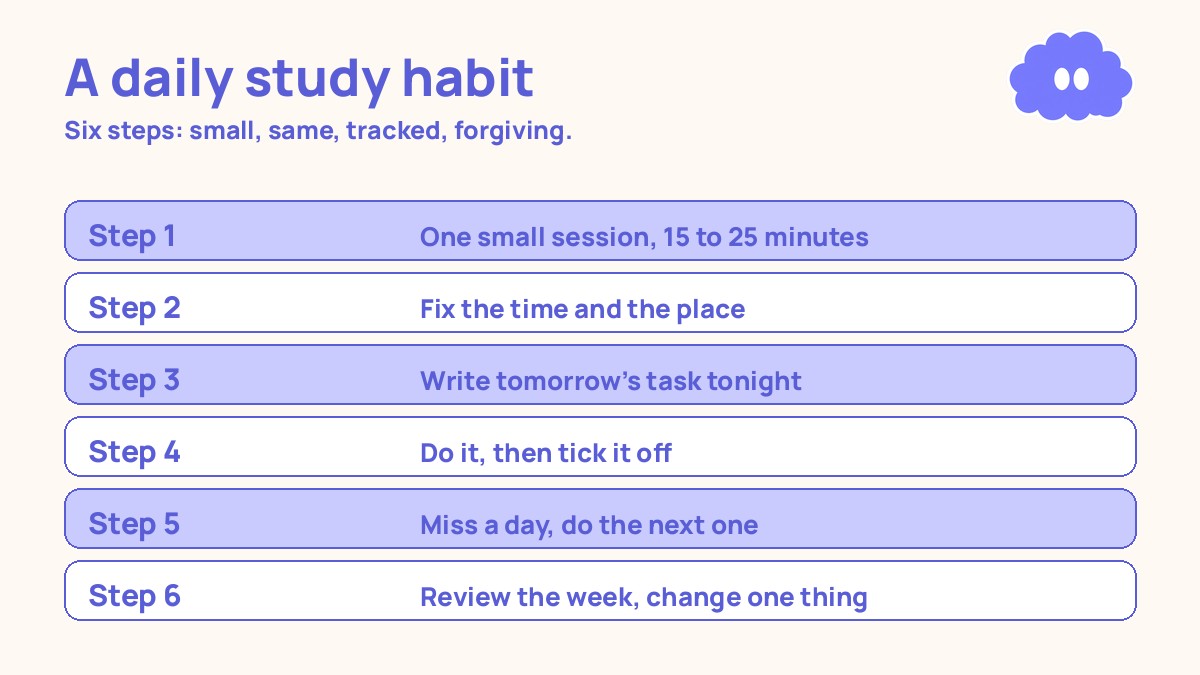
How to build a daily study habit: the system in short
- Pick one small session: 15 to 25 minutes, one task, every day.
- Fix the time and the place. Same time, same place, every day.
- Write tomorrow’s task tonight, in one line, with a clear finish.
- Do the session. Tick it off on a paper tracker. One tick per day.
- If you miss a day, do the next one. Never miss twice in a row.
- Every Sunday, look at the week’s ticks and pick one small change for next week.
Step 1: Pick one small session
The session has to be small enough that you will do it on your worst day. Fifteen to twenty-five minutes, one task, every day. “Answer the 8 questions on photosynthesis from memory.” “Work 4 mole problems.” That is a session.
Two hours a day is not a habit. It is a plan that needs a good day, a quiet house, and a lot of energy, all at once. A habit that needs a good day is a wish. Start small enough that the bad days still count, and let the session grow later. It grows on its own after a few weeks, because starting is the hard part and the habit makes starting automatic.
One session a day beats three long sessions a week: the same thing, at the same time, in the same place, until it stops needing a decision. That is what “automatic” means in the Lally study.
Step 2: Fix the time and the place
Pick a time and a place, and keep them the same every day. “7pm, kitchen table.” “6:30am, bedroom desk.” The time and place are the cue. When 7pm comes and you are at the kitchen table, the session starts without a decision.
If your timetable changes daily, anchor the habit to an event instead of a clock time. “After dinner.” “After my shift.” The event is the cue, and it works the same way, as long as it happens every day.
Tell one person the time and place: “I study at 7pm at the kitchen table.” That stops the house from planning over it.
The phone focus system for distracted students is the companion piece: phone in another room, timer on, one task at a time. The habit is the when and where.
Step 3: Write tomorrow’s task tonight
Every night, before bed, write tomorrow’s task in one line, with a clear finish. “Answer the 8 photosynthesis questions from memory, then check.” That takes one minute, and it is what makes tomorrow’s session start the moment you sit down.
A session without a written task starts with deciding, and deciding is when the habit breaks. You sit down, wonder what to do, check your phone, and the session never starts. The written task removes the decision. Deciding exactly when and where is what if-then plans for study are for.
Keep the tasks in a running list on paper, in order. When you finish one, cross it off and the next one is already there.
Step 4: Do it, then tick it off
Do the session. Set a timer for 15 to 25 minutes — the 25-minute length comes from Francesco Cirillo’s Pomodoro Technique in the late 1980s, and it was Cirillo’s practical choice, not a science-derived number. Work the one task until the timer rings. Then tick it off on a paper tracker.
The tracker is a piece of paper with the days of the week and one box per day. One tick per day. It shows you the habit is happening, and it makes a missed day visible — not as a failure, but as a blank box you can fill tomorrow.
Do not track hours. Track days. A week with seven ticks is a week the habit happened. A week with five ticks is a week it mostly happened. Both are good weeks. A week with two ticks is a week to change something.
If you want the tick to live somewhere you will see it, the study streak tracker gives you up to three habits to tick each day, a streak number and sixteen weeks of squares. A missed day breaks the streak, not the habit — the next square is still there tomorrow.
Step 5: Miss a day, do the next one
You will miss a day. A late shift, a family event, a bad cold, a day you simply forgot. When it happens, do the next day. That is the rule. Missing a single day did not measurably hurt the process in the Lally study, and it will not hurt yours either.
What hurts is the second missed day. One missed day is life. Two missed days is a new pattern, and three is the habit gone. So the rule is not “never miss”. The rule is “never miss twice in a row”. After a missed day, the next day’s session is the one that restarts the chain.
If you miss a day, do not make it up with a double session — that is a punishment, not a habit. Just do the next day’s session, at the same time, in the same place, and tick the box.
Step 6: Review the week, change one thing
Every Sunday, look at the week’s ticks and ask three questions. How many days did I do? Which days did I miss, and why? What one small change will I make next week?
The change should be small: a different time, a smaller task, a better place. One change, not three. The habit improves by one small change a week, not a new plan every Monday.
The weekly study review system is the fuller version of this: a weekly review that covers the whole study week, not just the habit.
A worked example: four weeks of a 7pm habit
You decide on Sunday: 20 minutes a day, 7pm, kitchen table.
Week 1 — days 1 to 7. Monday to Friday you do all five sessions, 20 minutes each. Saturday you miss — a family event. Sunday you do the session and tick 6 of 7 boxes. Total: 6 sessions, about 2 hours of focused work.
Week 2 — days 8 to 14. You move the session to 6:30pm, because 7pm kept clashing with dinner. Six sessions again, one missed on Wednesday — a late shift. You do Thursday, because the rule is never miss twice.
Week 3 — days 15 to 21. Seven sessions, all seven days. The session starts to feel normal: 6:30pm comes, you sit down, you start. The tasks are getting bigger — 10 questions instead of 8.
Week 4 — days 22 to 28. Seven sessions again. Four weeks in, 26 of 28 days ticked. The habit is not automatic yet — Lally’s median was 66 days — but it no longer needs a decision.
| Week | Sessions done | Missed | Change made |
|---|---|---|---|
| Week 1 | 6 of 7 | Saturday, family event | None |
| Week 2 | 6 of 7 | Wednesday, late shift | Moved to 6:30pm |
| Week 3 | 7 of 7 | None | Tasks got bigger |
| Week 4 | 7 of 7 | None | None |
When it goes wrong
You set the session too big, and by day four you are too tired to start. Shrink it. Fifteen minutes, one small task. A habit you keep on a bad day is a habit. Start smaller than you think you need to.
You miss one day and treat it as the end. It is not the end. Missing a single day did not measurably hurt the process in the Lally study. Do the next day. The rule is never miss twice in a row, not never miss.
You keep the habit in your head instead of on paper. A habit with no tracker and no written task is a habit that quietly disappears. The tracker makes it visible. The written task makes it startable. Both take one minute a day.
You change everything every Monday. A new time, a new place, a new subject, a new system. The habit never gets a chance to become automatic, because the routine keeps changing. Change one thing a week, on Sunday, and let the rest stay the same.
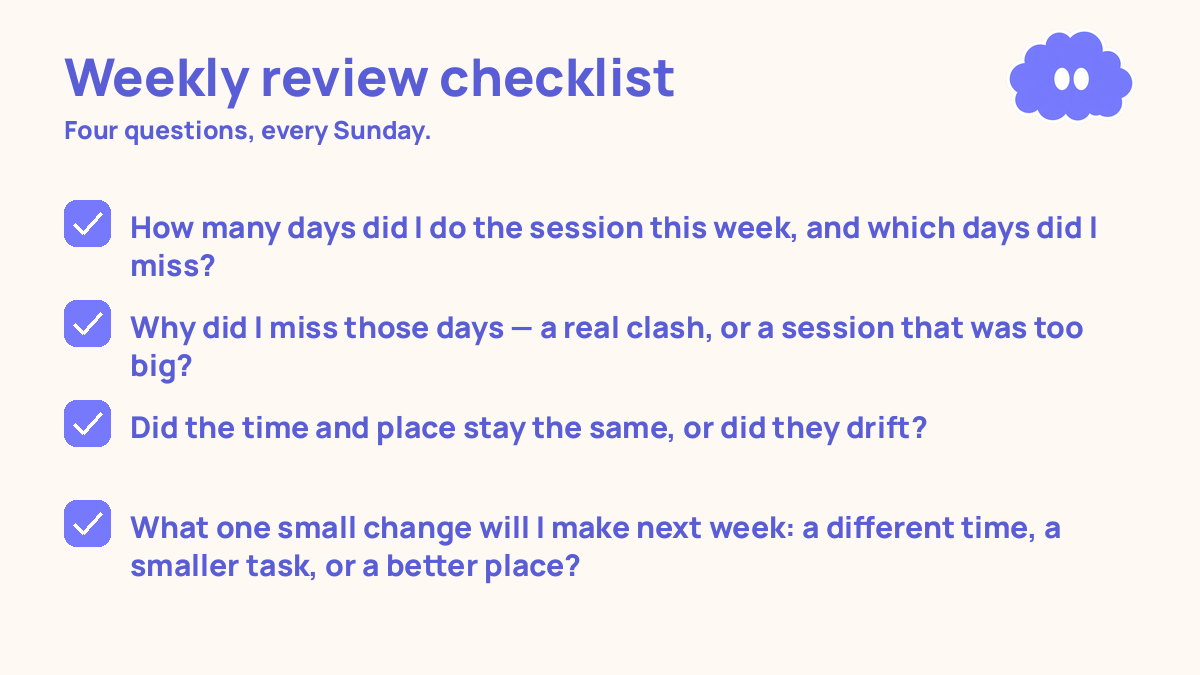
Weekly review checklist
Copy this list and use it each week:
- How many days did I do the session this week, and which days did I miss?
- Why did I miss those days — a real clash, or a session that was too big?
- Did the time and place stay the same, or did they drift?
- What one small change will I make next week: a different time, a smaller task, or a better place?
Downloadable infographic spec: one vertical image, title “A daily study habit”, with the six steps — one small session, fix the time and place, write tomorrow’s task tonight, do it then tick it off, miss a day do the next one, review the week change one thing — in Thynq cream, Cloud Purple, Dark Purple and pink, with the cloud mascot. Text taken word-for-word from this article.
What this system is not
It is not a promise that 66 days will make the habit automatic for you, and it is not a promise of a grade. The Lally study found a median of 66 days, with a range of 18 to 254 days — a wide range, and a median is not a deadline. The system is built to need as little willpower as possible: small sessions, same time and place, written tasks, a tracker. But the first weeks still need you to show up, and no system can do that for you.
Sources
- Lally, P., et al. (2010). “How are habits formed: modelling habit formation in the real world”, European Journal of Social Psychology 40(6), 998–1009. 96 people tracked one new daily behaviour for 12 weeks. The median time for it to feel automatic was 66 days, range 18 to 254 days. Missing a single day did not measurably hurt the process.
- Maltz, M. (1960). Psycho-Cybernetics. The “21 days” idea comes from this book: Maltz noticed patients took about 21 days to adjust to a new face. It is a 1960 plastic-surgery anecdote, not a study.
- Cirillo, F. — Pomodoro Technique, late 1980s. Classic cycle: 25 minutes work, 5 minutes break, longer break after four. The 25-minute length was Cirillo’s practical choice, not a science-derived number.
Questions
How long does it take to build a study habit?
Longer than the famous 21 days, and different for everyone. In one study, Lally and colleagues (2010) found the median time for a new daily behaviour to feel automatic was 66 days, with a range of 18 to 254 days. Expect weeks, not days.
What if I miss a day?
Nothing resets. In the same study, missing a single day did not measurably hurt the process. Just do the next day. The habit is built by the days you do, not broken by the days you miss.
How small should the daily session be?
Small enough that you will do it on your worst day. Fifteen to twenty-five minutes is right for most students. A habit you keep on a bad day is a habit. A habit that needs a good day is a wish.
Do I need to study at the same time every day?
Yes, if you can. The same time and the same place turn the decision into a routine: you do not decide to study, you just do what you do at 7pm. If your timetable changes daily, anchor the habit to an event instead, like after dinner.