The direct answer
If then plans for study work like this: decide the cue and the action in advance — “If it is 7pm and I am at the kitchen table, then I will answer the 8 photosynthesis questions from memory.” When the cue happens, you do the action. You do not decide again. That is the whole system.
You tell yourself you will study after dinner. Dinner ends, you sit on the sofa, you check your phone, and an hour later you have not studied. You did not decide against studying. You just never decided to start.
The problem is that “study after dinner” is a goal, not a plan. A goal says what you want. A plan says when, where, and what exactly. An if-then plan names the cue and the action in advance. When the cue happens, starting needs no fresh decision.
This is not a motivational trick. Across 94 independent studies, Gollwitzer and Sheeran (2006) found that if-then plans raised goal attainment by a medium-to-large amount (d = 0.65) over holding the goal alone. The effect is largest when the plan uses the if-then format, the person cares about the goal, and the plan has been rehearsed at least once. What it does not prove: that writing a plan is the same as doing it, or that a plan works for a goal you do not care about.
If then plans for study: the system in short
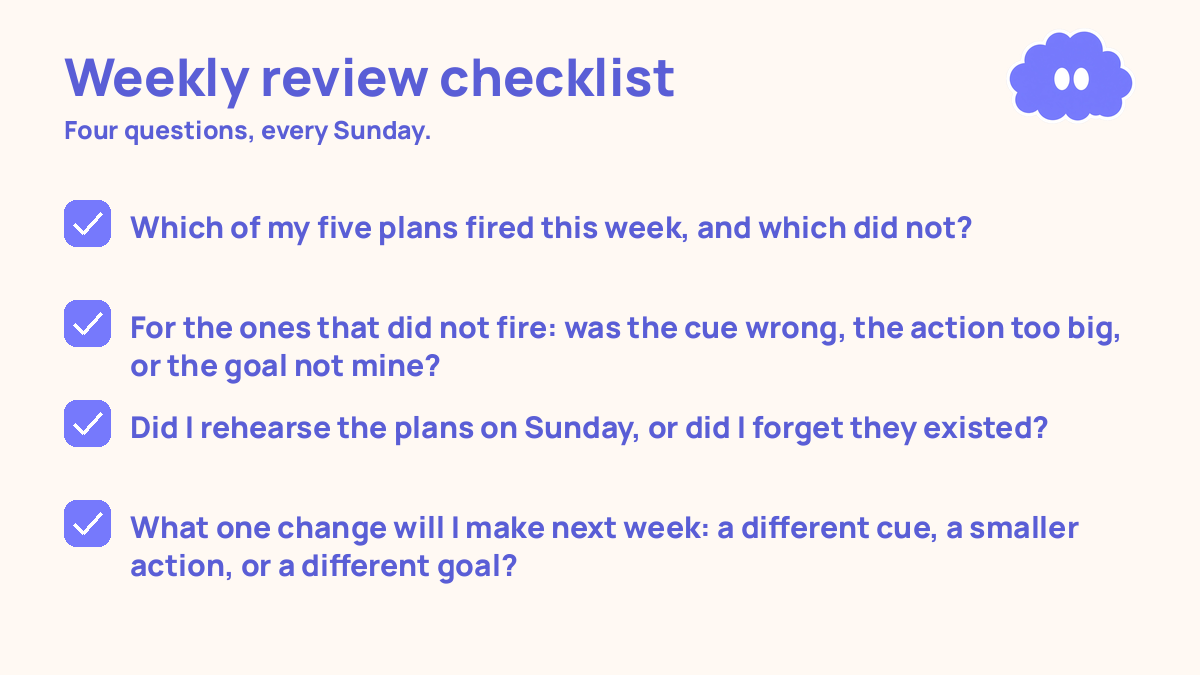
- Pick one goal you care about, and write it in one line.
- Write five if-then plans: start of day, main session, interruption, evening, missed day.
- Each plan names a daily cue and one specific action.
- Rehearse each plan once: say it out loud, and picture the cue happening.
- When the cue happens, do the action. No fresh decision, no argument.
- Every Sunday, check which plans fired and rewrite the ones that did not.
Step 1: Pick one goal you care about
An if-then plan works for a goal you care about. It does not work for a goal you do not. So start with one goal, written in one line: “Finish the biology syllabus before the exam in six weeks.” “Answer 10 questions a day until the test.”
If the goal does not matter to you, the plan will not fire. You will hear the cue, remember the plan, and ignore it, because the goal was never yours. Pick a different goal — one you actually want, not one you think you should want.
One goal, not five. Five goals need five sets of plans, and you will not remember them. One goal, five plans. When the goal is done, pick the next one.
Step 2: Write five if-then plans
Write five plans, one per moment that matters. Each plan has the same shape: “If [cue], then I will [action].” The cue must happen every day. The action must be one specific thing, small enough to start immediately.
The start of the day. “If I finish breakfast, then I will write today’s task on paper.”
The main session. “If it is 7pm and I am at the kitchen table, then I will answer the 8 photosynthesis questions.”
The interruption. “If someone interrupts my session, then I will write down where I stopped first.”
The evening. “If I finish dinner, then I will check tomorrow’s plan and pack my bag.”
The missed day. “If I miss a day, then I will do the session the next morning at 7am.”
Write them on paper, in your own words, and keep the paper where you will see it. Five plans, five sentences, one page. The daily study habit is the routine these plans build: same time, same place, same small session, tracked on paper.
Step 3: Make the cue unmissable and the action tiny
A plan fails in two ways: the cue never happens, or the action is too big to start.
The cue must happen every day, and you must notice it. “If it is 7pm” works if you are home at 7pm. “If I finish dinner” works if dinner happens every day. “If I feel like studying” is not a cue. Feelings do not happen on schedule.
The action must be tiny — the first step, not the whole task. “Then I will answer the 8 questions” is a task. “Then I will open my notes to page 42 and read the first question” is a first step. The smaller the action, the more likely it fires. The plan only has to get you started.
Check each plan against both tests. Does the cue happen every day? Is the action the first step, not the whole task? If either answer is no, rewrite it.
Step 4: Rehearse each plan once
A plan you have never rehearsed is a plan you will forget. Rehearse each one once: say it out loud, and picture the cue happening. “If it is 7pm and I am at the kitchen table, then I will answer the 8 questions.” That takes thirty seconds per plan, and two minutes for all five.
The rehearsal matters because the plan has to fire without thinking. When the cue happens, you should be doing it, not deciding whether to follow the plan. Gollwitzer and Sheeran found the effect is largest when the plan has been rehearsed at least once. Once is enough.
Rehearse again on Sunday, when you review the week. The plan is a tool, not a ritual.
Step 5: When the cue happens, do the action
This is the whole system, in one sentence: when the cue happens, do the action. No fresh decision. No argument. The decision was made when you wrote the plan.
You will argue with yourself. The plan says 7pm, and at 7pm you are tired, and the sofa is comfortable. That argument is the old decision process, and it is exactly what the plan replaces. The plan was written by you, on a good day, for a goal you care about. Trust the plan.
If you ignore the cue three days in a row, the plan is wrong, not you. The cue does not happen, the action is too big, or the goal does not matter. Rewrite the plan on Sunday.
Step 6: Review on Sunday, rewrite what did not fire
Every Sunday, look at the five plans and ask three questions. Which plans fired? Which ones did not, and why? What one change will I make next week?
A plan that did not fire is information, not failure. It tells you the cue was wrong, the action was too big, or the goal does not matter. Rewrite that one plan. Keep the ones that fired. One change a week, not five.
If all five plans fired all week, the goal is probably too easy, or the plans are working and the goal is nearly done. If you keep missing the same cue, change the cue, not the goal: a different time, a different place, a different event.
For the goal that keeps slipping, how to stop procrastinating study covers the wider system: starting small, making the first step tiny, and working in short blocks.
A worked example: a week of five plans
You pick one goal: “Answer 10 questions a day until the test in four weeks.”
Monday — the first day. Breakfast ends at 7:30am. The plan fires: you write today’s task — “Answer the 10 cell-division questions from memory” — before anything else. 7pm comes, kitchen table, you answer the 10 questions. 8 right, 2 wrong. The evening plan fires: after dinner, you pack your bag for Tuesday. Four of five plans fire. Nobody interrupted you.
Tuesday — the interruption. 7pm, kitchen table, questions open. At 7:10 your flatmate knocks. The plan fires: you write “stopped at question 4” on the pad before you answer. You deal with it, start a fresh block, and finish all 10.
Wednesday — the missed day. A late shift. No 7pm session. The missed-day plan fires on Thursday morning: 7am, before anything else, you do the 10 questions.
Thursday to Saturday. The plans fire every day. The cue comes, the action follows, no argument. By Saturday you have answered 50 questions in five days.
Sunday — the review. Four of five plans fired all week. The evening plan failed twice — dinner ran late, and you forgot to pack. You rewrite it: “If I finish dinner, then I will write tomorrow’s task on the kitchen table.” One change, not five.
| Day | Plans fired | Questions done | Note |
|---|---|---|---|
| Monday | 4 of 5 | 10 | — |
| Tuesday | 5 of 5 | 10 | Interruption plan fired |
| Wednesday | 0 of 5 | 0 | Late shift |
| Thursday | 5 of 5 | 10 | Missed-day plan at 7am |
| Friday | 5 of 5 | 10 | — |
| Saturday | 5 of 5 | 10 | — |
| Sunday | Review | — | Evening plan rewritten |
When it goes wrong
Your plans are goals, not plans. “If I have time, then I will study” is a goal wearing a plan’s clothes. It has no cue and no action. The fix is the shape: a cue that happens every day, and one specific action.
You write ten plans and remember none of them. Five is enough. Ten is a list you will not rehearse and cannot remember. Cut the list to five, and rehearse the five once.
The cue happens and you argue with yourself instead of acting. That is the old decision process, and it is what the plan replaces. The fix is a smaller action: make the first step so small that arguing about it feels silly. “Open the notes to page 42” is hard to argue with.
You keep a plan that never fires and blame yourself. If a plan has not fired in a week, the plan is wrong. The cue does not happen, the action is too big, or the goal does not matter. Rewrite the plan on Sunday.
Weekly review checklist
Copy this list and use it each week:
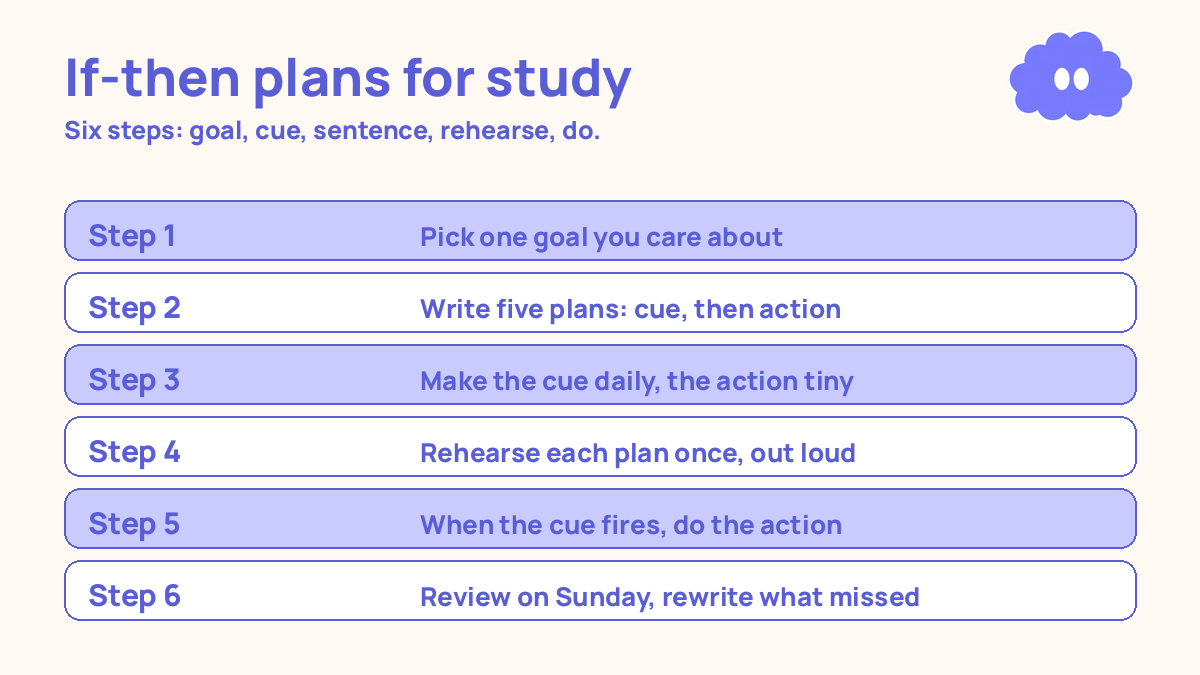
- Which of my five plans fired this week, and which did not?
- For the ones that did not fire: was the cue wrong, the action too big, or the goal not mine?
- Did I rehearse the plans on Sunday, or did I forget they existed?
- What one change will I make next week: a different cue, a smaller action, or a different goal?
Downloadable infographic spec: one vertical image, title “Decide the start in advance”, with the five plans — start of day, main session, interruption, evening, missed day — in Thynq cream, Cloud Purple, Dark Purple and pink, with the cloud mascot. Text taken word-for-word from this article.
What this system is not
It is not a claim that writing a plan is the same as doing it, and it is not a promise of a grade. Gollwitzer and Sheeran (2006) found if-then plans raised goal attainment by a medium-to-large amount (d = 0.65) across 94 studies — over holding the goal alone. That compares a plan with a goal, not a plan with doing the work. The plan gets you started. The work is still the work. It is also not a system for a goal you do not care about: the effect is largest when the person cares about the goal.
Sources
- Gollwitzer, P. M. & Sheeran, P. (2006). “Implementation intentions and goal achievement”, Advances in Experimental Social Psychology 38, 69–119. Across 94 studies, if-then plans raised goal attainment by a medium-to-large amount (d = 0.65) over holding the goal alone. The effect is largest when the plan uses the if-then format, the person cares about the goal, and the plan has been rehearsed at least once.
- Gollwitzer, P. M. (1999). “Implementation intentions: strong effects of simple plans”, American Psychologist 54(7), 493–503. An if-then plan names the cue and the action in advance, so starting does not need a fresh decision.
Questions
What is an if-then plan?
A plan in the form: if a situation happens, then I will do a specific action. If it is 7pm and I am at the kitchen table, then I will answer the 8 photosynthesis questions. The cue and the action are decided in advance.
Do if-then plans actually work?
Across 94 studies, Gollwitzer and Sheeran (2006) found if-then plans raised goal attainment by a medium-to-large amount (d = 0.65) over holding the goal alone. The effect is largest when the plan uses the if-then format and has been rehearsed at least once.
How many if-then plans should I write?
Five is enough to start: start of day, main session, interruption, evening, and missed day. More than five and you will not remember them. Five you can rehearse in two minutes.
What if the cue never happens?
Then the plan never fires, and that is useful information. Pick a cue that happens every day: a time, a place, or an event like finishing dinner. A cue that happens once a week is a plan for once a week, not a daily habit.