The direct answer
How to time your revision with a study stopwatch: start it when you start working, pause it for every break, and write down how long each task actually took. Compare the real time with the time you planned, and use the difference to plan tomorrow.
Most students plan from guesses. You write “revise maths, 7pm to 9pm” and assume two hours of revision, but the evening holds a phone break, a snack, and twenty minutes of staring at a problem you do not understand. The plan says two hours. The work took fifty minutes.
The top results for timing study are mostly tool pages that describe their own stopwatch, or short guides that say “press start and stop” and nothing else. None of them show what to do with the number once you have it. The stopwatch is only the first half.
The system in short
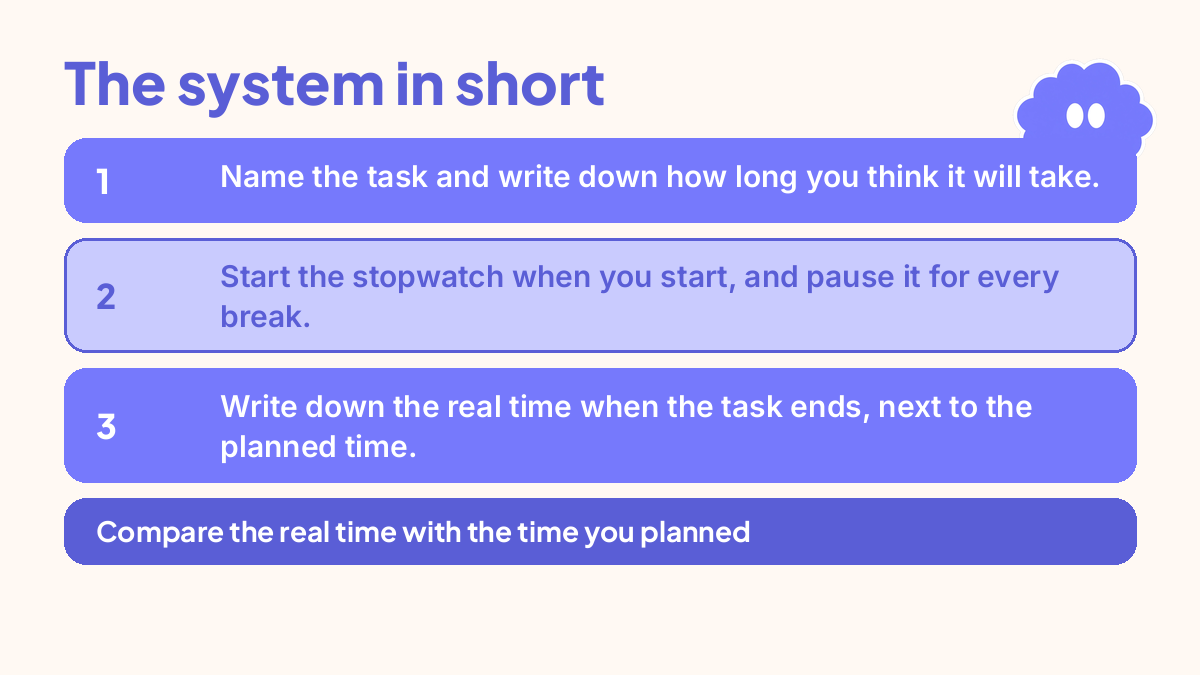
- Name the task and write down how long you think it will take.
- Start the stopwatch when you start, and pause it for every break.
- Write down the real time when the task ends, next to the planned time.
- Compare the totals at the end of the day and find the pattern.
- Use the real times to plan tomorrow, with bigger blocks for slow tasks.
- Review the week, reset the goal, and keep timing the tasks that still surprise you.
Step 1: Name the task and guess the time
Before you press start, write one line: the task, and how long you think it will take. “Past paper 3, questions 1 to 10, 60 minutes” is a task. “Revise maths” is not, because it has no finish and no size. If you cannot write the task in one line, split it first.
Write the guess down too. Without it, the stopwatch gives you a number with nothing to compare it against, and you learn nothing. With it, every session teaches you something: this kind of task takes longer than you think, or that kind takes less.
Keep the list short: three tasks at most for one evening. A list of eight tasks will not get timed properly, because you will stop writing the times down after the third one. Three tasks, each with a guess, fit on one page in a notebook.
Name the finish as well as the start. “Questions 1 to 10, finished when all ten are answered and marked” tells you when to stop the stopwatch. “Read chapter 4” does not, because reading has no clear end. A task with a clear finish gives you a clean time.
Step 2: Start the stopwatch and pause for every break
Press start when you open the book, not when you sit down. The minutes between sitting down and starting work are not study, and counting them flatters the total.
Pause it every time you stop working. Phone break, snack, chat with a housemate: all of it is a pause. The PomodoroMe guide to study stopwatches puts it simply: press start when you open the book and pause when you get up. The number at the end is how long you actually studied, not how long you sat at the desk.
Do not pause for thinking. Staring at a problem while you work through it is study, even if no words are being written. Pause only when you stop working on the task: when you leave the desk, pick up your phone, or switch to something else.
Use the stopwatch mode for open-ended work, not the countdown or the Pomodoro mode. The study timer has four modes: a countdown timer, Pomodoro with automatic breaks, a stopwatch, and a clock. The stopwatch is the right mode here because you do not yet know how long the task will take. For fixed blocks with breaks, see the Pomodoro technique for students.
Step 3: Write down the real time next to the guess
When a task ends, stop the stopwatch and write the real time next to the guess, on the same line. “Past paper 3, questions 1 to 10: guessed 60, took 85” is a complete record. Do it at once, while the number is on the screen.
Write the time in minutes, not hours, so the numbers are easy to compare. “85” and “60” sit side by side and the gap is obvious. Minutes also add up cleanly at the end of the day, when you total the evening in Step 4.
Note what made the task slow, in a few words, if you know it. “Question 7 took 20 minutes” is enough. You are leaving a clue for tomorrow, when you plan the same kind of task again. A slow task with a reason is a plan.
Do not round the numbers to make them look better. Eighty-five minutes is not “about an hour”. Rounding is how the guesses stay wrong for months. If a task took much longer than you guessed, that is good news: you have found the task that was breaking your plans.
Step 4: Compare the totals at the end of the day
At the end of the evening, add up the real times and compare the total with the time you planned. If you planned 120 minutes and the stopwatch shows 75, your plans have been asking for 45 minutes that never existed.
Look for the pattern across tasks, not just the total. Which kind of task always runs over? Which one always finishes early? The pattern only appears after three or four days of timing the same kinds of tasks.
The timer also shows today against your goal, so you can see the running total while you work. If your goal is 120 minutes and the timer shows 60 at 8pm, you know there are 60 minutes left to find. That decision is better made at 8pm, with the number in front of you, than at 11pm, when the day is over.
Write one line at the bottom of the page: planned time, real time, and the biggest gap. “Planned 120, real 75, past papers ran 25 over” is the whole day in one line. Keep the pages: after a week, you will have seven lines, and the pattern will be obvious.
Step 5: Plan tomorrow from the real times
Tomorrow’s plan starts from yesterday’s numbers, not from hope. If past papers took 85 minutes when you guessed 60, give them 90 minutes tomorrow. If reading took 30 when you guessed 60, give it 30 and use the freed time for the slow task.
Give slow tasks bigger blocks, or split them into smaller parts. A task that takes 85 minutes does not fit in a 60 minute block, and squeezing it in only guarantees that it runs over and eats the next task. Either give it 90 minutes, or split it into two parts with a clear finish for each, such as questions 1 to 5 and questions 6 to 10.
Put the slow task first, while you are fresh. The PomodoroMe guide makes this point about laps: if one topic keeps taking twice as long as the others, start with it tomorrow, while you are fresh. The task that runs over needs your best hour, not the hour that is left over.
Keep the total honest. If your real study time is 75 minutes a day, do not plan 120 minutes tomorrow and call it ambition. Plan 90, finish it, and let the total grow. A plan you finish beats a plan you abandon. If you only have an hour in the day, How to study in one hour a day shows how to split it.
Step 6: Review the week and reset the goal
Once a week, look at the seven daily lines together. Add up the real times and divide by seven, and you have your real daily average. If the average is far below the goal, the goal is wrong, not you. Set the goal to the average plus a little.
Look for the tasks that still surprise you. A task that runs over every single day is not a slow task. It is a task you do not understand yet, or one with a hidden step you keep missing. Ask for help, re-read the method, or break the task down further.
Stop timing the tasks you have learned. Once a kind of task takes the same time three days in a row, you know its shape, and you can plan it without the stopwatch. Keep timing the new kinds of tasks, the ones that still surprise you. The stopwatch is a measuring tool, not a permanent habit.
Reset the goal for next week from the real average, not from the goal you missed. A goal set from real times is a plan. A goal set from wishes is a disappointment waiting to happen.
A worked example: timing a Tuesday evening of maths revision
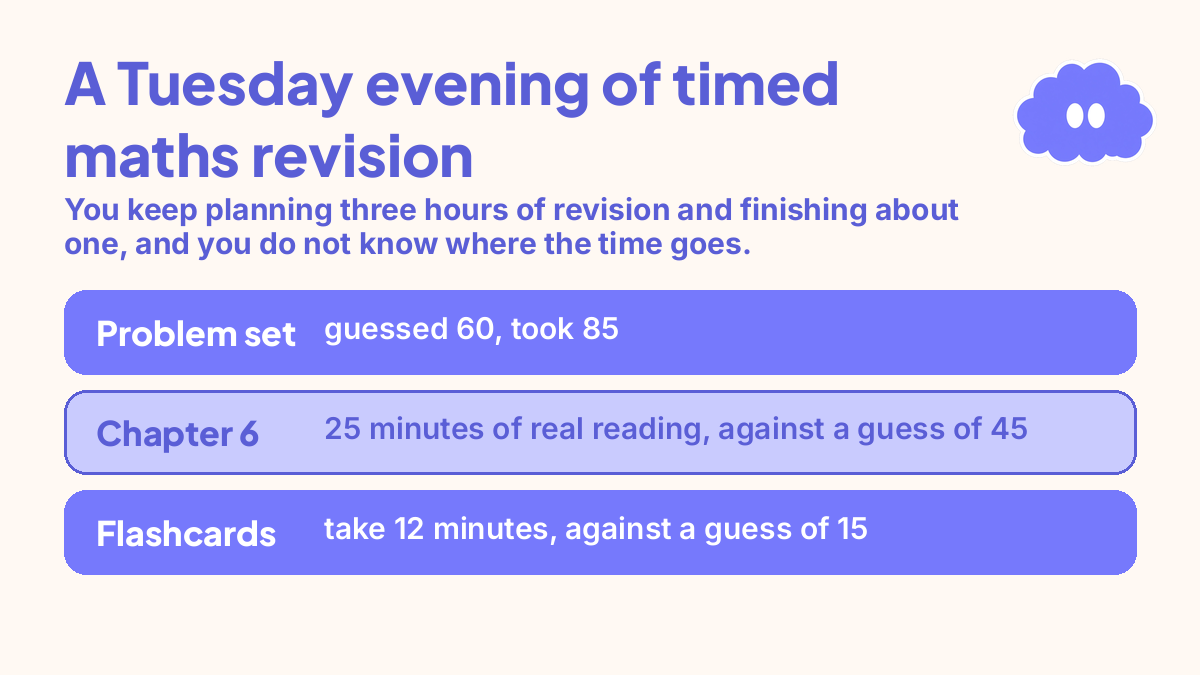
Your situation: you are a first-year engineering student with a maths exam in three weeks. You keep planning three hours of revision and finishing about one, and you do not know where the time goes.
You write three tasks with guesses: “Problem set 4, questions 1 to 10: 60 minutes”, “Read chapter 6, integration: 45 minutes”, “Test myself on 20 flashcards: 15 minutes”. The total planned is 120 minutes, from 7pm to 9pm.
You start the stopwatch at 7pm when you open the problem set. At 7:40pm you pause it for a ten minute phone break, then start it again. At 8:25pm you finish: 85 minutes of real work, against a guess of 60. You write “guessed 60, took 85” on the line, and note “questions 7 to 10 took 30 minutes”.
You start the stopwatch again for chapter 6, and finish at 8:50pm after 25 minutes of real reading, against a guess of 45. The flashcards take 12 minutes, against a guess of 15. The evening total is 122 minutes of real study, against a plan of 120, but the shape is different: the problem set ran 25 minutes over, and the reading finished 20 minutes early.
Tomorrow you plan from the numbers. The problem set gets 90 minutes, first, while you are fresh. Reading gets 30 minutes. The flashcards stay at 15. The total is 135 minutes, so you start at 6:45pm instead of 7pm. You also decide to ask your tutor about questions 7 to 10: a task that takes 30 minutes for four questions is one you do not yet understand.
When it goes wrong
You forget to pause for breaks. The total comes out too high, and the next plan is built on a lie. Pause the stopwatch every time you leave the desk, and put the phone in another room so the breaks are shorter. If you forgot to pause and the total is wrong, throw that day out and start again tomorrow.
You time “study” instead of a task. The stopwatch runs for two hours and tells you nothing, because “study” has no finish and no size. Go back to Step 1: name the task, name the finish, and guess the time.
The numbers make you feel slow. A task that takes twice as long as you guessed feels like failure, but it is information. The plan was wrong, not you. Give the task more time, split it, or ask for help with the part that eats the minutes. The how to study in 50-minute blocks system gives slow tasks a shape that fits: 50 minutes of work, a 10 minute break, repeat.
You stop writing the times down. The stopwatch runs, the day ends, and the numbers vanish. Write the time on the same line as the guess, the moment the task ends. Three numbers per task is the whole record.
You plan from one day. One evening can be unusual: a hard problem set, a bad night, a noisy house. One day is a story, not a pattern. Time the same kind of task three or four times before you change the plan. How to track your past paper scores to find weak topics turns scores into the same kind of evidence.
Weekly review checklist
- How many minutes did I really study each day, and how does that compare with my plan?
- Which kind of task ran over its guess most often, and by how much?
- Which kind of task finished early, and where did that time go?
- Is my daily goal close to my real average, or does it need resetting?
- Which tasks do I now know well enough to stop timing?
- What is the one change I will make next week?
Downloadable infographic spec: one vertical image, title “How to time your revision with a study stopwatch”, with the six steps and the six weekly review questions, in Thynq cream, Cloud Purple, Dark Purple and pink, with the cloud mascot. Text taken word-for-word from this article.
What this system is not
A stopwatch is not a measure of learning. It tells you how long the work took, not whether you understood it. A task can take 85 minutes and still be done badly. Test yourself from memory to check the learning, and use the stopwatch only for the time.
A stopwatch is not a way to make yourself faster. Timing a task does not shorten it, and watching the minutes tick by can make a hard task feel harder. If the stopwatch makes you anxious, look at the number only when the task ends. The number is for planning tomorrow, not for judging today.
A stopwatch is also not a promise. Knowing how long revision takes will not pass an exam on its own. It gives your plan real numbers. For the full system behind this method, start with how to build a study system that fits your life.
Sources
- PomodoroMe. Stopwatch for Study: Laps and Rain or Lofi Sound. PomodoroMe, accessed 24 November 2026. Supports starting when you open the book and pausing when you get up, the use of laps to compare tasks, and the difference between a stopwatch and a timer.
Questions
What is the difference between a study stopwatch and a study timer?
A stopwatch counts up from zero with no end, so it answers how long something took. A timer counts down from a duration you set and ends. Use the stopwatch when you do not know how long a task will take, and a timer when you have decided how long to give it.
Should I pause the stopwatch during breaks?
Yes. Pause it every time you stop working, and start it again when you return. The total should show your real study time, not the time you spent sitting at your desk.
How many days should I time my revision before trusting the numbers?
Three or four days of the same kind of task is enough to see the pattern. One day can be unusual, but three similar days give you a number you can plan from. Time each kind of task separately.
What do I do when revision takes much longer than I planned?
Change the plan, not the clock. Give that kind of task a bigger block tomorrow, or split it into smaller parts with a clear finish for each.