The direct answer
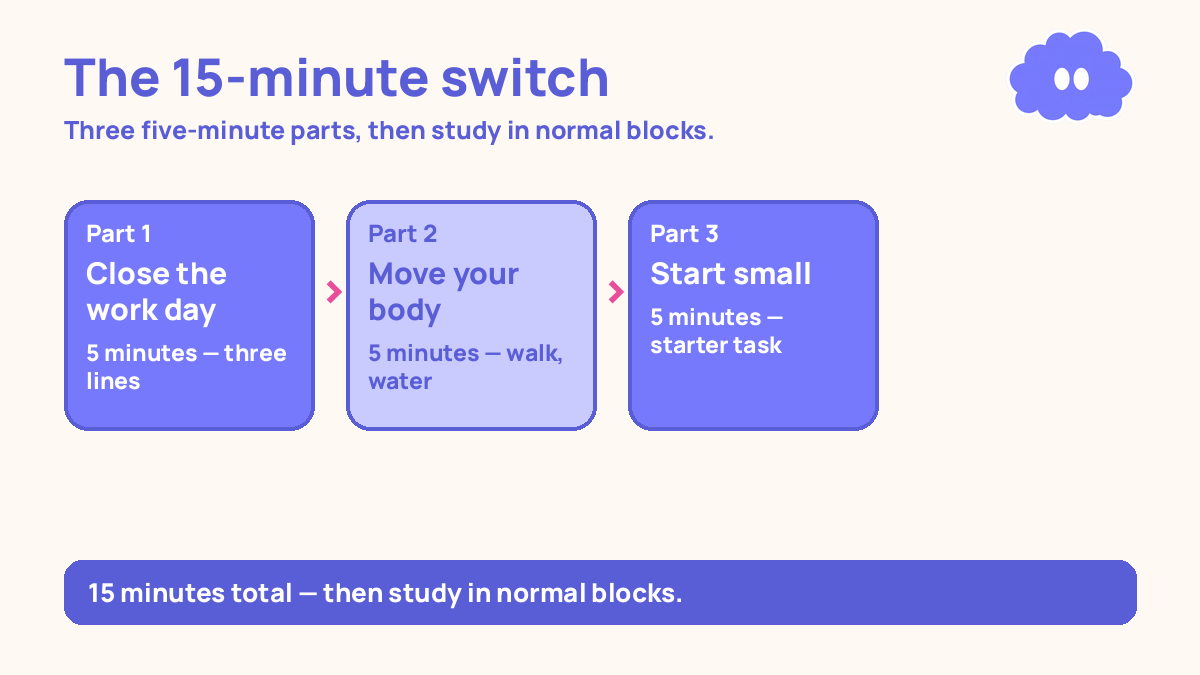
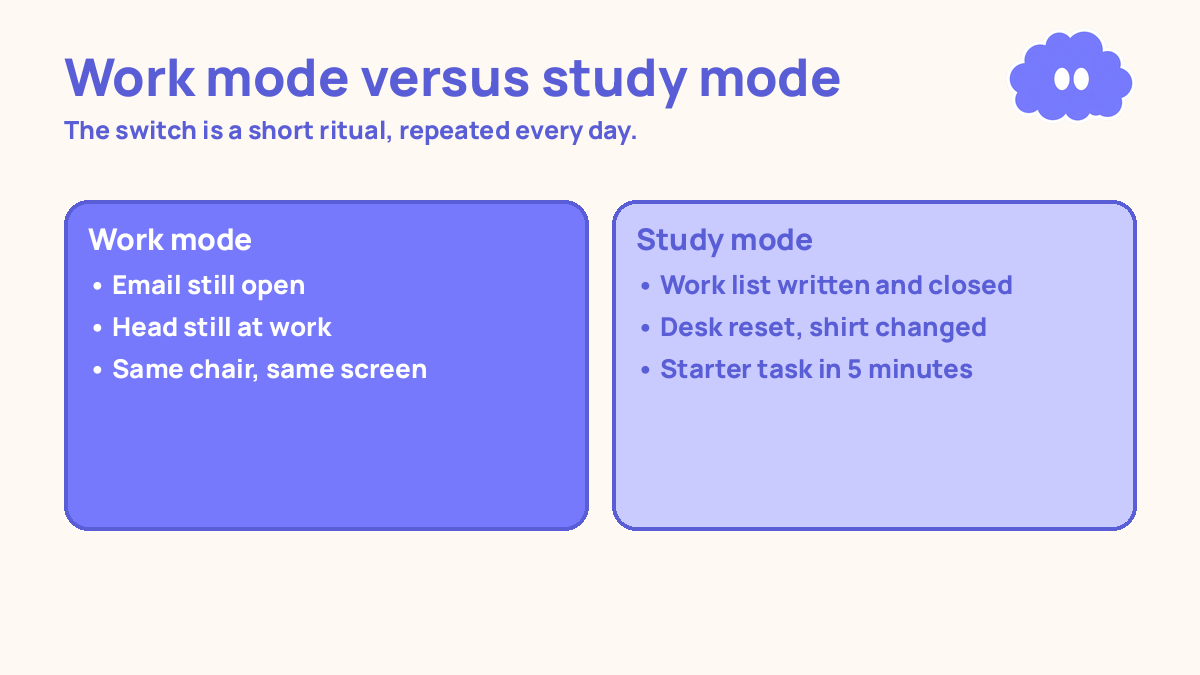
Give yourself a 15-minute switch between work and study: five minutes to close the work day, five minutes to reset your space and your body, and five minutes on one small starter task. Then study in your normal blocks. The whole switch is a short ritual you repeat every day, and after a few weeks the ritual itself tells your brain that work is over and study has started.
You finish work at 6pm. You sit down to study at 6pm. And nothing happens. Your body is at the desk, but your head is still answering the last email, replaying the meeting, or worrying about tomorrow’s shift. Half an hour passes, and you have read the same page three times.
The problem is not that you are lazy. The problem is that you tried to change modes without changing anything. Switching between tasks costs time: in four experiments, Rubinstein, Meyer and Evans (2001) found people lost 614 to 1,096 milliseconds on every switch, and lost more as the tasks got more complex. A whole work day is a far bigger switch than one task.
This switch is for a student who works and studies on the same day. It takes 15 minutes, it needs no new equipment, and it works in one room. It pairs with the study system for students who work from home, and when you are tired after work, the evening study routine for tired students shows what to study when your energy is low.
The system in short
- Close the work day: write down the three things work still owes you tomorrow, then close every work app.
- Move your body for five minutes: stand, stretch, walk, get water, change your shirt.
- Reset the space: clear the desk, put out one notebook and one pen, open only the study material.
- Start with a five-minute starter task: test yesterday’s material from memory, or read one page.
- Study in your normal blocks after the starter, with a timer and a break.
- If a work thought returns, write it on tomorrow’s work list and keep going.
The switch itself is the hard part: How to clear attention residue between study tasks gives the switch a proper close-out step.
Step 1: Close the work day on paper
Work does not end when you log off. It ends when you have written down what is left. Take a scrap of paper and write three lines: what work still needs doing tomorrow, who is waiting for an answer, and what time you will do it. Three lines, not a full plan. The point is to park the work, not to finish it.
Then close every work app. Close the email, the chat, the work tabs. If you work on a phone, put the phone on silent and face down, or in another room. One study found a phone on the desk cost focus even when it was off, but a later replication did not find the effect, so the evidence is mixed (Ward and colleagues, 2017). Treat “phone in another room” as a practical system, not a proven fact.
Do not check work messages “one last time” after closing them. One last check is never one check.
Step 2: Move your body for five minutes
Stand up. Stretch. Walk to another room and back. Get a glass of water. Change your shirt. Wash your face. Pick two of these and do them every day, in the same order, so they become the ritual.
The movement matters because your body has been in work posture all day. Sitting in the same chair, in the same position, tells your brain nothing has changed. Standing, walking, and cold water on your face tell it something has.
If you have been on your feet all day at a physical job, do the opposite: sit down somewhere else for five minutes and drink water. Change the state your body is in, and the head follows more easily.
Step 3: Reset the space
Clear the desk. Put the work papers in a pile at the side. Put out your study notebook, one pen, and the material for tonight only. Open only the study material.
If you study in a different room from where you work, walk to that room now, and do not bring the work laptop. The walk is part of the switch.
Put the starter task on top of the notebook, written in one line, before you sit down. “Answer the five questions on page 48 from memory.” When you sit down, there is nothing to decide. You just start. Deciding the cue and the action in advance is the heart of an if-then plan: across 94 studies, if-then plans raised goal attainment by a medium-to-large amount (d = 0.65) over holding the goal alone (Gollwitzer and Sheeran, 2006).
Step 4: Start with a five-minute starter task
Do not start with the hardest task. Start with the easiest one that still counts. Test yesterday’s material from memory for five minutes. Read one page. Write the three headings of tonight’s chapter from memory. A starter task is small on purpose: it gets you moving before the tired part of your brain can argue.
If the starter task feels too easy, that is fine. Easy is the point. The starter is not the study. It is the door into the study.
Step 5: Study in normal blocks after the starter
Once the starter is done, study the way you normally study. Use a timer: 25 minutes of work, 5 minutes of break, then another 25 minutes. The 25-minute length was Cirillo’s practical choice, not a number from cognitive science. If a task needs a longer run, use 50-minute blocks instead.
Keep the work list nearby but closed. If a work thought comes back, write it on the list in five seconds and return to the task. Do not open the work app to check it. The list is the parking place.
Test yourself from memory in the second half of the session, not just in the first. In a 2013 review, Dunlosky and colleagues rated ten common study techniques, and only two received a high utility rating: practice testing and distributed practice. Re-reading was rated low. A session that ends with a test tells you what stayed.
Stop at the time you planned. The switch works because the study has an end as well as a start. If you study until you fall asleep, tomorrow’s switch will feel heavier, because your brain will remember that study never ends.
A worked example: a Wednesday after a long shift
You finish work at 6pm. Study runs 6:15pm to 8:15pm.
6:00–6:05pm — Close the work day. Write three lines: finish the stock count tomorrow, reply to Sara, start at 9am. Close email and chat. Phone on silent, in the kitchen.
6:05–6:10pm — Move. Stand, stretch, walk to the kitchen and back, get water, change your shirt.
6:10–6:15pm — Reset the space. Clear the desk. Put out the notebook and the chapter. Write the starter on top: “Answer the five questions on page 48 from memory.”
6:15–6:20pm — Starter task. Answer the five questions from memory. You get three right and two wrong. Write the two wrong answers in your own words.
6:20–6:45pm — Block 1. Read pages 50 to 56. Write three questions in the margin.
6:45–6:50pm — Break. Stand up, get water, look out of the window.
6:50–7:15pm — Block 2. Work through the five problems on page 57, without looking at the answers first.
7:15–7:25pm — Break away from the desk. Ten minutes. Sit in another room.
7:25–7:55pm — Test block. Close the book. Answer the three margin questions and yesterday’s five questions from memory. Check your answers.
7:55–8:15pm — Review and plan. Write tomorrow’s first task in one line. Put the notebook away. Study is done, and work stayed closed.
When it goes wrong
The switch takes 45 minutes and study never starts. The switch has grown because it has no timer. Time each part: five minutes to close work, five to move, five to start. If closing work takes longer, your work list is too long. Cut it to three lines. A switch longer than 30 minutes is not a switch. It is the evening off.
A work message arrives during study and pulls you back. It happens. Answer it only if it truly cannot wait until tomorrow. If it can wait, write it on tomorrow’s work list and keep studying. If you answer it, note where you stopped and restart the block from the beginning.
You do the ritual but your head is still at work. Give it one more minute, not one more hour. Write the work thought down, in one sentence, on the work list. Then do the starter task. The ritual works by repetition, not by magic: a daily habit takes weeks to feel automatic — a median of 66 days in one study, with a range of 18 to 254 — and one missed day does not reset it (Lally and colleagues, 2010).
You are too tired to switch at all. Do the close and the move, then do only the starter task, and stop. Five minutes of testing yourself is a real session, and it keeps the ritual alive for tomorrow. If you are too tired every night, study for one hour instead of two, and keep the test in that hour.
Weekly review checklist
Copy this list and use it each Sunday:
- How many evenings did I do the full 15-minute switch, and how many did I skip it?
- Which part of the switch took longest — closing work, moving, or starting?
- How many work thoughts pulled me back during study, and did the work list catch them?
- What one change will I make next week: a shorter work list, a different starter task, or a fixed stop time?
Downloadable infographic spec: one vertical image, title “The 15-minute switch”, with the three five-minute parts — close the work day, move your body, start small — and the rule “write the work thought down, then keep going”, in Thynq cream, Cloud Purple, Dark Purple and pink, with the cloud mascot.
What this system is not
It is not a promise that you will feel fresh after work, and it is not a claim that a ritual fixes a job that leaves you exhausted every night. It is a practical switch for a normal tired evening: close the work, move, start small.
Sources
- Rubinstein, J. S., Meyer, D. E. & Evans, J. E. (2001). Executive control of cognitive processes in task switching. Journal of Experimental Psychology: Human Perception and Performance, 27(4), 763-797. Mean switch costs were 614 to 1,096 milliseconds per switch.
- Gollwitzer, P. M. & Sheeran, P. (2006). Implementation intentions and goal achievement: a meta-analysis. Advances in Experimental Social Psychology, 38, 69-119. Across 94 studies, if-then plans raised goal attainment by a medium-to-large amount (d = 0.65).
- Lally, P., et al. (2010). How are habits formed: modelling habit formation in the real world. European Journal of Social Psychology, 40(6), 998-1009. The median time for a behaviour to feel automatic was 66 days, with a range of 18 to 254 days.
- Ward, A. F., et al. (2017). Brain drain: the mere presence of one’s own smartphone reduces available cognitive capacity. Journal of the Association for Consumer Research, 2(2). The evidence is mixed: a later replication did not find the effect.
- Dunlosky, J., et al. (2013). Improving students’ learning with effective learning techniques. Psychological Science in the Public Interest, 14(1), 4-58. Only practice testing and distributed practice received a high utility rating; rereading was rated low.
- Cirillo, F. — Pomodoro Technique, late 1980s. The 25-minute length was Cirillo’s practical choice, not a number derived from cognitive science.
For the full evening around this switch, read the two-hour study system for working students, and when you are tired after work, use the evening study routine for tired students.
Questions
How long should the switch from work to study take?
About 15 minutes. Five minutes to close the work day, five minutes to reset your space and your body, and five minutes on one small starter task. A switch longer than 30 minutes usually becomes the evening off.
What if I am too tired to study after work?
Start with the easiest task, not the hardest. Ten minutes of testing yesterday’s material from memory is a real session. If you are tired every night, study for one hour instead of two, and keep the test in that hour.
Does it help to change clothes or move rooms to switch modes?
Yes, because the switch needs a signal your brain can feel. Changing your shirt, washing your face, or moving to a different chair all work. Pick one change and repeat it every day so it becomes the signal.
What do I do when a work thought keeps pulling me back?
Write it down on a work list for tomorrow, then close the list. The thought is parked, not lost. If the same thought returns, it is usually a task you have not written down clearly enough.