The direct answer
How to clear attention residue between tasks: finish or park the old task with a written note, close everything connected to it, take a two-minute reset away from your desk, then write the next task’s first step before you start it. That is the whole system. The note is the key: your mind keeps hold of unfinished work, and a written note is what lets it let go.
You finish a maths problem set and open your history notes. Ten minutes later you realise you have read the same paragraph three times. You are not reading history. You are still thinking about the maths problem you did not finish.
That leftover thinking has a name: attention residue. It is the part of your mind that stays on the previous task after you switch. You changed the book, but your attention did not change with it. The result is a block where you are half on the old task and half on the new one, and neither gets your full mind.
Switching has a measured cost. In four experiments, Rubinstein, Meyer and Evans (2001) found people lost between 614 and 1,096 milliseconds on every switch between tasks, and lost more as the tasks got more complex. That is the cost of the switch itself. The residue is the cost that comes after: minutes spent on the new task while your mind is still finishing the old one. This system clears it on purpose, in about five minutes.
How to clear attention residue between tasks: the system in short
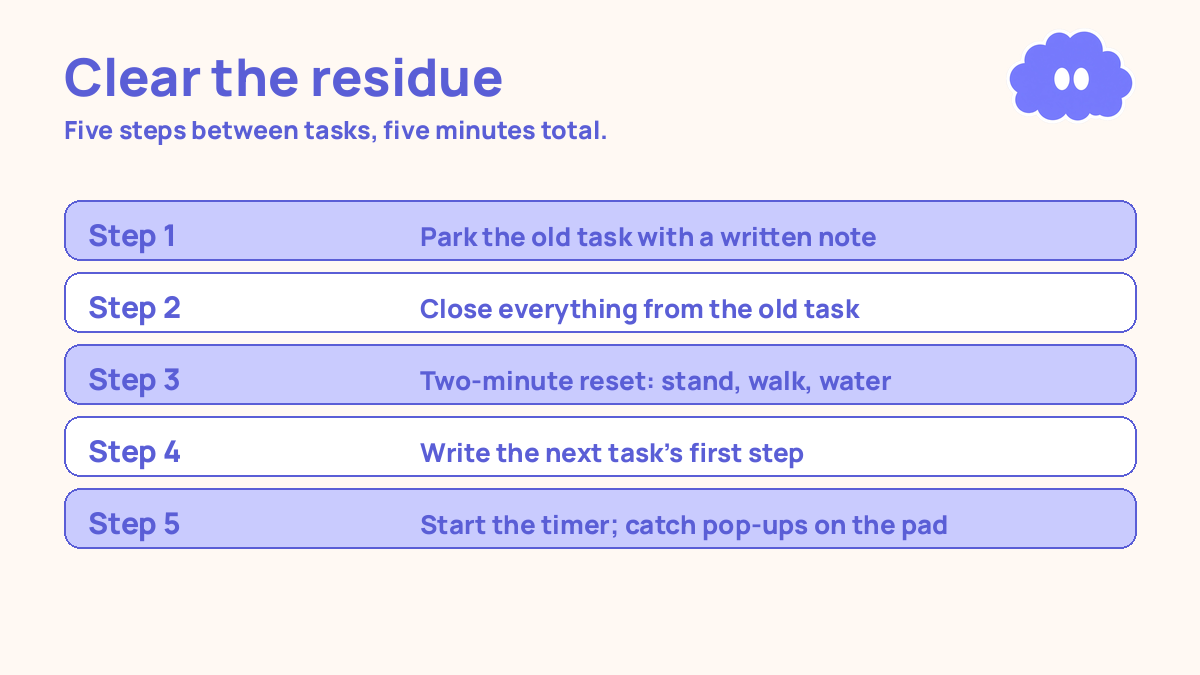
- Finish the old task, or park it with a written note saying where you stopped and what comes next.
- Close everything connected to the old task: tabs, books, notes, calculator.
- Take a two-minute reset: stand up, walk, get water. No phone, no new task.
- Write the next task in one line, with its first step.
- Set the timer and start. If the old task pops back into your head, write it on the pad and keep going.
Step 1: Park the old task with a note
Never leave a task half-open in your head. Either finish it, or park it properly. Parking means writing down three things on paper: where you stopped, what the next step is, and what you need for it.
“Stopped at question 7. Next: check the formula for question 7 on page 88. Need: the textbook.” That is a parked task. Your mind can let go of it, because the note holds everything it was trying to remember. Without the note, your mind keeps the task open as a worry, and the worry follows you into the next block.
This step does most of the work. The nagging after a switch is your mind trying not to lose an unfinished thing. Give it a place to live — the paper — and the nagging stops.
If the task is finished, the note is one line: “Done. 8 of 10 right, 2 to review tomorrow.” What matters is that the old task has a written ending, not an open one.
Step 2: Close everything connected to the old task
Close the tabs. Put the book away. Clear the desk of the old task’s things. If the old task was maths and the new one is history, the calculator, the formula sheet and the maths book all go away before history starts.
Every object from the old task is a cue that pulls your attention back to it. A formula sheet on the desk says “maths” while you are trying to read history. Close it, and the cue is gone.
Step 3: Take a two-minute reset
Stand up. Walk to the kitchen. Get water. Look out of a window. Two minutes, away from the desk, doing nothing related to study. Do not open your phone. Do not start the next task early. The reset is the gap between the old task and the new one, and it needs to be empty.
Two minutes is enough. This is not a break — a break is longer, and it is rest. The reset is a handover: a short pause that tells your mind the old task is over and the new one has not started yet. Go straight from one task to the next with no gap, and there is no moment when your mind can put the old one down. A reset is not a break, though — for a longer rest that actually helps the next block, see how to take breaks that actually help study.
If two minutes feels too short, take five. But take the reset standing up and away from the desk, not sitting at the desk staring at the new task.
Step 4: Write the next task’s first step
Before you start the new task, write it in one line, with its first step. “Read history chapter 6 and write 5 questions from it. First step: read pages 112 to 115.” The first step is what you do in the first minute. Without it, the first minute of the new block is spent deciding, and deciding is when the old task creeps back in.
A first step also gives the new task a shape. “Study history” is a fog. “Read pages 112 to 115” is a job. The clearer the first step, the faster your attention lands on the new task.
This is the same rule as in the single-tasking system for students: one task, defined before the timer starts, worked until it is finished or the timer rings.
Step 5: Start the timer, and catch the residue when it returns
Set the timer — 25 minutes for a short task, 50 for a longer one. The 25-minute length comes from Francesco Cirillo’s Pomodoro Technique in the late 1980s, and one thing to know honestly: it was Cirillo’s practical choice, not a number derived from cognitive science. Start the new task.
The old task will still pop back into your head once or twice in the first few minutes. That is normal. When it does, write it on the capture pad — one line, three words — and keep going. Do not follow the thought. The pad holds it, and the timer holds you.
If the old task keeps returning after ten minutes, the park note was not good enough. Stop, write a better note, and start the block again. A block started clean is worth more than a block spent fighting residue.
A worked example: an afternoon of two subjects
You have biology and maths to do after lunch. You start biology at 2:00.
2:00–2:50 — biology. Answer the 10 cell-division questions from memory, then check them. 8 right, 2 wrong. You write the note: “Done. 8 of 10. Review the 2 wrong ones tomorrow.” Timer rings.
2:50–2:55 — the handover. Close the biology book and notes. Put them on the shelf. Stand up, walk to the kitchen, get water. No phone. Write the next task: “Work 5 mole problems on page 42. First step: read the worked example on page 40.”
2:55–3:20 — maths, block 1. 25-minute block. You work problems 1 to 3. At minute 5, a biology question pops into your head — one of the two you got wrong. You write “cell division Q4” on the pad and keep going. It does not come back.
3:20–3:25 — break. Water, stretch. The pad has one entry. You cross it out — it is tomorrow’s review, already noted.
3:25–3:50 — maths, block 2. Problems 4 and 5, then check all 5 answers. Done. Park note: “Done. 5 of 5. Next: start chapter 5 tomorrow.”
3:50 — stop. Two subjects, two clean blocks each, and the biology did not follow you into the maths. The handover took five minutes.
| Time | What happens | Residue check |
|---|---|---|
| 2:00–2:50 | Biology: 10 questions | Park note written |
| 2:50–2:55 | Handover: close, walk, water, next task written | Desk clear |
| 2:55–3:20 | Maths: problems 1–3 | One pop-up, caught on pad |
| 3:20–3:25 | Break: water, cross out pad | Pad clear |
| 3:25–3:50 | Maths: problems 4–5, check | Done, park note written |
The phone focus system for distracted students is the wider system this sits inside: phone in another room, timer on, one task at a time.
When it goes wrong
You skip the handover and go straight from one task to the next. The old task follows you, and the first ten minutes of the new block are lost. The fix is not a longer handover. It is any handover at all: close the book, stand up, two minutes. Even a short reset beats no reset.
Your park note is vague, so the old task keeps nagging. “Maths, nearly done” is not a park note. It does not tell your mind where you stopped or what comes next, so your mind keeps holding it. Write the three things: where you stopped, the next step, what you need. If the note cannot answer those three, it is not finished.
You do the reset on your phone. Two minutes of scrolling is not a reset. It is a new task, and it brings its own residue into the next block. The reset is away from the desk, with no screen.
The old task keeps returning even after a good handover. Something about it is genuinely unresolved — a question you cannot answer, a decision you have not made. Stop and deal with it now, properly, for ten minutes. A block spent fighting residue is worse than a block spent closing the old task. Then do a fresh handover and start again.
Weekly review checklist
Copy this list and use it each week:
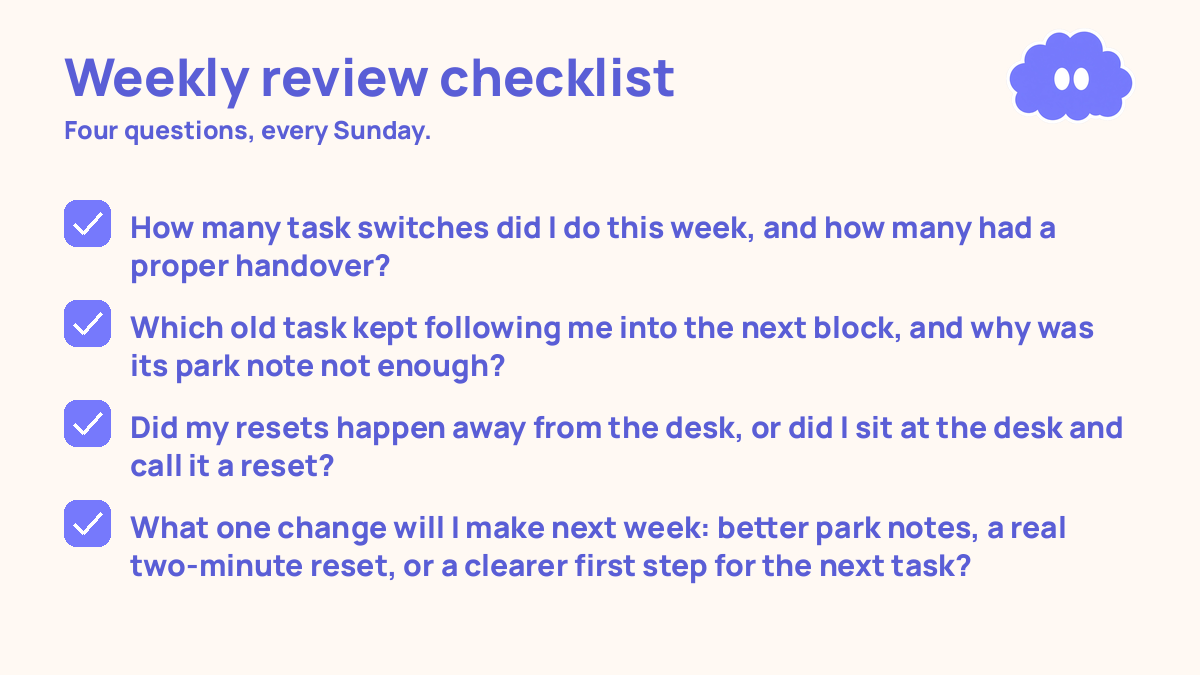
- How many task switches did I do this week, and how many had a proper handover?
- Which old task kept following me into the next block, and why was its park note not enough?
- Did my resets happen away from the desk, or did I sit at the desk and call it a reset?
- What one change will I make next week: better park notes, a real two-minute reset, or a clearer first step for the next task?
Downloadable infographic spec: one vertical image, title “Clear the residue”, with the five steps — park it with a note, close everything, two-minute reset, write the next first step, start the timer — in Thynq cream, Cloud Purple, Dark Purple and pink, with the cloud mascot. Text taken word-for-word from this article.
What this system is not
It is not a claim that switching is always bad, and it is not a promise of a grade. Some days need switching, and some tasks are genuinely hard to park. The research behind it is specific: in Rubinstein, Meyer and Evans (2001), people lost 614 to 1,096 milliseconds on every switch between tasks in lab experiments. That is the cost of the switch itself. The residue — the old task staying in your head afterwards — is the everyday experience that follows, and the park note and the reset are practical ways to deal with it, not findings from a study.
Sources
- Rubinstein, J. S., Meyer, D. E. & Evans, J. E. (2001). “Executive control of cognitive processes in task switching”, Journal of Experimental Psychology: Human Perception and Performance 27(4), 763–797. Mean switch costs were 614 to 1,096 milliseconds per switch, larger for more complex or less familiar tasks.
- Cirillo, F. — Pomodoro Technique, late 1980s. Classic cycle: 25 minutes work, 5 minutes break, longer break after four. The 25-minute length was Cirillo’s practical choice, not a science-derived number.
- Dunlosky, J., et al. (2013). Psychological Science in the Public Interest 14(1), 4–58. Only practice testing and distributed practice received a high utility rating; rereading was rated low. A clean block spent testing yourself beats a residue-filled block spent re-reading.
Questions
What is attention residue?
It is the part of your mind that stays on the previous task after you switch. You start the new task, but you are still thinking about the old one: the unfinished question, the argument you were making, the problem you could not solve.
How long does it take to clear?
Two to five minutes, if you do it on purpose. A short walk, a drink of water, and a written note about where the old task stopped is usually enough. Without a reset, the old task can follow you for the whole next block.
Is this the same as taking a break?
No. A break is rest. Clearing residue is a handover: you close the old task properly so the new one starts clean. You can do both in the same five minutes, but they are different jobs.
What if the old task is unfinished and keeps nagging me?
Write down exactly where you stopped and what the next step is. The nagging is your mind trying not to forget. A note on paper does the remembering for you, so your mind can let go.