The direct answer
A single tasking system for students means this: pick one task, work on it until it is finished or the timer rings, and do not start anything else in between. Write the day’s tasks in one line each, in order. Work the list top to bottom. When something interrupts you, write down where you stopped and deal with it, then start a fresh block on the same task. That is the whole system.
You have three things to do before lunch. You start the first, remember the second, open it to “just check something”, answer a message about the third, and by lunch you have touched all three and finished none of them. The morning felt busy. The list is exactly where it was.
That is what switching does. It is the cost of changing tasks, paid over and over. In four experiments, Rubinstein, Meyer and Evans (2001) found people lost between 614 and 1,096 milliseconds on every switch between tasks, and lost more as the tasks got more complex. A switch is not just the lost second. It is reloading the whole task in your head: where you were, what you were thinking, what comes next. Do that ten times in an hour and the hour is gone.
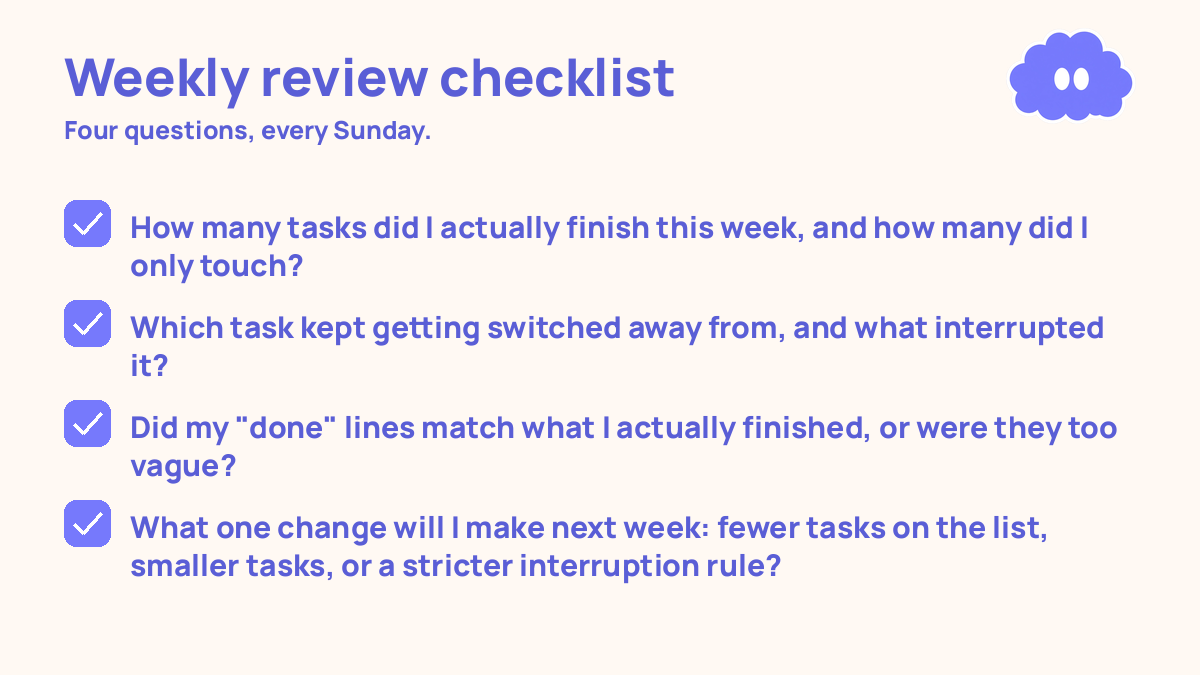
The single tasking system for students in short
- Write today’s tasks in one line each, in the order you will do them. No more than 5.
- Pick the top task. Write down what “done” means for it, in one line.
- Set a timer for 25 or 50 minutes. Work on that task only until it rings.
- If another task pops into your head, write it at the bottom of the list and keep going.
- If someone interrupts you, note where you stopped, deal with it, and start a fresh block.
- When the task is done, cross it off, take a 5-minute break, and start the next one.
Step 1: Write the list in order, one line per task
Before you start anything, write the day’s tasks on paper, one line each, in the order you will do them. No more than five. Five is enough for a study day; more than five means you are planning a week, not a day.
Each line needs a finish, not just a topic. “Biology” is not a task. “Answer the 10 questions on cell division from memory” is a task. “Essay” is not a task. “Write the first draft of paragraph 2” is a task. If you cannot write the finish in one line, the task is too big. Split it before you start, not halfway through.
Order matters. Put the hardest task first, while your focus is freshest, and the easiest last, so the day ends with a finish. Do not reorder the list during the day. Reordering is switching in disguise.
Step 2: Define “done” before you start
For the top task, write one line that says what done looks like. “10 questions answered and checked.” “Paragraph 2 drafted, about 150 words.” “5 mole problems worked, answers checked.” This line is the contract for the block. When the timer rings, you check the line: done or not done. No arguing with yourself about whether it counts.
Most half-finished work comes from a vague finish. If “done” is unclear, you drift: you read a bit more, tidy your notes, check a reference, and the block ends with nothing finished. A clear finish line stops the drift.
Step 3: One task, one timer, no switching
Set the timer — 25 minutes for a short task, 50 for a longer one. The 25-minute length comes from Francesco Cirillo’s Pomodoro Technique in the late 1980s, and one thing to know honestly: it was Cirillo’s practical choice, not a number derived from cognitive science. 50-minute blocks work the same way for tasks that need a longer run. Pick the length that fits the task, not the other way round.
During the block, you do the one task. If another task pops into your head, write it at the bottom of the list and keep going. Do not open it. Do not “just check”. The list holds it for you, so your head does not have to.
If the task needs something from another task, write that on the list too, and keep going with what you can do now. Fetching it mid-block is a switch.
Step 4: The interruption rule
Interruptions will happen. Someone knocks. A message arrives. A thought you cannot ignore. The system does not pretend they will not. It has a rule for them.
When you are interrupted, do three things. First, write down exactly where you stopped: the question number, the sentence, the step. Second, deal with the interruption. Third, start a fresh block on the same task. Do not try to pick up where you left off inside the old block. The old block is broken, and pretending it is not lies to you about how much focus you actually had.
This rule also covers self-interruptions. If you catch yourself opening another tab or reaching for your phone, stop, write down where you were, and start again. The phone focus system for distracted students is the companion piece here: phone in another room, timer on, one task at a time. If the phone is what interrupts you, fix the phone first.
Step 5: Finish, cross off, break, next
When the task is done, cross it off the list. Physically cross it off, on paper. That mark is the reward, and it is also the record: at the end of the day you can see what actually got finished, not what got touched.
Then take a 5-minute break. Stand up, get water, look out of a window. A break between tasks is what makes them separate tasks instead of one long blur. The break only works if the old task stays finished in your head — how to clear attention residue between study tasks is the reset that does that. After four blocks, take a longer break of 15 to 30 minutes.
Then start the next task the same way: define done, set the timer, one task only. Three finished tasks beat five half-started ones, every time.
A worked example: a morning before lunch
You have three tasks before lunch: 10 cell-division questions, 5 mole problems, and a draft of essay paragraph 2. You start at 9:00.
9:00 — the list. Three lines, in order: “Answer 10 cell-division questions from memory, then check.” “Work 5 mole problems on page 42.” “Draft essay paragraph 2, about 150 words.” Hardest first, easiest last.
9:00–9:50 — task 1. 50-minute block. You answer the 10 questions from memory in 30 minutes, then check them against your notes in the last 20. Two wrong. You write the two correct answers on the list for tomorrow’s review. Done. Cross it off.
9:50–9:55 — break. Water, stretch, stand up. You do not start task 2 yet.
9:55–10:20 — task 2. 25-minute block. You work the 5 mole problems. Problem 4 needs a formula you cannot remember. You write “look up mole formula” at the bottom of the list and finish the other 4. The block ends with 4 of 5 done and a note about the fifth.
10:20–10:25 — break. Look up the formula. Now problem 4 is unblocked.
10:25–10:50 — task 2, finished. 25-minute block. Problem 4, then check all 5 answers. Done. Cross it off.
10:50–10:55 — break. Water, stretch.
10:55–11:45 — task 3. 50-minute block. Draft paragraph 2, about 150 words. You write it in one go, then read it back once and fix the worst sentence. Done. Cross it off.
11:45 — lunch. Three tasks, three crossings-off, two and three-quarter hours. Compare that with the same morning spent switching: three tasks touched, none finished.
| Time | Task | Result |
|---|---|---|
| 9:00–9:50 | 10 cell-division questions | Done, 2 marked for review |
| 9:55–10:20 | 5 mole problems | 4 done, 1 blocked |
| 10:25–10:50 | Mole problem 4 + check | Done |
| 10:55–11:45 | Draft essay paragraph 2 | Done, about 150 words |
For longer stretches of uninterrupted work, the deep work system for students builds on this: the same one-task rule, with a longer block and a protected time slot. Single-tasking is the daily version; deep work is the same idea with the day cleared around it.
When it goes wrong
You finish a task and immediately start the next one without a break. The tasks blur together, and by the third one you cannot remember what you did in the first. Take the 5-minute break every time. It is what makes the tasks separate. If you skip it, you are not saving time. You are spending focus.
A task takes much longer than the timer, so you keep extending the block. The task was too big. Split it next time, or accept the block as one piece of a bigger task and write the next piece on the list. A 50-minute block that becomes 90 minutes is not a better block. It is a block without a finish line.
You keep a mental list instead of a paper list, and the tasks leak. The list has to be on paper, where you can see it and cross things off. A mental list is not a list. It is a worry. Write it down before you start, and do not trust your head to hold the order.
You treat every interruption as a reason to switch tasks. An interruption is a pause, not a new task. Use the rule: note where you stopped, deal with it, start a fresh block on the same task.
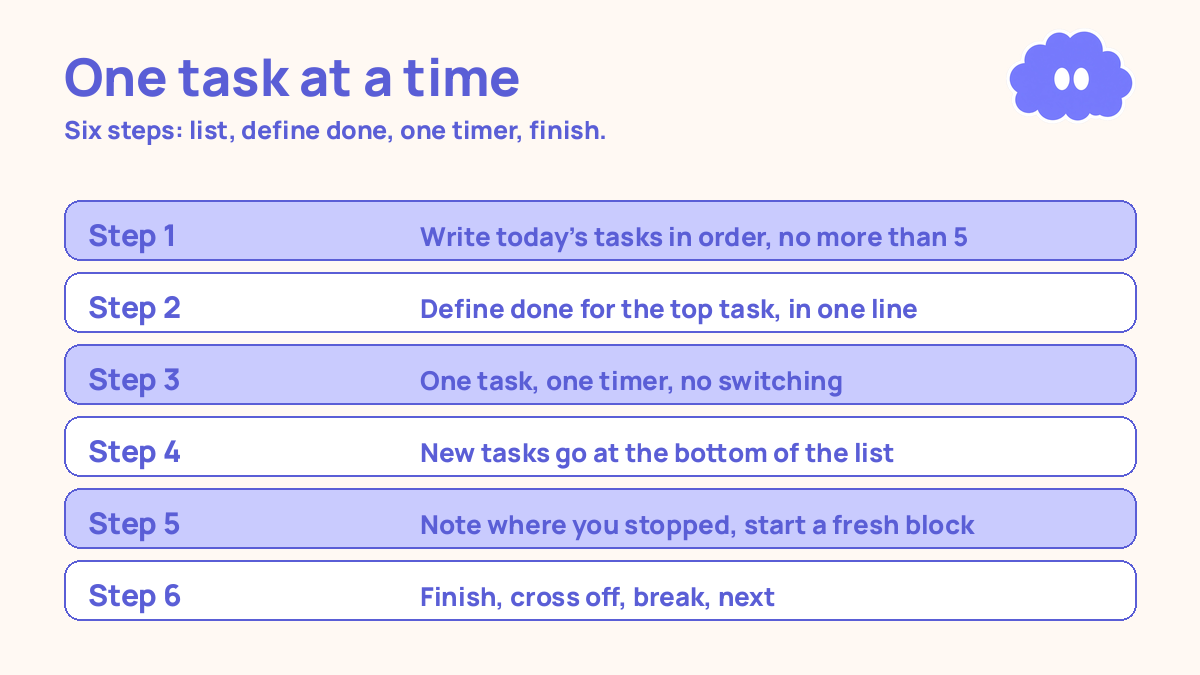
Weekly review checklist
Copy this list and use it each week:
- How many tasks did I actually finish this week, and how many did I only touch?
- Which task kept getting switched away from, and what interrupted it?
- Did my “done” lines match what I actually finished, or were they too vague?
- What one change will I make next week: fewer tasks on the list, smaller tasks, or a stricter interruption rule?
Downloadable infographic spec: one vertical image, title “One task at a time”, with the five steps — write the list in order, define done, one task one timer, the interruption rule, finish cross off break next — and the rule “three finished tasks beat five half-started ones”, in Thynq cream, Cloud Purple, Dark Purple and pink, with the cloud mascot. Text taken word-for-word from this article.
What this system is not
It is not a claim that you should never switch tasks, and it is not a promise of a grade. Some days need switching: a blocked task, a genuine emergency, a timetable that changes. The system is a default, not a law. It is also not a claim about how your brain works in general. The research it leans on is specific: in Rubinstein, Meyer and Evans (2001), people lost 614 to 1,096 milliseconds on every switch between tasks in lab experiments. That is a real cost, and it grows with complexity. But it is a lab finding about switching, not a verdict on your whole study life. Use the system when it helps, and switch when the day genuinely demands it.
Sources
- Rubinstein, J. S., Meyer, D. E. & Evans, J. E. (2001). “Executive control of cognitive processes in task switching”, Journal of Experimental Psychology: Human Perception and Performance 27(4), 763–797. Mean switch costs were 614 to 1,096 milliseconds per switch, larger for more complex or less familiar tasks.
- Cirillo, F. — Pomodoro Technique, late 1980s. Classic cycle: 25 minutes work, 5 minutes break, longer break after four. The 25-minute length was Cirillo’s practical choice, not a science-derived number.
- Dunlosky, J., et al. (2013). Psychological Science in the Public Interest 14(1), 4–58. Only practice testing and distributed practice received a high utility rating; rereading was rated low.
Questions
Is single-tasking just doing less?
No. It is doing the same work in order instead of in parallel. You still do three tasks in a morning, but you finish each one before starting the next, so nothing is half done at the end.
What if a task is blocked and I cannot finish it?
Park it properly. Write down exactly where you stopped and what you need, then move to the next task. A parked task with a note is not the same as an abandoned task. Come back to it when the block clears.
How long should one task take?
Most study tasks fit in 25 to 50 minutes. If a task takes longer than 50 minutes, split it. If it takes less than 10, batch three or four small ones into one block and treat the batch as the single task.
Can I single-task with other people around?
Yes, with one sentence at the start: tell them what you are doing and when you will be free. Interruptions still happen, and the system has a rule for them: note where you stopped, deal with it, and start a fresh block.