The direct answer
Work your normal hours, then close the work laptop, clear the desk, and study for two hours in the same room: one hour learning new material, a short break, then one hour testing yourself from memory on what you just learned and what you learned yesterday. The whole system is one fixed start time, one desk reset, and two honest hours — a clear line between work and study.
You work from home, and you study from home. The room is the same, the desk is the same, and the laptop is often the same. So the day blurs. Work runs into the evening, and study never quite starts.
The problem is not the room. The problem is that nothing in the room changes when work ends and study begins. The fix is a line you can see and feel: a desk reset, a different notebook, a different screen, and a start time that does not move.
This system is built for a student with a full-time job done from home. It assumes you finish work around 5 or 6pm and you cannot move to a library or a second room. If your job is outside the home, the two-hour study system for working students is the better fit, because it is built around coming home and starting again.
The system in short
- Pick one study start time and keep it every work day, for example 6:30pm.
- When work ends, close every work tab and work app, and shut the work laptop if you can.
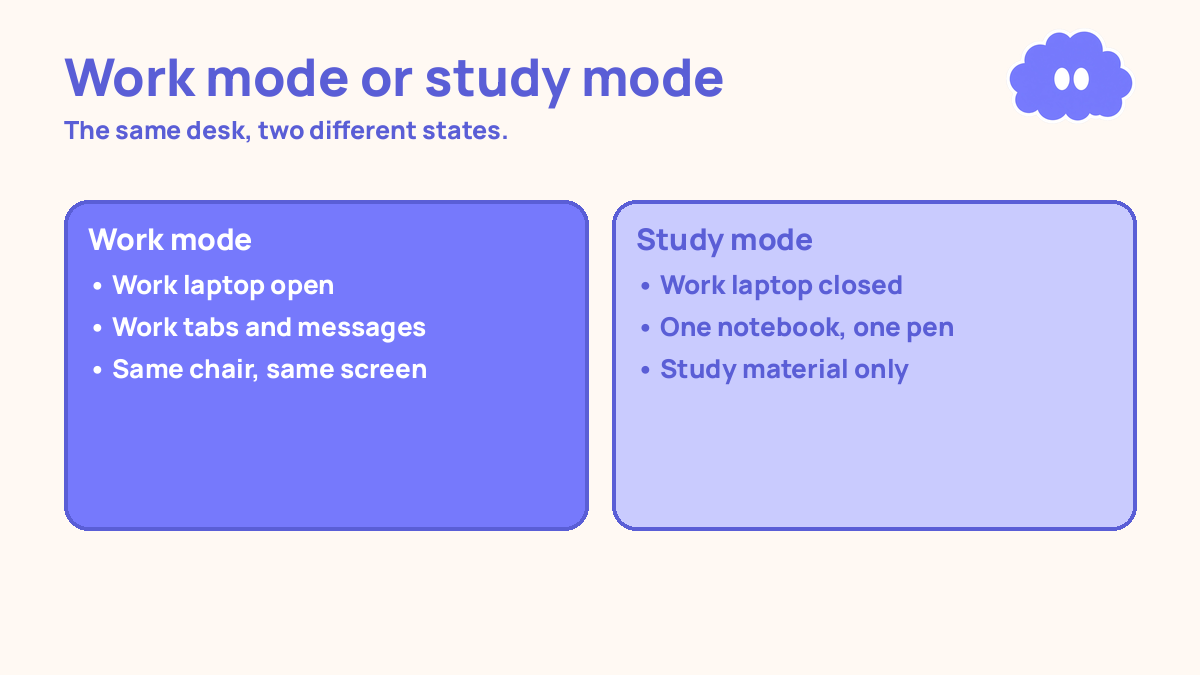
- Reset the desk: clear it, put out your study notebook and one pen, and open only the study material.
- Study for one hour: new material only, in short blocks with a timer.
- Take a 10-minute break away from the desk.
- Study for a second hour: test yourself from memory on today and yesterday, then check your answers.
- At 8:30pm, stop. Write tomorrow’s first task in one line, and close the study notebook.
This is the home version of the wider Study system for students with a full-time job — use that one to plan the whole week.
Step 1: Fix the start time and protect it
Pick a start time you can keep five days a week. For most people working from home, that is 30 minutes after work ends. If work ends at 6pm, study starts at 6:30pm. The half hour is for dinner or a walk. It is not for “one more email”, because one more email is how 6:30pm becomes 8pm.
Do not pick a heroic time. If you finish work at 6pm and pick 6pm as the study start, you will fail on the first day, because work never ends exactly on time. Give yourself the half hour. The system works because it happens, not because it is ambitious.
If your work hours change from day to day, fix the study time to the end of work instead of the clock. “Study starts 30 minutes after I log off” is a rule that survives a late meeting. “Study starts at 6:30pm” does not.
Step 2: Reset the desk like it is a different room
When work ends, change the desk. Close every work tab and work app. If you have a separate work laptop, shut it and put it away, in a drawer or on a shelf. If you share one laptop, close the work browser profile and open a study one, or at least close every work window so the screen is empty.
Change something about yourself too. Change your shirt or wash your face. It sounds small, and it is small, but it is the point: your brain needs a signal that the day has changed.
Step 3: Hour one — new material in short blocks
Hour one is for new material only. Read one section, watch one lesson, or work through one set of problems. Use a timer: 25 minutes of work, 5 minutes of break, then another 25 minutes. The 25-minute length was Cirillo’s practical choice, not a number from cognitive science. If a task needs a longer run, use 50-minute blocks instead.
Before each block, write the task in one line. “Read pages 40 to 48 and write three questions in the margin” is a task. “Study biology” is not.
Do not take notes on everything. Take notes on what you will test yourself on later: the definition, the steps, the example, the thing you got wrong last time. A page of copied text is not a study note. It is a copy.
When the hour ends, stop, even if you are in the middle of a section. Write down where you stopped, in one line, so tomorrow starts without hunting.
Step 4: A real break between the hours
Take 10 minutes away from the desk. Stand up, get water, step outside if you can. Do not check work messages in this break. Do not open social media either. The break is for your eyes and your head, not for a second screen.
This break matters more at home than anywhere else, because at home the desk is always there, and the temptation is to push straight through.
Step 5: Hour two — test yourself from memory
Hour two is the part most students skip, and it is the part that does the learning. Close the book and test yourself on what you studied in hour one, and on what you studied yesterday.
In a 2013 review, Dunlosky and colleagues rated ten common study techniques, and only two received a high utility rating: practice testing and distributed practice. Re-reading was rated low. An hour spent re-reading feels productive and is mostly not. An hour spent answering questions from memory feels harder and is the work that stays.
Check your answers after each test, not at the end of the hour. When you get something wrong, write the correct answer in your own words, and put it on tomorrow’s test list. Feedback matters: a meta-analysis by Rowland (2014) found testing beat restudying, and the benefit was larger with feedback (g = 0.73) than without it (g = 0.39).
Spread the review across days. Go back to today’s material tomorrow, and again in three days, and again in seven days. That 1–3–7 schedule is a practical starting point, not a rule from the research.
Step 6: Stop at the fixed time and plan tomorrow
Stop when the two hours are done. Do not add “just one more page”. A system that runs until you fall asleep is not a system.
Before you close the notebook, write tomorrow’s first task in one line. “Answer the five questions on page 48 from memory.” That is tomorrow’s start, decided tonight, when you are clear-headed. Tomorrow you will not have to decide anything.
Then close the notebook and put it away. Put the study material in one place, every night, so the desk is empty for work in the morning.
A worked example: a Tuesday after work
You work from home, 9am to 6pm. Dinner is at 6pm, study starts at 6:30pm.
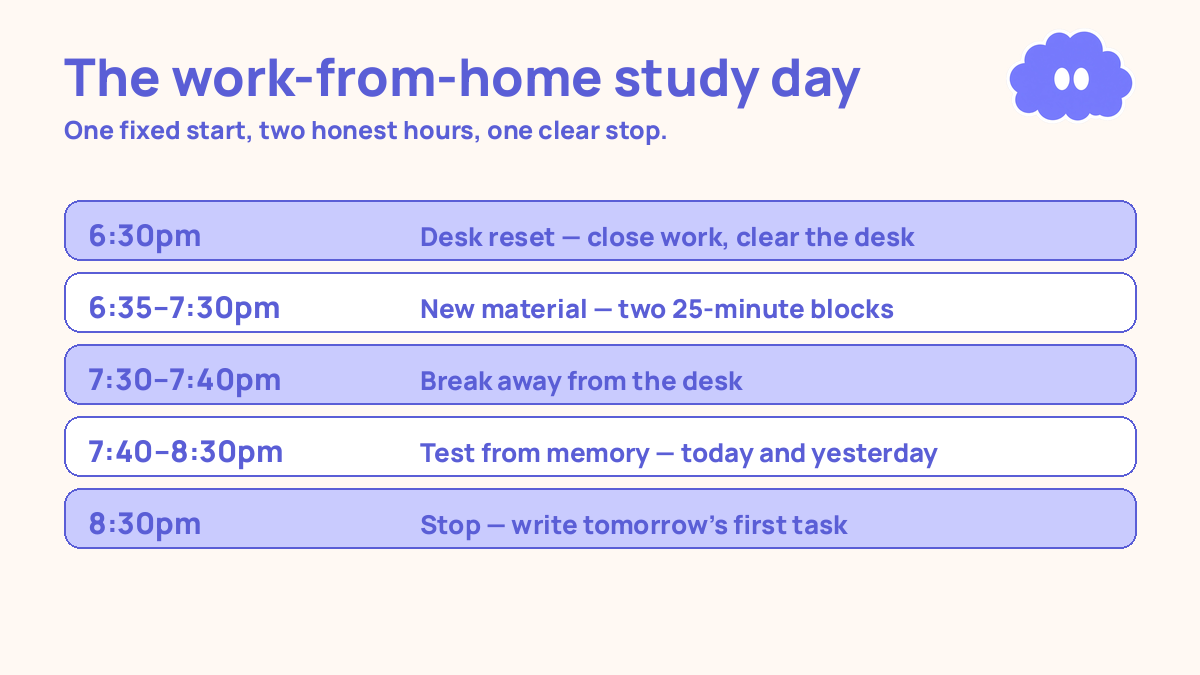
6:00–6:30pm — Work ends, dinner. Log off. Close the work laptop and put it on the shelf. Eat and change your shirt.
6:30–6:35pm — Desk reset. Clear the desk. Put out the study notebook, one pen, and the chapter for tonight. Open only the study material.
6:35–7:00pm — Block 1. Read pages 40 to 48. Write three questions in the margin as you go.
7:00–7:05pm — Break. Stand up, get water, look out of the window.
7:05–7:30pm — Block 2. Work through the five problems on page 49, without looking at the answers first.
7:30–7:40pm — Break away from the desk. Step outside or sit in another room for 10 minutes.
7:40–8:10pm — Test hour, part 1. Close the book. Answer the three margin questions and the five problems from memory, on paper.
8:10–8:30pm — Test hour, part 2. Check your answers. Write the two you got wrong in your own words. Test yesterday’s material for 10 minutes.
8:30pm — Stop. Write tomorrow’s first task: “Answer the five questions on page 48 from memory.” Close the notebook. Leave the desk clear.
When it goes wrong
Work runs late and eats the study hour. This will happen. When it does, do not cancel the whole evening. Do one 25-minute block: test yesterday’s material from memory, then stop. A short session keeps the habit alive.
You sit down to study and answer one work message, then another. The work laptop is the trap. If you share one laptop, close the work apps before the reset, and turn off work notifications for the study hours. If the work laptop is separate, put it in another room. A message you can see is a message you will answer.
The room is noisy and people keep walking in. Tell the people you live with the exact study time before you start, and put a simple sign on the door: “Studying until 8:30pm.” If you share a house with other students, the shared-house study system has more on dividing a shared space and agreeing quiet hours.
You study for two hours but only re-read. The timer controls time, not method. If hour two keeps turning into re-reading, change the rule: hour two starts with the book closed. Write what you remember first, then check.
Weekly review checklist
Copy this list and use it each Sunday:
- How many evenings did I start at my fixed time, and how many slipped?
- How many hours did I actually test myself from memory, not just read?
- Which work habit broke the line this week — late log-off, open tabs, or messages in study time?
- What one change will I make next week: an earlier log-off, a door sign, or a smaller first task?
Downloadable infographic spec: one vertical image, title “The work-from-home study day”, with the desk reset, two study hours, and the fixed stop time, and the three rules — close work, reset the desk, test from memory — in Thynq cream, Cloud Purple, Dark Purple and pink, with the cloud mascot.
What this system is not
It is not a promise of a grade, and it is not a claim that two hours is the right amount for every student and every subject. It is a practical system for a student who works from home and needs a line between work and study. If two hours is too much on a work day, do one hour and keep the test in it.
Sources
- Dunlosky, J., et al. (2013). Improving students’ learning with effective learning techniques. Psychological Science in the Public Interest, 14 (1), 4-58. Only practice testing and distributed practice received a high utility rating; rereading was rated low.
- Cepeda, N. J., et al. (2006). Distributed practice in verbal recall tasks. Psychological Bulletin, 132(3), 354-380.
- Cepeda, N. J., et al. (2008). Spacing effects in learning. Psychological Science, 19(11), 1095-1102. The right gap depends on when the test is.
- Rowland, C. A. (2014). The effect of testing versus restudy on retention. Psychological Bulletin, 140(6), 1432-1463. Testing beat restudying, and the benefit was larger with feedback (g = 0.73) than without it (g = 0.39).
- Cirillo, F. — Pomodoro Technique, late 1980s. The 25-minute length was Cirillo’s practical choice, not a number derived from cognitive science.
For the wider system behind these two hours, start with the two-hour study system for working students.
Questions
How do I separate work and study in the same room?
Use one change of state, not a second room. Close the work laptop, clear the desk, put out your study notebook, and start at the same time every day. The switch is a small ritual you repeat, and after a few weeks it is the ritual that tells your brain study has started.
How many hours can I study after working from home all day?
Two focused hours is a realistic target. One hour of new material and one hour of testing yourself from memory, with a short break between them. More than that on a work day usually means tired reading that you will not remember.
What if my family keeps interrupting my study time?
Tell them the exact start and end time before you begin, and put a simple sign on the door. Interruptions fall when the time is fixed and visible. If someone still needs you, note where you stopped and restart the block instead of drifting.
Should I study before work or after work?
After work suits most people, because the study time is protected by a fixed end to the work day. If your mornings are quiet and your evenings are full, study before work instead. Pick the slot you can keep five days a week, not the one that sounds best.