
The direct answer
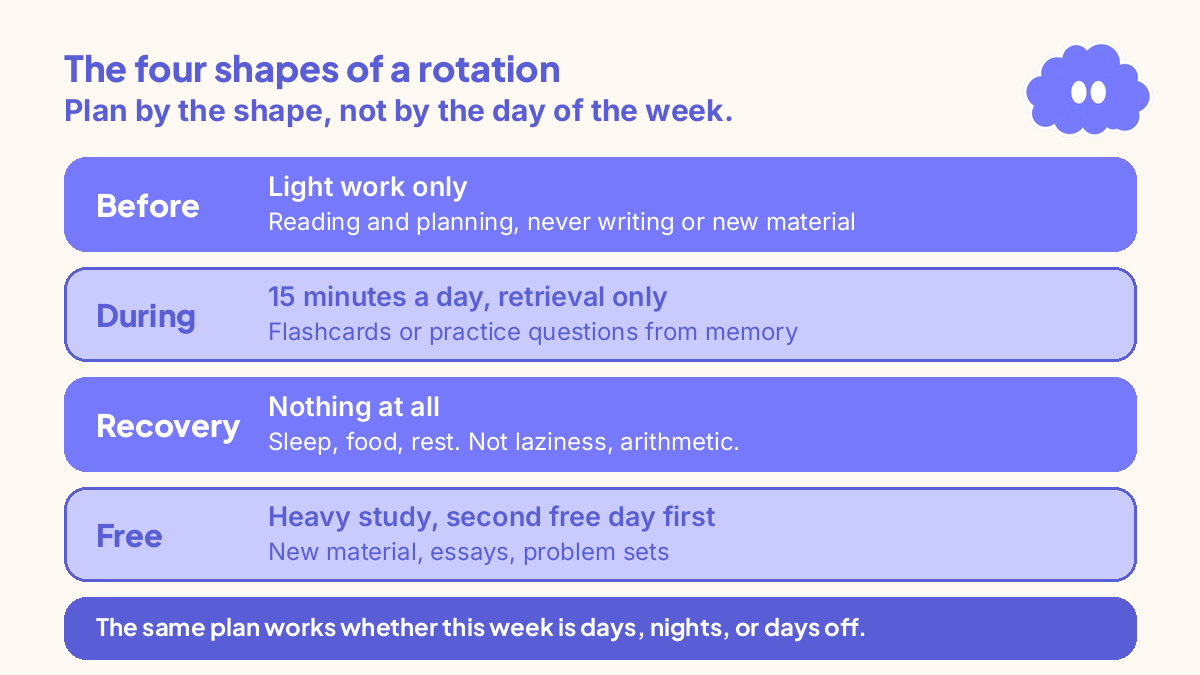
How to study when your shifts rotate: plan by the shape of your rotation, not by the day of the week. Every rotation has four shapes: the day before a block, the days during it, the recovery day after it, and the free days that follow. Give each shape a different kind of study, then map it onto the rota.
A fixed study plan assumes Tuesday is always Tuesday. On rotating shifts, Tuesday means nothing: sometimes it is your third night in a row, sometimes it is your first day off. Students on rotating shifts fail because they plan for a week that never repeats. The system below plans for the shape that does repeat, so the same plan works whether this week is days, nights, or days off.
The system in short
- Get the full roster cycle, not just this week, and mark the four shapes in it: before, during, recovery, and free.
- Put the heavy study on free days, the second free day first, when your mind is freshest.
- Use the day before a block for light work only: reading and planning, never writing or new material.
- During a block, study for 15 minutes a day at most, and only retrieval: flashcards or practice questions from memory.
- Take the recovery day off completely, and protect your sleep before you protect your study.
- Review for 15 minutes at the end of each cycle: which free days produced real study, and what the next cycle must protect.
Step 1: Get the full roster cycle and mark the four shapes
Ask for the full roster cycle, not just this week’s shifts. A rotation may run for eight days, two weeks, or four weeks, and it repeats. Once you have the cycle, mark every day with one of four shapes. The day before a block starts is a “before” day. The days you are working are “during” days. The first day after a block ends is the “recovery” day. The days after that, before the next block starts, are “free” days.
Write the shapes on a calendar, in colour if it helps, and keep the calendar where you study. The point is that the shapes are the same in every cycle, even when the dates move. A two-week cycle with three days, three nights, and two days off has the same shape every time it repeats. Your study plan is built on the shapes, so it repeats too.
Then count the free days in one cycle. A cycle with four free days can hold two heavy study sessions and two light ones. A cycle with two free days can hold one heavy session and one light one. That count is the honest size of your study week, and every plan after this step is built on it. If you plan for six study days in a cycle that only has two free days, the plan fails in the first week.
Step 2: Put the heavy study on free days, the second free day first
Free days are the only days with a fresh mind and unbroken time, so they carry the heavy study: new material, essays, problem sets, anything you have not seen before. If you have two free days in a row, the second free day is the best one, because the first free day is still carrying tiredness from the block. Put the hardest task on the second free day, and the second-hardest task on the first.
A free day holds two 90-minute blocks with a break between them. Each block has one job, written down the night before, so the day starts without a decision. Finish each block by testing yourself on what you just did.
The first free day takes a lighter load: admin, planning, reading, and the easy tasks that still need doing. Use it to set up the second free day: read the chapter, gather the sources, write the essay plan, so the hard day starts with the thinking already done. If you only have one free day in a cycle, it takes the hardest task, and the lighter work moves to the day before the next block.
Step 3: Use the day before a block for light work only
The day before a block starts is a trap. You feel fine, you have time, and you are tempted to do the hardest task. Do not. The block starts tomorrow, and the hard task will still be there on your next free day. The day before a block is for light work only: reading, planning, organising notes, and writing the plan for the free days.
Light work means work you can stop at any moment without losing anything: read one chapter and write three questions about it, plan the next free day’s tasks, or tidy your notes so the next session starts clean.
Protect your sleep on the day before a block, especially before nights. Go to bed at a normal time, or earlier if the first shift starts early. Sleep is what makes the free days work, and one short night before a block costs you more study than a whole evening of reading ever gains. For the wider problem of tired evenings, the system in How to study when you are tired after work covers the same trade in detail.
Step 4: During a block, study for 15 minutes a day at most
During a block of shifts, study is 15 minutes a day, and only retrieval. Flashcards on your phone, five practice questions from memory, or explaining one topic out loud without your notes. Do it on a break, on the journey home, or before the shift starts, and then stop. Fifteen minutes of retrieval is genuinely useful. An hour of new material during a block is not, because you are tired and you will have to learn it again.
Keep the 15 minutes ready. A deck of flashcards on your phone, a list of practice questions in your bag, or a topic you can explain from memory. The session must start in under a minute, because a session that needs setup does not happen between shifts. For short sessions built on testing yourself, the method in Flashcard system that works gives you decks that fit a 15-minute gap exactly.
If you are on nights, the same rule holds, and it matters more: night shifts wreck sleep, and sleep is what turns study into memory. A 15-minute retrieval session on a quiet night is fine. Two hours of new material at 3.00 in the morning is not study. The night-shift system in Study system for night-shift students covers the sleep side of this in full.
Step 5: Take the recovery day off completely
The recovery day is the first day after a block ends, and it is not a study day. It is a sleep day, a food day, and a rest day. Do not study on it, do not feel guilty about not studying on it, and do not let anyone tell you it is wasted. The recovery day is what makes the free days after it work. A student who studies on the recovery day arrives at the free days still tired, and the heavy study fails.
This is the hardest rule in the system, because it feels like laziness. It is not. It is arithmetic: a rotation gives you a fixed number of fresh hours, and spending them on the recovery day takes them from the free days, where they would do more.
If the recovery day is also the day your lectures fall on, go to the lectures and take notes, but do not add study on top. Lectures are attendance, not study, and the recovery day can hold attendance. It cannot hold a 90-minute block on top of a lecture day without breaking the next free day.
Step 6: Review for 15 minutes at the end of each cycle
At the end of each roster cycle, or on the last free day of the cycle, spend 15 minutes on three questions. First, which free days produced real study, and which ones leaked away? Second, did the 15-minute sessions happen during the block, or did they get skipped every day? Third, what must the next cycle protect: a free day that keeps getting eaten by overtime, a recovery day that keeps turning into study, a block that keeps running long?
Write the answers in two or three lines. If a free day keeps leaking, fix the setup: the task was not written down the night before, or the notes were not ready. If the block keeps running long, the fix is a conversation with your manager, using the words in How to ask your boss for study time.
A worked example: a two-week rotation, three days and three nights
Your situation: Third-year nursing student, hospital job on a two-week rotation. Week one: three day shifts, Monday to Wednesday, 7.00 to 7.00. Week two: three night shifts, Thursday to Saturday, 7.00 to 7.00. Days off: Thursday to Sunday in week one, Sunday to Wednesday in week two. Exam in six weeks, weakest topic is pharmacology.
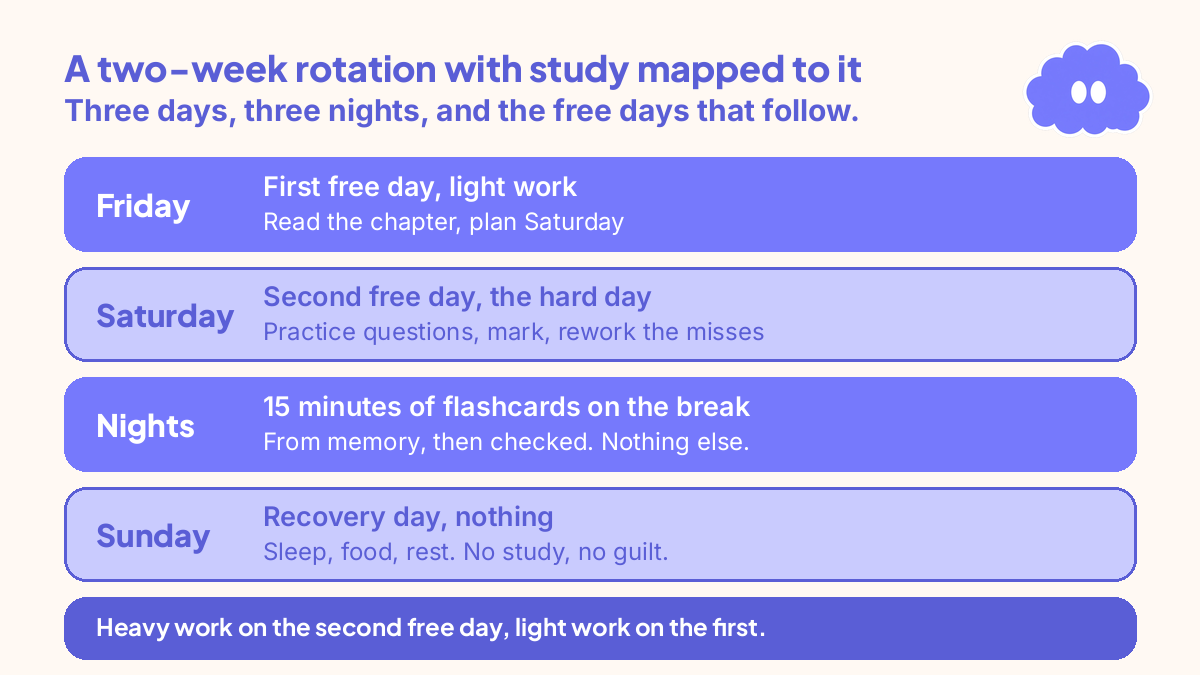
- Cycle map, shapes marked: Day shifts are “during” days. Thursday after the day block is the recovery day. Friday and Saturday are free days. Sunday is a “before” day, because nights start on Thursday of week two. Nights are “during” days. Sunday after nights is the recovery day. Monday to Wednesday are free days.
- Saturday, second free day: The hard day. 9.00 to 10.30, work through 20 pharmacology practice questions from memory, then mark them. Break. 11.00 to 12.30, rework the five questions missed, then test the drug groups again from memory.
- Sunday, before day: Light work only. Plan the night block, pack the flashcard deck on the phone, go to bed early.
- Thursday to Saturday nights, during days: 15 minutes of flashcards on the break, from memory, then checked. Nothing else. Sleep after the shift, not study.
- Sunday, recovery day: Nothing. Sleep, food, rest. No study, no guilt.
- Tuesday, second free day: The hard day again. Same shape as Saturday: practice questions, mark, rework the misses, test again.
When it goes wrong
The rota changes and the free days move. This happens, and it is why the plan is built on shapes, not dates. Take the new rota, mark the four shapes again, and move the study to match. The heavy work still goes on the second free day, wherever it now falls. The rebuild takes 20 minutes, and it is worth doing the same day the new rota arrives.
You study on the recovery day because you feel behind. You will feel behind, and you will be tempted. The fix is not willpower, it is the calendar: look at the next free day, see that the hard task is already planned there, and let the recovery day be what it is. If you really are behind, add a 15-minute retrieval session to the next “before” day, not to the recovery day.
Weekly review checklist
- Which shapes did this cycle have, and how many free days did it really give me?
- Did the heavy study happen on the second free day, with the hardest task?
- Did the 15-minute retrieval sessions happen during the block, or were they skipped?
- Did the recovery day stay free, or did study creep into it?
- Did the day before a block stay light, or did I try to do hard work there?
- What must the next cycle protect: a free day, a recovery day, or a conversation with my manager?
Downloadable infographic spec: one vertical image, title “How to study when your shifts rotate”, with the six steps from “The system in short” and the six review questions above, in Thynq cream, Cloud Purple, Dark Purple and pink, with the Cloud mascot. Text taken word-for-word from this article.
What this system is not
It is not a promise that rotating shifts stop being tiring. A rotation that moves between days and nights takes a real toll, and some cycles will give you fewer fresh hours than you want. It is not a way to study the same hours as a student with a fixed week. What it does is smaller: it gives you a plan that survives the rotation, because it is built on the shape of the rotation itself.
Sources
- Cepeda, N. J., et al. (2006). Distributed practice in verbal recall tasks. Psychological Bulletin, 132(3), 354-380. Spaced practice beat massed practice, which supports spreading study across the free days of a rotation instead of cramming it into one day.
- Roediger, H. L., & Karpicke, J. D. (2006). Test-enhanced learning. Psychological Science, 17(3), 249-255. Recallers remembered more a week later than restudiers, which supports the 15-minute retrieval sessions during a block.
- Dunlosky, J., et al. (2013). Improving students’ learning with effective learning techniques. Psychological Science in the Public Interest, 14(1), 4-58. Practice testing and distributed practice rated high; rereading rated low, which is why the block days use testing from memory and not re-reading.
For the wider working-student system behind this one, start with How to build a study system that fits your life.
Questions
How do I study when my shifts rotate every week?
Stop planning by the day of the week and plan by the shape of the rotation instead. Every rotation has the same shape: the day before a block starts, the days during the block, the recovery day after it, and the free days that follow. Give each of those a different kind of study, then map the shape onto whatever the rota says this week.
Should I study on night shifts?
Only in short retrieval sessions, and only if you are allowed to. Fifteen minutes of flashcards or practice questions from memory is useful on a quiet night. New material on a night shift is a waste: you are tired, you will not remember it, and you will have to learn it again on a day off.
How do I plan study around a rotating roster?
Get the full roster cycle, not just this week. A cycle may run for two weeks, four weeks, or eight days. Mark the free days in each cycle first, then put the heavy study there. The day before a block starts is light work only, and the recovery day after a block is nothing at all.
What if my rotation changes and my study plan falls apart?
Then the plan did its job badly, because a good rotation plan survives a roster change. Rebuild it in 20 minutes: take the new roster, find the same four shapes in it, and move the study to match. The heavy work still goes on free days; only the dates change.