
The direct answer
To study when you work in retail, study before your shift, not after it, and plan each week when the rota comes out. Give days off the heavy learning, give shift days short practice, and give late finishes retrieval only. A shop day spends your feet and your patience, so study has to happen before the shop takes them.
Retail work has a shape other jobs do not: the rota changes weekly, the busiest days are weekends, the shifts end late, and Christmas doubles the hours just as exams arrive. Students who copy a 9-to-5 study plan into that shape plan evenings that never happen and lose the weekends other students use to catch up.
The system in short
- Read the rota the day it comes out and sort the week into day types.
- Study before the shift, never after a late finish.
- Give days off the heavy learning, in 50-minute blocks.
- Use the hour before a shift for practice questions from memory.
- Keep late finishes to 20 minutes of retrieval, or nothing at all.
- Review every week: hours worked, hours studied, and next week’s rota.
Step 1: Read the rota the day it comes out and sort the week into day types
Retail rotas usually arrive a week ahead, sometimes less. The day it arrives, spend ten minutes sorting each day into one of three types: a day off, a shift day, or a late finish (home after 9 pm). Write the type next to each day in your diary. This ten-minute job is the whole planning system.
Each day type gets its own kind of study, fixed in advance so you never decide it in the moment. A day off is a heavy-learning day: new topics, essays, first drafts. A shift day is a practice day: questions from memory, in the hour before the shift. A late finish is a retrieval day: 20 minutes of flashcards, or nothing.
Keep the rota and the study plan in the same place, so a shift swap shows up next to the study it affects. If a colleague swaps your day off for a Saturday shift, move the heavy learning to the next day off the same day, in writing.
Step 2: Study before the shift, never after a late finish
Retail is physical work: hours on your feet, lifting stock, talking to customers. By the end of a shift, your body is tired and your attention is spent. Studying then usually means rereading the same page three times and remembering none of it. The students who keep going in retail study before the shop takes their energy, not after.
So the rule is simple: the study session comes first in the day, before the shift. For a late shift starting at 2 pm, that means a 50-minute session in the morning, on the hardest topic of the week. For an early shift starting at 8 am, it means 25 minutes before you leave: five practice questions from memory, checked, with the misses noted.
This is also why the system for tired evenings after work fits retail students so well: it assumes the evening is already spent, and builds the day around the hours that are still fresh. If the study happened in the morning, the evening is yours to rest.
Step 3: Give days off the heavy learning, in 50-minute blocks
A day off in retail is rare, and the mistake is spending it on chores, sleeping in, and then studying at 8 pm when the day is gone. Protect the morning of every day off for the heavy learning: new topics, essays, and anything you have not seen before, in 50-minute blocks with a 10-minute break. Two blocks is 100 minutes of real learning.
Start with the hardest topic, not the easiest: the fresh mind is available at 9 am on a day off, not at 9 pm on a shift day. Work in this order: read once and close the book, write what you remember, then check and fix the gaps. If you finish the morning’s blocks early, stop.
If you have two days off in a row, use the second for the second-hardest topic, and keep the afternoon free. The day off has to stay a day off, with study in the morning and life in the afternoon.
Step 4: Use the hour before a shift for practice questions from memory
The hour before a shift is the retail student’s most reliable study time: you are dressed, awake, and have nowhere else to be. Use it for practice: questions, problems, and past-paper questions, answered from memory and then marked. This is not reading time. Reading before a shift is too gentle; you will drift, and the shift will start with the reading unfinished.
Pick the questions the night before and leave them on the table: five questions, or one past-paper question with its mark scheme. When the hour starts, answer with the book closed. After 25 minutes, mark what you wrote, note the misses in one line each, and stop. The second 25 minutes, if you have it, is for the topic you missed most.
Keep a small notebook of misses by your uniform: one line per wrong answer, with the question, the right answer, and the rule behind it. Before the next shift, read the last five lines. This is the error log the past paper system uses.
Step 5: Keep late finishes to 20 minutes of retrieval, or nothing at all
A late finish means you get home after 9 pm, tired, hungry, and done for the day. The rule is 20 minutes of retrieval or nothing, and nothing is the right choice more often than students think. Retrieval means flashcards or questions on what you already know, for 20 minutes, then bed. It is not new material, not an essay, and not a past paper.
Set the 20 minutes up before the shift, not after it: put the flashcards or the question sheet on the kitchen table before you leave, so coming home means picking them up, not deciding what to do. If even 20 minutes feels impossible, skip it without guilt and go to bed. One skipped evening costs nothing.
The Christmas peak is this rule at full size. For the three or four peak weeks, drop to retrieval only: 20 minutes most evenings, one 90-minute anchor on your day off, and no new topics. Do the heavy learning in the quiet weeks before the peak, and ask for your exam days off as soon as the Christmas rota is published. The seasonal job system covers the same pattern in more detail.
Step 6: Review every week
Spend ten minutes on the day the new rota arrives, and ask five questions: how many hours did I work, and how many did I study? Did the pre-shift sessions happen, or did study slide to the evening? Did the day off hold the heavy learning? What is on the misses list, and is it getting shorter? Where do next week’s study hours go?
The review catches the two retail failure modes early. The first is the evening-study habit: if your review shows three evenings of rereading and no pre-shift sessions, move the sessions to the morning, not to trying harder in the evening. The second is the lost day off: if two weeks running it produced no heavy learning, write the morning blocks in the diary the day the rota arrives, as if they were shifts.
End the review by writing next week’s sessions into the diary, next to the shifts. That is the system: rota, day types, study before the shift, heavy learning on days off, retrieval after late finishes, review when the rota arrives.
A worked example: a week with two late finishes and one day off
Your situation: First-year student, part-time job in a clothing shop, 22 hours a week. Rota this week: Monday day off, Tuesday early shift 8 am to 2 pm, Wednesday late shift 2 pm to 10 pm, Thursday day off, Friday late shift 2 pm to 10 pm, Saturday shift 10 am to 6 pm, Sunday off. Exam in six weeks, weakest subject is biology.
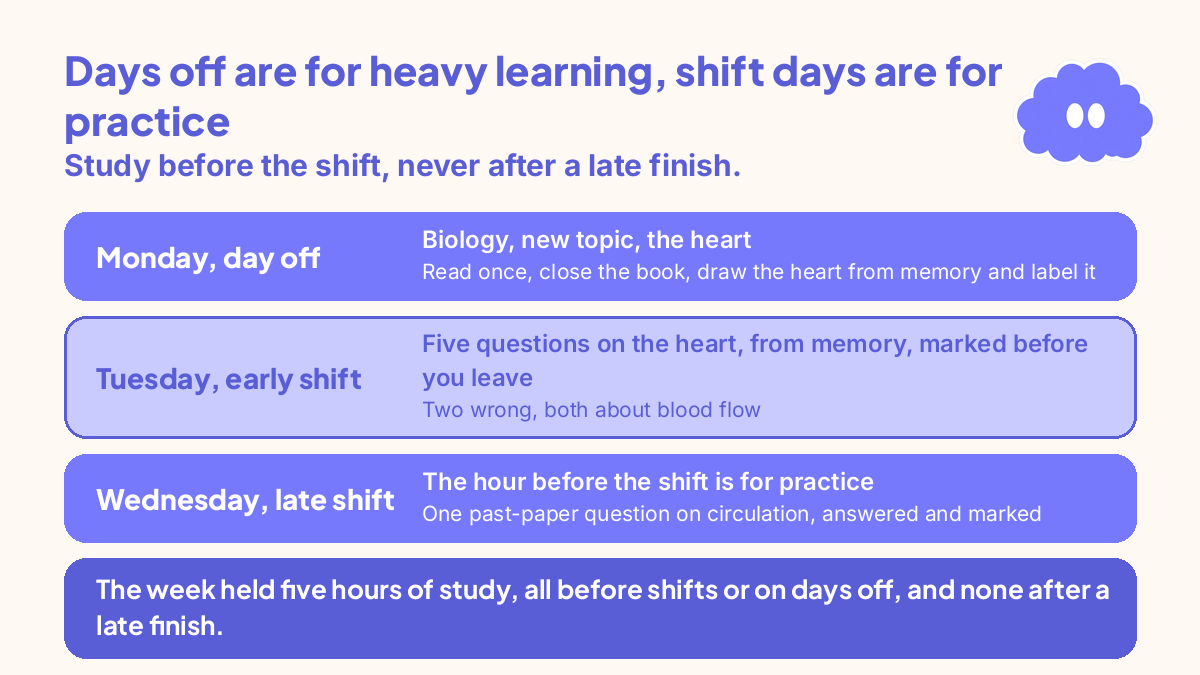
- Monday, day off, 9.00 to 9.50: Biology, new topic, the heart. Read once, close the book, draw the heart from memory and label it. Check, fix the two wrong labels, write them in the misses notebook.
- Monday, 10.00 to 10.50: Biology again, same topic. Draw it again from memory, all labels right this time, then five practice questions.
- Tuesday, 7.30 to 7.55: Early shift. Five questions on the heart, from memory, marked before you leave. Two wrong, both about blood flow; they go in the misses notebook.
- Wednesday, 1.00 to 1.50: Late shift. The hour before the shift is for practice: one past-paper question on circulation, answered and marked, then the misses notebook read once.
- Wednesday, 10.30 pm: Home, late finish. Flashcards on the kitchen table, 20 minutes, then bed. Nothing new.
- Thursday, day off, 9.00 to 9.50: Chemistry, new topic, rates of reaction. Same pattern: read once, close, write from memory, check.
- Friday, 1.00 to 1.25: Late shift. 25 minutes only: five questions on rates of reaction, marked, misses noted.
- Saturday, 9.00 to 9.25: Shift at 10 am. 25 minutes: the misses notebook, read and re-tested. The two blood-flow questions are right this time.
- Sunday, day off, 9.00 to 10.30: One 90-minute anchor: a timed past paper, biology and chemistry mixed, marked the same morning. Score noted, misses added to the notebook.
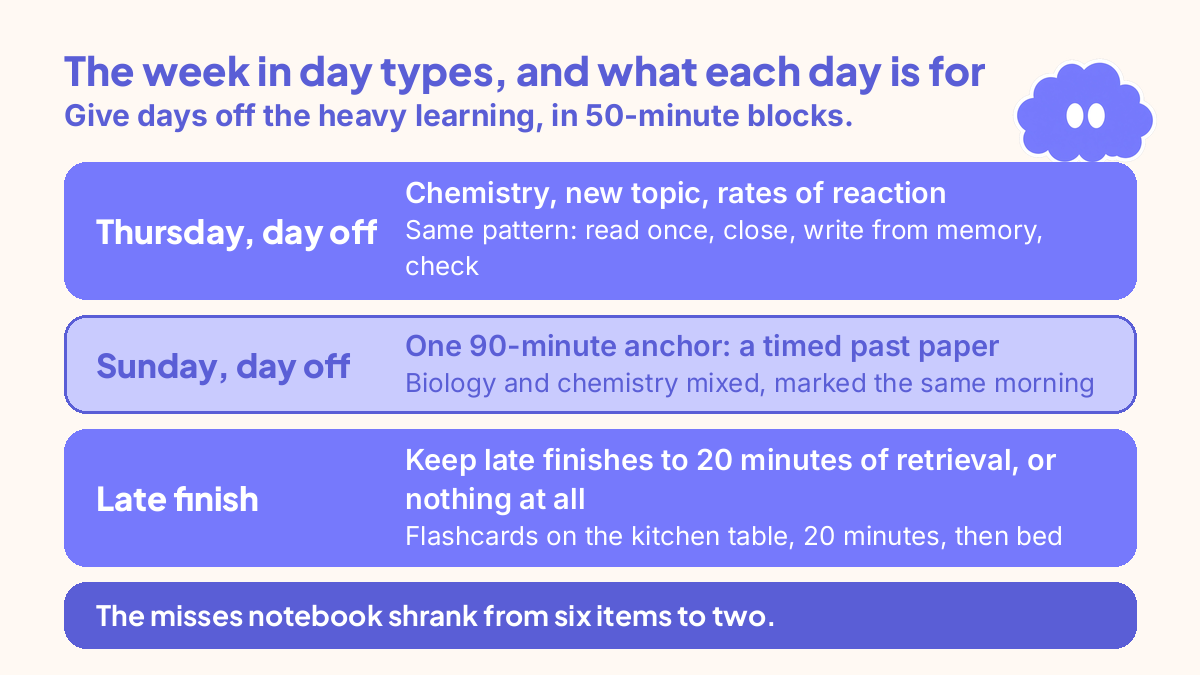
The week held five hours of study, all before shifts or on days off, and none after a late finish. The misses notebook shrank from six items to two.
When it goes wrong
The rota changes with two days’ notice. Re-sort the day types the day you hear, and move the heavy learning to the next day off in writing. If the new rota takes your only day off, the heavy learning moves to the longest pre-shift hour, and the week becomes a retrieval week.
Christmas doubles your hours. Drop to retrieval only for the peak weeks, keep the one weekly anchor on your day off, and do the heavy learning before the peak starts. Tell your manager your exam dates when the Christmas rota is published, and ask for exam days off in the same conversation, when swaps are still easy.
You keep studying after late finishes and retaining nothing. Stop. The evening is not a study slot, and forcing it teaches you that study does not work. Move the session to the morning before the next shift, even if it is only 25 minutes.
Weekends are always shifts, so you never catch up. The system for students who work weekends is built for exactly this: it treats Saturday and Sunday as work days and puts the heavy learning on weekday mornings instead.
You swap shifts to help a colleague and lose your study day. Say yes once, and the rota fills with favours. Keep one day a week that is not swappable, and tell colleagues it is a college day.
Weekly review checklist
- How many hours did I work, and how many did I study, in sessions that actually happened?
- Did the pre-shift sessions happen, or did study slide to the evening?
- Did the day off hold the heavy learning, or did chores take the morning?
- What is on the misses list, and is it getting shorter?
- Where do next week’s study hours go, given next week’s rota?
- Is there an exam or a peak period coming that needs days off requested now?
Downloadable infographic spec: one vertical image, title “How to study when you work in retail”, with the six steps from “The system in short” and the six review questions above, in Thynq cream, Cloud Purple, Dark Purple and pink, with the Cloud mascot. Text taken word-for-word from this article.
What this system is not
It is not a way to study after a 10 pm finish and still learn; nobody learns well then, and pretending otherwise wastes the evening and the sleep after it. It is not a promise that retail and study fit together in December; some peak weeks they barely fit, and the honest answer then is retrieval only, not a heroic all-nighter. It does not replace your lectures, your course handbook, or your manager’s rota. And it does not make weekends free: retail weekends are work, and the system plans around that instead of wishing it away.
Sources
- Dunlosky, J., et al. (2013). Improving students’ learning with effective learning techniques. Psychological Science in the Public Interest, 14(1), 4-58. Practice testing and distributed practice rated high; rereading rated low, which is why shift days use testing from memory instead of re-reading.
- Cepeda, N. J., et al. (2006). Distributed practice in verbal recall tasks. Psychological Bulletin, 132(3), 354-380. Spaced practice beat massed practice, which supports short sessions across the week instead of one long session.
- Roediger, H. L., & Karpicke, J. D. (2006). Test-enhanced learning. Psychological Science, 17(3), 249-255. Recallers remembered more a week later than restudiers, which supports testing from memory in the pre-shift hour.
For the wider working-student system behind this one, start with How to study with a part-time job.
Questions
How do I study when my retail shifts change every week?
Plan study on the day the rota comes out, not on Monday morning. Give each kind of day its own kind of study: heavy learning on days off, practice questions before a shift, and retrieval only after a late finish. A new rota means a new plan, made in ten minutes.
Should I study before or after a retail shift?
Before, almost always. After a shift on your feet, with customers all day, your attention is spent, and an evening session usually becomes rereading. A 50-minute session before a late shift, or 25 minutes before an early one, does more than two hours after work.
How do I study during the Christmas peak in retail?
Drop to retrieval only for the peak weeks: flashcards and practice questions in short sessions, one 90-minute anchor a week on your day off, and nothing new. Do the heavy learning in the quiet weeks before the peak starts, and ask for your exam days off as soon as the Christmas rota is published.
How many hours a week can a retail student study?
Five to eight hours is realistic on a part-time retail rota of 20 to 25 hours a week, and three to five on a full-time rota. Count only the hours you can protect, in sessions of 25 to 50 minutes.