
The direct answer
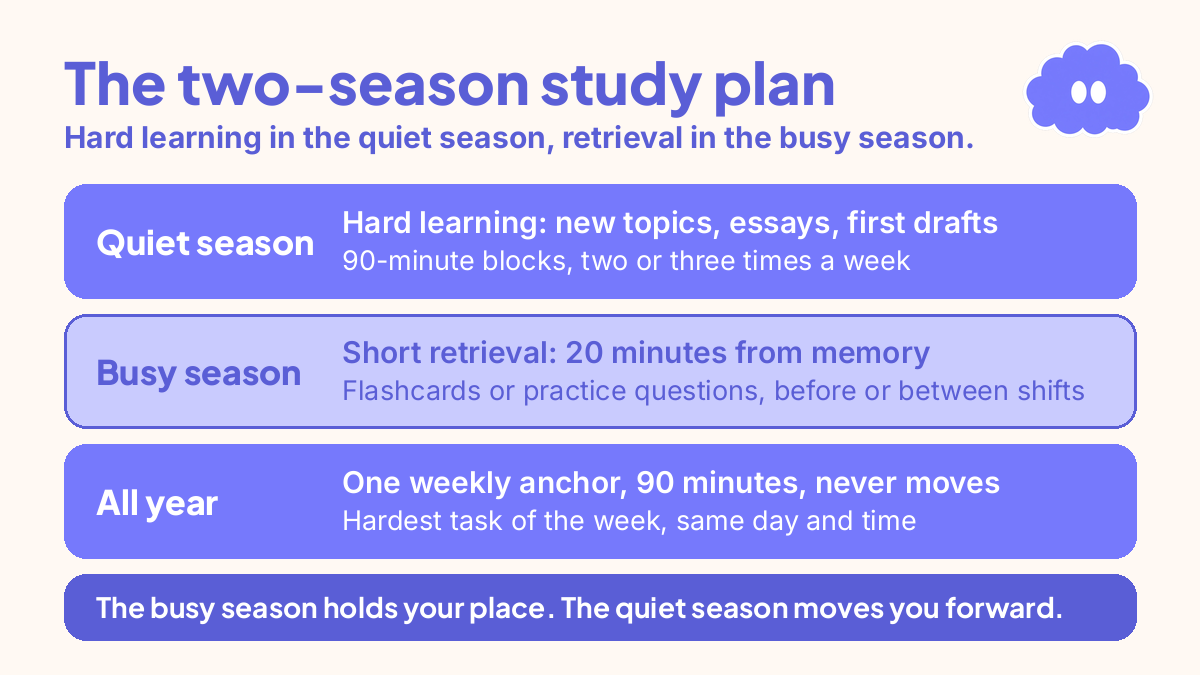
How to study when your job is seasonal: build a two-season plan. Put the hard learning in the quiet season, when you have time and energy, and switch to short retrieval sessions in the busy season, when you do not. One weekly anchor session stays fixed all year, so the course never stops completely.
A student who works Christmas retail, summer harvest work, or a busy tourist season has six weeks of long shifts and tired evenings, then weeks with almost no work at all. A plan built for the average week fails in both seasons: it asks for too much when the job is busy and wastes the quiet weeks when time is free. The system below plans for both seasons separately, and it works because it never asks a tired evening to do a quiet morning’s job.
The system in short
- Map the two seasons with real dates: when the busy season starts, when it ends, and how many hours a week you work in each.
- Put the hard learning in the quiet season: new topics, essays, and anything you have not seen before.
- Switch to short retrieval sessions in the busy season: 20 minutes of testing yourself from memory, before or between shifts.
- Keep one weekly anchor session that never moves, 90 minutes on your day off, for the hardest task of the week.
- Tell your employer your exam dates early, and ask for specific days off, not for a general favour.
- Review for 15 minutes each Sunday: what the busy season allowed, what slipped, and what the quiet season must catch up.
Step 1: Map the two seasons with real dates
Start with dates, not feelings. Write down the first and last days of the busy season, the hours you work in a normal busy week, and the hours you work in a normal quiet week. Christmas retail often runs from mid-November to the first week of January, at 30 to 40 hours a week. Summer work often runs from June to September. A tourist season may run from Easter to October. Your dates are yours, so get them from your contract or your rota, not from a guess.
Then work out what each season can hold. A quiet week with 10 hours of work can hold 12 to 15 hours of study. A busy week with 35 hours of work can hold five to eight hours, and only in short sessions. Write both numbers down, because the rest of the plan depends on them.
Mark the exams and deadlines on the same map. If your exams fall in January, just after the Christmas busy season, the quiet season for hard learning is October and early November, not December. If your exams fall in May, the quiet season is the spring term. The map tells you which weeks are for learning and which weeks are for holding your place.
Step 2: Put the hard learning in the quiet season
Hard learning means new material, first drafts, and anything you have to think through from the start. It needs a fresh mind and an unbroken hour or two, and the quiet season is the only time you have both. So the quiet season carries the heavy work, and you plan it first.
In the quiet season, work in blocks of 90 minutes, two or three times a week, plus short daily review. Each block has one job: read one chapter and test yourself on it, draft one essay section, work through one problem set. Finish each block by writing down the next block’s job, so the next session starts without a decision. This is the same rhythm as a normal study week, and it works here because the quiet season really is a normal study week.
Step 3: Switch to short retrieval sessions in the busy season
When the busy season starts, stop the long blocks and switch to retrieval. A retrieval session is 20 minutes of testing yourself from memory: flashcards, five practice questions, or explaining one topic out loud without your notes. You do it before a shift, between shifts, or on a break, and then you stop. It is short because short is all a busy day allows, and it works because testing yourself from memory is what makes learning stick.
Keep the sessions small and ready: a deck of flashcards on your phone, or a list of ten practice questions in your bag. The session must be startable in under a minute, because a session that needs ten minutes of setup does not happen on a busy day. For short sessions built on testing yourself, the method in Flashcard system that works gives you decks that fit a 20-minute gap exactly.
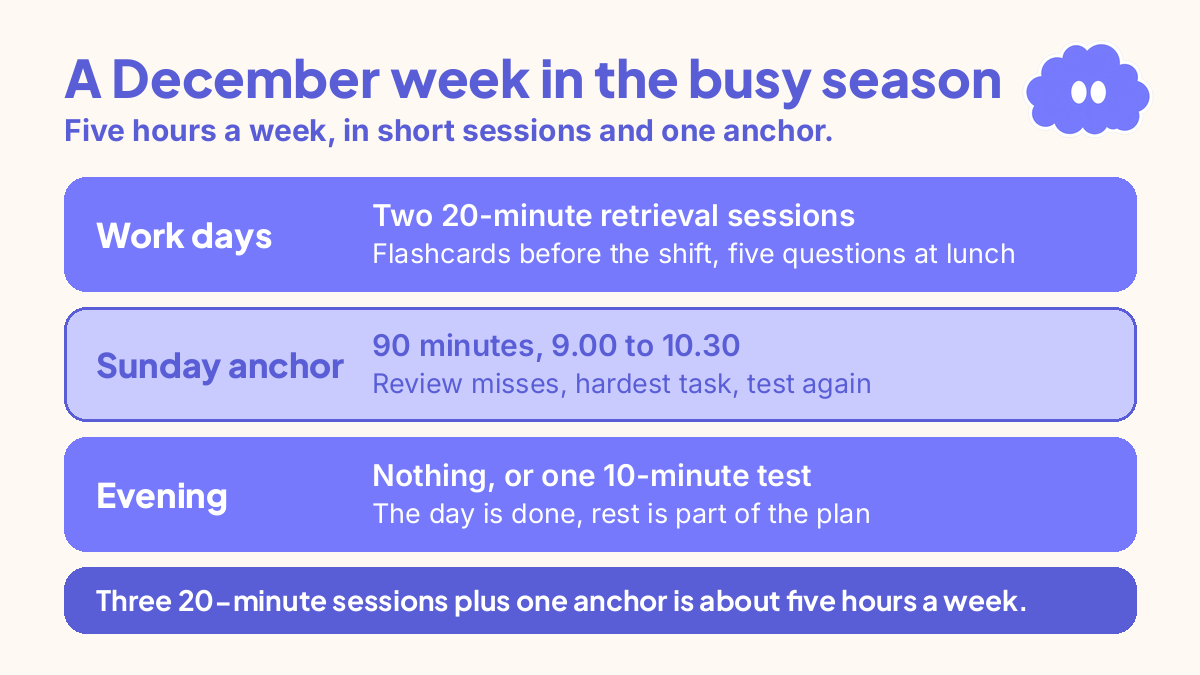
Do two or three of these sessions on work days, and one longer session on your day off, which is the anchor in Step 4. Three 20-minute sessions plus one 90-minute session is about five hours a week. That is enough to hold your place through a busy season. It is not enough to learn a new subject from scratch, which is why Step 2 matters so much.
On the worst days, when a shift runs long and you come home with nothing left, do one 10-minute test from memory and stop. That counts. The system survives a busy season because it asks for 10 minutes on the worst day, not two hours. For the evenings when tiredness wins completely, use the system in How to study when you are tired after work.
Step 4: Keep one weekly anchor session that never moves
The anchor is one 90-minute session, on the same day and at the same time every week, all year. In the quiet season it is one block among several. In the busy season it is the only long session you have, and it carries the hardest task of the week: the essay draft, the problem set, the topic you keep getting wrong.
Put the anchor on your day off, in the morning if you can, when your mind is freshest. Protect it the way you protect a shift: it does not move for a social plan, and it does not move because a shift was added at short notice. If a shift is added on top of it, move the anchor to another day that week, but never cancel it.
The anchor has a fixed shape: ten minutes reviewing what you got wrong last week, 60 minutes on the hardest task, 20 minutes testing yourself on what you just did. Write the task down the night before, so the session starts the moment you sit down.
Step 5: Tell your employer your exam dates early
Seasonal employers expect students to have exams, and most will help if they know early. Tell your manager your exam dates as soon as you know them, at least six weeks ahead, and ask for specific days, not for a general favour. “My exams are on 12 and 15 January. Can I have 10, 11 and 14 January off?” is a request a manager can plan around. “I might need some time off in January” is not.
Ask for three kinds of time: the day before each exam and the exam day itself, one or two days in the week before the exam for final revision, and a lighter rota in the last two weeks before the exam if that is possible. You will not always get all three, but asking early gives you the best chance.
If you need the words for the wider conversation, How to ask your boss for study time has a script for exactly this, including what to say when the answer is no. And if the busy season is also the season when your course is heaviest, the system in How to study with a full-time job covers the same two-season problem at full-time hours.
Step 6: Review for 15 minutes each Sunday
On Sunday, or on your first free evening after the week ends, spend 15 minutes on three questions. First, what did the busy season allow this week, and what slipped? Second, which short sessions actually happened, and which ones were planned but never started? Third, what must the quiet season catch up, and when will it happen?
Write the answers in two or three lines. If the short sessions keep failing, fix the setup, not your willpower: the flashcards were not on your phone, or the session needed a desk you did not have.
The review also tells you when the season has turned. When the busy season ends, the review is where you switch back: long blocks return, new material starts again, and the short sessions become daily review instead of the main work. If your lunch break is one of the short sessions, How to study on your lunch break shows how to turn 30 minutes into a real retrieval session.
A worked example: Christmas retail and January exams
Your situation: Second-year student, part-time job in a supermarket. Christmas busy season runs 17 November to 4 January, 35 hours a week. Quiet season is January to March, 10 hours a week. Exams on 12 and 15 January. Weakest subjects are statistics and organic chemistry.
- October, quiet season, 12 hours of study a week: Three 90-minute blocks plus daily review. Each block has one job: statistics, one chapter and a problem set; chemistry, one topic and five practice questions. By 14 November, both subjects are learned, not just read.
- 17 November to 4 January, busy season, five hours a week: Two 20-minute retrieval sessions on work days, before the morning shift, using flashcards on the phone. One 90-minute anchor on Sunday morning: the hardest task of the week, usually a statistics problem set or a chemistry topic that keeps going wrong.
- Exam dates told to the manager on 1 November: 10, 11 and 14 January booked off, plus the exam days. The manager agrees because the request came six weeks early.
- Sunday anchor, 9.00 to 10.30: Review the week’s missed questions, work on the statistics topic with the most errors, then test the chemistry reactions again.
- 5 to 11 January, after the busy season ends: Quiet season again. Two 90-minute blocks a day, one per subject, testing from memory under timed conditions. 10 and 11 January off work, used for full timed practice papers.
When it goes wrong
The busy season starts earlier than you expected. A manager asks you to start extra shifts in October, and the quiet season shrinks. Move the hard learning into the remaining quiet weeks by cutting the easiest subject to retrieval only, and protect the anchor.
You come home too tired for even 20 minutes. Then do 10 minutes, or nothing, and do not count it as a failure. One missed day does not break the system. Two missed weeks do, so the fix is the next day, not the same night: put the retrieval session before the next shift instead of after it.
Your employer will not give you the days off before the exam. Ask for the exam day itself and the evening before, even if the days before that are refused. Study in the short sessions right up to the exam, and use the anchor in the final week for timed practice. It is not the plan you wanted, but it is still a plan.
Weekly review checklist
- Which season am I in this week, and how many study hours does it really allow?
- Did the short retrieval sessions happen on the days they were planned?
- Did the weekly anchor run, on the same day and time, with the hardest task?
- What did the retrieval sessions expose: a topic I could not recall, a question type I keep missing?
- Are my exam dates and days off still agreed with my employer, or has the rota changed?
- What must the quiet season catch up, and when will that work happen?
Downloadable infographic spec: one vertical image, title “How to study when your job is seasonal”, with the six steps from “The system in short” and the six review questions above, in Thynq cream, Cloud Purple, Dark Purple and pink, with the Cloud mascot. Text taken word-for-word from this article.
What this system is not
It is not a promise that a seasonal job stops being hard. A busy season takes your time and your energy, and some weeks you will study less than you want. It is not a way to learn a new subject from scratch in December, and it will not work if you treat the busy season as a holiday from study. What it does is smaller: it keeps the course moving through the busy weeks, and it puts the heavy work where the time really is.
Sources
- Dunlosky, J., et al. (2013). Improving students’ learning with effective learning techniques. Psychological Science in the Public Interest, 14(1), 4-58. Practice testing and distributed practice rated high; rereading rated low, which is why the busy season uses retrieval instead of re-reading.
- Cepeda, N. J., et al. (2006). Distributed practice in verbal recall tasks. Psychological Bulletin, 132(3), 354-380. Spaced practice beat massed practice, which supports spreading short sessions across the busy season instead of one long session.
- Roediger, H. L., & Karpicke, J. D. (2006). Test-enhanced learning. Psychological Science, 17(3), 249-255. Recallers remembered more a week later than restudiers, which supports testing from memory in the short sessions.
For the wider working-student system behind this one, start with How to build a study system that fits your life.
Questions
How do I study when my seasonal job gets busy?
Stop trying to study the way you study in the quiet season. In the busy season, switch to short retrieval sessions: 20 minutes of flashcards or practice questions from memory, done before or between shifts. Protect one weekly anchor session of 90 minutes for the hardest task, and let the rest wait for the quiet season.
Should I quit a seasonal job to study for exams?
Only if the money is not needed and the exam is close. Most students are better off keeping the job and changing the study plan: move the heavy work to the weeks before the busy season starts, and use the busy weeks for retrieval only. Talk to your manager about your exam dates before you decide anything.
How many hours a week can I study during a busy season?
Plan for five to eight hours a week in the busy season, in short sessions, and count only the hours you can really protect. Three 20-minute retrieval sessions on work days plus one 90-minute session on your day off is about five hours. That is enough to hold your place; the quiet season is where you move forward.
What if my seasonal job runs over Christmas and my exams are in January?
Then the plan is decided by the calendar, not by hope. Finish the hard learning before the busy season starts, use December for testing yourself from memory in short sessions, and book two or three days off in the week before the exam. Ask for those days off as soon as the rota for December is published.