The direct answer
Study on weekdays only, in two blocks of about 45 minutes on four or five weekdays, testing yourself from memory and checking your answers. Keep one weekday light or free, review the week on Friday evening, and do not study on your working weekend. That is the whole system: weekdays for study, weekends for work and rest, and a Friday review.
You work Saturday and Sunday, and by Sunday night you are tired. Monday comes, and the study plan says “catch up on the weekend’s work” — but there was no weekend to catch up on. It was work. So Monday becomes a guilt day, Tuesday becomes a catch-up day, and by Wednesday the plan is already behind.
The fix is to stop treating the weekend as study time. Your study week is Monday to Friday. The weekend is work, and the weekend is rest. Once you accept that, the plan gets simpler: five weekdays, two blocks a day, and one of those days kept light. The two-hour study system for working students is the parent system; this article adapts it for a weekend job, where the week is shorter and the rest day moves to a weekday. The weekend study plan for working students is the mirror image of this article: it is for students who study at the weekend, while this one is for students who work at the weekend and study on weekdays instead.
The system in short
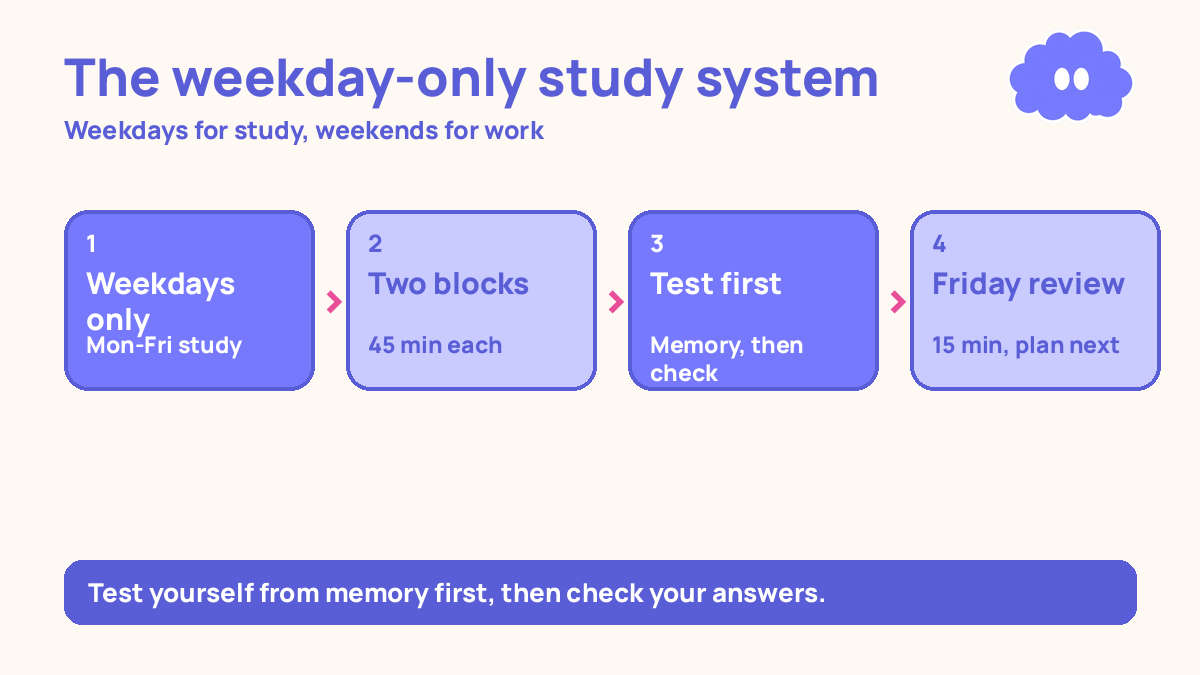
- Study Monday to Friday only. The weekend is work and rest, not study.
- Two blocks of about 45 minutes on four weekdays, one block on the fifth.
- In each block, test yourself from memory first, then check your answers.
- Review yesterday’s topic for 10 minutes at the start of the first block.
- Keep one weekday light: one short block, testing only, no new material.
- Review the week on Friday evening, in 15 minutes, and plan the next week.
Step 1: Make Monday to Friday the whole study week
Write your study week as Monday to Friday, and cross out Saturday and Sunday. That sounds obvious, but most plans fail here: they put a “catch-up session” on Sunday evening, and Sunday evening is when you are most tired. Cross it out. A plan with five real days beats a plan with seven days, two of which never happen.
Decide which weekday is your light day. For most weekend workers, that is Monday, because Sunday’s shift ends late and Monday morning is recovery. Make Monday one short block of 30 minutes, testing only. The other four weekdays get two blocks each. That gives you nine blocks a week: eight full ones and one short one. That is enough, if the blocks are used well.
Tell the people you live with that weekday evenings are study time. You are asking for four evenings a week, not seven.
Step 2: Two blocks a day, hardest topic first
Study in the evening after classes, or in the free hours between classes if you have them. The time of day matters less than the fact that it is the same time every weekday. Pick your two slots and write them down: for example, 6:00 to 6:45 and 7:00 to 7:45.
Start the first block with the hardest topic, or the one you tested worst on last time. Your focus is best at the start. Save easy reading and tidying notes for the second block. If you study between classes instead of in the evening, the same rule holds: hardest first, while you are fresh.
Use an if-then plan for the start: “When I get home from classes, I will put my bag down, sit at my desk, and open yesterday’s questions.” If-then plans raised goal attainment by a medium-to-large amount (d = 0.65) across 94 studies (Gollwitzer & Sheeran, 2006), because the cue and the action are decided in advance. You do not sit down and decide what to do. You sit down and the next step is already written.
Step 3: Test yourself, then check
In each block, close your notes and answer questions from memory, work problems, or write down what you remember. Then open your notes and check. Mark what you got wrong. That is the block.
In a 2013 review, Dunlosky and colleagues rated ten common study techniques, and only two received a high utility rating: practice testing and distributed practice. Re-reading was rated low. A later meta-analysis found testing yourself beat restudying by a medium amount (g = 0.50), and the advantage was larger with feedback (g = 0.73 with feedback, against g = 0.39 without it) (Rowland, 2014). The checking step is the feedback.
Roediger and Karpicke (2006) found students who recalled a passage remembered more a week later than students who restudied it, even though the restudiers felt more confident straight after studying. Feeling fluent right after re-reading is not the same as remembering a week later. If it felt easy, test yourself.
Keep a wrong-answer list: one line per question you got wrong. Test those questions again the next day, and again after three days. Use a practical starting schedule: review a topic the next day, then after three days, then after seven days. This 1–3–7 schedule is a practical starting point, not a research rule. Spaced practice beats massed practice, and the right gap grows with how long you need to remember the material (Cepeda et al., 2006).
Step 4: Friday review, weekend off
On Friday evening, spend 15 minutes reviewing the week. Count the blocks you completed. Look at the wrong-answer list: which questions are still wrong after three tests? Those are next week’s first tests. Then write next week’s plan in one line per day, around your class timetable and your weekend shifts.
Then stop. Saturday and Sunday are work days. Work them, rest after them, and do not open your course. This is the hardest part of the system, because it feels like you should be doing more. You should not. A weekend worker who studies on weekdays and rests at the weekend has a system that lasts a term. A weekend worker who studies every day has a system that lasts three weeks.
If your weekend shifts are short — a Saturday morning only, for example — you can use Saturday afternoon for one long session. But only if the shift genuinely ends early and you are not tired. If you are tired, rest. The rule is simple: study on the weekend only when the weekend gives you a real, rested slot. Otherwise, weekdays only.
Students with a part-time job during the week face a similar squeeze from the other direction: their weekdays are partly taken by work. If that is your situation too, the study system for students with a part-time job shows how the same testing-first blocks fit around part-time hours.
A worked example: a week with weekend shifts
You have classes Monday to Friday, and you work Saturday 9am to 5pm and Sunday 10am to 4pm. You study in the evening after classes. Monday is your light day.
| Day | Study | Minutes |
|---|---|---|
| Monday | 6:00–6:30, test last week’s topic only | 30 |
| Tuesday | 6:00–6:45 test Topic A, 7:00–7:45 learn Topic B | 90 |
| Wednesday | 6:00–6:45 test Topic B, 7:00–7:45 review Topic A | 90 |
| Thursday | 6:00–6:45 mixed test, 7:00–7:45 learn Topic B | 90 |
| Friday | 6:00–6:45 test both topics, 7:00–7:15 weekly review | 60 |
| Saturday | Work 9am–5pm, no study | 0 |
| Sunday | Work 10am–4pm, no study | 0 |
That is 360 minutes in the week, all on weekdays. The numbers are the plan’s own totals, not a research finding. The shape is what matters: four solid evenings, one light Monday, a Friday review, and a weekend that is work and rest only.
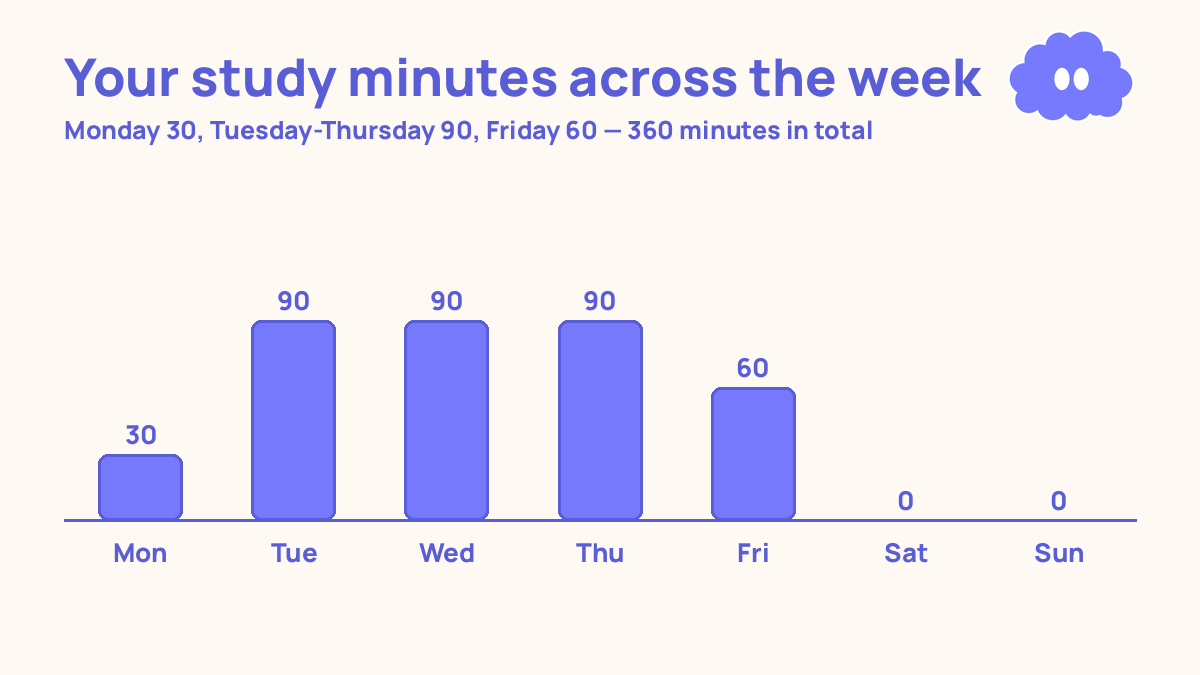
If your classes finish early on one weekday, use that afternoon for the longer session instead of the evening. The blocks stay the same size. Only the clock time moves.
The system in a diagram
When it goes wrong
You try to study on Sunday evening after a long shift. Stop. Sunday evening study after a weekend of work is the lowest-quality study of the week, and it steals the rest you need for Monday. Move the block to Tuesday instead. If it happens every week, the plan is wrong: cut one weekday block and accept a shorter week, rather than adding a Sunday block that never works.
Monday is a write-off because Sunday ran late. Make Monday the light day, every week, not just when it goes wrong. One 30-minute test on Monday keeps the habit alive and keeps the wrong-answer list warm. A Monday with no study at all is a Monday where Tuesday has to do two days of work. A light Monday is enough.
You fall behind and try to catch up on the weekend. Do not. A weekend catch-up session after two work shifts is how a small slip becomes exhaustion. Catch up by cutting instead: drop the oldest topic from the plan for one week, and test only the newest one. You will cover less, but you will cover it properly, and you will still be studying next week.
Friday review never happens because Friday is a social night. Move the review to Friday afternoon, before the evening, or to Thursday evening. The review takes 15 minutes. It does not need Friday night. It needs a fixed slot, and it needs to happen before the weekend, so the weekend is genuinely free.
Weekly review checklist
Copy this list and use it every Friday:
- How many of the nine weekday blocks did I complete, and which did I miss?
- Which questions are still on my wrong-answer list after three tests?
- What is the one topic I will test most next week, and what is the one new topic?
- Is Monday still the right light day, or should it move?
- What one change will I make next week: earlier slots, smaller tasks, or a different review time?
Downloadable infographic spec: one vertical image, title “Weekdays for study, weekends for work”, with the five weekday blocks, the memory-first rule, and the five-question Friday review, in Thynq cream, Cloud Purple, Dark Purple and pink, with the cloud mascot. Text taken word-for-word from this article.
What this system is not
It is not a promise of a grade, and it is not a claim that 360 minutes a week is enough for every course. Some courses need more, and some weeks will need a bigger plan. It is a system for doing steady work inside the weekdays a weekend job leaves you, and checking honestly whether that work happened. If your course needs more hours, the honest answer is to change the hours — fewer weekend shifts, a lighter term, or a longer timeline — not to pretend the same hours will do more.
Sources
- Dunlosky, J., et al. (2013). Improving students’ learning with effective learning techniques. Psychological Science in the Public Interest, 14(1), 4-58. Only practice testing and distributed practice received a high utility rating; rereading was rated low.
- Rowland, C. A. (2014). The effect of testing versus restudy on retention: a meta-analytic review of the testing effect. Psychological Bulletin, 140(6), 1432-1463. Testing beat restudy by g = 0.50; with feedback g = 0.73, without feedback g = 0.39.
- Roediger, H. L., & Karpicke, J. D. (2006). Test-enhanced learning. Science, 311, 648-649.
- Cepeda, N. J., et al. (2006). Distributed practice in verbal recall tasks. Psychological Bulletin, 132(3), 354-380.
- Gollwitzer, P. M., & Sheeran, P. (2006). Implementation intentions and goal achievement: a meta-analysis. Advances in Experimental Social Psychology, 38, 69-119. If-then plans raised goal attainment by d = 0.65 across 94 studies.
For the full system behind these weekday blocks, start with the two-hour study system for working students, and if you study at the weekend instead of working, read the weekend study plan for working students.
Questions
How do I study if I work every weekend?
Make weekdays your study days. Two blocks of about 45 minutes on four or five weekdays, plus a short review, gives you a full study week without touching the weekend.
Do I need to study on Saturday or Sunday at all?
No. If you work both days, do not study on them. Your study week is Monday to Friday, and the weekend is work and rest. Trying to add study to a work weekend is how the whole plan collapses.
What if my weekend shifts are long and I am tired on Monday?
Make Monday a light day: one short block, testing only, no new material. Put the heavier study on Tuesday to Thursday, when you have recovered. A light Monday beats a missed Monday.
How do I revise for exams while working weekends?
Use the same weekday blocks, but spend them on past papers and testing instead of new material. In the last two weeks before an exam, ask for one weekend day off if you can, and use it for a longer revision session.