
The direct answer
To study when you work in hospitality, study in the split-shift gap and before your shift, not after a late finish, and plan each week when the rota comes out. Give mornings off the heavy learning, give gaps short practice, and give late finishes retrieval only. Study has to happen before the guests take your energy.
Hospitality work has a shape other jobs do not: the rota changes weekly, the busiest days are weekends, shifts end late, split shifts break the day in two, and the busy season doubles the hours just as exams arrive. Students who copy a 9-to-5 study plan into that shape plan evenings that never happen.
The system in short
- Read the rota the day it comes out and sort the week into shift types.
- Study before the shift, never after a late finish.
- Use the split-shift gap for 25 minutes of practice, then rest.
- Give mornings off the heavy learning, in 50-minute blocks.
- Keep late finishes to 20 minutes of retrieval, or nothing at all.
- Review every week: hours worked, hours studied, and next week’s rota.
Step 1: Read the rota the day it comes out and sort the week into shift types
Hospitality rotas usually arrive a week ahead, sometimes less. The day it arrives, spend ten minutes sorting each day into one of four types: a morning off, a single shift, a split shift, or a late finish (home after 10 pm). Write the type next to each day in your diary. This ten-minute job is the whole planning system.
Each day type gets its own kind of study, fixed in advance so you never decide it in the moment. A morning off is a heavy-learning morning: new topics, essays, first drafts. A single shift day is a practice day: questions from memory, in the hour before the shift. A split shift day is a gap day: 25 minutes of practice in the gap, then rest. A late finish is a retrieval day: 20 minutes of flashcards, or nothing.
The How to study when you work split shifts uses the same day-type idea, and it works well alongside this one.
Step 2: Study before the shift, never after a late finish
Hospitality is physical work done in public: hours on your feet, carrying plates or trays, smiling at guests, solving problems on the spot. By the end of a shift, your body is tired and your attention is spent. Studying then usually means rereading the same page three times and remembering none of it. The students who keep going in hospitality study before the guests take their energy, not after.
So the rule is simple: the study session comes first in the day, before the shift. For a dinner service starting at 5 pm, that means a 50-minute session in the morning, on the hardest topic of the week. For a breakfast shift starting at 7 am, it means 25 minutes before you leave: five practice questions from memory, checked, with the misses noted.
This is also why How to study when you are tired after work fits hospitality students so well: it assumes the evening is already spent, and builds the day around the hours that are still fresh. If the study happened in the morning, the evening is yours to rest.
Step 3: Use the split-shift gap for 25 minutes of practice, then rest
A split shift is the hospitality pattern other jobs do not have: lunch service, then a gap of two or three hours, then dinner service. The gap looks like free time, and the mistake is treating it as a full study session. It is not. You still have a second shift to work, and a two-hour study session in the gap leaves you flat for dinner service.
Use the first 25 minutes of the gap for practice questions from memory, then stop and rest. Pick the questions before the lunch shift and leave them where you will sit. Answer with the book closed, mark what you wrote after 25 minutes, and note the misses in one line each.
Rest for the rest of the gap. Eat properly, sit down, and do not study.
Step 4: Give mornings off the heavy learning, in 50-minute blocks
A morning off in hospitality is rare, and the mistake is spending it on chores, sleeping in, and then studying at 8 pm when the day is gone. Protect the morning of every day off for the heavy learning: new topics, essays, and anything you have not seen before, in 50-minute blocks with a 10-minute break. Two blocks is 100 minutes of real learning.
Start with the hardest topic, not the easiest: the fresh mind is available at 9 am on a morning off, not at 9 pm on a shift day. Work in this order: read once and close the book, write what you remember, then check and fix the gaps. If you finish the morning’s blocks early, stop.
Keep the afternoon free. Weekends are usually shifts in hospitality, so the Study system for students who work weekends is the right companion for this one: it treats Saturday and Sunday as work days and puts the heavy learning on weekday mornings instead.
Step 5: Keep late finishes to 20 minutes of retrieval, or nothing at all
A late finish means you get home after 10 pm, tired, hungry, and done for the day. The rule is 20 minutes of retrieval or nothing, and nothing is the right choice more often than students think. Retrieval means flashcards or questions on what you already know, for 20 minutes, then bed. It is not new material, not an essay, and not a past paper.
Put the flashcards on the kitchen table before you leave, so coming home means picking them up, not deciding what to do. If even 20 minutes feels impossible, skip it and go to bed.
The busy season is this rule at full size. For the three or four busiest weeks, drop to retrieval only: 20 minutes most evenings, one 90-minute anchor on your quietest morning, and no new topics. Do the heavy learning in the quiet weeks before the season, and ask for your exam days off as soon as the busy-season rota is published. The How to study when your job is seasonal covers the same pattern in more detail.
Step 6: Review every week
Spend ten minutes on the day the new rota arrives, and ask: how many hours did I work, and how many did I study? Did the pre-shift sessions happen? Did the gaps hold the 25 minutes of practice? Did the morning off hold the heavy learning? Is the misses list getting shorter?
The review catches the two hospitality failure modes early: evening study that becomes rereading, and gaps that produce no practice. If either shows up two weeks running, move the sessions to the morning, and put the question sheet in your bag the night before.
End the review by writing next week’s sessions into the diary, next to the shifts. That is the system: rota, shift types, study before the shift, practice in the gap, heavy learning on mornings off, retrieval after late finishes, review when the rota arrives.
A worked example: a week with two split shifts and one morning off
Your situation: Second-year student, part-time job in a hotel restaurant, 24 hours a week. Rota this week: Monday morning off, Tuesday split shift 11 am to 2 pm and 5 pm to 10 pm, Wednesday single shift 5 pm to 11 pm, Thursday morning off, Friday split shift 11 am to 2 pm and 5 pm to 10 pm, Saturday single shift 10 am to 10 pm, Sunday off. Exam in five weeks, weakest subject is economics.
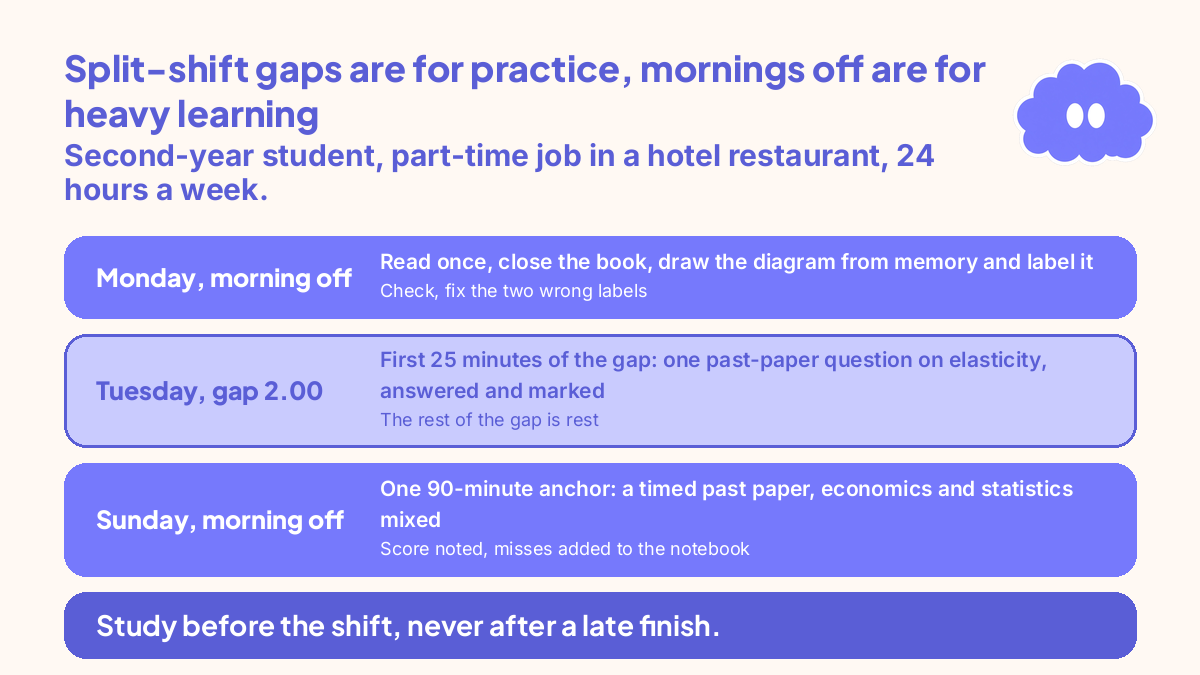
- Monday, morning off, 9.00 to 9.50: Economics, new topic, supply and demand. Read once, close the book, draw the diagram from memory and label it. Check, fix the two wrong labels, write them in the misses notebook.
- Monday, 10.00 to 10.50: Economics again, same topic. Draw the diagram again from memory, all labels right this time, then five practice questions.
- Tuesday, 10.00 to 10.25: Split shift. 25 minutes before lunch service: five questions on supply and demand, from memory, marked before you leave. Two wrong, both about price elasticity; they go in the misses notebook.
- Tuesday, gap 2.00 to 2.25: First 25 minutes of the gap: one past-paper question on elasticity, answered and marked. The rest of the gap is rest.
- Tuesday, 10.30 pm: Home, late finish. Flashcards on the kitchen table, 20 minutes, then bed. Nothing new.
- Wednesday, 4.00 to 4.50: Single shift at 5 pm. The hour before the shift is for practice: five questions on elasticity, marked, misses noted.
- Thursday, morning off, 9.00 to 9.50: Statistics, new topic, standard deviation. Same pattern: read once, close, write from memory, check.
- Friday, gap 2.00 to 2.25: Split shift again. 25 minutes only: five questions on standard deviation, marked, misses noted. The rest of the gap is rest.
- Saturday, 9.00 to 9.25: Shift at 10 am. 25 minutes: the misses notebook, read and re-tested. The two elasticity questions are right this time.
- Sunday, morning off, 9.00 to 10.30: One 90-minute anchor: a timed past paper, economics and statistics mixed, marked the same morning. Score noted, misses added to the notebook.
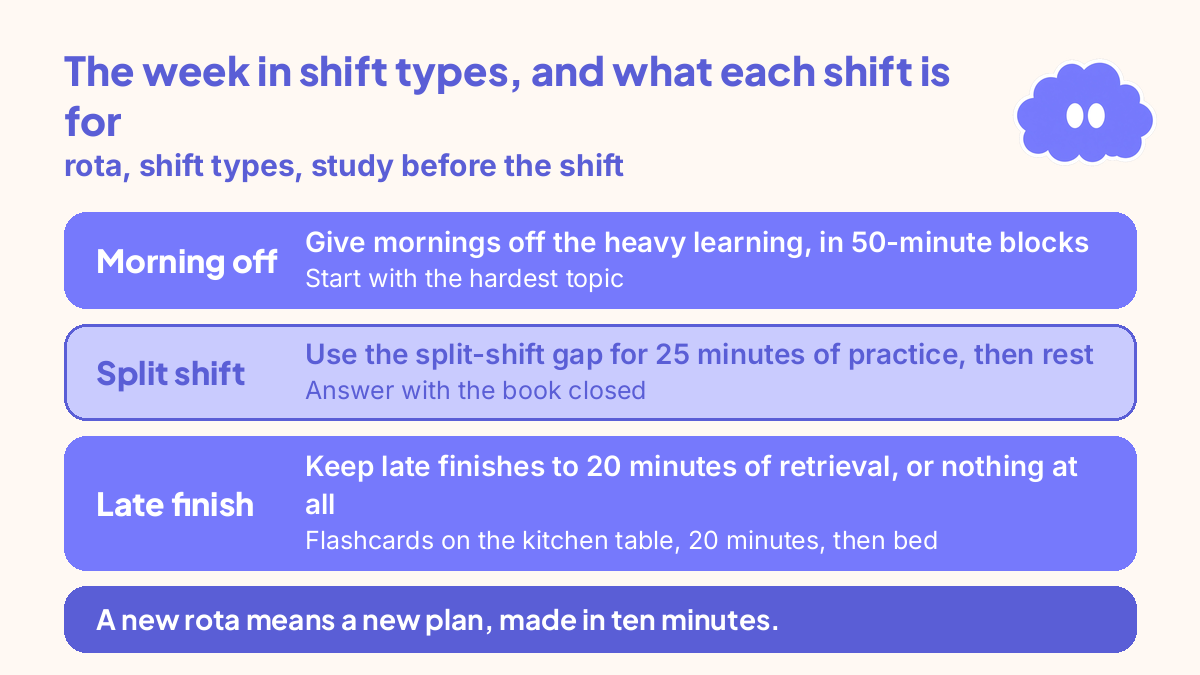
The week held five and a half hours of study, all before shifts, in gaps, or on mornings off. The misses notebook shrank from six items to two.
When it goes wrong
The rota changes with two days’ notice. Re-sort the shift types the day you hear, and move the heavy learning to the next morning off. If the new rota takes your only morning off, the week becomes a retrieval week.
The busy season doubles your hours. Drop to retrieval only for the busy weeks, keep the one weekly anchor, and do the heavy learning before the season starts. Tell your manager your exam dates when the busy-season rota is published.
You keep studying after late finishes and retaining nothing. Stop. The evening is not a study slot, and forcing it teaches you that study does not work. Move the session to the morning before the next shift, even if it is only 25 minutes.
Split-shift gaps keep turning into naps or scrolling. Put the question sheet in your bag the night before, and set a 25-minute timer when the gap starts. When it ends, close the book.
You swap shifts to help a colleague and lose your study morning. Keep one morning a week that is not swappable, and tell colleagues it is a college morning. The How to study on your lunch break is a useful backup if a swap eats your morning.
Weekly review checklist
- How many hours did I work, and how many did I study, in sessions that actually happened?
- Did the pre-shift sessions happen, or did study slide to the evening?
- Did the split-shift gaps hold the 25 minutes of practice, or did they turn into rest from the start?
- Did the morning off hold the heavy learning, or did chores take the morning?
- What is on the misses list, and is it getting shorter?
- Is there an exam or a busy season coming that needs days off requested now?
Downloadable infographic spec: one vertical image, title “How to study when you work in hospitality”, with the six steps from “The system in short” and the six review questions above, in Thynq cream, Cloud Purple, Dark Purple and pink, with the Cloud mascot. Text taken word-for-word from this article.
What this system is not
It is not a way to study after an 11 pm finish and still learn; nobody learns well then, and pretending otherwise wastes the evening and the sleep after it. It is not a promise that hospitality and study fit together in the busy season; some peak weeks they barely fit, and the honest answer then is retrieval only, not a heroic all-nighter. It does not replace your lectures, your course handbook, or your manager’s rota. And it does not make weekends free: hospitality weekends are work, and the system plans around that instead of wishing it away.
Sources
- Dunlosky, J., et al. (2013). Improving students’ learning with effective learning techniques. Psychological Science in the Public Interest, 14(1), 4-58. Practice testing and distributed practice rated high; rereading rated low, which is why split-shift gaps use testing from memory instead of re-reading.
- Cepeda, N. J., et al. (2006). Distributed practice in verbal recall tasks. Psychological Bulletin, 132(3), 354-380. Spaced practice beat massed practice, which supports short sessions across the week instead of one long session.
- Roediger, H. L., & Karpicke, J. D. (2006). Test-enhanced learning. Psychological Science, 17(3), 249-255. Recallers remembered more a week later than restudiers, which supports testing from memory in the pre-shift hour.
For the wider working-student system behind this one, start with How to build a study system that fits your life.
Questions
How do I study when my hospitality shifts change every week?
Plan study on the day the rota comes out, not on Monday morning. Give each kind of shift its own kind of study: heavy learning on mornings off, practice questions in the split-shift gap, and retrieval only after a late finish. A new rota means a new plan, made in ten minutes.
Should I study before or after a hospitality shift?
Before, almost always. After a service shift spent on your feet and talking to guests, your attention is spent, and an evening session usually becomes rereading. A 50-minute session before a late shift, or 25 minutes before an early one, does more than two hours after work.
How do I study during the busy season in hospitality?
Drop to retrieval only for the busy weeks: flashcards and practice questions in short sessions, one 90-minute anchor a week on your quietest morning, and nothing new. Do the heavy learning in the quiet weeks before the season starts, and ask for your exam days off as soon as the busy-season rota is published.
What do I do with the gap between split shifts?
Treat the gap as a study slot, not dead time. Use the first 25 minutes for practice questions from memory, then rest for the rest of the gap. Do not use it for new topics, and do not use it for a full study session, because you still have a second shift to work.