The direct answer
How to study when you work split shifts: study in the gap between your shifts, not after the second one ends. Stay out between shifts, set up in a library or cafe, and give the gap one task before it starts. That gap is the only part of the day you truly own, so protect it like a shift.
A split shift day gives you two shifts and one gap, and most students waste the gap. They go home and lose an hour to the journey and another to getting going again. Or they treat the gap as rest and then try to study at 10.00 at night, after two shifts, when nothing goes in. The system below turns the gap into the main study block of the day, with a morning block as backup for the days the gap collapses.
The system in short
- Measure the gap and sort it: under one hour is a retrieval gap, one to two hours is a single-task gap, over two hours is a full study block with a break.
- Stay out between shifts and set up a base near work, so the gap starts the moment the first shift ends.
- Give every gap one job before it starts, written down the night before, so no gap is spent deciding what to do.
- Protect a morning block before the first shift as your backup, and keep the evening after the second shift for rest or a 10-minute test.
- Ask for the gap to be usable: grouped shifts, a longer gap, or a later second start, using the words in Step 5.
- Review on Sunday for 15 minutes: which gaps produced real study, which ones leaked away, and what to change next time.
Step 1: Measure the gap and sort it by length
Start with the real gap, not the gap on the rota. The rota says your first shift ends at 2.00 and your second starts at 5.00, which looks like three hours. In practice, you finish at 2.10, you need 15 minutes to change and eat, and you need to be back and ready by 4.45. Your real gap is about two hours and 20 minutes. Time it for three days and use that number, not the rota number.
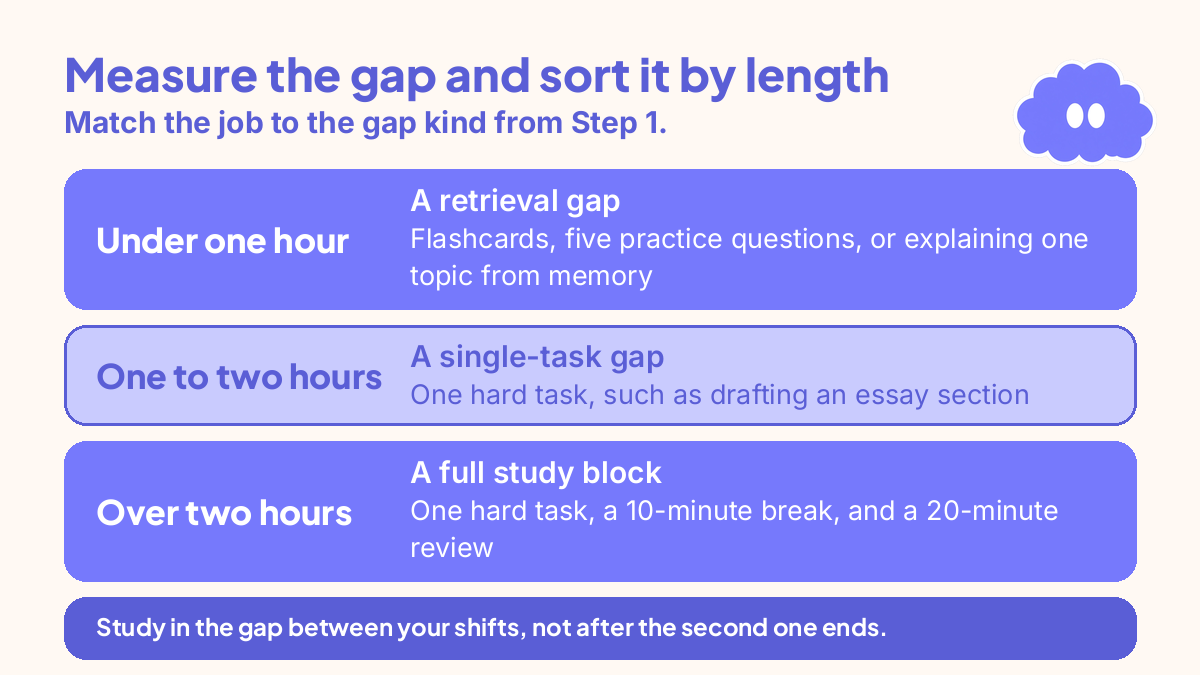
Then sort the gap into three kinds, because each kind takes a different kind of work. A gap under one hour is a retrieval gap: flashcards, five practice questions, or explaining one topic from memory. It does not fit new material. A gap of one to two hours is a single-task gap: one hard task, such as drafting an essay section, working through a problem set, or reading one chapter and testing yourself on it. A gap over two hours is a full study block: one hard task, a 10-minute break, and a 20-minute review.
Write the kind of gap next to each day. Monday, gap 2.00 to 5.00, single-task gap, essay plan. Tuesday, gap 11.00 to 12.00, retrieval gap, flashcards. When the gap changes, the task changes with it.
Step 2: Stay out between shifts and set up a base near work
The single biggest leak in a split-shift day is the journey home. Two journeys, a change of clothes, a sit-down that becomes a lie-down, and a gap that was three hours becomes 45 minutes of real study. So stay out. Pick a base near work: the university library, a quiet cafe, or a study room on campus. It needs a seat, light, somewhere to charge your phone or laptop, and food within a short walk.
Pack a study kit the night before and keep it in your bag all day: the notes for the one task, flashcards on your phone, a pen, water, and a snack. If the kit is not in your bag, the gap becomes a trip home to fetch it, and the trip home is where the gap dies. Arrive at the base, set a timer for the gap minus 15 minutes, and start within five minutes of sitting down.
If your base is a cafe, buy one small thing and stay for the gap.
Step 3: Give every gap one job before it starts
A gap fails in its first five minutes, when you sit down and have to decide what to do. You are already tired from the first shift and the second one is waiting, so decide the night before. Each gap gets one job, one subject, and one finish line, written in the plan.
Match the job to the gap kind from Step 1. A retrieval gap gets one deck of flashcards or three practice questions, done from memory, then checked. A single-task gap gets one hard task, not two medium ones, because switching tasks inside a short gap wastes the time you fought to protect. A full study block gets one hard task, a 10-minute break, and a review: re-test the three things you got wrong, and write down the next task for the next gap. For short sessions built on testing yourself, the method in Flashcard system that works gives you decks that fit a gap exactly.
Keep a small list of gap-sized jobs ready: ten flashcards, one diagram from memory, three practice questions, one paragraph of an essay. When a shift ends early or a second shift starts late, you have a job ready instead of a surprise hour spent scrolling.
Step 4: Protect a morning block before the first shift
The gap is the main block, but it is not the only block. Split shifts are fragile: a first shift runs late, a gap shrinks to 40 minutes, a manager asks you to stay on. When the gap collapses, the morning block is what saves the day. Protect 45 minutes before the first shift, three or four days a week, and put the hardest task there. A fresh mind at 7.00 in the morning does more in 45 minutes than a tired mind does in two hours at night.
Keep the morning block short and fixed. Set the same time each day, for example 7.00 to 7.45, and use it for the task that needs the most thinking: new material, a problem set, an essay draft. If the morning block is the only study you do on a split-shift day, it is still a real day of study, because 45 minutes of hard work plus a short gap of retrieval is more than most students manage on a free day.
The evening after the second shift belongs to rest, so do not plan a study block there. If you have energy left, do one 10-minute test from memory, then stop. For the evenings when tiredness wins completely, use the system in How to study when you are tired after work.
Step 5: Ask for the gap to be usable
You cannot control the split, but you can often make it more usable, and a small change is worth a lot when it repeats every week. The three asks that help most are grouped shifts, a longer gap, and a later second start. Grouped shifts means both shifts on the same days, so your days off are whole days instead of scattered halves. A longer gap means the difference between a retrieval gap and a single-task gap. A later second start, even by 30 minutes, can turn a 90-minute gap into a two-hour block.
Ask with dates and a specific request, not a general complaint. “My lectures are on Tuesdays and Thursdays, and my split on those days leaves me a 45-minute gap. Could my second shift start at 5.30 instead of 5.00 on those two days, so I have a two-hour gap to study?” That is a request a manager can say yes to. Ask at least a week before the rota is written. If you need the words for the wider conversation, How to ask your boss for study time has a script for exactly this, including what to say when the answer is no.
If the answer is no, the system still works. It leans harder on the morning block and the retrieval gaps. That is slower, but it is not a zero.
Step 6: Review on Sunday for 15 minutes
On Sunday, or on your first free evening after the week ends, spend 15 minutes on three questions. First, which gaps produced real study, and which ones leaked away? Second, what leaked, and why? A gap that leaked because the base was closed needs a new base. A gap that leaked because the first shift ran late needs a shorter job for that day. Third, what must next week protect? One exam, one deadline, one long gap for the hardest task.
Write the answers in two or three lines. That note is what makes the system improve instead of repeating. And if your lunch break is part of the gap too, How to study on your lunch break shows how to turn 30 minutes into a real retrieval session.
A worked example: a Tuesday with a three-hour gap
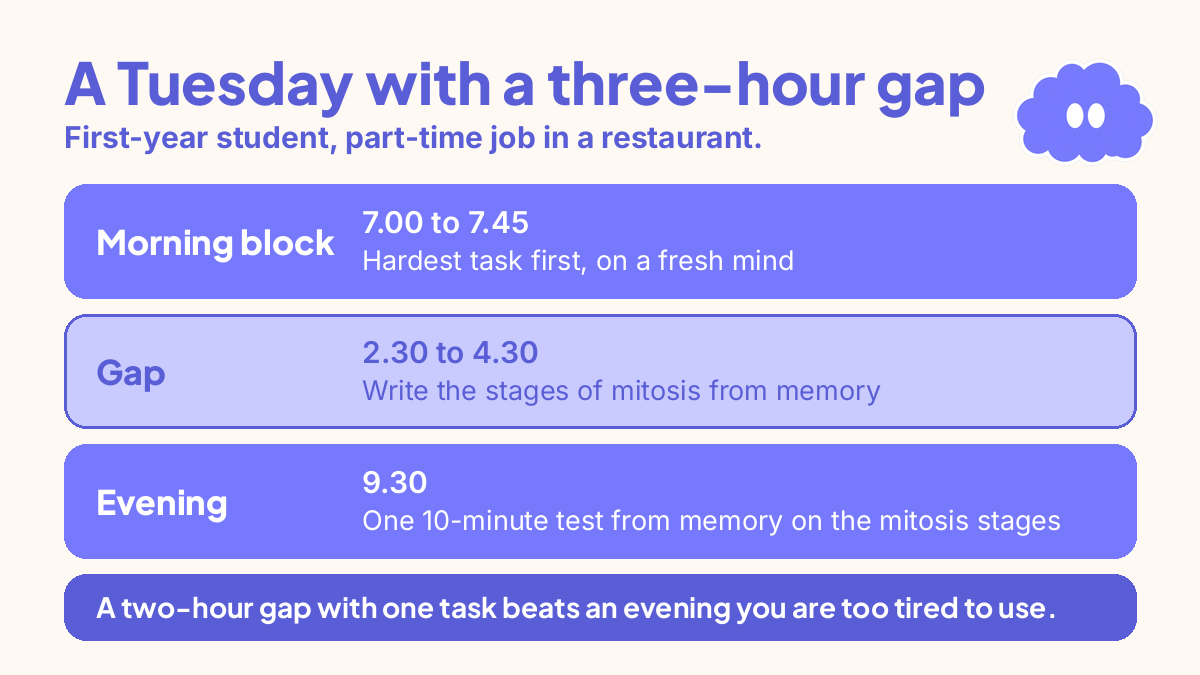
Your situation: First-year student, part-time job in a restaurant. Tuesday shifts: lunch service 11.00 to 2.00, dinner service 5.00 to 9.00. Gap 2.00 to 5.00. University library is a 10-minute walk from the restaurant. Exam in four weeks, weakest topic is cell biology, and the essay plan for psychology is due on Friday.
- Monday night, pack the kit: Cell biology notes, psychology essay question, flashcards on your phone, pen, water, sandwich. Write the gap job in the plan: “Tuesday gap, 2.30 to 4.30, mitosis from memory, check, re-write the two missed.”
- Tuesday morning block, 7.00 to 7.45: Hardest task first, on a fresh mind. Read the psychology essay question, write a one-page plan with three arguments and two sources for each.
- First shift, 11.00 to 2.00: Lunch service. No study, no guilt.
- Gap, 2.00 to 2.30: Walk to the library, eat the sandwich, open the notes. No phone scrolling. The 30 minutes is travel and food, not study, and it is in the plan.
- Gap study block, 2.30 to 4.30: Write the stages of mitosis from memory, 25 minutes. Check against notes, 10 minutes. Re-write the two stages missed, 15 minutes. Break, 10 minutes. Review: test the three stages that were shaky, 20 minutes, then write tomorrow’s gap job in the plan, 10 minutes.
- Second shift, 5.00 to 9.00: Dinner service. Arrive at 4.45, calm, because the gap ended 15 minutes early on purpose.
- Evening, 9.30: One 10-minute test from memory on the mitosis stages, then stop. No new material.
When it goes wrong
The first shift runs late and the gap shrinks to 40 minutes. Do not try to rescue the full plan. Drop to the retrieval version: flashcards or three practice questions, done from memory, then checked. A 40-minute retrieval gap still counts. The hard task moves to tomorrow’s morning block.
You go home between shifts and lose the gap. This will happen once, and it will feel comfortable, which is why it is dangerous. The fix is not willpower. It is the kit: if the kit is in your bag, you have no reason to go home.
The gap is under an hour and you keep trying to start new material in it. Stop. A short gap is a retrieval gap, and new material in a short gap feels like failure because it is the wrong job for the time. Use the short gap for flashcards and move the new material to the morning block.
Weekly review checklist
- Which gaps produced real study this week, and which ones leaked away?
- Did the morning block run on the days it was planned, and did it carry the hardest task?
- Did every gap have one job written down before it started?
- How many minutes of real study happened inside gaps, and was that enough for the week’s deadlines?
- What leaked the gaps: journeys home, late shifts, no kit, or the wrong job for the gap length?
- What will change next week: a new base, a different gap job, or an ask to the manager?
Downloadable infographic spec: one vertical image, title “How to study when you work split shifts”, with the six steps from “The system in short” and the six review questions above, in Thynq cream, Cloud Purple, Dark Purple and pink, with the Cloud mascot. Text taken word-for-word from this article.
What this system is not
It is not a promise that split shifts stop being tiring. Two shifts in one day take energy, and some days the gap will be the only study you manage. It is not a way to study for hours every day on a split-shift week, and it will not work if you plan evening blocks after the second shift and then blame yourself when they do not happen. What it does is smaller: it turns the dead time between your shifts into the main study block of the day.
Sources
- Dunlosky, J., et al. (2013). Improving students’ learning with effective learning techniques. Psychological Science in the Public Interest, 14(1), 4-58. Practice testing and distributed practice rated high; rereading rated low, which is why gaps are used for testing from memory.
- Cepeda, N. J., et al. (2006). Distributed practice in verbal recall tasks. Psychological Bulletin, 132(3), 354-380. Spaced practice beat massed practice, which supports spreading study across gaps and morning blocks instead of one long evening session.
- Roediger, H. L., & Karpicke, J. D. (2006). Test-enhanced learning. Psychological Science, 17(3), 249-255. Recallers remembered more a week later than restudiers, which supports the retrieval jobs used in short gaps.
For the wider working-student system behind this one, start with How to build a study system that fits your life.
Questions
How do I study when I work split shifts?
Treat the gap between your two shifts as a study block, not as dead time. Stay out between shifts, set up in a library or cafe, and give the gap one task before it starts. A two-hour gap with one task beats an evening you are too tired to use.
Should I go home between my shifts?
Only if the gap is longer than three hours and the journey home is under 20 minutes each way. A short gap disappears in two journeys and a change of clothes. For gaps under three hours, stay near work and study there.
What should I study in a short gap between shifts?
Use gaps under an hour for retrieval only: flashcards, practice questions, or explaining a topic from memory. Do not start new material in a short gap, because you will spend half of it finding your place and the second shift will cut you off mid-thought.
What if my split shifts leave me too tired to study at all?
Then study before the first shift, not after the second. A 45-minute morning block on a fresh mind does more than two tired hours at night. On the worst days, do one 10-minute test from memory and stop. The system survives because the gap block and the morning block share the load.