The direct answer
Study in the quiet windows the children’s day gives you: before the first drop-off, during nap time if your setting allows it, and after work. Put new material on days off, test yourself from memory in the short gaps, and protect your sleep. A childcare day is physical and emotional work, so short blocks beat long evening sessions.
Learning how to study when you work in childcare starts with accepting what the job takes from you. You are on your feet all day, lifting toddlers, bending to small chairs, and staying alert to a room full of children who need you. You also carry the emotional load: comforting an upset child, calming a worried parent, and staying patient when the day runs long. By the time you get home, your body is tired and your head is full. That is not a lack of discipline. It is a real limit, and a system that ignores it will fail within a week.
The system below works with that limit. It puts the hard work where you are freshest, uses the quiet windows the children’s routines already create, and keeps the heavy learning for your days off. You do not need more hours.
The system in short
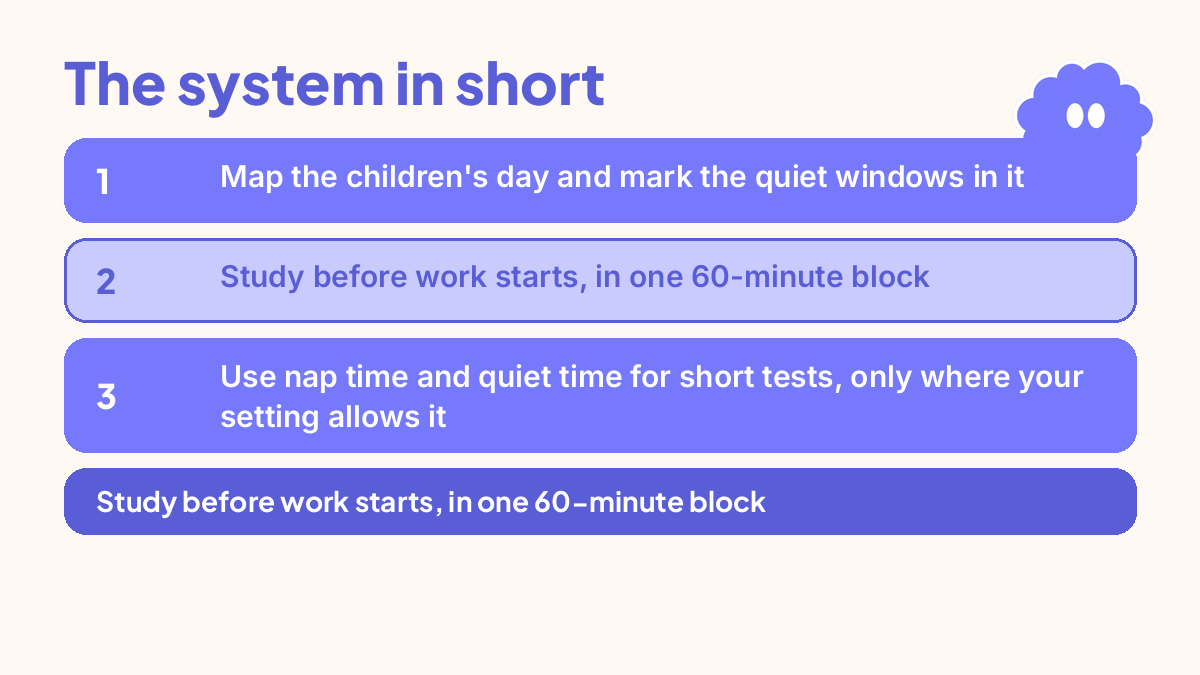
- Map the children’s day and mark the quiet windows in it.
- Study before work starts, in one 60-minute block.
- Use nap time and quiet time for short tests, only where your setting allows it.
- Keep evening study to one 20-minute test from memory, then stop.
- Put new material on days off, in two 50-minute blocks.
- Review every Sunday in 20 minutes and plan around next week’s routines.
Step 1: Map the children’s day, then fit study around it
Sit down on Sunday with your work rota and the children’s routine, and write down the shape of each day. When do the children arrive? When is nap time? When is outdoor play, when is lunch, and when do the last children leave? Write the fixed points down, then look for the gaps. The gaps are where your study lives.
Now decide what each gap is for, before the week starts. The hour before work is for new material or a test, depending on the day. Nap time, if you may use it, is for a short test only. The hour after work is for one 20-minute test, then rest. Days off are for new material. When the decision is made in advance, you open your notes and start instead of spending 15 minutes wondering what to study.
Keep one gap free as a spare. Children get ill and colleagues call in sick. If nothing goes wrong, use it for a second test of your weakest topic. If something does go wrong, the spare absorbs it and the week holds together. Rebuild this map whenever the routine changes, not just at the start of term.
Step 2: Study before the first drop-off
Your best study hour is the one before work. Before the first drop-off you are rested, the house is quiet, and nobody has asked you for anything yet. After work you have spent hours on your feet, and your attention is spent. Reading after work often means reading the same paragraph three times and remembering none of it.
Set your alarm 75 minutes earlier than you need for work. Use 15 minutes to wake up, eat, and get ready, then study for 60 minutes with a timer. Sixty minutes is enough for one clear task: learn one new topic, test yourself on one old topic, or write one practice answer. One task, done properly, moves you further than three tasks started and abandoned.
If your shift starts at 7.30am, the morning window shrinks to 30 minutes. Study the evening before the early shift instead, and treat the morning as a 20-minute test only. The rule stays the same: the main block goes where you are freshest. How to study when you are tired after work covers the same problem in more detail.
Step 3: Use nap time and quiet time honestly
Nap time is the one long quiet stretch in a childcare day. Use it, but use it honestly. First, check your setting’s policy. Some settings allow staff to do paperwork or study during nap time; others expect you to stay fully available to the children. If your setting does not allow it, do not study during nap time. The risk to your job is not worth 20 minutes of revision.
If your setting does allow it, keep nap time study to one 20-minute test, prepared the night before. Write five questions on a card, from the topic you studied that morning. When the children are settled, answer the questions from memory, in writing. Stop the moment a child stirs. Do not start new material during nap time: it needs a desk and your full attention, and nap time gives you neither. How to study on your lunch break explains how to run a 20-minute test inside a break.
Step 4: Keep evenings short and quiet
After work, keep study to one 20-minute test from memory, then stop. Eat first, sit down, and rest for half an hour before you open your notes. Then close your notes, write down what you remember about one topic, and check what you missed. Those missed points become tomorrow’s test. Twenty minutes is enough.
Do not try to learn new material in the evening. New material needs a fresh mind, and yours is spent. An evening spent struggling through a new chapter usually ends with nothing learned and a bad night’s sleep. Save new material for the morning block or a day off. If you have no energy even for a 20-minute test, skip it and go to bed. One skipped test costs you nothing. A late night costs you tomorrow’s morning block as well. If you are a parent as well as a student, study system for students with kids covers the same evening problem with children of your own in the house.
Step 5: Put new material on days off
Days off are the only time you have long, quiet, uninterrupted hours, so spend them on the work that needs exactly that: new material. A new topic takes two to three hours to learn properly, with breaks, and it needs a fresh mind. Do it on a day off, in the morning, in two blocks of 50 minutes with a 10-minute break between them. Test yourself from memory at the end of each block. Then stop. A day off is also a rest day, and studying all day on it leaves you as tired as a shift would.
Use the rest of the day off for light work: sorting notes, writing flashcards, planning next week’s rota, and doing the weekly review. The review takes 20 minutes and happens every Sunday, even in a bad week. Ask the six questions in the checklist below, write the answers on one page, and decide the one change for next week. The review keeps the system honest. Without it, you drift to the topics you like and ignore the ones you keep failing.
If you have only one day off a week, protect it. Study system for students who work weekends covers the same problem for students whose days off fall on weekdays. The pattern is the same one in How to study in one hour a day: the hard task first, then the test.
Step 6: Review on Sunday and plan around the rota
The weekly review takes 20 minutes and happens every Sunday, even in a bad week. Sit down with your notes and your rota for next week, and ask the six questions in the checklist below. Write the answers on one page. Then look at next week’s rota and move your study blocks to fit it. If a shift changes, the blocks move the same day.
The review is also where you spot patterns. If you missed every morning block this week, the alarm time is wrong, or the evening before was too late. If one topic keeps failing its test, it needs a day-off block, not another 20-minute test. If nap time never worked, stop planning around it and move that test to the evening. Fix one thing a week, not five.
A worked example
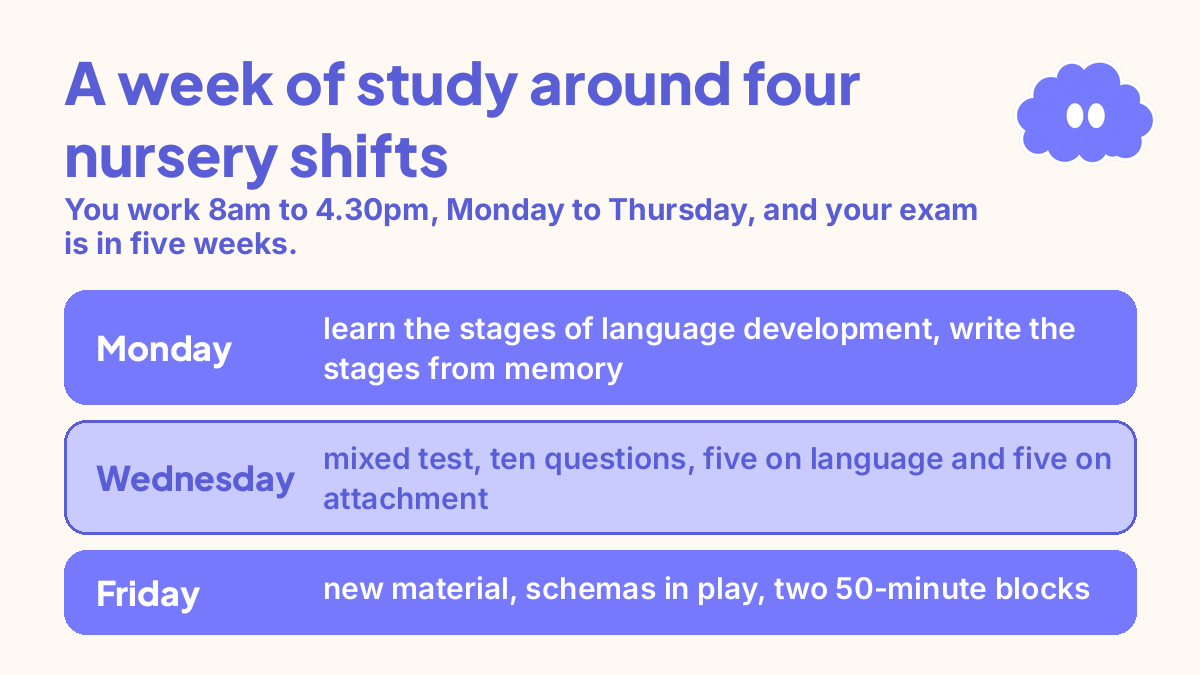
Your situation: You are a second-year early childhood studies student. You work in a nursery four days a week, Monday to Thursday, 8am to 4.30pm. The children nap from 12.30pm to 2pm, and your setting allows quiet study during nap time. Your exam in child development is in five weeks. You have Friday, Saturday, and Sunday off.
- Monday, 6.45am to 7.45am: Learn the stages of language development. Read one chapter, write a one-page summary, then close your notes and write the stages from memory. You get four right and miss one.
- Monday nap time, 12.45pm: Answer five questions on language development from memory, from a card you wrote on Sunday night. You score three out of five. The two misses join the wrong-answer list. A child stirs at 1.10pm, so you stop and settle them.
- Tuesday, 6.45am to 7.45am: Test attachment theory from memory for 20 minutes, then learn the two attachment patterns you missed. Write the new material as three short paragraphs you could reproduce in the exam.
- Wednesday, 6.45am to 7.45am: Mixed test. Ten questions, five on language and five on attachment. You score seven. The three misses get a flashcard each.
- Thursday, 6.45am to 7.45am: Write one full practice answer by hand in 40 minutes: “Describe how a nursery supports language development in two-year-olds.” Then mark it against your notes.
- Friday, 9am to 11am: Day off. New material: schemas in play. Two 50-minute blocks, each ending with a test from memory. Afternoon free.
- Sunday, 10am to 10.20am: Weekly review. You studied 6 hours and 40 minutes this week. Language development is still the weakest topic, so next Monday’s block goes to it again.
When it goes wrong
A child is ill and the room is short-staffed. Your morning block may survive, but nap time will not. Do not try to study in a short-staffed room. Give the day to the children, skip the tests, and use the spare window later in the week. One missed day is nothing.
You are too tired to study in the morning. This usually means the night before was too late, not that you lack discipline. Move the block, shorten it to 40 minutes, or swap it for a 20-minute test. If the morning keeps failing for two weeks, change the alarm time or the bedtime. The system must fit your sleep, not fight it.
Nap time never works. Some weeks the children do not settle, or the room needs you constantly. If nap time fails three weeks in a row, stop planning around it. Move that test to the evening, and treat any nap time test that does happen as a bonus. A system that depends on a quiet nap time is built on luck.
Your rota changes. When a new rota lands, redo Step 1 the same day. Move the study blocks to fit the new shifts, and check whether any exam date now clashes with a shift. If it does, ask for the day off at once, not the week before the exam. How to ask your boss for study time gives you the words for that conversation.
Weekly review checklist
- How many hours did I study this week, and how many of them were before a shift?
- Which topics did I test from memory, and which did I only re-read?
- Which questions are still wrong after three tests?
- Did I use nap time honestly, and did I stop when a child needed me?
- What changed in next week’s rota, and where do the study blocks move?
- What is the one change I will make next week?
Downloadable infographic spec: A vertical 1000x1500 infographic in Thynq colours with the cloud mascot, titled “How to study when you work in childcare”, listing the six steps of the system and the six weekly review questions, word for word from this article.
What this system is not
This system is not a way to study 20 hours a week on top of a full-time childcare job. That much study, on top of 35 hours of physical and emotional work, is not realistic for most people, and pretending otherwise leads to burnout and a failed exam. Eight to 12 hours a week, placed well, is enough to pass most courses if the hours are spent testing yourself rather than re-reading.
It is also not a way to study while you are meant to be watching children. Nap time study only works when your setting allows it and the children stay supervised. If a child needs you, the study stops. No exam is worth a child’s safety or your job.
Sources
- Roediger, H. L., and Karpicke, J. D. (2006). Test-enhanced learning: Taking memory tests improves long-term retention. Psychological Science, 17(3), 249-255. Supports testing yourself from memory instead of re-reading.
- ChildCareEd. Online Training That Works Around Your Child Care Schedule. Accessed 24 November 2026. Supports short 20 to 30-minute study blocks.
- ChildCareEd. How to Earn a Child Care Certification Online Without Quitting Your Day Job. Accessed 24 November 2026. Supports flexible online study around full-time childcare work.
For the full system behind this method, start with how to build a study system that fits your life.
Questions
Can I study during nap time at work?
Only if your setting allows it, and only for short tests. Nap time is still work time: children wake, need settling, and need supervision. Check your setting’s policy first, and never study instead of watching the children. If nap time is yours to use, keep it to one 20-minute test, prepared the night before.
How do I study when I am physically tired from childcare work?
Study before work, not after it, and keep evening study to one 20-minute test from memory. Childcare is physical work: lifting, bending, chasing, and being on your feet all day. Rest first, eat properly, and stop when your body says stop. A short test done awake beats an hour of reading done half asleep.
How many hours a week can I study around a childcare job?
Most students in this situation manage between 8 and 12 hours a week. That is one 60-minute block before each shift, plus two longer blocks on days off. Count only real study time, not time spent staring at notes. Eight focused hours beat fifteen tired ones.
What is the best study method for childcare workers?
Testing yourself from memory, in short blocks. Close your notes and write down what you remember, use flashcards, and redraw diagrams. These methods need no talking, no screen, and no long stretch of quiet, so they fit the gaps in a childcare day. They also show you what you actually know, which re-reading never does.