
The direct answer
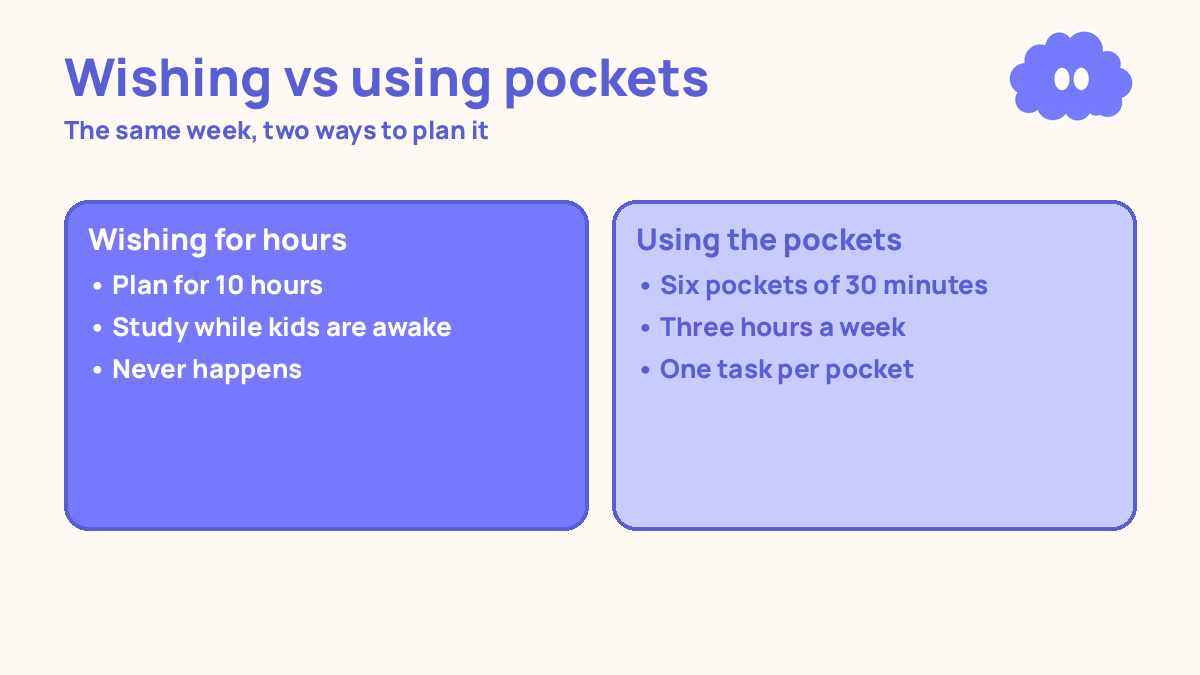
Map the week’s real pockets of time, give each pocket one task written the night before, and use if-then plans so the start is decided before the pocket opens. Six pockets of 30 minutes is three hours a week — three honest hours beat a plan for ten that never happens.
Studying with kids is not a time-management problem. It is a time-finding problem. The hours do not exist in the shape a timetable assumes — they exist in pockets: the nap, the school run, the hour after bedtime, the lunch break at work. A system built for a student with free evenings will fail you, because your evenings are not free. This system is built around the pockets: find them, give each one a task, so a 30-minute window is enough to do something real.
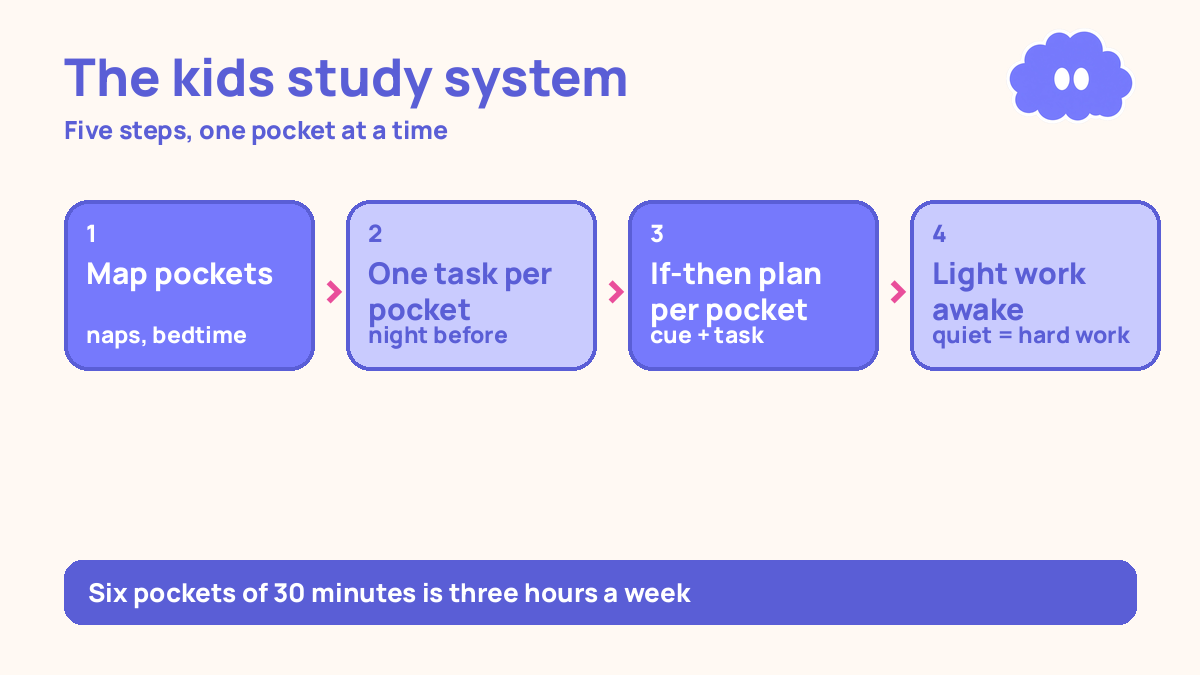
The system in short
- Map the week’s real pockets: when are the kids asleep, at school, or with someone else?
- Give each pocket one task, written the night before, in one line.
- Make an if-then plan for each pocket: when the pocket opens, I will do this.
- Use awake hours for light work — listening, reviewing — and quiet hours for hard work.
- When a pocket is interrupted, write down where you stopped and move on.
- Spend 20 minutes every Sunday planning the week’s pockets and tasks.
Step 1: Map the week’s real pockets
Take a blank week. Mark the times the kids are asleep, at school or nursery, or with someone else. Those are your pockets — not the times you wish were pockets, the ones that actually happen most weeks.
A pocket is 20 minutes or longer. Shorter than that is a gap, and gaps are for rest. Count the pockets: a typical week might hold six — three naps, two evenings after bedtime, and one lunch break. Six pockets of 30 minutes is three hours, a real amount of study.
Write the pockets on a card and keep it where you can see it. If a pocket disappears — a nap is skipped, a bedtime runs late — cross it off and carry on.
Do not plan study for the times when the kids are awake and with you. That is not a pocket, it is a wish, and wishes are where plans fail.
For the wider picture of fitting study around a life that is already full, the study system for students with a busy week covers the same ground for any student with no free evenings.
Step 2: One task per pocket, written the night before
Each pocket gets one task, written the night before, in one line. “Answer the 10 questions on cell division from memory.” Not “study biology”. A pocket is 30 minutes, and 30 minutes holds one small, finished piece of work.
Write the tasks the night before, not in the morning. The morning has enough to do. The night before, when the kids are asleep, you have five minutes to write tomorrow’s tasks on a card.
If you cannot write a task in one line, it is too big. Split it. A task that fits on one line is a task you can start in ten seconds.
This is practice testing, in the smallest possible form. In a 2013 review, Dunlosky and colleagues rated practice testing one of only two high-utility techniques, alongside distributed practice. Answering questions from memory in a 30-minute pocket is testing; re-reading your notes in that pocket is not.
Step 3: Make an if-then plan for each pocket
The hardest moment in a study week is not the studying. It is the moment the pocket opens and you have to decide to start. An if-then plan moves that decision to the night before, when deciding is easy: “When the baby goes down for a nap, I will open the book to page 42 and start the timer.”
Gollwitzer and Sheeran’s 2006 meta-analysis of 94 studies found if-then plans raised goal attainment by a medium-to-large amount (d = 0.65) over holding the goal alone. The effect was largest when the plan used the if-then format, the person cared about the goal, and the plan had been rehearsed at least once. So rehearse it: say it out loud once when you make it.
Make one if-then plan per pocket, written on the same card as the task. Two lines per pocket: the cue, and the task. When the cue happens, the task starts.
Step 4: Awake hours for light work, quiet hours for hard work
Not all pockets are equal. A pocket while the kids are awake is a light-work pocket: listening to a lecture, reviewing flashcards, reading a short section. A pocket when the house is quiet is a hard-work pocket: writing, problem sets, testing yourself.
Sort your tasks by pocket. The listening goes in the awake pockets, the writing in the quiet ones. A quiet pocket spent listening is a waste of the quiet. An awake pocket spent writing will be interrupted.
This is also where switching costs matter. Rubinstein, Meyer and Evans found in 2001 that people lost time on every switch between tasks, with mean switch costs of 614 to 1,096 milliseconds per switch, growing as the tasks got more complex. The measured cost is small; the real cost is bigger: every switch out of a task to deal with a child, and back again, costs minutes of refocusing.
A practical split for a week with six pockets: two quiet pockets for testing and writing, four awake pockets for listening and reviewing. Two hours of light work and one hour of hard work.
Step 5: When a pocket is interrupted, write down where you stopped
Pockets get interrupted. A nap ends early, a child wakes up, a school calls. The rule is simple: stop, deal with it, and write down where you stopped.
The pocket is not wasted. The note tells you where to start next time, and the next pocket is already planned.
Do not try to make up the lost time. A missed pocket is a missed pocket. Trying to squeeze an extra pocket into a day that does not have one is how the system breaks.
If a whole week goes wrong, start again with one pocket, not a catch-up marathon. Lally and colleagues found in a 2010 study of 96 people that the median time for a new daily behaviour to feel automatic was 66 days, with a range of 18 to 254 days.
Step 6: Twenty minutes every Sunday to plan the week
Sunday evening, after bedtime, spend 20 minutes planning the week. Look at the calendar: which pockets are real this week? A school holiday, a sick child, a shift change.
Write the week’s pockets on a card, and write the first task for each one. Not all the tasks — just the first one for each pocket.
The Sunday plan is also where you check the balance: are there at least two quiet pockets for hard work? If the week has only awake pockets, move one hard task to the weekend.
A worked example: a Tuesday with a toddler at home
Your toddler naps from 1pm to 2pm, and is asleep for the night at 7:30pm. You have a chemistry test in three weeks.
Monday night — Plan: Card written: Tuesday 1pm nap pocket — “Answer the 10 questions on moles, page 42.” Tuesday 8pm quiet pocket — “Write one essay paragraph on reaction rates.” If-then plans under each: “When the nap starts, I will open the book to page 42.” 1:00–1:30 — Nap pocket: Answer the 10 questions from memory, then check. Seven right, three wrong — the three wrong go on Wednesday’s card. 1:30 — Interrupted: The nap ends early at 1:25. You write down where you stopped: “Checked 7 of 10, 3 wrong.” Pocket done, not wasted. 8:00–8:30 — Quiet pocket: Write one essay paragraph on reaction rates, from memory, then check it against your notes. 8:30–8:35 — Tidy up: Write Wednesday’s first task on the card: “Answer the 3 mole questions I got wrong, then start the questions on page 48.” Card on the desk.
One hour of study in a day with a toddler at home, and both pockets did real work: 10 questions tested, one paragraph written, and tomorrow’s first task already planned.
| When | Task | |
|---|---|---|
| Nap | 1:00–1:30pm | 10 questions from memory, then check |
| After bedtime | 8:00–8:30pm | One essay paragraph, from memory |
| Lunch break | 12:30–1:00pm | Listen to lecture, follow summary |
| Saturday morning | 9:00–10:00am | Review the week’s questions |
| Sunday evening | 8:00–8:20pm | Plan next week’s pockets |
When it goes wrong
You plan study for the times the kids are awake and with you. That is not a pocket, it is a wish. Cross it off the plan and find a real pocket — a nap, a bedtime, a lunch break.
A pocket opens and you spend it deciding what to do. The task was not written the night before. Write it tonight, one line, on a card.
You lose a pocket to an interruption and feel like the day is wasted. It is not. Write down where you stopped, in one line.
You miss a whole week and think the system has failed. It has not. Start again with one pocket, not a catch-up marathon.
Weekly review checklist
Copy this list and use it each week:
- Did I map the week’s real pockets, not the ones I wished for?
- Did each pocket have one task, written the night before, in one line?
- Did I use an if-then plan for each pocket?
- Did the quiet pockets hold the hard work, and the awake pockets the light work?
- When a pocket was interrupted, did I write down where I stopped?
- Did I spend 20 minutes on Sunday planning next week’s pockets?
- What one change will I make next week: more pockets, better tasks, or a clearer Sunday plan?
Downloadable infographic spec: one vertical image, title “The study system for students with kids”, with the five steps — map the real pockets, one task per pocket written the night before, an if-then plan for each pocket, light work in awake hours and hard work in quiet hours, write down where you stopped — and the pocket rule — six pockets of 30 minutes is three hours a week — in Thynq cream, Cloud Purple, Dark Purple and pink, with the cloud mascot.
What this system is not
It is not a promise of a grade, and not a claim that three hours a week is enough for every course. It is a practical system for a student whose time comes in pockets, built on the two techniques researchers rated highest — testing yourself and spacing study out — plus if-then plans that decide the start in advance.
Sources
- Dunlosky, J., et al. (2013). Improving students’ learning with effective learning techniques. Psychological Science in the Public Interest, 14(1), 4-58. Only practice testing and distributed practice rated high utility; rereading rated low.
- Gollwitzer, P. M. & Sheeran, P. (2006). Implementation intentions and goal achievement. Advances in Experimental Social Psychology, 38, 69-119. Across 94 studies, if-then plans raised goal attainment by a medium-to-large amount (d = 0.65).
- Rubinstein, J. S., Meyer, D. E. & Evans, J. E. (2001). Executive control of cognitive processes in task switching. Journal of Experimental Psychology: Human Perception and Performance, 27(4), 763-797. Mean switch costs 614 to 1,096 milliseconds per switch, growing with complexity.
- Lally, P., et al. (2010). How are habits formed. European Journal of Social Psychology, 40(6), 998-1009. Median time for a behaviour to feel automatic was 66 days, range 18-254; missing a single day did not measurably hurt the process.
For the full system behind this one, start with how to build a study system that fits your life. The study system for students with a part-time job covers fitting study around work hours, and the study system for students with a busy week covers weeks with no free evenings.
Questions
How much study time can I realistically get in a week?
Count the pockets, not the hours you wish you had. Six pockets of 30 minutes is three hours a week, and three honest hours beat a plan for ten that never happens.
What do I do when a study pocket gets interrupted?
Stop, deal with it, and write down where you stopped. The pocket is not wasted — the note tells you where to start next time, and the next pocket is already planned.
How do I study when the kids are awake?
Use the awake hours for light work — listening to a lecture, reviewing cards — and save the quiet hours for the hard work: writing, problem sets, testing yourself.
What if I miss a whole week?
Start again with one pocket, not a catch-up marathon. A missed week is a week, not a failure. The system is a structure you return to, not a streak you protect.