
The direct answer
How to study when you work as a tutor comes down to order: study before tutoring starts, not after it, use the gaps between pupils for short retrieval tests, and treat explaining a topic as testing yourself on it. Cap tutoring hours in exam weeks, and treat a cancelled pupil as a bonus study slot, not a lost hour.
Tutoring looks like study and it is not. You spend the evening talking about maths or English, and it feels as if you have been studying. But you have been teaching school material, not learning your own, and by the time the last pupil leaves, your voice is tired, your patience is spent, and your own revision has not happened.
The system below fixes the order: your study comes first, before the first pupil arrives, and tutoring comes second. The gaps and the explaining do the small jobs: keeping topics warm and showing you what you do not know.
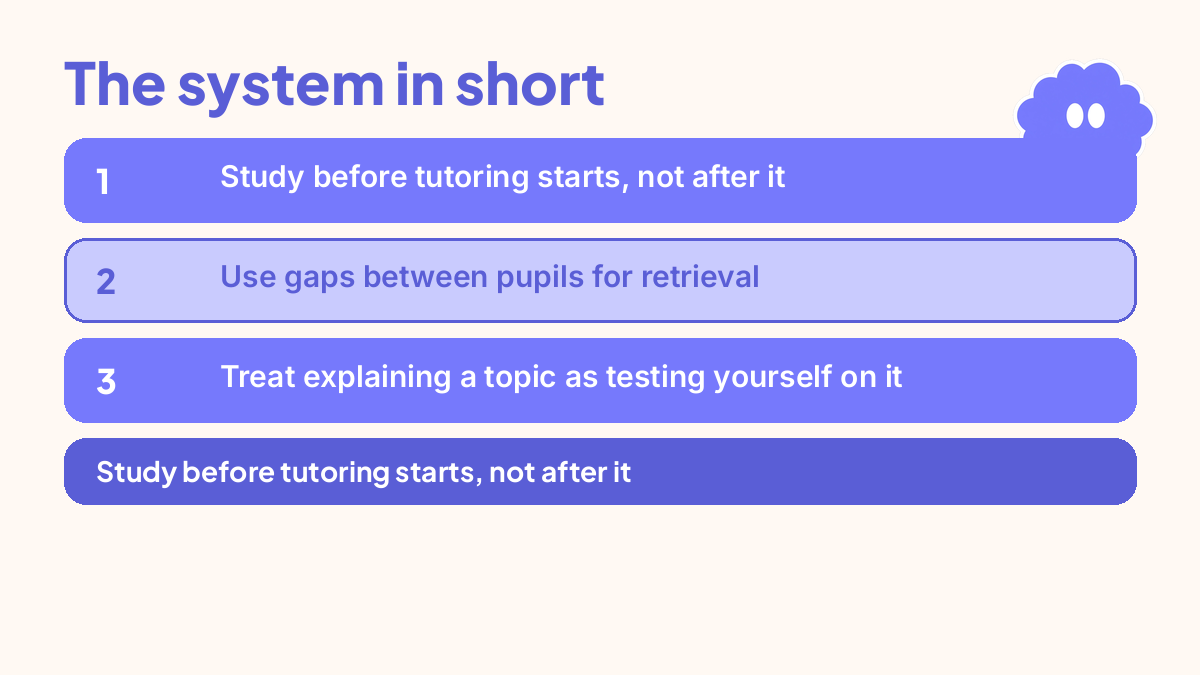
The system in short
- Study before tutoring starts, not after it.
- Use gaps between pupils for retrieval.
- Treat explaining a topic as testing yourself on it.
- Cap tutoring hours in exam weeks.
- Treat a cancelled pupil as a bonus study slot, not a lost hour.
- Review every Sunday, and plan tutoring and study together.
Step 1: Study before tutoring starts, not after it
Tutoring usually happens in the evening or at the weekend, which leaves the morning and early afternoon free. That is your study time, and it has to come first. If you tutor from 5pm, study from 10am to 12pm. The reason is simple: tutoring takes your voice, your patience, and your attention, and after two hours of explaining you have little of any of them left.
After tutoring, study usually becomes re-reading, which teaches you little. A session before tutoring is done with a fresh brain, and it is the only session that can take new material. Give the block one topic: learn it, then test yourself from memory before it ends. Two hours is enough for a new topic; one hour is enough for a test and a fix. If you tutor in the morning, flip the shape: study the evening before. The rule is the order, not the clock. The same rest-first logic applies after any tiring job: How to study when you are tired after work sets out the rule this step relies on.
Step 2: Use gaps between pupils for retrieval
Most tutors have gaps: 30 minutes between one pupil leaving and the next arriving, or a pupil who finishes early. Those gaps are too short for new material and too useful to waste. Use them for retrieval: short tests from memory on topics you have already studied.
Keep flashcards or a question list in your tutoring bag at all times: ten to fifteen cards on one topic, all from material you have already studied. When a gap opens, answer the cards from memory, one by one, before turning each one over. A 30-minute gap holds about 15 cards. Write the ones you get wrong in a small notebook. Never use a gap for new material, and never use it to prepare the next lesson: lesson preparation belongs on Sunday, when you plan the week. If your gaps fall between two halves of a split day, How to study when you work split shifts shows how to give every gap one job. If two pupils are back to back with no gap, take five minutes to breathe and reset instead.
Step 3: Treat explaining a topic as testing yourself on it
Explaining is the best test you have, because it shows you exactly what you do and do not know. When you explain a topic, you have to put it in order, choose the simple words, and answer questions you did not expect. If you can do that without looking at your notes, you know the topic. If you cannot, you have found a gap.
Use that deliberately. Before a session, pick one GCSE topic that overlaps with your own course, and explain it from memory, out loud, for five minutes. Then check your notes. Whatever you missed goes on your wrong-answer list, and that list is tomorrow’s first test. The full method is in Retrieval practice system for students: close the book, recall from memory, then check. But keep the limit clear: explaining only tests topics you already know, at school level. It does not teach you second-year material, and it never replaces a proper study block. If a pupil looks confused, check your own understanding before you carry on.
Step 4: Cap tutoring hours in exam weeks
Tutoring income is real money, and in exam weeks the temptation is to keep every hour. Do not. In the two weeks before your exams, halve your tutoring hours, and tell your pupils and their parents three weeks ahead, so they can plan around it. If you usually tutor six hours a week, cap it at three.
The cap has to be agreed in advance, not announced the week before. A tutor who cancels at short notice loses pupils, and a tutor who warns three weeks ahead keeps them. Write the message now: which weeks are capped, how many hours you can do, and when normal hours resume. Use the freed hours for study, not rest alone. Three hours freed from tutoring is three hours of study in exam week, and those are the most valuable hours of the term. If a parent asks for an extra session in exam week, say no, and offer the week after the exams instead.
Step 5: Treat a cancelled pupil as a bonus study slot, not a lost hour
Pupils cancel. They get ill, they go on holiday, their parents forget. When one does, you gain an hour you did not expect, and the system says: use it straight away, for study, before it fills with something else. Do not spend it deciding what to study, and do not spend it on chores.
The rule is fixed, so there is nothing to decide. A cancelled session becomes a 25-minute test from memory on your weakest topic, then checking your answers and writing the gaps on your wrong-answer list. If the session was an hour, use 20 more minutes to test a second topic, and take the last 15 off. Keep a small list of your three weakest topics, in order. When a cancellation lands, take the top one. Do not pick a favourite topic, and do not pick the easiest one.
Over a term, cancellations add up to real hours, and those hours go to your weakest topics.
Step 6: Review every Sunday, and plan tutoring and study together
The review is 20 minutes, every Sunday, with your tutoring diary and study notes side by side. Answer six questions. How many hours did I tutor, and how many hours did I study? Which topics did I test from memory, and which did I only re-read? Which questions are still wrong after three tests? What explaining gaps did tutoring show me? What changed in next week’s tutoring, and where do the study blocks move? What is the one change for next week?
Every time you could not explain something, or checked your notes mid-lesson, that is a gap in your own knowledge, and it goes on the wrong-answer list. If tutoring is creeping up and study sliding down, fix it in the plan: move or shorten one session, or move a study block to a morning with no pupils. If you want the fuller method, How to build a study system that fits your life sets out the one-situation, one-time, one-task routine. Students who tutor at weekends face the same squeeze: Study system for students who work weekends shows how to keep weekdays for study.
A worked example
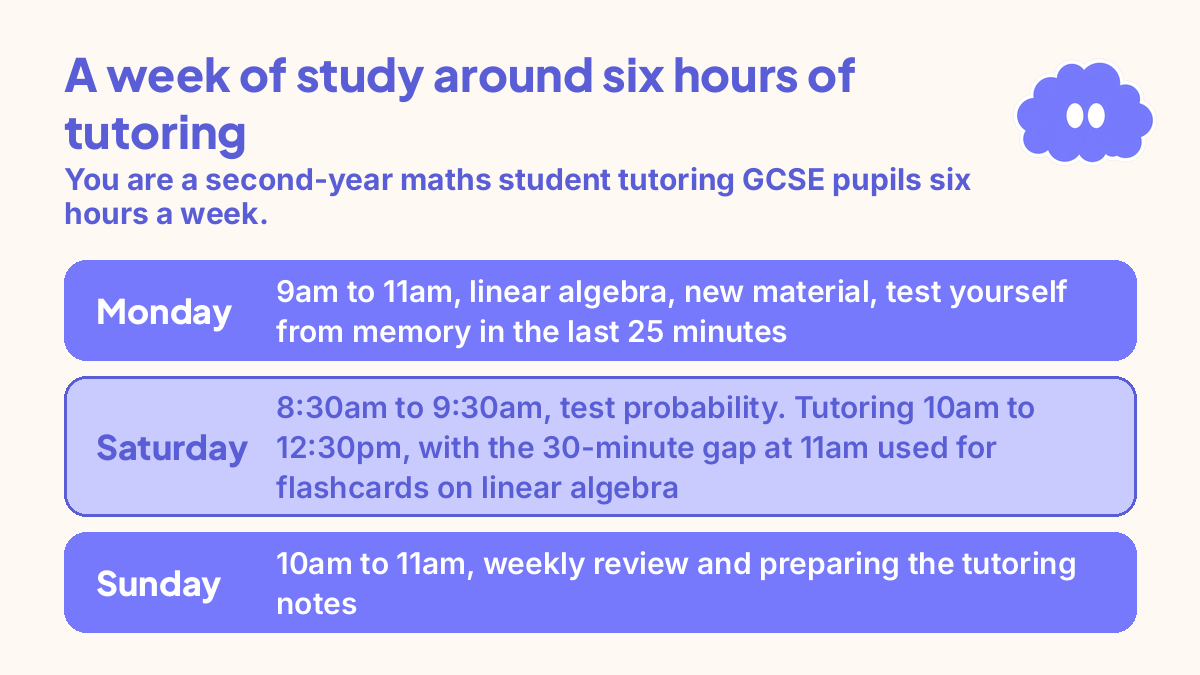
Your situation: You are a second-year maths student tutoring GCSE pupils six hours a week. Your sessions are Tuesday 5pm to 7pm, Thursday 5pm to 6:30pm, and Saturday 10am to 12:30pm. Your exams are in four weeks, and you have four topics: linear algebra, real analysis, probability, and differential equations.
- Monday: 9am to 11am, linear algebra, new material, test yourself from memory in the last 25 minutes. 2 hours.
- Tuesday: 10am to 11am, test linear algebra from memory, then prepare Wednesday’s topic. Tutoring 5pm to 7pm. 1 hour.
- Wednesday: 9am to 11am, real analysis, new material. 2 hours.
- Thursday: 10am to 11am, test real analysis from memory. Tutoring 5pm to 6:30pm. 1 hour.
- Friday: 9am to 11am, probability, new material. 2 hours.
- Saturday: 8:30am to 9:30am, test probability. Tutoring 10am to 12:30pm, with the 30-minute gap at 11am used for flashcards on linear algebra. 1 hour plus 30 minutes.
- Sunday: 10am to 11am, weekly review and preparing the tutoring notes. 1 hour.
Count the week: 120 plus 60 plus 120 plus 60 plus 120 plus 60 plus 30 plus 60 is 630 minutes, about ten and a half hours of study around six hours of tutoring. Every block lands before tutoring, never after it. In week two the shape repeats for differential equations, and in weeks three and four the blocks become past papers. In the exam weeks you cap tutoring at three hours, and you tell the parents three weeks ahead.
When it goes wrong
You study after tutoring and remember nothing. Tutoring spends your attention, and studying on spent attention does not work. Move the block to before tutoring, even if it is shorter. A 25-minute test before tutoring beats two hours of re-reading after it.
A pupil cancels and you waste the hour. Fix it with the rule: a cancellation always becomes a 25-minute test on your weakest topic, no deciding, no delay. Keep the three weakest topics written down, so the hour has a job the moment it opens.
Tutoring hours creep up in exam weeks. This is the most expensive failure, because it costs you the exams. Cap the hours three weeks ahead, in writing, and say no to extra sessions in exam week. Three hours of tutoring pays a little; an exam failed because you were too tired to revise costs far more.
You explain a topic to a pupil and realise you do not know it. That is the system working. Note the gap, check it after the session, and test it in your next study block.
Your pupils are all in the evenings and your mornings disappear. Mornings disappear into lie-ins, chores, and phone time, not into nothing. Set the study block for 10am, put your phone in another room, and start whether you feel ready or not.
You tutor seven days a week and never rest. Stop. One full day off a week, with no tutoring and no study, is part of the system, not a break from it. A tutor who never rests teaches badly and revises worse.
Weekly review checklist
- How many hours did I tutor this week, and how many hours did I study?
- Which topics did I test from memory, and which did I only re-read?
- Which questions are still wrong after three tests?
- What explaining gaps did tutoring show me this week?
- What changed in next week’s tutoring, and where do the study blocks move?
- What is the one change I will make next week?
Downloadable infographic spec: A vertical 1000 by 1500 image in Thynq colours, cream background, cloud-purple headings, phoenix-pink accents, and the Thynq cloud mascot at the top. Title: “How to study when you work as a tutor”. Six steps, word for word from the article: “Study before tutoring starts, not after it”, “Use gaps between pupils for retrieval”, “Treat explaining a topic as testing yourself on it”, “Cap tutoring hours in exam weeks”, “Treat a cancelled pupil as a bonus study slot, not a lost hour”, “Review every Sunday, and plan tutoring and study together”. Then the six review questions, word for word: “How many hours did I tutor this week, and how many hours did I study?”, “Which topics did I test from memory, and which did I only re-read?”, “Which questions are still wrong after three tests?”, “What explaining gaps did tutoring show me this week?”, “What changed in next week’s tutoring, and where do the study blocks move?”, “What is the one change I will make next week?”.
What this system is not
It is not a way to revise by tutoring alone. Explaining school topics tests what you already know, and it never teaches you second-year material, so a week of tutoring with no study blocks is a week with no learning in it. It is not a promise of a grade, and it is not a claim that ten hours a week is enough for every course: if your course needs more, the extra hours have to come from cutting tutoring, not from cutting sleep. It is not business advice: what to charge and how to find pupils are separate questions.
Sources
- Roediger & Karpicke (2006). Test-enhanced learning: Taking memory tests improves long-term retention. Psychological Science, 17(3), 249-255. Supports the testing-from-memory rule in the gaps between pupils, the explaining test, and the cancellation slots.
- Gollwitzer & Sheeran (2006). Implementation intentions and goal achievement: A meta-analysis of effects and processes. Advances in Experimental Social Psychology, 38, 69-119. Supports the if-then planning in Steps 4 and 5: deciding in advance what happens when exam weeks arrive and when a pupil cancels.
Questions
Should I study before or after tutoring?
Before, almost always. Tutoring takes your voice, your patience, and your attention, and after two hours of explaining you have little left. Study in the morning or early afternoon, before the first pupil arrives, when you are fresh. After tutoring, do nothing harder than a 20-minute retrieval test, or nothing at all.
Can explaining a topic to a pupil count as revision?
Yes, when you explain it from memory. If you can teach a topic without looking at your notes, you know it. If you have to check your notes first, you have found a gap, and that gap goes on your wrong-answer list. But explaining only tests topics you already know, so it never replaces a proper study block.
How many hours of tutoring is too many in exam weeks?
Halve what you normally do. If you usually tutor six hours a week, cap it at three in the two weeks before your exams, and tell your pupils and their parents three weeks ahead, so they can plan around it. Tutoring income matters, but an exam failed because you were too tired to revise costs more than the hours you gave up.
What do I do when a pupil cancels?
Use the hour straight away as a bonus study slot. Do not spend it deciding what to study: test your weakest topic from memory for 25 minutes, check your answers, and write the gaps on your wrong-answer list. A cancelled pupil is an hour you did not expect, and it only counts if you use it before the hour fills with something else.