
The direct answer
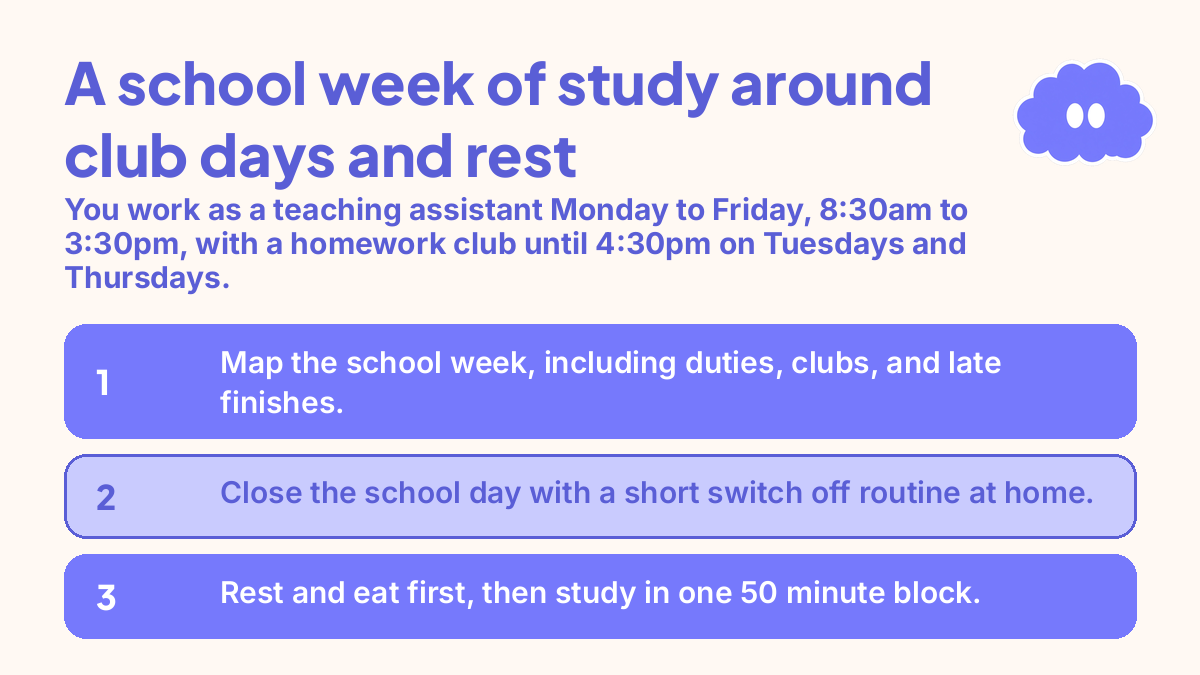
How to study when you work as a teaching assistant starts with a boundary: close the school day properly, rest and eat before you open your own books, then study in one planned block at home. Term time carries short steady work. School holidays carry the heavy blocks, with rest protected first.
Teaching assistant work fills the day with other people learning: supporting pupils, preparing resources, supervising breaks, responding to needs. Hours look regular, but the day is socially and emotionally full, so study that ignores that cost fails by Wednesday. The system below separates school from study: steady testing in term time, drafting and past papers in holidays.
The system in short
- Map the school week, including duties, clubs, and late finishes.
- Close the school day with a short switch off routine at home.
- Rest and eat first, then study in one 50 minute block.
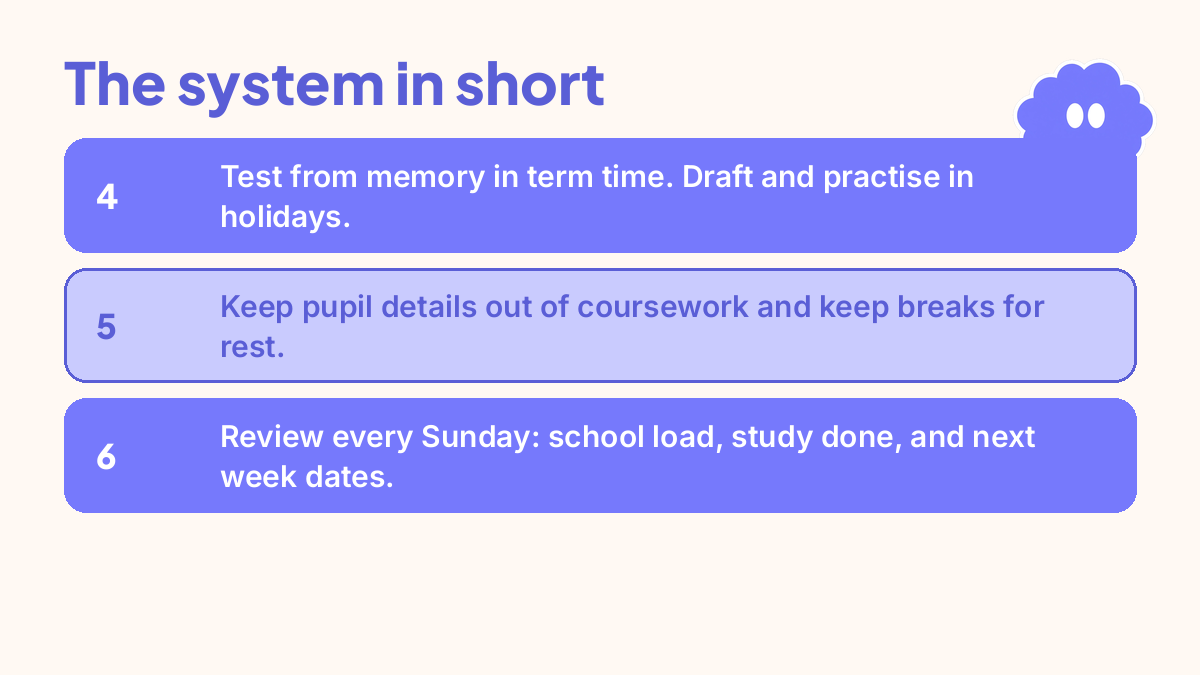
- Test from memory in term time. Draft and practise in holidays.
- Keep pupil details out of coursework and keep breaks for rest.
- Review every Sunday: school load, study done, and next week dates.
Step 1: Map the school week as it really runs
Start with the real week, not contract hours: finish times, duties, clubs, parents evenings, trips, and late finishes. A 3:30pm finish may be 4:30pm twice a week. Mark heavy term weeks too, such as reports or events. They should carry lighter study.
Mark three true windows: a weekday block after rest at home, a weekend block, and holiday blocks. School breaks do not count. They are short, interrupted, and needed for recovery. How to study on your lunch break suits protected breaks away from work. School breaks rarely meet that test.
End with a term map on one page: school dates, course deadlines, and planned holiday study days. Update it when the school calendar changes. A plan that ignores a parents evening or a trip week will keep colliding with real life.
Step 2: Close the school day before you study
At school you respond to others. In study you direct your own attention. Without a break, pupil worries and incidents follow you to the desk. Come home, change, eat, and take at least 45 minutes with no coursework. The clear edge matters more than the activity.
During that break, park school thoughts on paper. Write three lines in a notebook: anything you must pass on tomorrow, anything you are still turning over, and one thing that went well. Then close the notebook. Parking the thoughts gives them a place that is not your study block. This is the same clearing step described in How to clear attention residue between study tasks, applied to the move from work to study. The wider routine is in How to switch from work mode to study mode.
Keep the routine short: parking notes, food, change of clothes. A clean start beats a perfect evening.
Step 3: Study in one block after rest, and test from memory
After the break, study for 50 minutes on one topic or one assignment section. Start by testing yourself from memory for 15 minutes: close the book and write what you remember, or answer questions from your last session. Then spend 25 minutes on the gaps, or on drafting one section. End with 10 minutes writing the next starting point: the exact page, question, or paragraph you will open tomorrow. A clear starting point makes the next session begin at once, which matters when sessions are short.
Testing from memory is the engine of term time study. It supports later recall better than repeated reading and shows what you know. Spread tests over days: Monday topic returns Thursday. On tired days, cut to a 20 minute test. See How to study when you are tired after work: rest first, short test second.
If 50 minutes feels too much on school days, use the one hour shape in How to study in one hour a day across the week: shorter weekday tests plus one longer weekend block. The total matters less than the steady return.
Step 4: Give term time and holidays different jobs
Term time and holidays should not carry the same work. Term time suits steady, small jobs: testing topics from memory, reading one section, drafting one paragraph, or reviewing tutor feedback. Each job fits in 50 minutes and leaves a clear next step. Split every assignment into small jobs before the week starts: read the brief, gather sources, outline, draft section one, draft section two, check references, proofread. Then a short session always has a job waiting. Planning the next day in this way is covered in How to plan a study day the night before.
Holidays suit heavy jobs: full drafts and timed past papers. Plan before the break starts. First two days free, then two blocks a day on set days, with two full days still free. An unplanned holiday drifts into panic or exhaustion.
In term time, one weekend block of 100 minutes plus one full rest day is sustainable. Rest is part of the system, not a reward.
Step 5: Keep boundaries around pupils, breaks, and coursework
Three boundaries protect both your job and your study. First, breaks at school are for food and recovery. Do not build study into them, and do not use pupil facing time for coursework in any form. Your attention at school belongs to the pupils and the teacher you support. Second, keep coursework at home. Do not print, store, or discuss your assignments at school, and do not use school resources for your course unless your school has agreed it clearly.
Third, guard confidentiality in your writing. If your course covers education, childcare, or support work, your job will suggest examples. Use principles and methods, never identifiable details about pupils, families, colleagues, or your school. Change no details to disguise a real case and then present it as evidence. Follow your course guidance on workplace evidence, and ask your tutor when unsure. The related system for early years work is in How to study when you work in childcare, where the same boundary rules apply.
Clear lines help both sides: school stays focused, home study starts clean.
Step 6: Review every Sunday in 20 minutes
Every Sunday, spend 20 minutes with your term map, your wrong answer list, and next week school dates. Count the study blocks you actually did, not the ones you planned. Name the topics you tested from memory and the assignment sections you moved forward. Check the coming week for duties, clubs, parents evenings, and trips, and place study blocks around them with clock times.
Test oldest wrong answers first. Remove an item after two correct answers on different days. Check the next assignment job and its session. If a deadline is close and progress is behind, contact your tutor early. Early contact gives options.
Choose one change for next week. If study collapsed, name the cause and fix it. Steady weeks win a long term.
A worked example
Your situation: You work as a teaching assistant Monday to Friday, 8:30am to 3:30pm, with a homework club until 4:30pm on Tuesdays and Thursdays. You are studying for a degree module with an essay due in five weeks and an exam after that. You have four essay sections to draft and three exam topics to learn. You get home at 4pm on normal days and 5pm on club days.
- Monday: home at 4pm, rest and food until 5pm, study 5pm to 5:50pm on exam topic one, testing first. 50 minutes.
- Tuesday: club day, home at 5pm, rest until 6pm, 25 minute test from memory on topic one. 25 minutes.
- Wednesday: study 5pm to 5:50pm drafting essay section one. 50 minutes.
- Thursday: club day, 25 minute test on essay sources and topic one wrong answers. 25 minutes.
- Friday: no study. Rest evening. 0 minutes.
- Saturday: two 50 minute blocks drafting essay section two, with a break between them. 100 minutes.
- Sunday: 20 minute review and wrong answer test. 20 minutes.
Count the week: 50 plus 25 plus 50 plus 25 plus 0 plus 100 plus 20 is 270 minutes, which is 4 hours and 30 minutes of study in a full school week. Week two repeats the shape for essay sections three and four. The following holiday week keeps the first two days free, then runs two blocks a day on three days for past papers: 6 blocks of 50 minutes is 300 minutes, with two full days still free.
When it goes wrong
You study straight after school and retain little. The school day is still in your head. Restore the switch off routine: change, eat, park school thoughts on paper, then study. Test the same topic again after the break to see what stayed.
Club days and parents evenings keep eating the block. They are on the term map, so plan smaller study on those days in advance: a 25 minute test, not a full block. Move drafting to the weekend. A planned small session holds. A cancelled full session breeds guilt and then avoidance.
A difficult week at school leaves you drained. Drop to the floor: two 25 minute tests and one 20 minute review. Tell your tutor early if a deadline will slip. Pupil needs come first at school, and a short honest study week keeps the course moving without pretending otherwise.
Holiday study expands until the whole break is gone. Return to the holiday plan: first two days free, set study days, two full days free at the end. If drafting overruns, cut scope by returning to the assignment brief, not by taking the rest days. You need energy for the new term.
You are tempted to use a pupil example in coursework. Stop and check your course guidance. Write about the method in general terms, or ask your tutor. No assignment mark is worth a confidentiality breach.
Weekly review checklist
- How many study blocks did I actually do this week, and how many did I plan?
- Did I rest and eat before every study block, with school thoughts parked?
- Which topics did I test from memory, and which assignment jobs moved forward?
- Which answers are still wrong after three tests?
- What duties, clubs, or school events change next week study times?
- What is the one change I will make next week?
Downloadable infographic spec: A vertical 1000 by 1500 image in Thynq colours, cream background, cloud-purple headings, phoenix-pink accents, and the Thynq cloud mascot at the top. Title: “How to study when you work as a teaching assistant”. Six steps, word for word from the article: “Map the school week as it really runs”, “Close the school day before you study”, “Study in one block after rest, and test from memory”, “Give term time and holidays different jobs”, “Keep boundaries around pupils, breaks, and coursework”, “Review every Sunday in 20 minutes”. Then the six review questions, word for word: “How many study blocks did I actually do this week, and how many did I plan?”, “Did I rest and eat before every study block, with school thoughts parked?”, “Which topics did I test from memory, and which assignment jobs moved forward?”, “Which answers are still wrong after three tests?”, “What duties, clubs, or school events change next week study times?”, “What is the one change I will make next week?”.
What this system is not
It is not a way to study at school, nor permission to use pupil time or school resources for coursework. It is not a promise of a grade. If your role regularly extends into evenings, or your course assumes full time study, talk to your tutor about load. Longer tired evenings will not fix it.
Sources
- Karpicke and Roediger (2008). The critical importance of retrieval for learning. Science, 319(5865), 966 to 968. Supports the testing from memory rule in term time blocks and the wrong answer list.
- Cepeda, Pashler, Vul, Wixted and Rohrer (2006). Distributed practice in verbal recall tasks: A review and quantitative synthesis. Psychological Bulletin, 132(3), 354 to 380. Supports spreading tests over days rather than massing them in one evening.
- Practical Outcomes (2026). Time management for study and work. Supports mapping the real week, splitting assessments into small jobs, and leaving a clear starting point at the end of each session.
- Randstad UK (2026). Working as a teaching assistant. Supports the school day and term time shape of the role, including duties in and out of class and rare weekend work.
Questions
Can I study at school during breaks?
Plan as if you cannot. Breaks in school are short, often involve duty, and can end without warning when a pupil needs you. Studying in the staffroom also blurs a boundary you need later. Eat, rest, and talk to colleagues in breaks. Your study belongs at home, in one planned block after school, and in longer blocks on days off and in holidays.
Should I study straight after school or later in the evening?
Later, after a clear break. Coming home and opening coursework at once carries the school day into your study. Eat, change clothes, walk or rest for at least 45 minutes, then study for 50 minutes. If you are too tired after that break, do a 20 minute test from memory and stop. A short honest session beats an evening of tired reading.
How do I use school holidays for study without losing rest?
Split each holiday before it starts. Give the first two days to rest with no study. Then run two study blocks a day on set days, and keep at least two full days free. Holidays are good for heavy work such as essay drafting and past papers. They are also your recovery time. A holiday spent entirely on coursework leaves you tired at the start of term.
What if my course is about education and my job gives me examples?
Use general lessons from practice, never identifiable details about pupils, families, or your school. Write about methods and principles, not about named children or incidents. Check your course guidance on confidentiality and workplace evidence before you submit anything. If you are unsure whether an example is safe to use, ask your tutor first and keep the example out until you have an answer.