
The direct answer
To study when you work as a delivery driver, study before your driving block, listen while you drive, and use the gaps between drops for five-minute retrieval. Give days off the heavy learning, give driving days audio and short practice, and give late evenings retrieval only or nothing.
Delivery driving has a shape other jobs do not: you work alone, on the road, with hours set by an app or a rota that changes weekly, gaps of a few minutes between drops, and no desk, no colleagues, and no fixed lunch break. Students who copy a 9-to-5 study plan into that shape plan library evenings that never happen.
The system in short
- Set your driving hours first, then plan study around them.
- Study before the driving block, never after a late block.
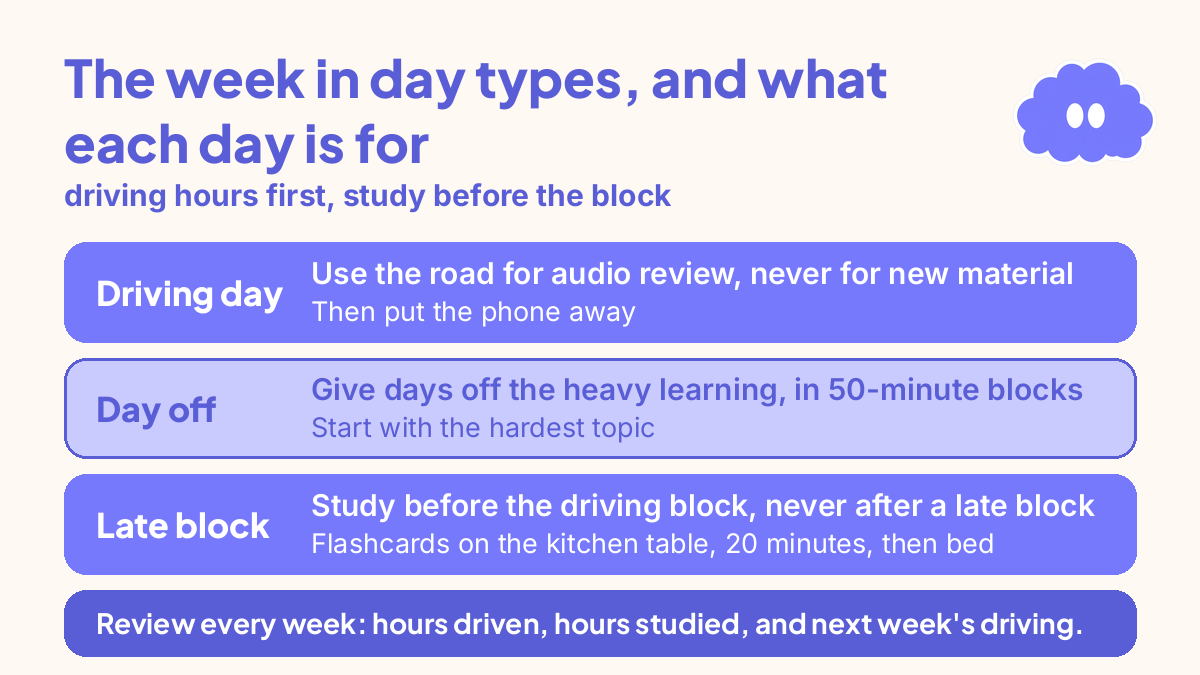
- Use the road for audio review, never for new material.
- Use the gaps between drops for five-minute retrieval.
- Give days off the heavy learning, in 50-minute blocks.
- Review every week: hours driven, hours studied, and next week’s driving.
Step 1: Set your driving hours first, then plan study around them
Delivery hours are set by you, on an app, or set by a rota. Either way, the driving week comes first, and the study week is built around it. The day you set your driving hours, spend ten minutes sorting each day into three types: a day off, a driving day, or a late block (home after 9 pm). Write the type next to each day in your diary.
Each day type gets its own kind of study, fixed in advance so you never decide it in the moment. A day off is a heavy-learning day: new topics, essays, first drafts. A driving day is an audio day: listening on the road, five-minute retrieval in the gaps, and 25 minutes of practice before the block. A late block is a retrieval day: 20 minutes of flashcards, or nothing.
App drivers have one advantage over rota drivers: you choose the hours. Pick driving blocks that leave a study morning free at least twice a week, and protect those mornings. The How to study when you work freelance makes the same point: the freedom to choose hours only helps if you choose them on purpose.
Step 2: Study before the driving block, never after a late block
Driving is concentrated work: watching the road, following the app, finding addresses, carrying parcels, talking to customers at the door. By the end of a long block, your attention is spent, and studying then usually means rereading the same page three times and remembering none of it.
So the rule is simple: the study session comes first in the day, before the driving block. For an afternoon block starting at 2 pm, that means a 50-minute session in the morning, on the hardest topic of the week. For a morning block starting at 8 am, it means 25 minutes before you leave.
This is also why How to study when you are tired after work fits delivery drivers so well: it assumes the evening is already spent, and builds the day around the hours that are still fresh. If the study happened in the morning, the evening is yours to rest.
Step 3: Use the road for audio review, never for new material
The road is the delivery driver’s most reliable study time: it happens every driving day and needs no planning. Use it for audio review of what you already know: recorded lectures, your own voice notes, or a summary you recorded the night before. Listen once, then say the key points out loud from memory.
Never use the road for new material. New topics need a desk, a pen, and your full attention, and a driver cannot give that. Audio is for retrieval, not for learning. Keep the audio to familiar material only, and never look at a screen while driving.
Record your own summaries after a study session: three minutes, the three things you must remember, in your own words. Play that recording on the next driving block. Making it is itself a test of what you know.
Step 4: Use the gaps between drops for five-minute retrieval
The gaps between drops are the delivery driver’s hidden study time: five minutes waiting for a parcel, ten minutes waiting for a customer. The mistake is treating a gap as a study session. The app can offer the next job at any moment, and a gap that turns into a twenty-minute study session is a gap that makes you late.
Use a gap of five minutes or more for one round of retrieval: five flashcards, or one question answered from memory. Then put the phone away. Do not start new material in a gap, and do not study while the app is offering the next job.
Keep the retrieval ready before the block starts: the flashcard app on your home screen, or question cards in the van. Three gaps a day is fifteen minutes of retrieval that cost you nothing, because the time was already there.
Step 5: Give days off the heavy learning, in 50-minute blocks
A day off from driving is rare, and the mistake is spending it on chores and then studying at 8 pm when the day is gone. Protect the morning of every day off for the heavy learning: new topics, essays, and anything you have not seen before, in 50-minute blocks with a 10-minute break.
Start with the hardest topic, not the easiest: the fresh mind is available at 9 am on a day off, not at 9 pm on a driving day. Work in this order: read once and close the book, write what you remember, then check and fix the gaps. If you finish the morning’s blocks early, stop.
Use the day off to make the audio for the driving week: after the morning blocks, spend ten minutes recording the three-minute summaries you will listen to on the road. The Spaced repetition system for students is built for exactly this rhythm: learn on the day off, then test yourself again on the road and in the gaps over the next few days.
Step 6: Review every week
Spend ten minutes on your first day off each week, and ask: how many hours did I drive, and how many did I study? Did the pre-block sessions happen? Did the road hold the audio review? Did the gaps hold the five-minute retrieval? Is the misses list getting shorter?
The review catches the two delivery-driver failure modes early: evening study that becomes rereading, and the lost road. If either shows up two weeks running, move the sessions to the morning, and record the summaries on the next day off.
End the review by writing next week’s sessions into the diary, next to the driving blocks. That is the system: driving hours first, study before the block, audio on the road, retrieval in the gaps, heavy learning on days off, review every week.
A worked example: a week with four driving days and two days off
Your situation: First-year student, part-time delivery driver for a parcel company, 22 hours a week. Driving this week: Monday day off, Tuesday block 9 am to 3 pm, Wednesday block 2 pm to 9 pm, Thursday day off, Friday block 9 am to 3 pm, Saturday block 10 am to 6 pm, Sunday off. Exam in six weeks, weakest subject is maths.
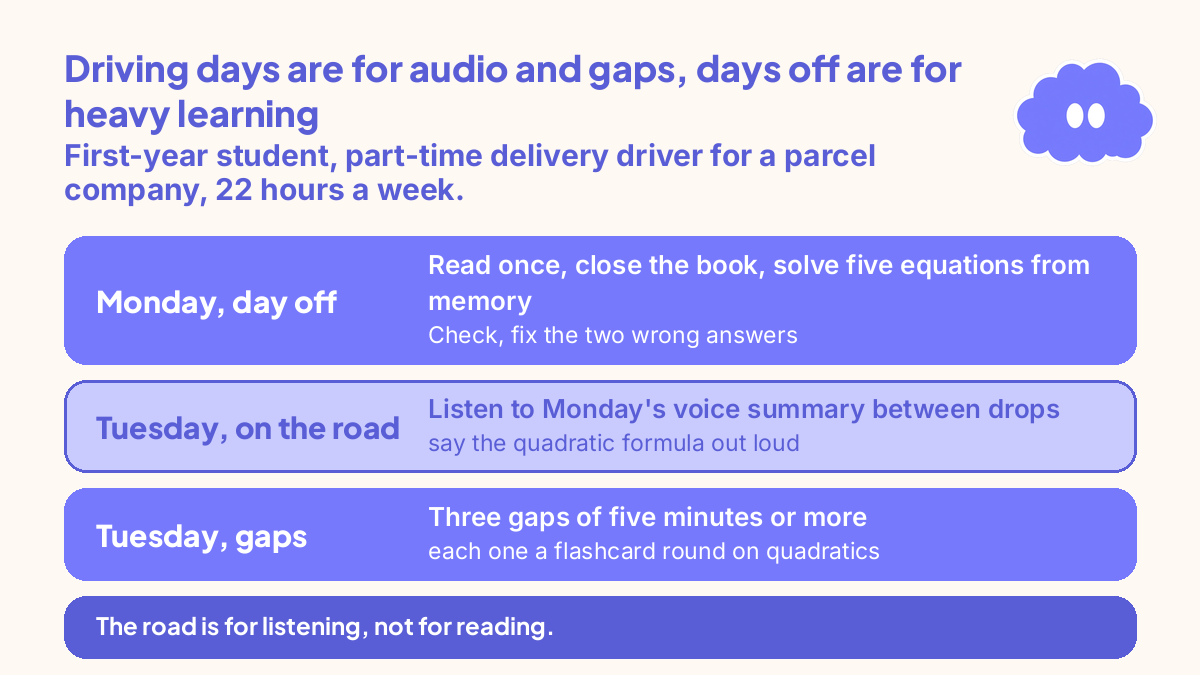
- Monday, day off, 9.00 to 9.50: Maths, new topic, quadratic equations. Read once, close the book, solve five equations from memory. Check, fix the two wrong answers, write them in the misses notebook.
- Monday, 10.00 to 10.50: Maths again, same topic. Five more equations from memory, all right this time, then record a three-minute voice summary of the quadratic formula.
- Tuesday, 8.30 to 8.55: Driving block at 9 am. 25 minutes before you leave: five practice questions on quadratics, from memory, marked before you leave. Two wrong, both about the sign of the answer; they go in the misses notebook.
- Tuesday, on the road: Listen to Monday’s voice summary between drops, then say the quadratic formula out loud at a red light. No new material.
- Tuesday, gaps: Three gaps of five minutes or more, each one a flashcard round on quadratics.
- Wednesday, 1.00 to 1.50: Driving block at 2 pm. The hour before the block: one past-paper question on quadratics, answered and marked.
- Wednesday, 9.30 pm: Home, late block. Flashcards on the kitchen table, 20 minutes, then bed. Nothing new.
- Thursday, day off, 9.00 to 9.50: Statistics, new topic, averages and spread. Same pattern: read once, close, write from memory, check. Then record a three-minute summary for the road.
- Friday, on the road: Listen to Thursday’s statistics summary between drops, with a flashcard round in each gap.
- Saturday, 9.30 to 9.55: Driving block at 10 am. 25 minutes: the misses notebook, read and re-tested. The two sign-of-the-answer questions are right this time.
- Sunday, day off, 9.00 to 10.30: One 90-minute anchor: a timed practice paper, maths and statistics mixed, marked the same morning. Score noted, misses added to the notebook. The How to use an exam countdown to stay on track keeps the six weeks to the exam visible, so the anchor stays on the calendar.
The week held five and a half hours of study, all before blocks, on the road, in gaps, or on days off. The misses notebook shrank from six items to two.
When it goes wrong
The app changes your hours with a day’s notice. Re-sort the day types the day you hear, and move the heavy learning to the next day off. If the new hours take your only day off, the week becomes a retrieval week.
You keep studying after late blocks and retaining nothing. Stop. The evening is not a study slot, and forcing it teaches you that study does not work. Move the session to the morning before the next block, even if it is only 25 minutes.
Gaps keep turning into scrolling. Put the flashcard app on your home screen and the question cards in the van, so a gap starts with the cards in your hand. If a gap is under five minutes, do nothing.
You drive extra blocks for the money and lose your study mornings. Keep two mornings a week that are not drivable, and tell yourself they are college mornings. The How to study on your lunch break is a useful backup if an extra block eats your morning. The Study system for students who travel for work covers the same road pattern in more detail.
You listen to lectures on the road and remember none of it. Stop listening to new material while driving. Switch to your own three-minute summaries of things you already learned, and say the key points out loud. If you cannot say them, the material needs a desk session on the next day off.
Weekly review checklist
- How many hours did I drive, and how many did I study, in sessions that actually happened?
- Did the pre-block sessions happen, or did study slide to the evening?
- Did the road hold the audio review, or did it turn into music and podcasts?
- Did the gaps hold the five-minute retrieval, or did they turn into scrolling?
- What is on the misses list, and is it getting shorter?
- Is there an exam or a busy driving period coming that needs mornings protected now?
Downloadable infographic spec: one vertical image, title “How to study when you work as a delivery driver”, with the six steps from “The system in short” and the six review questions above, in Thynq cream, Cloud Purple, Dark Purple and pink, with the Cloud mascot. Text taken word-for-word from this article.
What this system is not
It is not a way to study after a 9 pm finish and still learn; nobody learns well then, and pretending otherwise wastes the evening and the sleep after it. It is not a promise that delivery driving and study fit together in the busiest weeks; some weeks they barely fit, and the honest answer then is audio and retrieval only. It does not replace your lectures, your course handbook, or the driving rules that keep you and everyone else safe. And it does not make the road into a classroom: the van is for driving, the desk is for learning, and the system keeps them apart.
Sources
- Dunlosky, J., et al. (2013). Improving students’ learning with effective learning techniques. Psychological Science in the Public Interest, 14(1), 4-58. Practice testing and distributed practice rated high; rereading rated low, which is why gaps and pre-block sessions use testing from memory instead of re-reading.
- Cepeda, N. J., et al. (2006). Distributed practice in verbal recall tasks. Psychological Bulletin, 132(3), 354-380. Spaced practice beat massed practice, which supports short sessions across the week instead of one long session.
- Roediger, H. L., & Karpicke, J. D. (2006). Test-enhanced learning. Psychological Science, 17(3), 249-255. Recallers remembered more a week later than restudiers, which supports testing from memory in the gaps between drops.
For the wider working-student system behind this one, start with How to build a study system that fits your life.
Questions
How do I study when I work as a delivery driver?
Study before your driving block, use audio while you drive, and use the gaps between drops for five-minute retrieval. Give days off the heavy learning in 50-minute blocks, give driving days short audio and practice, and give late evenings retrieval only or nothing. The road is for listening, not for reading.
Can I study while driving deliveries?
Only by listening, never by reading or looking at a screen. Audio review of material you already know is safe and useful; new material is not, because it needs your full attention. Keep the audio to familiar topics, keep your eyes on the road, and do the real learning at a desk.
How do I study when my delivery hours change every week?
Plan study on the day you set your driving hours, not on Monday morning. Give each kind of day its own kind of study: heavy learning on days off, audio and gaps on driving days, and retrieval only after a late block. A new driving week means a new plan, made in ten minutes.
What do I do in the gaps between deliveries?
Use a gap of five minutes or more for one flashcard round or one question from memory, then put the phone away. Do not start new material in a gap, and do not study while the app is offering the next job. Gaps are for retrieval, and five minutes done well beats twenty minutes of half attention.