The direct answer
To study when you work freelance, set a weekly study budget of six to ten hours and place those hours after your client bookings are known, not before. Use feast weeks for earning and short retrieval only, and famine weeks for the heavy learning. The plan is built on hours, not on days.
A fixed study timetable assumes your week repeats. Freelance work does not repeat: one week brings three client briefs, the next brings one small job and four empty days. Students who plan by weekday keep breaking their plan, then conclude they cannot study at all. The problem is the plan, not the student.
The system in short
- Map your real work pattern for four weeks: billable hours, admin hours, and empty days.
- Set a weekly study budget of six to ten hours, and treat it like a client booking.
- Put study in the diary after bookings are known, usually on Sunday evening.
- Give feast weeks retrieval only, and famine weeks the heavy learning.
- Study in 25-minute sessions between client tasks, testing yourself from memory.
- Review every Sunday: hours earned, hours studied, and next week’s bookings.
Step 1: Map your real work pattern for four weeks
Before you plan anything, find out what your weeks actually look like. For four weeks, write down three numbers each Sunday: billable hours, admin hours (invoices, emails, chasing payments, finding work), and empty days. Most freelance students are surprised twice: admin takes far more time than they thought, and empty days cluster together instead of spreading out.
The pattern matters more than the total. If your empty days cluster on Mondays and Tuesdays, those are your heavy study days; if billable hours spike at month end, that week is a retrieval week.
This step also shows you what you can honestly afford. If you average 20 billable hours a week, a 15-hour study plan is fiction. A six to ten hour budget is not a low ambition; it is the budget that survives contact with your real week.
Step 2: Set a weekly study budget and treat it like a client booking
Choose a number of study hours for the week, between six and ten, and write it down as a booking in the same diary you use for client work. Freelancers protect client bookings because a client is waiting; study has no client, so it gets moved first. Writing the hours in the same diary gives study the same status as paid work.
Decide the budget from your four-week map, not from your course handbook. A handbook that asks for 20 hours of self-study assumes a student without a job. Your real budget is the hours left after billable work, admin, lectures, sleep, and one day off. If that leaves eight hours, eight is your budget. If it leaves six, six is your budget. A smaller budget you keep beats a larger one you abandon in week two. The working student study planner can hold the same numbers if you prefer a tool to a paper diary, and it will show you the week as hours rather than as days.
Step 3: Put study in the diary after bookings are known
Plan study on Sunday evening, once next week’s client work is booked. Planning on Monday morning, before you know the week, means re-planning by Tuesday. Planning on Sunday evening, with the bookings in front of you, means the plan fits the week that is actually coming.
Place the hours in this order. First, the heavy learning: new topics, essays, anything you have not seen before, on your emptiest day, in a block of 50 minutes or more. Second, the practice: questions, problems, and past papers, in 25-minute sessions between client tasks. Third, the review: 15 minutes testing what the week covered. If the week has no empty day, skip the heavy learning and do practice and review only; the heavy learning waits for a famine week.
Write each session as a start time, not a wish. “Study 9.00 to 9.50 on Tuesday” survives; “study Tuesday morning” does not. If a client books over a study session, move the session the same day, to the next free hour, and write the new time down. A moved session is still a session. A session that simply disappears is the start of a lost week.
Step 4: Give feast weeks retrieval only, and famine weeks the heavy learning
A feast week brings more billable hours than usual; a famine week brings few or none. Most freelance students try to study the same way in both, and fail in both: in a feast week they sit down to learn a new topic at 10 pm and retain nothing, and in a famine week they drift, because no plan told them this was the week to do the hard work.
So split the work by week type. In a feast week, study means retrieval only: flashcards, practice questions, and testing yourself from memory in 25-minute sessions, before work or between tasks. No new topics, no essays, no first drafts. Retrieval is the one kind of study that works when you are tired, because it uses what you already know. If you come home too tired to start, the system for tired evenings after work covers exactly that problem, and its 20-minute rule fits a feast week well.
In a famine week, do the heavy learning: new topics, long reading, essays, and first drafts, in 50-minute blocks with a 10-minute break. A famine week is not a holiday; it is the week your course moves forward. The mistake is treating a famine week as free time and then panicking when the next feast week arrives.
Step 5: Study in 25-minute sessions between client tasks
Freelance days are full of gaps: 25 minutes while a client reviews a draft, 20 minutes before a call, half an hour on the bus between jobs. These gaps are the freelance student’s study hall, and the system that fits them is short, closed-book testing. Pick one question, close the notes, and write or say the answer from memory. Then check it, note what you missed, and move on.
The 25-minute length is deliberate. A 25-minute session fits between client tasks without rearranging the day, and it is long enough for one real test: ten flashcards, five practice questions, or one past-paper question with marking. Set a timer, and stop when it rings. Stopping on time is what makes the next session easy to start.
Keep a small list of “gap tasks” ready: the five flashcards you keep missing, the three questions you got wrong last week, the one definition you cannot hold. When a gap appears, you start in under a minute.
Step 6: Review every Sunday
Spend 15 minutes every Sunday on three numbers and one decision: billable hours earned, study hours done, and study hours planned. The decision is what next week looks like, and which kind of week it is, feast or famine. Write the answers in the same place every week, so four weeks of reviews show you a pattern you can trust.
The review is also where you catch the two failure modes early. The first is the study budget quietly becoming client work: three weeks of “I will catch up next week” is not a plan, it is a debt, and the fix is to cut the budget to six hours and keep it. The second is the famine week that never comes: if you have had four feast weeks in a row, block two mornings next week as study time and tell clients those mornings are taken.
End the review by writing next week’s study hours into the diary, in the gaps the bookings leave. That is the whole system, repeated weekly: map, budget, place, split by week type, test in short sessions, review.
A worked example: a Tuesday in a famine week, and a Thursday in a feast week
Your situation: Second-year student, freelance social media work for three small clients. Feast weeks bring 25 billable hours; famine weeks bring 6. Exams in January, weakest subjects are statistics and research methods. This week is a famine week; next week is a feast week.
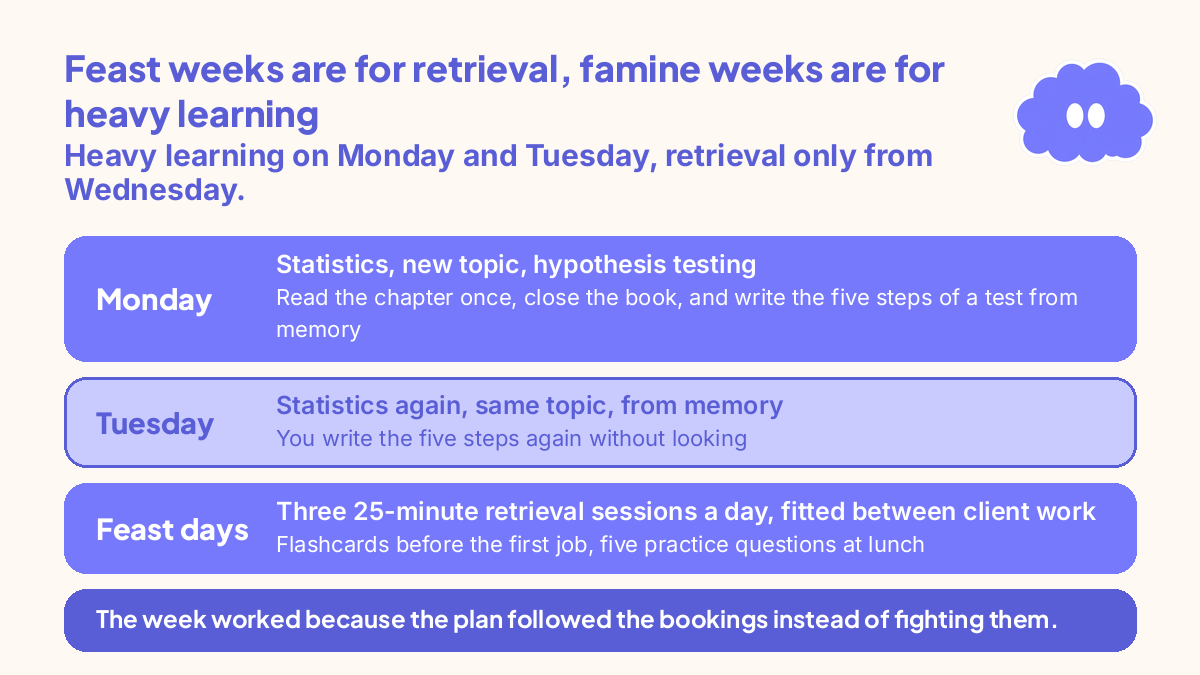
- Sunday evening, 15 minutes: You check next week’s bookings: three client jobs, all due Wednesday. The work is front-loaded, so Monday and Tuesday are famine days and Wednesday to Friday are feast days. You write the study budget in the diary: 8 hours. Heavy learning on Monday and Tuesday, retrieval only from Wednesday.
- Monday, 9.00 to 9.50: Statistics, new topic, hypothesis testing. You read the chapter once, close the book, and write the five steps of a test from memory. Three right, two wrong; the two wrong go on the gap list.
- Monday, 10.00 to 10.50: Research methods, essay plan. You draft the structure: question, three arguments, one counter-argument. No full sentences yet, just the skeleton.
- Tuesday, 9.00 to 9.50: Statistics again, same topic, from memory. You write the five steps again without looking. This time you get all five, and you add one practice question.
- Tuesday, 11.00 to 11.25: Gap session. The two hypothesis-testing steps you missed on Monday, tested again, then checked.
- Wednesday to Friday, feast days: No heavy learning. Three 25-minute retrieval sessions a day, fitted between client work: flashcards before the first job, five practice questions at lunch, one past-paper question in the evening. Each session ends with the misses written on the gap list.
- Sunday, 15 minutes: Billable hours 24, study hours 8, budget kept. The gap list is now three statistics definitions. Next week has one client job only, so it is a famine week: heavy learning on Monday and Tuesday again.
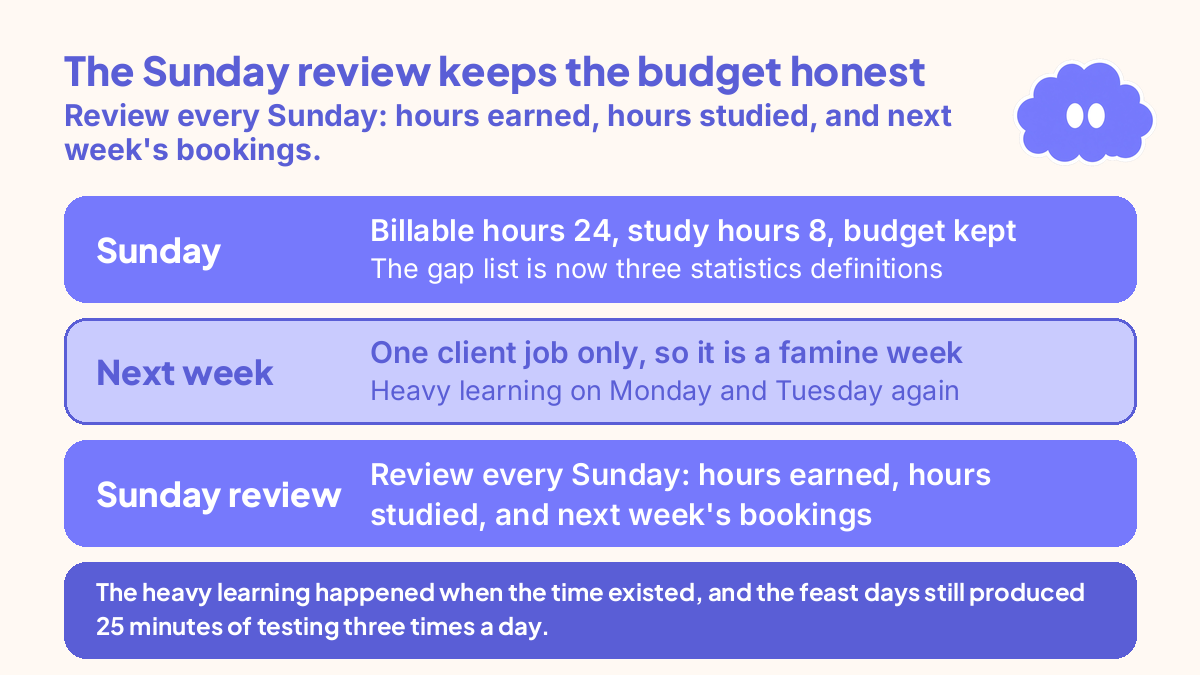
The week worked because the plan followed the bookings instead of fighting them. The heavy learning happened when the time existed, and the feast days still produced 25 minutes of testing three times a day.
When it goes wrong
A client books over your study day. Move the session the same day, to the next free hour, and write the new time down. If the whole day is gone, move the heavy learning to your next empty day and use the lost day for retrieval only. Do not try heavy learning at 10 pm after a full client day.
Four feast weeks in a row. Block two mornings next week as study time, tell clients those mornings are taken, and use them for the heaviest topic only.
You take every job because the money is good. Freelance income is lumpy, and a big month makes the next month feel safe. It is not. Keep a simple rule: if the exam is within six weeks, you need one famine week in every two, and you protect it the way you protect a client deadline.
You study in the gaps but never do the heavy learning. Retrieval keeps you where you are; it does not move you forward. If your review shows three weeks of retrieval and no new topics, your next famine day is a heavy-learning day, and you start it with the hardest topic, not the easiest.
A client asks for weekend work during exam week. Say no, and say it early. Offer an earlier delivery or a smaller scope: two weeks of notice is what makes a no acceptable.
Weekly review checklist
- How many billable hours did I work, and how many study hours did I actually do?
- Did the study budget survive, or did client work take it? If it did, what will I cut next week?
- Was this a feast week or a famine week, and did I study the right way for it?
- What is on the gap list, and is it getting shorter or longer?
- What are next week’s bookings, and where do the study hours go?
- Is there an exam or deadline within six weeks that needs a protected famine week?
Downloadable infographic spec: one vertical image, title “How to study when you work freelance”, with the six steps from “The system in short” and the six review questions above, in Thynq cream, Cloud Purple, Dark Purple and pink, with the Cloud mascot. Text taken word-for-word from this article.
What this system is not
It is not a way to study 20 hours a week on top of full-time freelance work; nobody sustains that, and a plan that asks for it fails in week three. It is not a promise that freelancing and studying fit together easily; some months they do not, and the honest answer then is fewer clients or fewer modules, not a better app. It does not replace your course handbook, your lectures, or your supervisor. And it does not make client work disappear: the system works with feast and famine weeks, it does not abolish them.
Sources
- Dunlosky, J., et al. (2013). Improving students’ learning with effective learning techniques. Psychological Science in the Public Interest, 14(1), 4-58. Practice testing and distributed practice rated high; rereading rated low, which is why feast weeks use retrieval instead of re-reading.
- Cepeda, N. J., et al. (2006). Distributed practice in verbal recall tasks. Psychological Bulletin, 132(3), 354-380. Spaced practice beat massed practice, which supports spreading short sessions across the week instead of one long session.
- Roediger, H. L., & Karpicke, J. D. (2006). Test-enhanced learning. Psychological Science, 17(3), 249-255. Recallers remembered more a week later than restudiers, which supports testing from memory in the short sessions.
For the wider working-student system behind this one, start with How to study with a full-time job.
Questions
How do I study when freelance work is unpredictable?
Stop planning by weekday and plan by hours instead. Set a weekly study budget of six to ten hours, then place those hours after your client bookings are known, usually on Sunday evening. Feast weeks get short retrieval sessions only; famine weeks get the heavy learning. The budget stays the same, the days move.
Should I turn down freelance work to study?
Only in the two weeks before an exam, and only the work you can afford to refuse. Turning down every job to study leaves you short of money, which brings its own stress. The better move is to tell clients your exam dates early and stop taking new bookings for the last ten days, so the work tapers off instead of stopping suddenly.
How many hours a week should a freelance student study?
Six to ten hours is a realistic budget for most freelance students, in sessions of 25 to 50 minutes. Fewer than six hours and you lose the thread between sessions; more than ten on top of client work and you burn out by week three. Count only hours you can protect, not hours you hope to find.
What if a client deadline clashes with an exam?
Tell the client as soon as you know, and offer a real choice: an earlier delivery, a smaller scope, or a handover date. Most clients accept a changed date if they hear it two weeks ahead; almost none accept it two days ahead. Never promise both the deadline and the exam in the same week. One of them will lose, and it is usually the exam.