
The direct answer
When you travel for work, study runs on a kit and a routine, not on a desk and a timetable. Pack a paper set of question cards and the notes for one topic only. Study 30 minutes on the night you arrive, review for 15 minutes the next morning, and when you get home, take one fixed catch-up day of 90 minutes before you go back to your normal plan. That is the whole system — a kit that works anywhere, two short sessions a day, and one day to close the gap.
You need material that works on a train, in a hotel room, and over breakfast — and a routine small enough to survive a day of travelling.
Why travel breaks study plans
A normal study plan assumes you are in the same place every evening, with the same desk, the same books, and the same two hours. Travel takes all of that away. You leave before breakfast, you sit in meetings or on site all day, you eat dinner late with colleagues, and by the time you are alone in a hotel room you are tired and the notes are in your bag at the bottom of a suitcase.
The usual response is to promise yourself you will study on the trip and then not study at all, because the plan needed a desk and a quiet evening and you had neither. The fix is not more willpower. The fix is a plan built for the conditions you actually have: no desk, no quiet, tired, and away from home.
The system in short
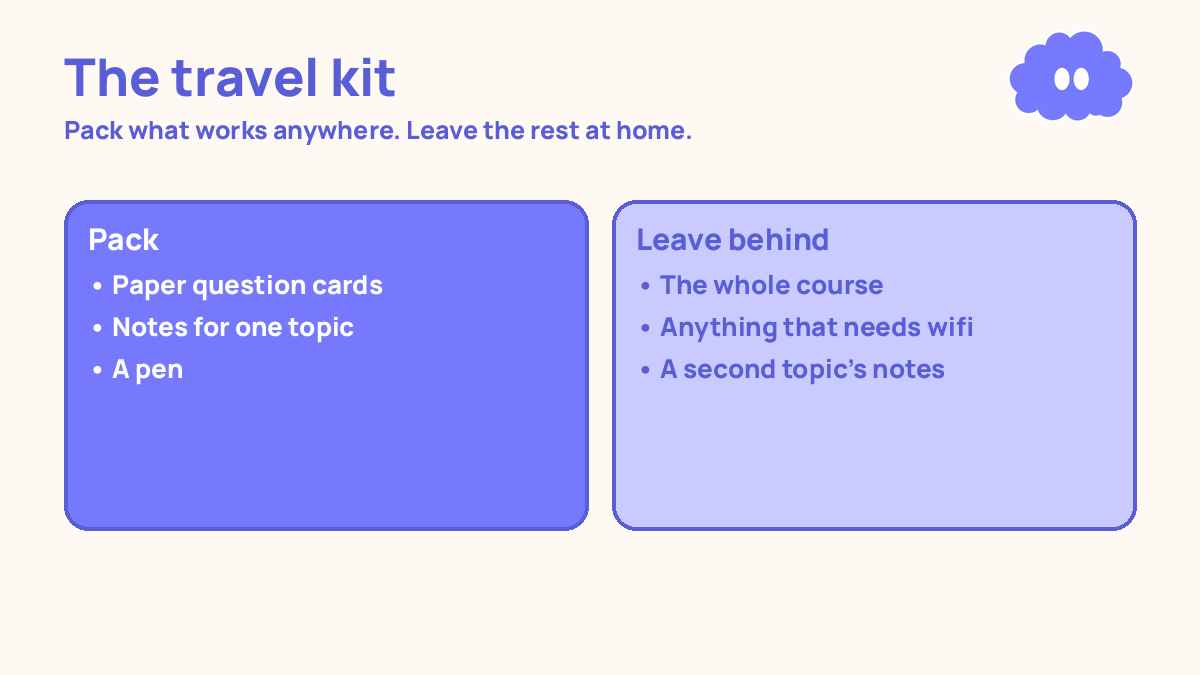
- Pack the travel kit the night before you leave: question cards, one topic’s notes, a pen. Nothing that needs wifi.
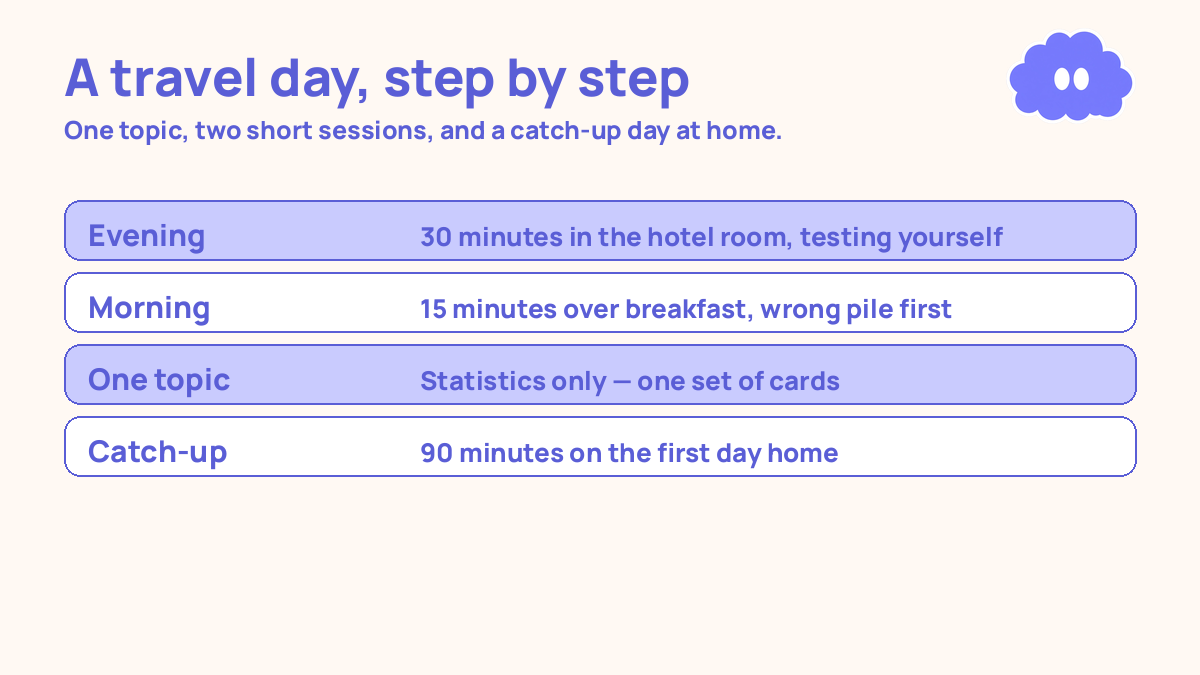
- On a travel day, study 30 minutes in the evening, in the hotel room, sitting up. Test yourself — do not re-read.
- Next morning, review for 15 minutes over breakfast: yesterday’s cards, from memory.
- One topic per trip. Do not pack the whole course.
- The first full day home is catch-up day: 90 minutes, testing yourself on everything from the trip, then back to the normal plan.
For the journey itself, Study system for studying on your commute turns the travel time into a test session.
Step 1: Pack the kit the night before
Pack the night before you leave, not the morning of the trip. Mornings before travel are rushed, and a kit packed in a rush is a kit with the wrong notes. The kit is small: paper question cards for one topic, the notes for that topic, and a pen. Paper works on a train with no signal, in a hotel room with no desk, and at a breakfast table.
One topic per trip. If the trip is three days, one topic is enough for three evenings and three mornings. Packing the whole course means you carry weight you will not open, and you spend the first ten minutes of every session deciding what to study. Decide before you leave: this trip is for statistics, or for contract law, or for anatomy.
Step 2: The travel day
A travel day is a working day with hours of sitting in between. Use the sitting, but do not count on it. A train or a plane is a fine place to read your cards, but it is a bad place to promise yourself an hour of study. Delays, seatmates, and tiredness get in the way.
The real session is the evening: 30 minutes, in the hotel room, sitting up. Not lying on the bed — lying down after a travel day is how a 30-minute session becomes a nap. Sit at the small table, or sit up in bed with the cards on your lap. Set a timer for 30 minutes.
Spend the 30 minutes testing yourself. Read a question on a card, answer it from memory, then turn the card over and check. Put the cards you got wrong in a separate pile. When the timer rings, stop. In a 2013 review, Dunlosky and colleagues rated ten common study techniques, and only two received a high utility rating: practice testing and distributed practice. Testing yourself is one of the two best-supported things you can do — and it fits in a hotel room.
If dinner with colleagues runs late, do the 30 minutes after dinner, not before.
Step 3: The 15-minute morning review
The next morning, before the work day starts, spend 15 minutes over breakfast reviewing yesterday’s cards. Take the pile of cards you got wrong the night before and test yourself on those first, then run through the rest quickly.
This is where spacing does its work. Spaced practice beat massed practice across materials, ages and retention intervals in a major synthesis, and the right gap grows with how long you need to remember the material (Cepeda et al., 2006). An evening session plus a morning review is a gap of one night — short, but it is a gap, and a gap is what makes the second attempt a test rather than a re-read.
Do the review at breakfast, not in the hotel room before breakfast. The room before breakfast is where you will check your phone, answer a work message, and lose the 15 minutes. Put the cards on the breakfast table.
Step 4: Protect your sleep
Travel disrupts sleep — late dinners, strange beds, early starts — and sleep is when the day’s learning is consolidated. Diekelmann and Born (2010) reviewed how sleep supports memory: during slow-wave sleep, patterns of brain activity from learning are re-activated, and memories are gradually moved toward long-term storage. A short night after a long study day means the work was done but the consolidation was cut short. Do not trade sleep for an extra hour of study on a trip. Go to bed, and let the 30 minutes you did count.
Step 5: The catch-up day
The first full day you are home is catch-up day. Not the second day, not “sometime this week”. The first full day home, 90 minutes, fixed in advance.
Spend the 90 minutes like this: 30 minutes testing yourself on everything from the trip, from memory. Then 30 minutes on the topic you are weakest on — work problems, write answers, check them. Then 30 minutes planning the normal week ahead, so the trip does not bleed into the next seven days.
A meta-analysis of the testing effect found that testing yourself beat restudying by a medium amount (g = 0.50), and that the advantage was larger when you got feedback on your answers (g = 0.73 with feedback, against 0.39 without) (Rowland, 2014). So check your answers during the catch-up session, in the same sitting.
A worked example: a three-day trip
You travel Tuesday to Thursday for work. The topic for this trip is statistics — one topic, one set of cards. You pack the kit on Monday night.
Tuesday — travel day: Train in the morning, meetings all day, dinner with colleagues at 7pm. 9:00–9:30pm — evening session: 30 minutes in the hotel room, testing yourself on 20 statistics cards. You get 13 right, 7 wrong. The 7 go in the wrong pile. Total: 30 minutes.
Wednesday — morning review, then a full day: 7:30–7:45am — breakfast review: 15 minutes over breakfast, testing the 7 wrong cards first, then a quick run through the rest. You get 5 of the 7 right this time. 9:00–9:30pm — evening session: 30 minutes, 20 new cards on the next part of statistics. Total: 45 minutes.
Thursday — morning review, travel home: 7:30–7:45am — breakfast review: 15 minutes, the wrong pile from Wednesday. Evening — home: No study. You travelled home, you are tired, and the catch-up day is tomorrow. Total: 15 minutes.
Friday — catch-up day: 6:00–7:30pm — 90 minutes: 30 minutes testing all the trip cards from memory, 30 minutes working the five hardest problems and checking every answer, 30 minutes planning next week. Then the trip is closed and the normal plan resumes on Saturday.
Trip total: 135 minutes on the road plus 90 minutes at home — 225 minutes for a three-day trip, and not one of those minutes needed a desk, wifi, or a quiet room.
When it goes wrong
The trip is longer than planned and you run out of cards. You packed one topic for three days and the trip became five. Do not buy a textbook in an airport shop. Re-test the same cards — testing the same material again after a gap is still useful, because the gap is what makes it a test. Then use the extra evenings for the wrong pile: the cards you keep getting wrong are the ones that need the repetitions.
You skip the evening session two nights in a row. The session is too late. If dinner ends at 10pm, a 9pm session was never going to happen. Move it to the morning: 30 minutes before breakfast instead of 15. Or split it — 15 minutes before dinner and 15 after. A session that keeps failing at the same time of day needs a new time, not more effort.
The catch-up day gets eaten by work. You come home on Thursday and Friday is full of catching up at work. Move the catch-up to Saturday morning, once, and protect it like a work meeting. If it slips past Saturday, do a 30-minute version on Sunday — test the cards, nothing else — and accept that the trip’s weakest topic goes on next week’s list.
Weekly review checklist
Copy this list and use it each week you travel:
- Is the kit packed the night before, with one topic only?
- How many evening sessions happened on the trip — and at what time?
- Did the morning review happen at breakfast, or did it slip?
- Did the catch-up day happen on the first full day home?
- What one change will I make next trip: a different session time, fewer cards, or a better wrong pile?
Downloadable infographic spec: one vertical image, title “The travel study kit”, with the kit list — question cards, one topic’s notes, a pen — and the routine: 30 minutes in the evening, 15 minutes at breakfast, one 90-minute catch-up day at home, in Thynq cream, Cloud Purple, Dark Purple and pink, with the cloud mascot. Text taken word-for-word from this article.
What this system is not
It is not a way to study a full week from a hotel room. Three days of 30-minute sessions cover less than a normal week, and this system does not pretend otherwise. It is also not a promise that a paper kit and a short routine will carry you through an exam on their own. It is a way to keep studying alive while you travel for work, so that a trip costs you a little ground instead of a whole week.
Sources
- Dunlosky, J., et al. (2013). Improving students’ learning with effective learning techniques. Psychological Science in the Public Interest, 14(1), 4-58. Only practice testing and distributed practice received a high utility rating.
- Cepeda, N. J., et al. (2006). Distributed practice in verbal recall tasks: a review and quantitative synthesis. Psychological Bulletin, 132(3), 354-380. Spaced practice beat massed practice; the optimal gap grows with how long you need to remember the material.
- Diekelmann, S. & Born, J. (2010). The memory function of sleep. Nature Reviews Neuroscience, 11(2), 114–126. Sleep improves the consolidation of what was learned; during slow-wave sleep, learning patterns are re-activated and memories move toward long-term storage.
- Rowland, C. A. (2014). The effect of testing versus restudy on retention: a meta-analytic review of the testing effect. Psychological Bulletin, 140(6), 1432–1463. Testing beat restudying (g = 0.50); with feedback the effect was larger (g = 0.73) than without it (g = 0.39).
For the full system this fits inside, start with the two-hour study system for working students, and if the whole week is packed rather than just travel, read the study system for students with a busy week.
Questions
What should I pack for studying while travelling?
A paper set of question cards, the notes for one topic only, and a pen. Everything must work without internet and without a desk. If it needs wifi, a charger, or a quiet room, it does not go in the kit.
How much study is realistic on a travel day?
Thirty minutes in the evening and 15 minutes the next morning. A travel day is tiring, and a tired hour of staring at notes teaches nothing. Two short sessions beat one long one you skip.
What if the hotel has no quiet place to study?
Study in the room, sitting up in bed or at the small table, with headphones in if the corridor is noisy. The 30-minute session is short enough to survive a bad room. Do the morning review over breakfast instead.
How do I catch up after a trip?
One fixed catch-up day, the first full day you are home. Ninety minutes: test yourself on everything from the trip, then go back to your normal plan. Do not spread the catch-up across the week — it never happens.