
The direct answer
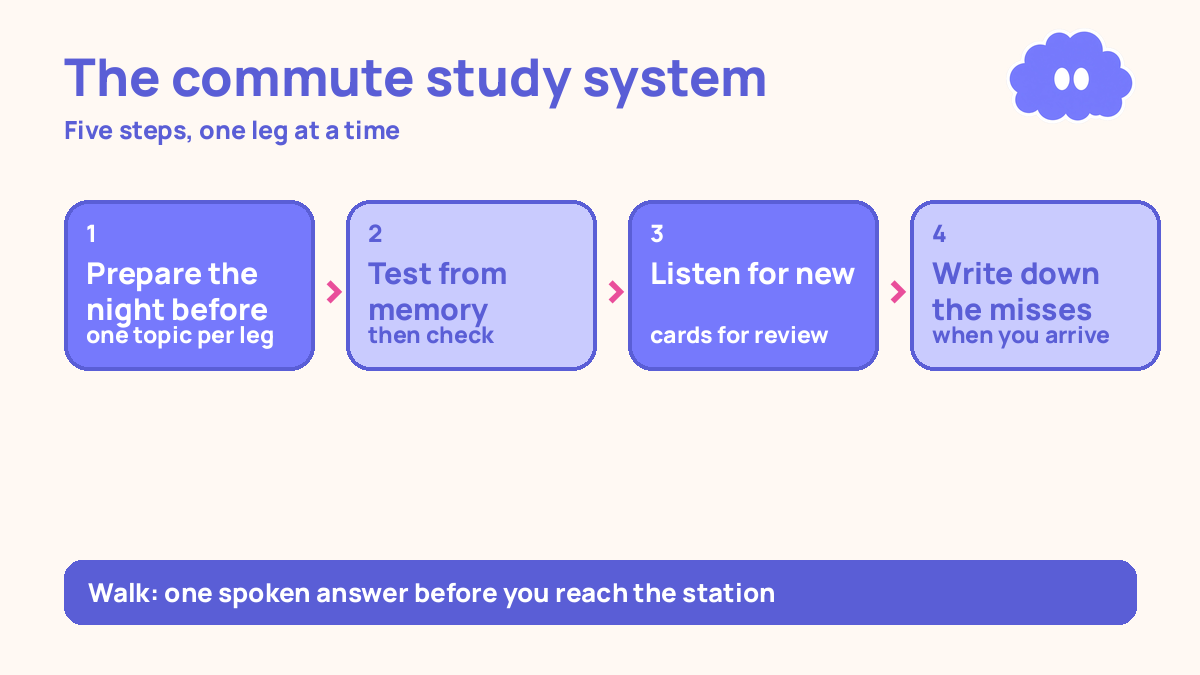
Prepare one topic per leg the night before, test yourself from memory on the way, and write down what you got wrong when you arrive. A 45-minute commute each way is 90 minutes a day — seven and a half hours a week.
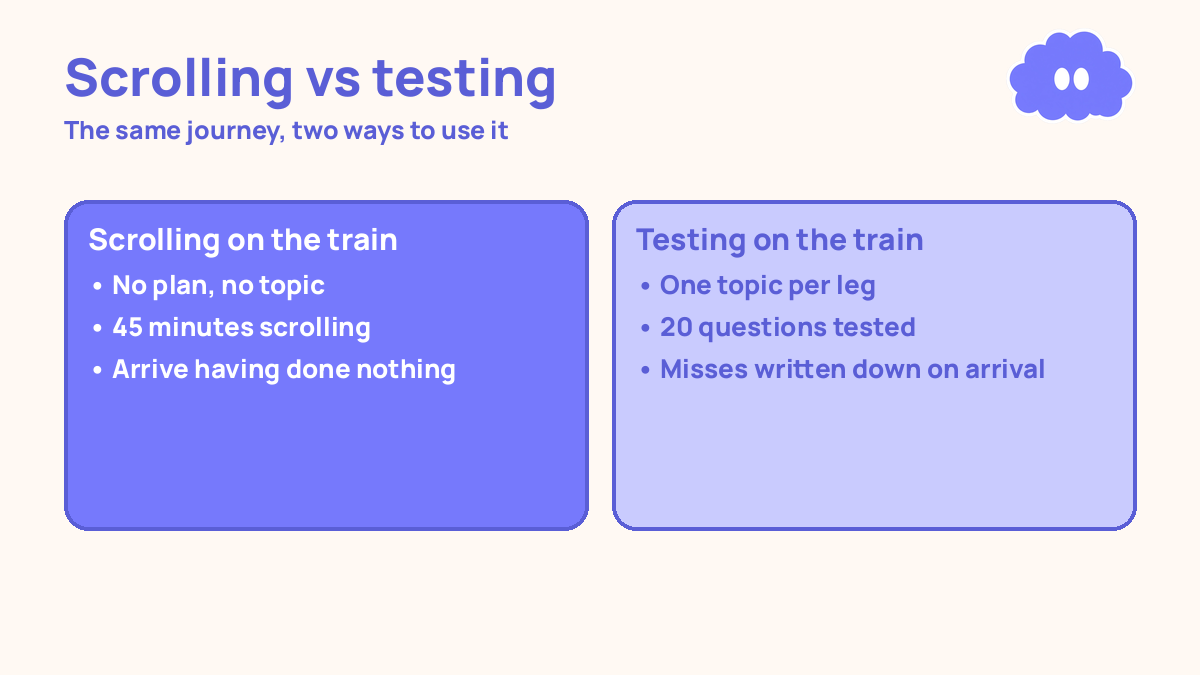
A commute is dead time that most students write off. You sit on a bus or a train, scroll your phone, and arrive having done nothing. The time is not the problem — 45 minutes each way is an hour and a half a day. The problem is that the time arrives without a plan, and unplanned time fills itself with the easiest thing available.
The system in short
- Prepare the night before: one topic per leg, on your phone or a card.
- Test yourself from memory on the way — do not re-read your notes.
- Listen to lectures for new material, use cards for review. Never both at once.
- Write down what you got wrong when you arrive, in one line each.
- Use the walk to the station for one spoken answer — say it out loud.
- Review on a 1-3-7 day schedule: next day, in 3 days, in 7 days. That is a practical starting schedule, not a research rule.
Step 1: Prepare the night before, in five minutes
Five minutes, the night before, decides whether tomorrow’s commute is study or scrolling. Pick one topic per leg: morning, test yesterday’s lecture questions; evening, listen to tomorrow’s lecture or review the cards due today.
Put the preparation on your phone or on a card: the questions to test, the lecture to listen to, or the cards to review. One topic, one leg, one thing ready to open.
Make an if-then plan for the morning: “When I sit down on the train, I will open the questions and answer the first one.” Gollwitzer and Sheeran’s 2006 meta-analysis of 94 studies found if-then plans raised goal attainment by a medium-to-large amount (d = 0.65) over holding the goal alone.
For the wider picture of fitting study into short windows, the study system for students with a busy week covers weeks with no free evenings.
Step 2: Test yourself from memory, never re-read
The commute is a testing machine. You are sitting down, you have 45 minutes, and you have nothing else to do. The best use of that time is answering questions from memory, then checking them.
Open your questions and answer them in your head, speak them quietly, or write the answers on your phone. Then check. The ones you get wrong go on tomorrow’s list.
In a 2013 review, Dunlosky and colleagues rated practice testing one of only two high-utility techniques, alongside distributed practice. Re-reading your notes was rated low. Re-reading on a train feels productive because it fills the time, but it is the weakest method applied to the longest stretch of free time you have.
Rowland’s 2014 meta-analysis of 61 studies found testing beat restudying by a medium amount (g = 0.50), and 81% of the comparisons showed a benefit for testing. The advantage grows with time: on an immediate test, restudying often wins; after a delay, testing wins. Feedback mattered too: with feedback the effect was larger (g = 0.73) than without it (g = 0.39).
A 45-minute leg holds about 20 to 30 questions if you are honest about the ones you miss. Two legs a day is 40 to 60 questions.
Step 3: Listen for new material, cards for review — never both at once
A commute holds one kind of work per leg. Listening to a lecture is new material. Reviewing cards is old material. Doing both in one leg means doing neither properly.
Rubinstein, Meyer and Evans found in 2001 that people lost time on every switch between tasks, with mean switch costs of 614 to 1,096 milliseconds per switch, growing as the tasks got more complex. The measured cost is small. The real cost on a commute is bigger: switching from listening to cards and back means you lose your place in both.
The rule: morning leg is testing, evening leg is listening — or the other way round, whichever fits your day. Pick one, and stick to it for the week.
Listening works on a commute because it does not need your hands or your eyes. Listen at normal speed, and pause after each section to say the answer to that section’s question in your head.
Step 4: Write down what you got wrong when you arrive
When you arrive, before you do anything else, write down what you got wrong. One line each, on a card or in your notes: the question, and the correct answer in a few words.
This is the step that makes the system compound. Without it, every commute tests the same questions and misses the same ones, and nothing improves.
The arrival note is also the feedback that makes testing work. Rowland’s meta-analysis found feedback raised the effect of testing from g = 0.39 to g = 0.73.
Keep the missed questions in one place — a single card, or a single list on your phone. When the list grows past 20, stop adding new topics until it is under 10.
Step 5: Use the walk for one spoken answer
The walk to the station or the bus stop is five to ten minutes. Use it for one spoken answer: pick one question from yesterday’s list and say the answer out loud while you walk.
Speaking an answer from memory is a recall format, and Rowland’s meta-analysis found recall formats like short answers beat recognition formats like multiple choice as practice.
One question a day, five days a week, is five answers a week that you have spoken, checked, and remembered.
Step 6: Space the reviews on a 1-3-7 schedule
Review a topic the next day, then in 3 days, then in 7 days — a practical starting schedule, not a research rule. Cepeda and colleagues’ 2006 synthesis found spaced practice beat massed practice, and the best gap grows with how long you need to remember the material.
On a commute, the schedule is easy to run: tomorrow’s morning leg tests yesterday’s topic, the leg in 3 days tests it again, and the leg in 7 days tests it a third time. If you get a question right three times in a row, it leaves the list. If you keep getting it wrong, it stays on the arrival card.
A worked example: a Wednesday with a 45-minute train each way
You have a 45-minute train to campus in the morning and 45 minutes home in the evening, and a biology test in three weeks.
Tuesday night — Prepare: Five minutes. Morning leg: the 20 questions on cell division from yesterday’s lecture, on your phone. Evening leg: the genetics lecture recording, 40 minutes, ready to play. 7:30–7:40 — Walk: One spoken answer while walking to the station: “What are the three stages of the cell cycle?” Said out loud, checked against the card. 7:40–8:25 — Morning leg: 20 questions on cell division, answered from memory, then checked. Fifteen right, five wrong. 8:25 — Arrive: Write the five wrong answers on the card, one line each. Thirty seconds. 5:00–5:45 — Evening leg: Listen to the genetics lecture, 40 minutes. Pause after each section and say the answer in your head. 5:45 — Arrive home: Write one line on the card: “Genetics lecture listened to, two sections tested, review on Friday.”
Ninety minutes of commute, and the day holds 20 questions tested, one lecture listened to with pauses, one spoken answer on the walk, and a card that tells you exactly what to study tomorrow.
| Leg | Time | What you do |
|---|---|---|
| Walk | 7:30–7:40 | One spoken answer |
| Morning train | 7:40–8:25 | 20 questions from memory, then check |
| Arrive | 8:25 | Write the 5 wrong answers on the card |
| Evening train | 5:00–5:45 | Listen to lecture, pause and test |
| Arrive home | 5:45 | One line: what was done, what is next |
When it goes wrong
You get on the train and spend the leg scrolling. The preparation did not happen the night before. Do the five minutes tonight: one topic, one leg, ready to open.
You re-read your notes on the train and feel like you studied. You did the weakest method for 45 minutes. Switch to testing: open the questions, answer them from memory, check them.
You listen to a lecture and a podcast and check your messages in one leg. You switched three times and finished nothing. One kind of work per leg.
You test yourself but never write down what you got wrong. The same questions keep coming back, and nothing improves. Write the misses on the card when you arrive, one line each, thirty seconds.
Weekly review checklist
Copy this list and use it each week:
- Did I prepare each leg the night before, in five minutes, one topic per leg?
- Did I test myself from memory on the morning leg, and check every answer?
- Did I listen to one lecture on the evening leg, pausing to test after each section?
- Did I write down what I got wrong when I arrived, one line each?
- Did I say one answer out loud on the walk, each day?
- Did I review older topics on the 1-3-7 schedule, using the commute legs?
- What one change will I make next week: better preparation, more testing, or fewer switches?
Downloadable infographic spec: one vertical image, title “The commute study system”, with the five steps — prepare the night before, test from memory on the way, listen for new material and cards for review, write down what you got wrong when you arrive, use the walk for one spoken answer — and the commute numbers — 45 minutes each way is 90 minutes a day, seven and a half hours a week — in Thynq cream, Cloud Purple, Dark Purple and pink, with the cloud mascot.
What this system is not
It is not a promise of a grade, and not a claim that a commute can replace a desk. Writing, problem sets, and long essays still need a desk and a quiet hour. What the commute can do is testing and listening — and seven and a half hours a week of testing and listening is a serious amount of study, done in time that was dead before.
Sources
- Dunlosky, J., et al. (2013). Improving students’ learning with effective learning techniques. Psychological Science in the Public Interest, 14(1), 4-58. Only practice testing and distributed practice rated high utility; rereading rated low.
- Rowland, C. A. (2014). The effect of testing versus restudy on retention. Psychological Bulletin, 140(6), 1432-1463. Testing beat restudy (g = 0.50) in 81% of comparisons; feedback raised the effect (g = 0.73 with, 0.39 without); recall formats beat recognition.
- Gollwitzer, P. M. & Sheeran, P. (2006). Implementation intentions and goal achievement. Advances in Experimental Social Psychology, 38, 69-119. Across 94 studies, if-then plans raised goal attainment by a medium-to-large amount (d = 0.65).
- Rubinstein, J. S., Meyer, D. E. & Evans, J. E. (2001). Executive control of cognitive processes in task switching. Journal of Experimental Psychology: Human Perception and Performance, 27(4), 763-797. Mean switch costs 614 to 1,096 milliseconds per switch, growing with complexity.
- Cepeda, N. J., et al. (2006). Distributed practice in verbal recall tasks. Psychological Bulletin, 132(3), 354-380. Spaced beat massed; the best gap grows with the retention interval.
- Cepeda, N. J., et al. (2008). Spacing effects in learning. Psychological Science, 19(11), 1095-1102. Best gap about 20-40% of a one-week delay, 5-10% of a one-year delay.
For the full system behind this one, start with how to build a study system that fits your life, and if your week has no free evenings at all, the study system for students with a busy week covers the shape of that. For the shortest sessions, how to study in short bursts covers the 10-minute version.
Questions
What can I actually study on a noisy bus or train?
Testing and listening, not writing. Answer questions from memory, listen to a lecture, review cards. Save writing and problem sets for a desk.
How do I prepare the night before?
Pick one topic per leg and put it on your phone or a card: the questions to test, or the lecture to listen to. Preparation takes five minutes and decides whether the journey is study or scrolling.
What if my commute is only 15 minutes?
Fifteen minutes holds one small job: five questions tested, or one section listened to. A short commute is a short pocket, and short pockets still count.
Should I use my phone for commute study?
Yes — it is the tool that fits a train or a bus. Use it for questions and audio, with notifications off. The phone is a study tool here, not a distraction to remove.