The direct answer
How to study in short bursts: pick one small task, study it for 15 to 25 minutes, take a 5-minute break, and repeat. Write each task in one line before you start, with a clear finish. Four bursts of 25 minutes is a real study day. The system works because the burst is short enough to start and long enough to finish something.
You have twenty minutes before your shift, half an hour between lectures, or an evening after a long day at work. The idea of “studying for three hours” is laughable. So you study nothing, because the only version of studying you know needs a long, quiet stretch you do not have.
That is the trap. Studying does not need three hours. It needs a task small enough to finish in the time you actually have, and a timer that says when the time is up. A 20-minute burst that finishes one set of questions is worth more than a three-hour plan that never starts.
One thing the research supports: in a 2013 review, Dunlosky and colleagues rated ten common study techniques, and only two received a high utility rating — practice testing and distributed practice. Spacing your study out, in short sessions with gaps between them, is one of the two best-supported methods there is. Short bursts are not a compromise. They are spacing, done on purpose.
How to study in short bursts: the system in short
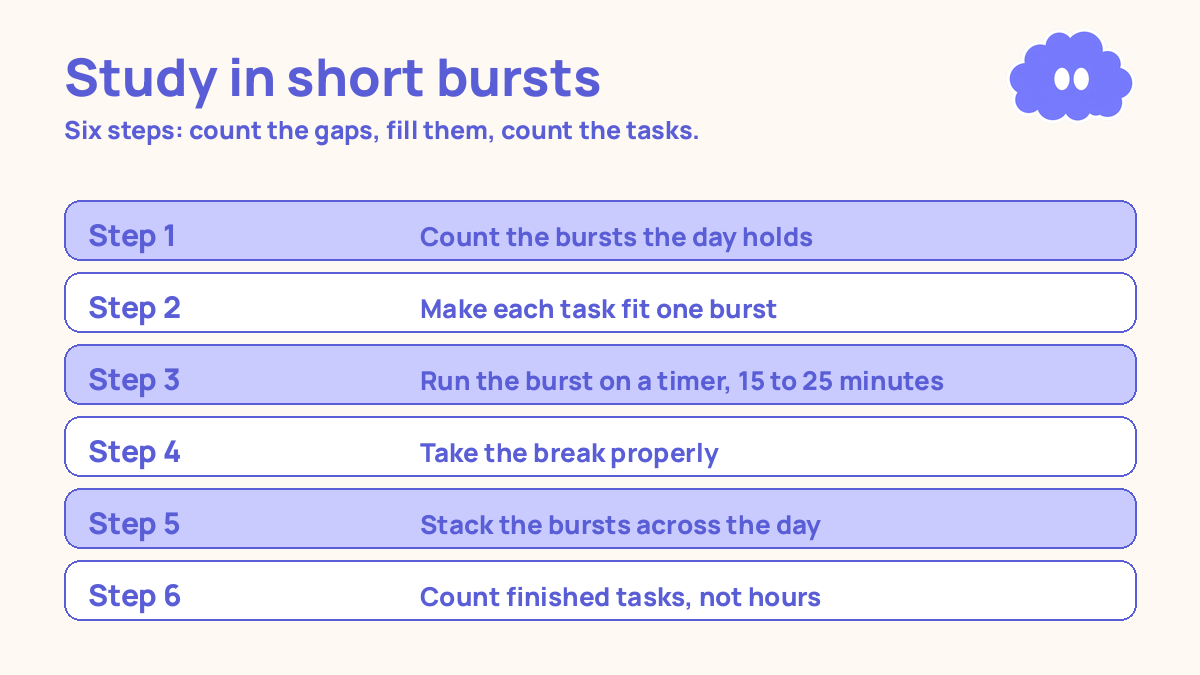
- Look at the time you actually have today, and count the bursts it holds.
- Write each burst’s task in one line, with a clear finish. One burst, one task.
- Set a timer for 15 to 25 minutes. Work on that task only until it rings.
- Take a 5-minute break. Stand up, water, look out of a window. No phone.
- Start the next burst the same way. After four bursts, take a longer break.
- At the end of the day, count finished tasks, not hours.
Step 1: Count the bursts the day actually holds
Before you plan anything, look at the day honestly. Where are the gaps? Twenty minutes before your shift. Half an hour between lectures. An hour after dinner, if you are not too tired. Write them down with their times: “7:00–7:25, before work. 12:30–12:55, between lectures. 8:00–8:25, after dinner.”
Each gap is one burst. A 15-minute gap is a burst. A 25-minute gap is a burst. A gap under 15 minutes is not a burst — it is a break. Do not plan a burst in a gap that does not exist. The most common reason short-burst studying fails is a plan that needs four hours from a day that has ninety minutes in it.
Plan the bursts the day actually holds, and the system works.
Step 2: Make each task fit one burst
A burst holds one small task. “Answer the 8 questions on photosynthesis from memory.” “Work 4 mole problems.” “Read pages 112 to 115 and write 3 questions.” “Draft one paragraph, about 150 words.” Each one fits in 15 to 25 minutes, and each one has a clear finish.
If a task is too big for one burst, split it the night before, not during the burst. “Revise chapter 6” becomes three bursts: “Answer the 5 questions on section 1.” “Answer the 5 questions on section 2.” “Write the 3 questions I still cannot answer.”
Write the tasks in order, one line each, on paper. The list is the day. When a burst starts, you look at the next line, not at your notes, not at your phone. The decision was made when you wrote the list.
Step 3: Run the burst on a timer
Set a timer for 15 to 25 minutes. Fifteen for a tired evening or a gap between lectures. Twenty-five when you have a proper half hour. The 25-minute length comes from Francesco Cirillo’s Pomodoro Technique in the late 1980s, and one thing to know honestly: it was Cirillo’s practical choice, not a number derived from cognitive science. Fifteen minutes is a practical choice too. Pick the length that fits the gap, not the other way round.
During the burst, you do the one task. If another task pops into your head, write it on the list and keep going. Do not switch. In four experiments, Rubinstein, Meyer and Evans (2001) found people lost between 614 and 1,096 milliseconds on every switch between tasks. In a 15-minute burst, two switches can eat the whole thing.
When the timer rings, stop. Even if the task is nearly done. The phone focus system for distracted students is the companion rule for the phone: put it in another room, or it will eat the burst. The burst ends when the timer says so, not when the task says so. That is what makes the next burst possible.
Step 4: Take the break properly
A 5-minute break is not a reward. It is part of the system. Stand up, get water, look out of a window, stretch. Do not open your phone. Five minutes of scrolling is not a break — it is a new task that will follow you into the next burst, and in a short-burst day there is no time to recover from it.
After four bursts, take a longer break of 15 to 30 minutes. Eat, walk, rest properly. If you skip it and push on, the fifth burst will be the one where your focus falls apart, and you will blame yourself instead of the missing break.
The break is also when you check the list. Cross off the finished task. Look at the next one.
Step 5: Stack the bursts across the day
Short bursts work because they spread across the day, and spreading is what the research supports. Cepeda and colleagues (2006) found spaced practice beat massed practice across materials and ages, and the best gap grows with how long you need to remember the material. Four bursts spread across a day — morning, midday, evening — are spaced practice. Four bursts crammed into one hour are not. The gaps between bursts are part of the learning, not dead time.
So do not try to do all four bursts in one sitting. Do one in the morning, one at midday, one in the evening. The gaps let the material settle, and the next burst starts with a quick test: “What did I do this morning?” A burst that starts by recalling the last burst is two techniques in one.
If you only have one gap today, use it for one burst and stop. One burst is not a failed day. It is one finished task, and tomorrow there will be more gaps. Short bursts are also the core of the study system for students with ADHD, which builds a whole day from short blocks with movement between them.
For the full timer version of this — 25 minutes on, 5 minutes off, a longer break after four — see the Pomodoro technique for students. Short bursts are the same idea, shrunk to fit the gaps your day actually has.
A worked example: a working student’s day
You work a shift from 9am to 5pm, with lectures at 12:30. Your gaps today: 7:00–7:25 before work, 12:30–12:55 between lectures, 8:00–8:25 after dinner. Three bursts, three tasks, written the night before.
7:00–7:25 — burst 1. Answer the 8 photosynthesis questions from memory, then check. 6 right, 2 wrong. Write the 2 wrong ones on the list for tomorrow’s burst.
7:25–7:30 — break. Water, stretch. Then work.
12:30–12:55 — burst 2. Work 4 mole problems. Problem 3 needs a formula — look it up, write it on the pad, finish. Check all 4. Done.
12:55–1:00 — break. Water, walk back to the lecture hall.
8:00–8:25 — burst 3. Start by recalling the morning: “What were the 2 photosynthesis questions I got wrong?” Answer them from memory, then check. Then draft one essay paragraph, about 150 words. Done.
8:25 — stop. Three bursts, three finished tasks, 75 minutes of focused work spread across the day. The morning burst was tested again in the evening, which is spacing and testing in one.
| Time | Burst | Task | Result |
|---|---|---|---|
| 7:00–7:25 | Burst 1 | 8 photosynthesis questions | 6 right, 2 for review |
| 12:30–12:55 | Burst 2 | 4 mole problems | Done |
| 8:00–8:25 | Burst 3 | Re-test 2 questions, draft one paragraph | Done |
When it goes wrong
You plan bursts in gaps that do not exist. The day has ninety minutes in it and you planned four hours. The fix is step 1: look at the day honestly, write down the real gaps, and plan only those. A plan that fits the day is a plan that happens.
Your tasks are too big for the burst, so every burst ends unfinished. Split them the night before. A task that takes 40 minutes is two bursts, not one burst that fails. The split is the planning, and without it the burst is just a timer on a task that cannot finish.
You skip the break and run bursts back to back. The bursts blur into one long session, and the focus falls apart by the third one. Take the 5-minute break every time. It is what makes the bursts separate, and the separation is what makes them work.
You use the burst to re-read notes, because it feels productive. Re-reading was rated low utility by Dunlosky and colleagues in 2013. In a short burst it is worse: you spend the whole burst reading and finish with nothing you can prove you know. Every burst must include testing yourself from memory, then checking.
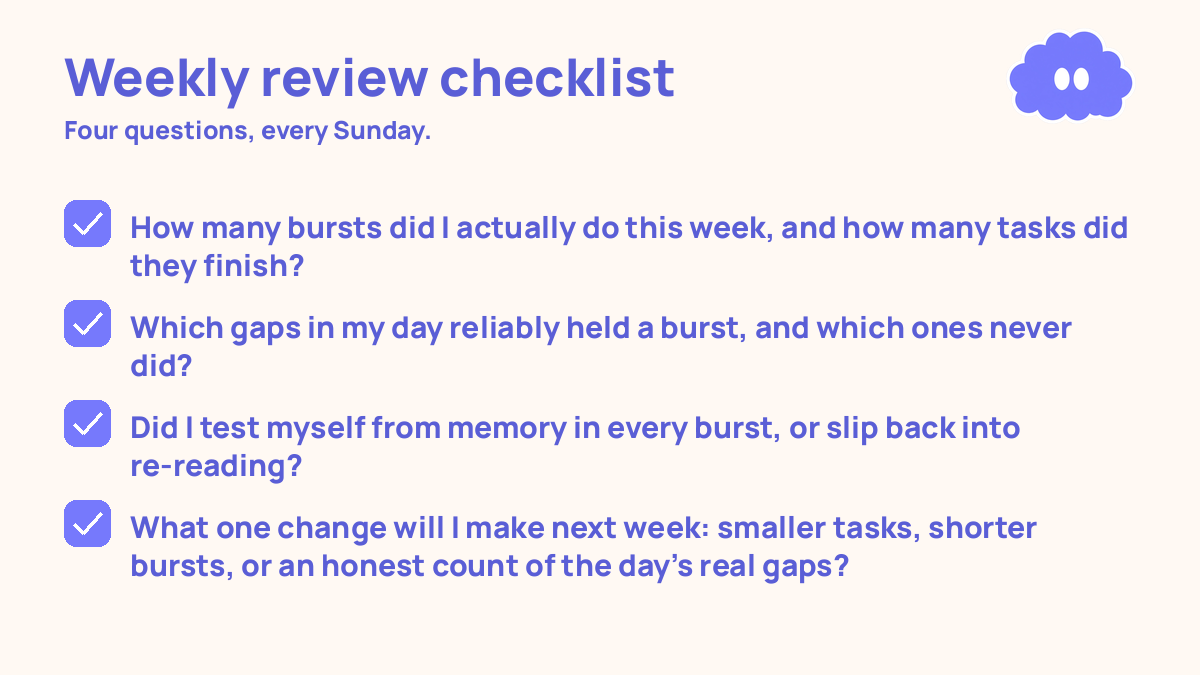
Weekly review checklist
Copy this list and use it each week:
- How many bursts did I actually do this week, and how many tasks did they finish?
- Which gaps in my day reliably held a burst, and which ones never did?
- Did I test myself from memory in every burst, or slip back into re-reading?
- What one change will I make next week: smaller tasks, shorter bursts, or an honest count of the day’s real gaps?
Downloadable infographic spec: one vertical image, title “Study in short bursts”, with the six steps — count the bursts the day holds, make each task fit one burst, run the burst on a timer, take the break properly, stack the bursts across the day, count finished tasks — and the rule “four bursts of 25 minutes is a real study day”, in Thynq cream, Cloud Purple, Dark Purple and pink, with the cloud mascot. Text taken word-for-word from this article.
What this system is not
It is not a claim that short bursts replace long study, and it is not a promise of a grade. Some work needs a long stretch: a full essay draft, a long problem set, a deep read. Short bursts are for the days when the long stretch does not exist. The research it leans on is specific: Dunlosky and colleagues (2013) rated practice testing and distributed practice as the only high-utility techniques of the ten they reviewed, and Cepeda and colleagues (2006) found spacing beat massing. Use bursts when the day is chopped up, and longer blocks when the day allows it.
Sources
- Dunlosky, J., et al. (2013). “Improving students’ learning with effective learning techniques”, Psychological Science in the Public Interest 14(1), 4–58. Only practice testing and distributed practice received a high utility rating; rereading was rated low.
- Cepeda, N. J., et al. (2006). Psychological Bulletin 132(3), 354–380. Spaced practice beat massed practice across materials, ages and retention intervals; the best gap grows with how long you need to remember the material.
- Rubinstein, J. S., Meyer, D. E. & Evans, J. E. (2001). Journal of Experimental Psychology: Human Perception and Performance 27(4), 763–797. Mean switch costs were 614 to 1,096 milliseconds per switch, larger for more complex or less familiar tasks.
- Cirillo, F. — Pomodoro Technique, late 1980s. Classic cycle: 25 minutes work, 5 minutes break, longer break after four. The 25-minute length was Cirillo’s practical choice, not a science-derived number.
Questions
How short can a burst be?
Fifteen minutes is the shortest useful burst: long enough to do one small task properly, short enough to fit between other things. Below fifteen minutes, you spend more time starting than studying.
Do short bursts work for hard subjects?
Yes, if the task is small enough. A hard subject in a short burst means one problem, one page, one set of questions — not a whole chapter. Split the hard work into burst-sized pieces the night before.
How many bursts make a real study day?
Four bursts of 25 minutes is a real study day: 100 minutes of focused work, with breaks. Six bursts is a strong day. Count finished tasks, not hours, and a day of four bursts with four finished tasks is a good day.
What if I keep getting interrupted mid-burst?
Make the burst shorter and the task smaller. A 15-minute burst with one written task survives interruptions better than a 50-minute block. Write down where you stopped, and start the next burst from there.