
The direct answer
Study in 15-minute blocks with a timer, keep one next step written where you can see it, decide your start in advance with an if-then plan, and keep your desk clear of everything except the task. This is a system for making starting easy and stopping clear — not a treatment, not a diagnosis.
If starting is the hardest part of studying for you, you are not alone in that, and it is not a character flaw. A session that begins with “sit down and study for three hours” has no clear first step, so anything else looks easier. This system fixes the size of the first step, the length of the session, and the moment you stop, so the only decision left is to begin. Everything here is practical structure: timers, written steps, a clear desk, a plan made in advance.
The system in short
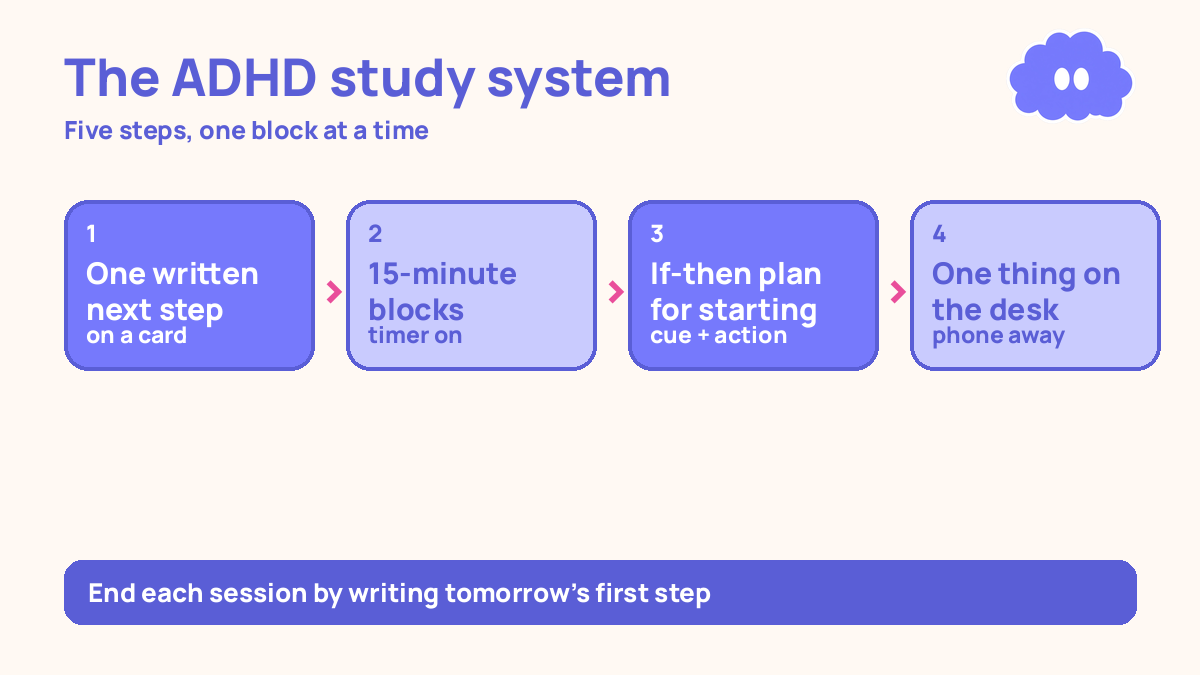
- Write the next step on a card, in one line, before you start. Not the goal — the step.
- Study in 15-minute blocks with a timer. One block, one task, then a 5-minute break.
- Decide the start in advance: “When I finish lunch, I will open the book to page 40.”
- Keep one thing on the desk: the task. Everything else goes in another room or in a drawer.
- Write down distractions instead of following them. A scrap of paper catches them.
- End every session by writing tomorrow’s first step. Never end on a blank page.
Step 1: Write the next step, not the goal
“Revise biology” is not a step. It is a goal, and goals do not tell you what to do with your hands. “Answer the 5 questions on cell division on page 42” is a step.
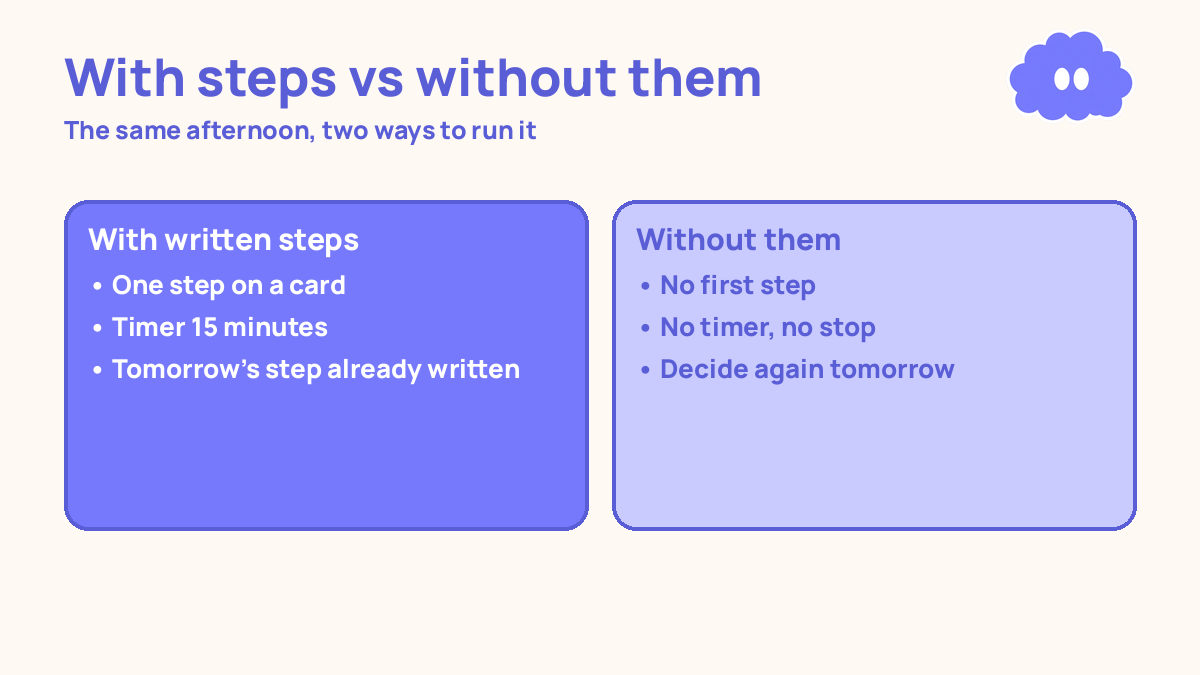
Before every session, write the next step on a card in one line and put the card where you can see it. If you cannot write it in one line, the step is too big — split it.
This matters because every switch costs you. Rubinstein, Meyer and Evans found in 2001 that people lost time on every switch between tasks, with mean switch costs of 614 to 1,096 milliseconds per switch, growing as the tasks got more complex. Every time you stop to decide what to do next, you have to decide to start again. A written step removes that decision.
For more on keeping the work visible and small, the study system for students who get distracted covers the same ground from the distraction side.
Step 2: Fifteen-minute blocks, one task, timer on
Set a timer for 15 minutes. Work on the one task on the card until it rings, then take a 5-minute break, away from the desk. That is one block — three blocks is a good session, four is a strong one.
Fifteen minutes is the starting length, not a rule. If 15 feels easy after a week, try 20; if 15 feels too long, try 10. The right length is the one you actually finish — a 15-minute block you complete beats a 60-minute plan you abandon.
The timer does two jobs: a start you cannot negotiate with — when the timer starts, you start — and a stop you can trust. Knowing the block ends in 15 minutes makes it easier to stay in, and knowing you can stop makes it easier to begin.
The 15-minute length is a practical choice, not a number from cognitive science — the same is true of the classic 25-minute Pomodoro: Francesco Cirillo’s 25 minutes was a practical choice, not a science-derived number. Use the length that works for you and keep the structure.
Step 3: Decide the start in advance with an if-then plan
The hardest moment in a study day is the moment you have to decide to start. An if-then plan moves that decision to an earlier moment, when deciding is easy: “When I finish lunch, I will open the book to page 40 and start the timer.” The cue is lunch ending, the action is opening the book — both named in advance.
Gollwitzer and Sheeran’s 2006 meta-analysis of 94 studies found if-then plans raised goal attainment by a medium-to-large amount (d = 0.65) over holding the goal alone. The effect was largest when the plan used the if-then format, the person cared about the goal, and the plan had been rehearsed at least once. So rehearse it: say it out loud once when you make it.
Make one if-then plan per day, for the first block only. Once the first block is done, the second one is easier — you are already sitting down, the desk is already clear, and the next step is already written.
Write the plan on the same card as the next step. One card, two lines: the step, and the if-then plan for when you will do it.
Step 4: One thing on the desk
Clear the desk before you start. One thing on it: the task — the book, the paper, the pen. Everything else goes in a drawer or in another room, including your phone.
The phone deserves its own rule. One study found that a phone on the desk cost focus even when it was off — but a later replication did not find the effect, so the evidence is mixed. This system treats “phone in another room” as a practical rule, not a proven fact.
The same rule applies to the screen: one window open, one task in it. Close the other tabs. Every open tab is a switch waiting to happen, and every switch costs time and attention.
Set up the desk the night before if you can. A clear desk and a written card mean the morning has no setup to do, and no reason to put it off.
Step 5: Write down distractions, and end with tomorrow’s first step
Distractions will come: a thought, a message you should send, a thing you forgot to do. Write it on a scrap of paper and keep going. Do not switch to it. Do not open the app.
The scrap of paper works because it takes the thought out of your head without taking you out of the task. At the break, look at the paper: most of the things on it will not need doing, and the ones that do go on tomorrow’s list.
End every session by writing tomorrow’s first step on a fresh card. Never end on a blank page — a blank page tomorrow morning means a decision tomorrow morning, and decisions are where sessions fail.
Missing a day does not break the system. Lally and colleagues found in a 2010 study of 96 people that the median time for a new daily behaviour to feel automatic was 66 days, with a range of 18 to 254 days — and missing a single day did not measurably hurt the process.
A worked example: a Monday afternoon after lectures
You have a 3pm to 5:30pm afternoon and a biology test on Friday.
2:55 — Set up: Desk cleared the night before. One card on the desk: “Answer the 5 questions on cell division, page 42.” 3:00–3:15 — Block 1: Answer the 5 questions from memory, then check. Two wrong — they go on tomorrow’s card. 3:20–3:35 — Block 2: Read the section on mitosis, one page only, and write 3 questions about it on the back of the card. 3:40–3:55 — Block 3: Answer the 3 new questions from memory, then check. One wrong — it goes on tomorrow’s card. 4:00–4:15 — Block 4: Review yesterday’s questions from memory. Four right, one wrong — the wrong one stays on the card. 4:20–4:35 — Block 5: Write tomorrow’s first step on a fresh card: “Answer the 3 questions on mitosis, then start the meiosis questions on page 48.” Put the card on the desk. Session done.
Two and a half hours, five blocks, 8 questions tested, one section read, and tomorrow’s first step already written.
| Time | Block | What you do |
|---|---|---|
| 3:00–3:15 | Block 1 | 5 questions from memory, then check |
| 3:20–3:35 | Block 2 | Read one page, write 3 questions |
| 3:40–3:55 | Block 3 | Answer the 3 new questions, check |
| 4:00–4:15 | Block 4 | Review yesterday’s questions |
| 4:20–4:35 | Block 5 | Write tomorrow’s first step |
When it goes wrong
You sit down and cannot start. The step is too big or it is not written. Write it on a card in one line. If you cannot write it in one line, split it. Then use your if-then plan.
You keep leaving the block to follow a thought. The scrap of paper is missing. Put it on the desk before you start. Write the thought down, keep going.
Fifteen minutes feels too long and you keep stopping at 8. Drop to 10-minute blocks for a week. Ten minutes you finish beats 15 you abandon.
You miss a day and feel like the system is broken. It is not. Lally’s study found that missing a single day did not measurably hurt habit formation. Do the next day’s block and carry on.
Weekly review checklist
Copy this list and use it each week:
- Did I write the next step on a card before each session?
- Did I finish most of my 15-minute blocks, or keep stopping early?
- Did I use an if-then plan for the first block each day?
- Was my desk clear — one task on it, phone in another room?
- Did I write distractions on the scrap of paper instead of following them?
- Did I end each session by writing tomorrow’s first step?
- What one change will I make next week: shorter blocks, a clearer desk, or a better if-then plan?
Downloadable infographic spec: one vertical image, title “The ADHD study system”, with the five steps — one written next step, 15-minute blocks with a timer, an if-then plan for starting, one thing on the desk, write distractions down and end with tomorrow’s first step — and the block rule — 15 minutes work, 5 minutes break, three blocks is a good session — in Thynq cream, Cloud Purple, Dark Purple and pink, with the cloud mascot.
What this system is not
It is not a treatment, a diagnosis, or a claim about how any brain works. It is a practical system of structure — timers, written steps, a clear desk, a plan made in advance — for a student whose attention wanders.
Sources
- Gollwitzer, P. M. & Sheeran, P. (2006). Implementation intentions and goal achievement. Advances in Experimental Social Psychology, 38, 69-119. Across 94 studies, if-then plans raised goal attainment by a medium-to-large amount (d = 0.65).
- Rubinstein, J. S., Meyer, D. E. & Evans, J. E. (2001). Executive control of cognitive processes in task switching. Journal of Experimental Psychology: Human Perception and Performance, 27(4), 763-797. Mean switch costs 614 to 1,096 milliseconds per switch, growing with complexity.
- Lally, P., et al. (2010). How are habits formed. European Journal of Social Psychology, 40(6), 998-1009. Median time for a behaviour to feel automatic was 66 days, range 18-254; missing a single day did not measurably hurt the process.
- Ward, A. F., et al. (2017). Brain drain. Journal of the Association for Consumer Research, 2(2). One study found a phone on the desk cost focus even when off; a later replication (Ruiz Pardo & Minda, 2022) did not find the effect, so the evidence is mixed.
- Dunlosky, J., et al. (2013). Improving students’ learning with effective learning techniques. Psychological Science in the Public Interest, 14(1), 4-58. Only practice testing and distributed practice rated high utility.
- Cirillo, F. — Pomodoro Technique, late 1980s. 25 minutes work, 5 minutes break, longer break after four. The 25-minute length was Cirillo’s practical choice, not a number derived from cognitive science.
For the full system behind this one, start with how to build a study system that fits your life, and for shorter sessions, the study system for students who get distracted covers the same ground from the distraction side. For the shortest sessions, how to study in short bursts covers the 10-minute version.
Questions
How long should a study block be?
Start with 15 minutes. If 15 feels easy after a week, try 20. The right length is the one you actually finish, not the one that sounds impressive.
What do I do when I keep getting distracted mid-block?
Write the distraction on a scrap of paper and keep going. Do not switch to it. At the break, look at the paper and decide if it needs doing — most of the time it does not.
How do I start when I cannot get myself to sit down?
Decide the start in advance with an if-then plan: when I finish lunch, I will open the book to page 40. Starting is easier when the decision was already made.
What if I miss a day?
Nothing resets. In one study of habit formation, missing a single day did not measurably hurt the process. Do the next day’s block and carry on.