
The direct answer
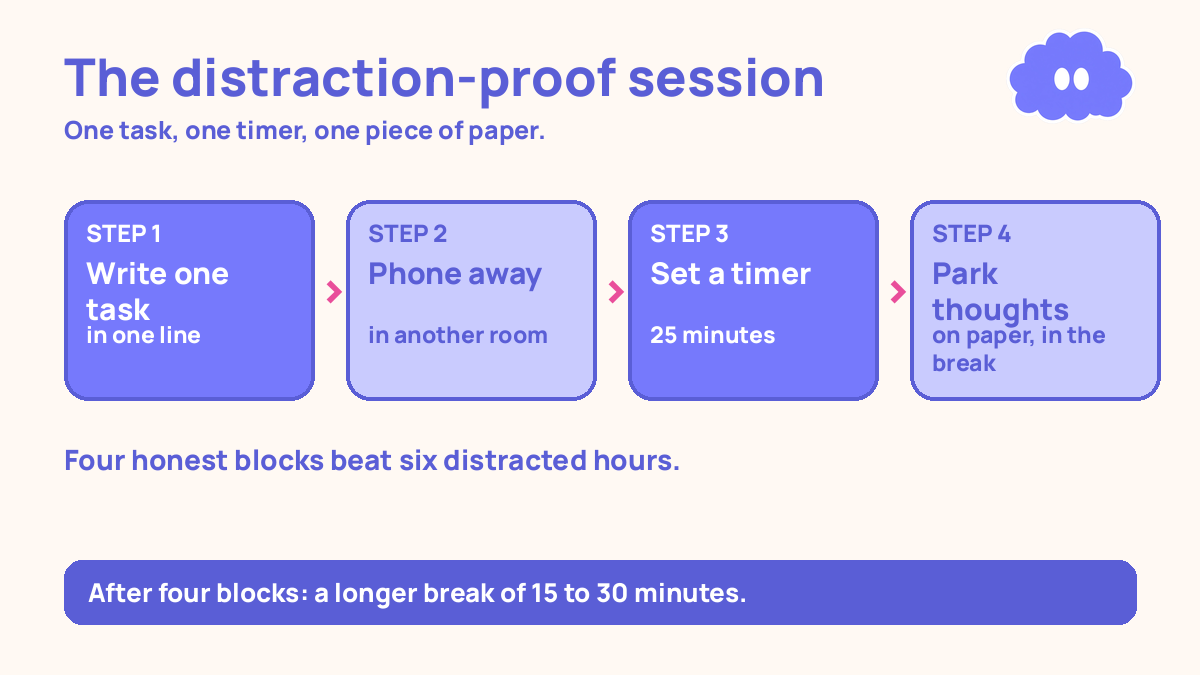
A study system for a distractible brain is: one task written down in one line, your phone in another room, a timer set for 25 minutes, and a paper list beside you for every stray thought. Work on that one task until the timer rings, take a real 5-minute break, then repeat. Distraction is not banned — it is parked on paper, and dealt with in the break.
You are not lazy. Your setup is doing the distracting. Fix the setup, and the same brain can hold a session.
Why “just focus” does not work
“Just focus” is advice for a brain that is already focused. If your attention drifts every few minutes, the problem is rarely effort. It is that the session has no shape: a vague task, a phone in reach, twenty tabs open, and no clear end. Every one of those is an invitation to drift, and your brain accepts the invitations because there is nothing holding it in place.
So this system does not ask you to try harder. It removes the invitations, one by one, and gives your attention something small and concrete to hold: one task, one timer, one piece of paper.
For the full system behind this one, start with how to build a study system that fits your life. This article is that system, fitted to a brain that wanders.
The system in short
- Write one task in one line before you start. Not “study biology” — “answer the 10 questions on cell division from memory.”
- Put your phone in another room, on silent. Not face down on the desk — another room.
- Close every tab except the one you need. One tab, one task.
- Set a timer for 25 minutes and start. Work on that one task only.
- Every stray thought goes on a paper list beside you. Check the list in the break, not during the block.
- When the timer rings, take a 5-minute break away from your desk. After four blocks, take a longer break of 15 to 30 minutes.
- At the end of the day, count finished blocks, not hours. Four honest blocks beat six distracted hours.
Step 1: Write the task before you touch anything else
A vague task is a distracted session waiting to happen. “Revise chemistry” can mean anything, so your brain picks the easiest thing in the room — usually the phone. A task written in one line cannot mean anything: “Work through the five mole-calculation problems on page 42.” You either did it or you did not.
Write it on paper, in one line, before you open a book or a laptop. If you cannot write it in one line, the task is too big — split it. A block holds one small, finished piece of work: one set of questions, one section of notes, one page of a draft.
Keep the task visible while you work. When your attention drifts, the line is there to pull it back: this is the task, this is the only task, the timer will ring.
Step 2: Remove the phone from the room
This is the step that does the most work, and the one people skip. A phone on silent, face down, on the desk, is still a phone you can check in two seconds. A phone in another room is a phone you have to stand up and walk to. That distance is the whole trick. Willpower fails; distance works.
If you need a timer, use a kitchen timer, a watch, or a laptop timer — with the phone still in another room. If you need the phone for the work itself, put it on silent, open only the app you need, and put it face down the moment that job is done. A timer on the same device as your messages is a timer that loses.
The same rule applies to the laptop: one tab for the task, everything else closed. Twenty tabs are twenty invitations. One tab is one job. The phone focus system for distracted students is this same idea, applied to the phone in detail: phone in another room, timer on, one task at a time.
Step 3: Use a timer, and trust the end
Set a timer for 25 minutes and start. The timer does two jobs. First, it gives you a start you cannot negotiate with — the session starts when the timer starts, not when you feel ready. Second, it gives you an end you can trust — you only have to hold focus until it rings, and then you get a break.
The 25-minute block comes from the Pomodoro Technique, built by Francesco Cirillo as a university student in the late 1980s: 25 minutes of work, 5 minutes of break, a longer break after four rounds. The 25-minute length was his practical choice, not a number derived from cognitive science — but the structure is what helps a wandering brain: a clear start, a clear stop, and a break you actually take.
If 25 minutes is too long at first, start with 15. A 15-minute block you finish is worth more than a 25-minute block you abandon. Build up over a week. The timer still does the same job at any length.
For a longer task that needs a proper run — writing, problem sets — try 50-minute blocks once the 25-minute habit holds. Do not start with the longer block. Short and finished beats long and abandoned.
Step 4: Park every stray thought on paper
Your brain will interrupt you. “I need to reply to Sara.” “Did I pay that bill?” “What was that video?” Do not fight the thought, and do not follow it. Write it on a paper list beside you — one line, no detail — and keep going. The thought is parked, not lost. You will deal with it in the break.
This works because the fear behind most distractions is forgetting. Writing the thought down removes the fear. Following it removes the session. The list is the difference.
If the same thought appears every session — the same person, the same worry, the same task — it is not a distraction, it is a job you have not done. Schedule it. A thought that returns daily is a system gap, not a focus failure.
Step 5: Take the break properly
A 5-minute break is not a reward for finishing. It is part of the system. Stand up, get water, look out of a window, stretch. Check the paper list if you need to — one or two small things, then stop. Do not open your phone. Five minutes of scrolling is not a break, it is a new distraction that will follow you into the next block.
The longer break after four blocks is when you eat, walk, or rest properly. If you skip it and push on, the fifth block will be the one where your focus falls apart, and you will blame yourself instead of the missing break.
A worked example: an evening that usually falls apart
You sit down at 6pm to revise. Normally, by 6:20pm you have checked your phone four times, opened three tabs, and done nothing.
6:00 — Set up (2 minutes): Task written down: “Answer the 10 cell-division questions from memory.” Phone in the kitchen. One tab open. Paper list beside you. Timer set for 25 minutes. 6:00–6:25 — Block 1: Three stray thoughts go on the paper list. You keep going. Ten questions answered, checked against your notes. Three wrong — they go on tomorrow’s list. 6:25–6:30 — Break: Water, stretch, check the paper list. One reply to Sara — sent, done, phone back in the kitchen. 6:30–6:55 — Block 2: Five mole-calculation problems. One thought parked. Problems done. 6:55 — Stop: Two blocks, two finished pieces of work. You know exactly what you did, and the paper list is empty.
The evening did not need more willpower. It needed a task on paper, a phone in another room, and a timer.
When it goes wrong
You keep checking your phone during the block. The phone is too close. Another room is the rule, not a suggestion. If you work in a library or a shared room and cannot leave it in another room, put it in your bag, zipped, on silent, at the bottom. Two seconds to check becomes twenty seconds of unzipping — and that is usually enough.
You finish a block and immediately open social media “for five minutes”. Five minutes becomes forty, and the next block never starts. The break is for water, air, and stretching — not for the thing you just removed from the room. If the phone is the break, the phone is still running the session.
Every block is broken by someone else. If people interrupt you, the block is broken — note where you stopped, deal with it, and start a fresh one. That sounds strict, and it is, but it is also honest: a broken block was not 25 minutes of focus, and counting it as one lies to you about how much you actually did. If interruptions are daily, the fix is a place or an hour, not more effort — a library slot, or an agreed quiet hour.
You use the timer but still just re-read notes. The timer only controls time. What you do inside it still matters. Use blocks for testing yourself, not re-reading: answer questions from memory, work problems, write from recall. In a 2013 review, Dunlosky and colleagues rated ten common study techniques, and only two received a high utility rating: practice testing and distributed practice. Re-reading was rated low. A block spent re-reading is a well-timed version of the weakest method.
Weekly review checklist
Copy this list and use it each week:
- How many blocks did I actually complete this week, and how many were broken by the phone, by other people, or by tasks too big?
- Which setup step helped most — phone in another room, one tab, the paper list, or the timer?
- What thought keeps appearing on the paper list, and is it a job I should schedule instead of parking?
- What one change will I make next week: a different block length, phone further away, smaller tasks, or a different study place?
Downloadable infographic spec: one vertical image, title “The distraction-proof session”, with the four setup steps — one task written down, phone in another room, one tab open, stray thoughts on paper — and the cycle 25 work / 5 break, in Thynq cream, Cloud Purple, Dark Purple and pink, with the cloud mascot. Text taken word-for-word from this article.
What this system is not
It is not a promise of a grade, and it is not a claim that distraction is a character flaw you can fix by trying harder. Some brains wander more than others, some rooms are noisier than others, and some days the phone wins. This is a practical system for a wandering brain: one task, one timer, one piece of paper, and a phone in another room. If a step does not help, change one step and check after a week — do not change everything at once, or you will never know what actually helped.
Sources
- Dunlosky, J., et al. (2013). Improving students’ learning with effective learning techniques. Psychological Science in the Public Interest, 14(1), 4-58. Only practice testing and distributed practice received a high utility rating; rereading was rated low.
- Cirillo, F. — Pomodoro Technique, late 1980s. Classic cycle: 25 minutes work, 5 minutes break, longer break after four. The 25-minute length was Cirillo’s practical choice, not a number derived from cognitive science.
For the full system behind this one, start with how to build a study system that fits your life. If your phone is the main problem, the phone focus system for distracted students goes deeper on it. And if you want the timer itself explained step by step, use the Pomodoro technique for students.
Questions
Is getting distracted a willpower problem?
Mostly no. It is a setup problem. A phone on the desk, twenty open tabs, and a vague task will distract almost anyone. Fix the setup first — one task, phone away, timer on — and willpower has far less to do.
What do I do with thoughts that pop up while I study?
Write them on a paper list beside you and keep going. The thought is parked, not lost. Check the list in your break. If you follow every thought the moment it appears, the session becomes twenty half-started things.
How long should a study block be if I get distracted easily?
Start with 25 minutes. A short block with a clear end is easier to hold than an hour with no end. If 25 minutes is still too long, start with 15 and build up over a week — the timer still does the same job.
Do I need to block apps and websites?
Blocking helps, but removing the phone from the room helps more. A block you can switch off in two taps is a suggestion, not a wall. Distance is the wall: phone in another room, one tab open, one task written down.