The direct answer
How to study when you work as a cleaner is mostly a sleep and timing problem: map every contract by its start and finish times, protect the night before an early start, and place one anchor study block in the middle of the day or on a day off. Cleaning shifts leave no usable study time on site.
Most cleaning work sits at the edges of the day: offices cleaned before staff arrive or after they leave, often as a stacked morning and evening contract. Paid hours can look small while the day they span is very long, so evening study advice fails. After an evening clean you are tired. Before a morning clean you are asleep. The system below places study where your brain is awake.
The system in short
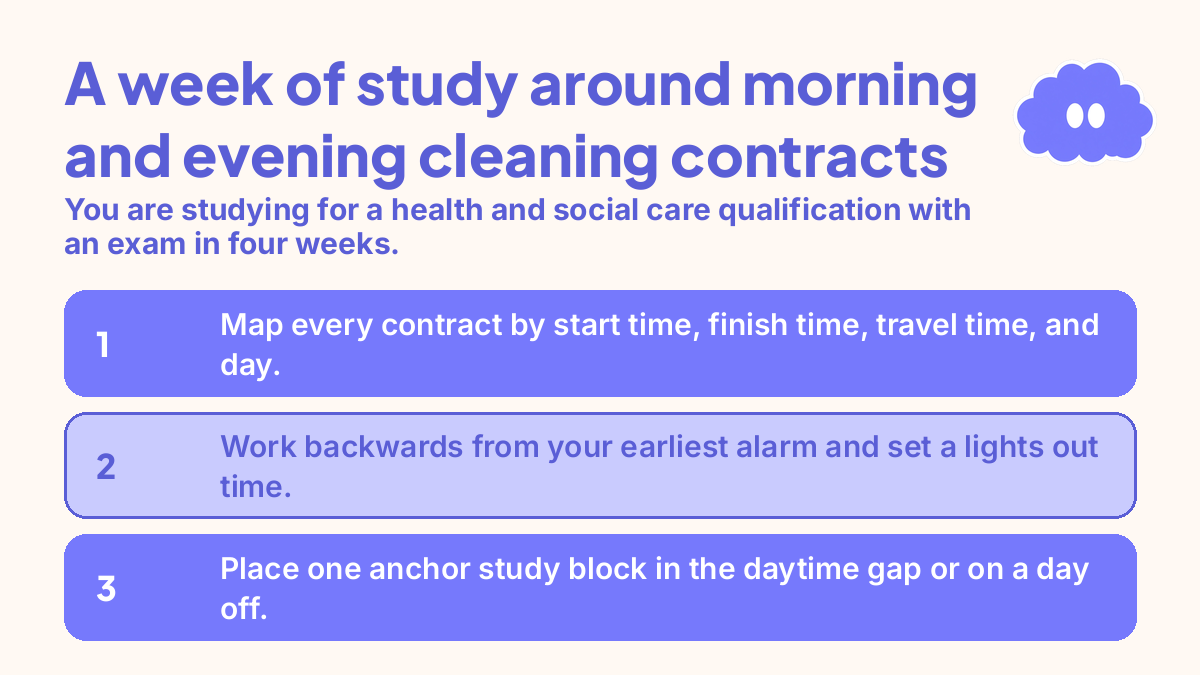
- Map every contract by start time, finish time, travel time, and day.
- Work backwards from your earliest alarm and set a lights out time.
- Place one anchor study block in the daytime gap or on a day off.
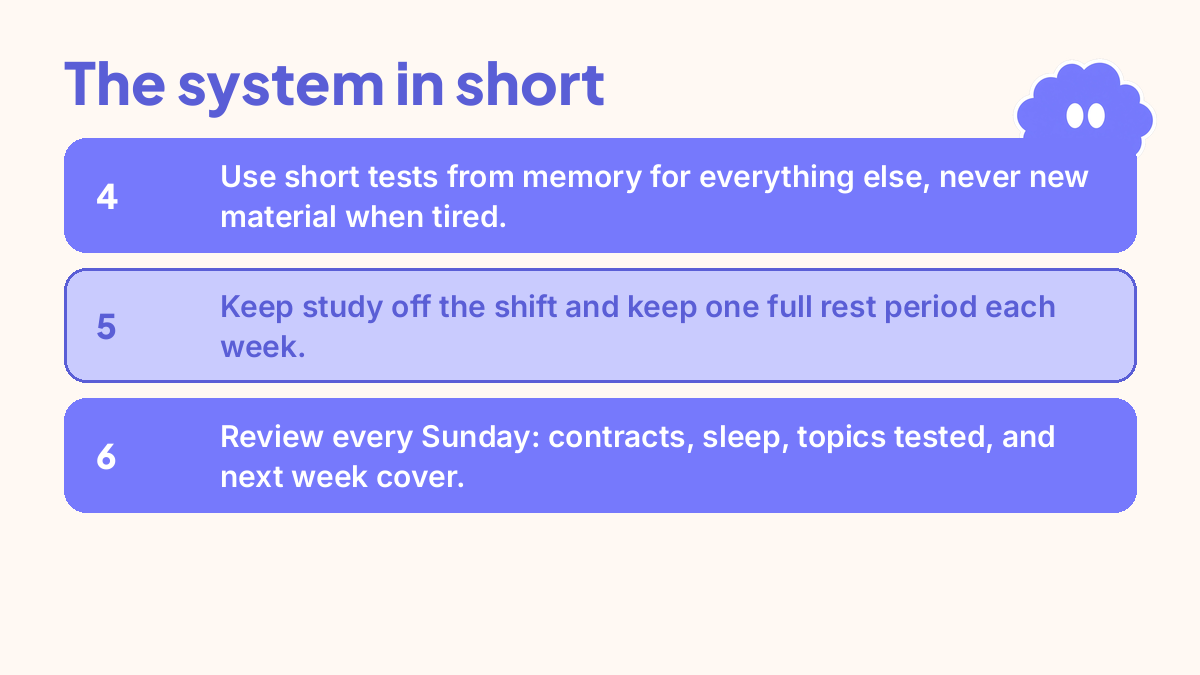
- Use short tests from memory for everything else, never new material when tired.
- Keep study off the shift and keep one full rest period each week.
- Review every Sunday: contracts, sleep, topics tested, and next week cover.
Step 1: Map every contract before you plan any study
Start with the contracts, not with the course. Write down one normal week in full: each clean, its start and finish times, and the journey each way. A 5am to 8am clean with a 30 minute bus ride each way is not a three hour commitment. It is a 4:15am alarm and a return home at about 8:30am. Fifteen paid hours spread across five mornings and five evenings can span 5am to 9pm every weekday, so planning from paid hours alone puts study in the wrong places.
Mark three things: your earliest alarm each day, the true gap between contracts minus travel and food, and the days with no evening clean or no work. Those marks decide where study can go. For a broken day, How to study when you work split shifts and Study system for shift-work students give the wider rules. Update the map the day any contract changes.
Step 2: Set your sleep window backwards from the alarm
Sleep is the fixed point. Study moves around it. If your alarm is 4:15am and you aim for seven hours in bed, lights out is 9:15pm, so study must end by about 8:30pm. That one calculation rules out late evening study before an early clean, which is the point. It stops a 10pm session from quietly stealing an hour of sleep. If you work evenings only, run the rule forwards: study late morning or early afternoon, before the shift, not after a 9pm finish. For tired evenings in general, How to study when you are tired after work sets out the rest first rule.
Protect the window with small actions: clothes laid out the night before, food before bed, and any daytime nap kept short and early. Write the lights out time on the map. When study runs long, cut the study, not the sleep. A topic can wait a day. Short nights make every topic harder.
Step 3: Place one anchor block where your brain is awake
An anchor block is one planned session of 50 minutes at a time when you are awake, fed, and not about to leave for work. With morning and evening contracts it usually sits in the middle of the gap, for example 11am to 11:50am, after food and rest. With mornings only it can sit after lunch. With evenings only it can sit at 10:30am. Keep the same clock time on each working day, and give the block one topic.
Use the anchor for the hardest work: 15 minutes testing from memory, 25 minutes fixing gaps, 10 minutes writing three questions you still cannot answer. Testing from memory supports later recall far better than repeated reading, so new material belongs here, where your head is clear. On a day off, run two or three anchors on one main topic. If an anchor is missed, move it. Never add a late night block.
Step 4: Use short tests from memory around the anchor
Around the anchor, use short tests that survive tiredness: 10 minutes on the bus, 15 minutes while food cooks, or 20 minutes before the evening shift. These tests keep topics reachable between anchors. They are not a place to meet a topic for the first time. Build their material during the anchor block. End each anchor by writing five to ten questions on cards or in a notebook, answers on the back. Keep the set small and current: this week topics only.
Answer from memory before you look. Wrong cards stay in the set. Right cards return after a longer gap, because spreading tests over days supports later recall better than massing them. Keep study off site: cleaning is timed and physical, often alone with chemicals and machinery, so there is no safe way to revise between tasks. Tests belong on journeys and at home. See How to study in short bursts. Floor for bad weeks: two 25 minute tests and one review.
Step 5: Plan for cover, deep cleans, and contract changes
Cleaning weeks change. A colleague is ill, a school books a holiday deep clean, or a mobile role adds a building. When cover is booked, update the week map the same day and move the anchor blocks. Move them, do not stack them. Keep one buffer day with no anchor planned, which can take a moved block. If the buffer is not used, rest. A buffer filled in advance is not a buffer.
Exam weeks need earlier action. As soon as exam dates are published, check them against your contracts. An exam at 9am after a 5am to 8am clean is a hard start. Ask about swapping the shift before the exam while a supervisor can still plan cover. The wording for that conversation is in How to ask your boss for study time. On a day when your body is spent, shrink study to a short test or stop. New material studied when spent has to be redone. The wider rules are in How to study when your job is physical work.
Step 6: Review every Sunday in 20 minutes
Every Sunday, spend 20 minutes with your week map, your wrong answer list, and next week contracts. Count the hours you worked, including travel, and the study minutes you actually did. Name the topics you tested from memory and the topics you only read. Reading without testing feels productive and often is not, so the review must separate the two.
Keep a dated wrong answer list. Test the oldest items first. Remove an item after two correct answers on different days. An item still wrong after three tests becomes the first topic of the next anchor. Place next week anchors on the map, choose one change only, and if study collapsed, name the broken rule and fix that one.
A worked example
Your situation: You are studying for a health and social care qualification with an exam in four weeks. You clean offices from 5am to 8am and again from 6pm to 9pm, Monday to Friday, with a 30 minute journey each way. That is 30 paid hours a week. You wake at 4:15am and set lights out at 9:15pm. You have five topics: infection control, safeguarding, communication, record keeping, and health and safety law.
- Monday: anchor block 11am to 11:50am on infection control, testing from memory first. 50 minutes.
- Tuesday: anchor block 11am to 11:50am on safeguarding, plus a 15 minute card test before the evening shift. 65 minutes.
- Wednesday: no anchor. One 25 minute test from memory on infection control and safeguarding, then rest. 25 minutes.
- Thursday: anchor block 11am to 11:50am on communication, plus a 15 minute card test before the evening shift. 65 minutes.
- Friday: anchor block 11am to 11:50am on record keeping. 50 minutes.
- Saturday, a day off: two 50 minute blocks on health and safety law, with a break between them. 100 minutes.
- Sunday: 20 minute review and wrong answer test. 20 minutes.
Count the week: 50 plus 65 plus 25 plus 65 plus 50 plus 100 plus 20 is 375 minutes, which is 6 hours and 15 minutes of study alongside 30 paid hours of cleaning. Week two repeats the shape with the topic order rotated. Week three replaces the Saturday blocks with timed past paper questions. Week four keeps the anchors but shortens them, so sleep stays protected before the exam.
When it goes wrong
You keep studying after the 9pm finish and remember little. That is the expected result of studying when tired and close to bed. Move the work to the daytime anchor and keep the evening for food, washing, and rest. Test the same topic again in the next anchor to see what stayed.
The daytime gap fills with chores and the anchor vanishes. The gap holds travel, food, rest, and home duties. Protect 50 minutes of it by naming the clock time in advance. If the gap is too full on a given day, move the anchor to the buffer day rather than pushing it to 10pm.
You are offered extra cover every week and cannot refuse the money. Take the cover if you must, and shrink study to the floor: two 25 minute tests and one 20 minute review. Tell your tutor early if deadlines will slip. A smaller honest week keeps the course alive.
A new contract changes your start times. Rebuild the week map on the day the new times are confirmed. Recalculate the alarm and lights out time first, then place the anchors. Do not carry old anchor times into a new pattern.
You fall asleep in the anchor block. Check the night before first. A short night or a long late nap will do this. Shorten the anchor to 25 minutes of testing, eat, and rest. If sleepiness lasts for weeks despite a protected window, treat it as a health matter and seek advice.
Weekly review checklist
- How many hours did I work this week, including travel, and how many minutes did I study?
- Did I keep my lights out time on every night before an early start?
- Which topics did I test from memory, and which did I only read?
- Which answers are still wrong after three tests?
- What cover, deep cleans, or contract changes are booked for next week?
- What is the one change I will make next week?
Downloadable infographic spec: A vertical 1000 by 1500 image in Thynq colours, cream background, cloud-purple headings, phoenix-pink accents, and the Thynq cloud mascot at the top. Title: “How to study when you work as a cleaner”. Six steps, word for word from the article: “Map every contract before you plan any study”, “Set your sleep window backwards from the alarm”, “Place one anchor block where your brain is awake”, “Use short tests from memory around the anchor”, “Plan for cover, deep cleans, and contract changes”, “Review every Sunday in 20 minutes”. Then the six review questions, word for word: “How many hours did I work this week, including travel, and how many minutes did I study?”, “Did I keep my lights out time on every night before an early start?”, “Which topics did I test from memory, and which did I only read?”, “Which answers are still wrong after three tests?”, “What cover, deep cleans, or contract changes are booked for next week?”, “What is the one change I will make next week?”.
What this system is not
It is not a way to study on shift, nor permission to cut corners at work. Cleaning done badly can put people at risk. It is not a promise of a grade. It places a small amount of study where it can work. Beyond about 40 split hours a week, no timetable makes study easy. In exam weeks, fewer hours help most.
Sources
- Karpicke and Roediger (2008). The critical importance of retrieval for learning. Science, 319(5865), 966 to 968. Supports the testing from memory rule in the anchor block and the short card tests.
- Cepeda, Pashler, Vul, Wixted and Rohrer (2006). Distributed practice in verbal recall tasks: A review and quantitative synthesis. Psychological Bulletin, 132(3), 354 to 380. Supports spreading tests over days rather than massing them in one sitting.
- Clean Sweep Jobs (2026). Office cleaning hours: Shift patterns explained. Supports the dawn and evening contract windows, short contract lengths, and stacked morning and evening shifts described in Step 1.
- Learning Sphere (2025). Study tips for achieving a qualification while working. Supports breaking study into small tasks and keeping a simple log, adapted here into anchor blocks and a wrong answer list.
Questions
Can I study during a cleaning shift?
No, not in any useful way. Cleaning is active work done to a checklist, often alone and often timed, so there is no quiet desk time to use. Keep study off the shift completely. Your study time comes from the gap between contracts, from one anchor block on a day without an evening clean, and from a day off. That boundary also keeps you safe at work.
Should I study in the gap between a morning and an evening clean?
Yes, but only in one planned block, and only after food and rest. The gap between a 5am to 8am clean and a 6pm to 9pm clean looks long, yet travel, food, and sleep debt eat most of it. Use 50 minutes in the middle of the gap for one topic, then stop. Trying to fill the whole gap with study leaves you too tired for the evening shift.
How do I study with a 5am start without losing sleep?
Work backwards from the alarm. If you must wake at 4:15am, lights out at 9:15pm gives you seven hours, so study must end by about 8:30pm. Put study in the daytime gap or on a day off, never after the evening clean. If you work evenings only, the same rule runs in reverse: study before the shift, not after it.
What should I do when extra cleaning cover wipes out my study day?
Move the block, do not double it. Extra cover, holiday cover, and a weekend deep clean will happen, so plan for them. Drop to the minimum week: two 25 minute tests from memory and one 20 minute review. Then put the missed heavy learning on the next day off. One lost day is normal. A week of trying to catch up is what breaks the system.