The direct answer
How to study when you are on call for work: never plan study in on-call time. Plan only in time that is certainly free, and keep every session short and interrupt-proof, so a call-out costs you minutes, not the day.
On-call work is different from a changing rota, because a rota at least tells you the hours. On call, you do not know if the phone will ring, when it will ring, or how long the call-out will last. A plan that assumes a quiet evening will break the first time the phone rings. The system below splits your week into certain time and maybe time, makes every session survive an interruption, and puts the hard work where the phone cannot reach it.
The system in short
- Split the week into certain time and maybe time. Plan study only in certain time.
- Make every session interrupt-proof: one task, one chunk, and a kit that is always packed.
- Use the call-out drill when the phone rings: stop at once, write one line about where you stopped, and go.
- Use on-call quiet hours for retrieval only, never for new material.
- Put the hard work on off-call days: long blocks, hardest task first.
- Ask for the on-call rota earlier and for protected cover around exams, using the words in Step 6. Review on Sunday for 15 minutes.
Step 1: Split the week into certain time and maybe time
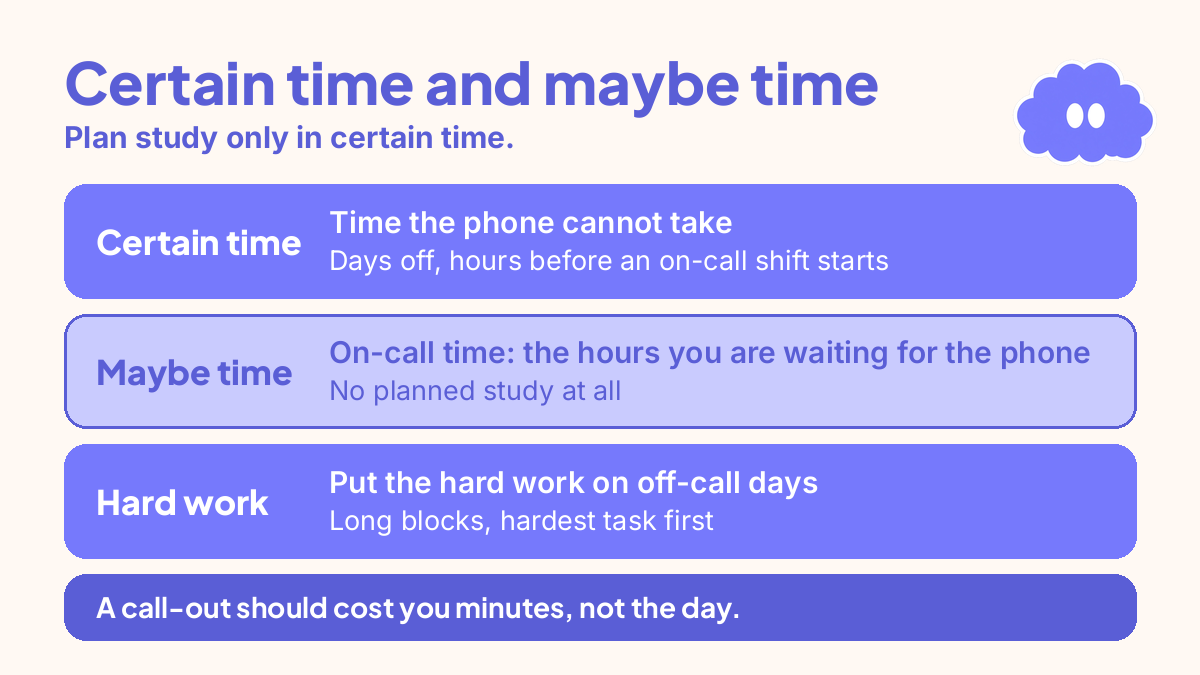
Start by marking your week in two colours. Certain time is time the phone cannot take: days off, hours before an on-call shift starts, and the hours after an on-call shift ends when you are not on call. Maybe time is on-call time: the hours you are waiting for the phone, including evenings and weekends on call. Write both on the calendar. A week with on-call Friday to Sunday might have 15 hours of certain time and 30 hours of maybe time. Those numbers are the truth of the week, and the plan should use them.
Plan study only in certain time. That means the hard tasks, the new material, and the deadlines all sit in certain time. Maybe time gets no planned study at all. A plan built on maybe time breaks the first time the phone rings. A plan built on certain time survives every call-out, because the call-out was never in the plan.
If your on-call pattern changes every week, the re-plan in How to study when your rota changes covers how to rebuild the week when the rota lands.
Step 2: Make every session interrupt-proof
An interrupt-proof session has three parts: one task, one chunk, and a kit that is always packed. One task means the session has a single job with a clear finish line, such as “write the five stages from memory” or “do ten practice questions”. One chunk means the session is short, 20 to 30 minutes, so it can finish before the phone rings or restart cheaply if it does not. A packed kit means the notes, flashcards, and pen are already in your bag, so a surprise free half hour becomes study instead of a search for materials.
End every chunk by writing the next task in the plan. “Next: question 11, kidney function” takes 10 seconds and saves 10 minutes the next time you sit down, because you never have to decide what to do. Keep a list of chunk-sized jobs ready: ten flashcards, one diagram from memory, three practice questions, one paragraph of an essay. When a quiet half hour appears, pick the top job and start within two minutes.
Do not open a textbook and read. Reading has no finish line and no restart point, so an interruption wastes the whole chunk.
Step 3: Use the call-out drill when the phone rings
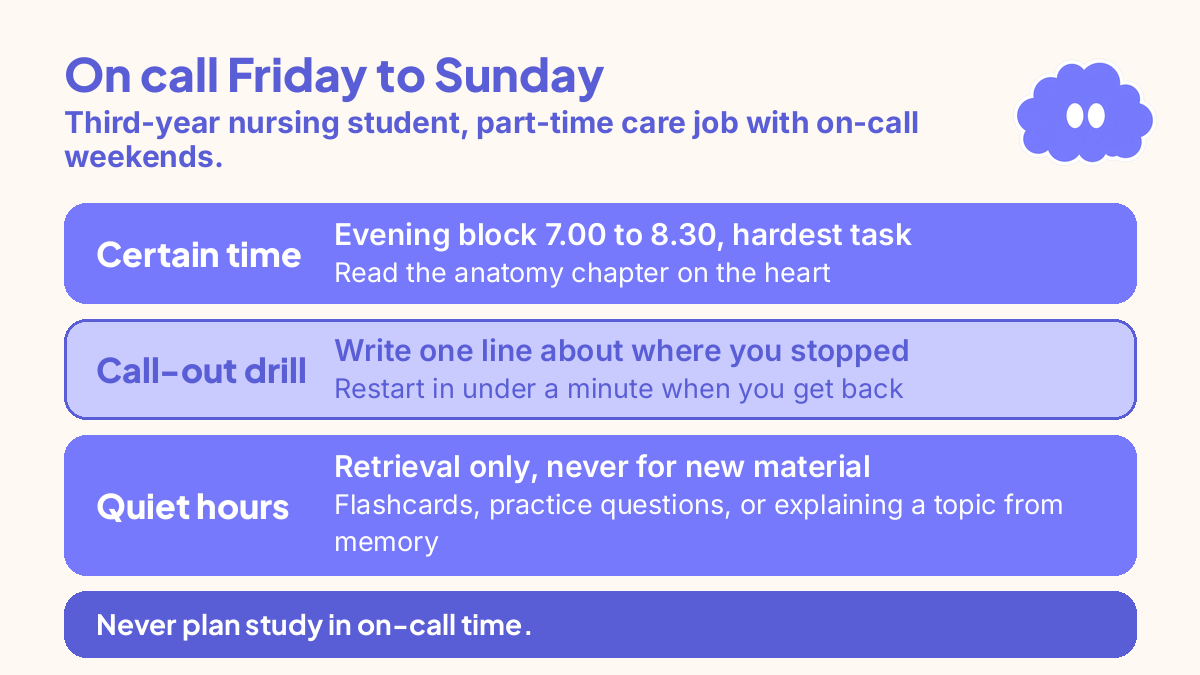
When the phone rings in the middle of a study session, do not finish the thought. Stop at once, write one line about where you stopped, and go. The line can be as short as “Q11, kidney” or “page 42, second paragraph”. That line is the whole drill. It is what lets you restart in under a minute when you get back, instead of spending 15 minutes finding your place and giving up.
Close the book, put the pen down, and leave the one line visible. When you return, read the line, do the next chunk, and carry on. If you are called out three times in one evening, you lose three minutes to the drill and nothing else. Without the drill, you lose the evening, because each interruption feels like a fresh start and fresh starts are exhausting.
If the call-out runs long and the evening is gone, do not try to rescue it when you get back. Sleep, and let tomorrow’s certain time carry the task. A call-out that costs you one evening is normal. A call-out that costs you the week is a planning failure, and the drill is what prevents it.
Step 4: Use on-call quiet hours for retrieval only
On-call quiet hours look like study time, but they are not. They are maybe time, and maybe time has one safe use: retrieval. Flashcards, practice questions, explaining a topic from memory, or re-testing the mistakes from yesterday. These jobs fit a quiet hour, survive an interruption, and need no setup. If the phone rings after 10 minutes, you have still done 10 minutes of real study, and the next chunk starts exactly where the last one stopped.
Never start new material in on-call time. New material needs an unbroken stretch, a clear head, and time to get stuck and work through it. A call-out in the middle leaves you with half an idea, no notes to return to, and a feeling that the topic is harder than it is. Move new material to certain time, even if that means waiting two days for a day off. The material will still be there, and you will meet it fresh.
Keep retrieval materials on your phone, so a quiet hour anywhere becomes a session: flashcards, practice questions, or a voice memo of yourself explaining a topic.
Step 5: Put the hard work on off-call days
Off-call days carry the week. They are the only days with enough unbroken time for hard tasks, so protect them. Plan two blocks on each off-call day: a morning block of 90 minutes and an afternoon block of 60 minutes, with at least an hour between them. Put the hardest task in the morning block, when you are freshest. Put practice and review in the afternoon block.
Do not plan a full day of study on an off-call day. Two blocks, three hours at most including breaks, and the rest of the day is yours. If you have two off-call days in a row, use the first for the hardest task and the second for practice and review. If you have one off-call day, use it for the single most important task and let the certain-time chunks carry the rest.
Tell the people you live with which days are off-call study days, and ask for the morning block to be quiet. For the wider system behind fitting study around a full-time job, How to study with a full-time job covers the weekly shape in more detail.
Step 6: Ask for the rota earlier and protected cover around exams
You cannot control when the phone rings, but you can often get the on-call rota sooner, and sooner is worth a lot. When the rota lands late, you plan late, and the first two days of the week are already gone. Ask your manager when the rota is usually ready and whether you can have it a day earlier. Say why: you have exams that do not move, and you plan your study around the rota.
Around exams, ask for something specific. Not “less on-call”, which is vague and easy to refuse, but one protected thing: no on-call duty in exam week, or cover for one on-call weekend, or the exam morning off. One specific ask, made two weeks early, with the date named, has a far better chance than a general complaint made the day before. If you need the words, How to ask your boss for study time has a script for exactly this, including what to say when the answer is no.
On Sunday, spend 15 minutes on three questions. First, how much certain time did the week actually have, and did the plan use it? Second, how much maybe time became study, and how much was lost to call-outs? Third, what must next week protect: one exam, one deadline, one off-call day for the hardest task? If you also work overtime on top of on-call, the system in How to study when you work overtime covers the extra hours.
A worked example: on call Friday to Sunday
Your situation: Third-year nursing student, part-time care job with on-call weekends. This week: on call Friday 5.00 to Monday 9.00. Certain time: Monday to Thursday evenings and Friday daytime. Exam in three weeks, weakest topic is anatomy, and the essay on patient care is due in 10 days.
- Monday, certain time: Evening block 7.00 to 8.30, hardest task: read the anatomy chapter on the heart and test yourself on it. Write Tuesday’s task in the plan.
- Tuesday, certain time: Evening block 7.00 to 8.30, practice questions on the heart, mark them, note the weak areas. Kit packed for the on-call weekend: flashcards on the phone, anatomy questions list.
- Wednesday, certain time: Evening block 7.00 to 8.30, essay plan: three arguments and two sources for each. Write Thursday’s task in the plan.
- Thursday, certain time: Evening block 7.00 to 8.00, test the whole heart chapter from memory. Then pack the kit and stop. No study is planned for the on-call weekend.
- Friday, on-call from 5.00: Daytime is certain time. Morning block 9.00 to 10.30, draft the essay introduction. Quiet hour at 8.00: 20 minutes of flashcards, then the phone rings. Drill: write “card 14, valves”, go. Return at 9.30, read the line, do 10 more minutes, stop.
- Saturday, on call: No planned study. Two quiet hours become retrieval: practice questions in the morning, flashcards in the evening. One call-out at 3.00, drill, restart in a minute.
- Sunday, on call: One quiet hour, re-test the week’s mistakes. Sunday review: certain time produced six hours of study, maybe time added two hours of retrieval, and the essay draft is half done. Next week must protect Thursday evening.
When it goes wrong
The phone rings five minutes into a session and you lose the whole evening. Use the drill. One line about where you stopped, then go. When you return, read the line and restart in under a minute. The evening is lost only if you spend it finding your place instead of writing the line.
You plan study in on-call time and the plan breaks every night. Stop planning in maybe time. Move the tasks to certain time, even if that means fewer planned hours. A plan that survives is worth more than a plan that looks full and breaks on day one.
You start new material in a quiet hour and a call-out leaves you halfway through. Move new material to certain time and use quiet hours for retrieval only. The topic is not harder than you thought. It was the wrong job for the time.
A call-out runs all night and you are too tired to study the next day. Sleep first, study second. Drop to the minimum for that day: one 10-minute test, then rest. If call-outs run all night three times in one week, talk to your manager about cover, or talk to your tutor about which deadline can move.
You stop planning because the week is too uncertain to plan. Plan only the certain time. Even three certain hours a week, planned and protected, beats 20 maybe hours that never happen.
Weekly review checklist
- How much certain time did the week have, and did the plan use it all?
- How much maybe time became study, and how much was lost to call-outs?
- Did every session have one task and a packed kit before it started?
- Did the call-out drill run every time, and did restarts take under a minute?
- Did the off-call days carry the hard work, or did they leak into chores?
- What will change next week: an earlier rota ask, a protected exam day, or a different certain-time block?
Downloadable infographic spec: one vertical image, title “How to study when you are on call for work”, with the six steps from “The system in short” and the six review questions above, in Thynq cream, Cloud Purple, Dark Purple and pink, with the Cloud mascot. Text taken word-for-word from this article.
What this system is not
It is not a promise that on-call work stops being uncertain. The phone will still ring, and some weeks it will ring at the worst moment. It is not a way to study for hours every day in an on-call week, and it will not work if you plan study in maybe time and then blame yourself when the plan breaks. What it does is smaller: it protects the time you can count on, and it makes the rest of the week survive interruptions.
Sources
- Dunlosky, J., et al. (2013). Improving students’ learning with effective learning techniques. Psychological Science in the Public Interest, 14(1), 4-58. Practice testing and distributed practice rated high; rereading rated low.
- Cepeda, N. J., et al. (2006). Distributed practice in verbal recall tasks. Psychological Bulletin, 132(3), 354-380. Spaced practice beat massed practice.
- Roediger, H. L., & Karpicke, J. D. (2006). Test-enhanced learning. Psychological Science, 17(3), 249-255. Recallers remembered more a week later than restudiers.
For the wider working-student system behind this one, start with How to build a study system that fits your life.
Questions
How do I study when I am on call for work?
Plan study only in time that is certainly free, never in on-call time. Keep every session short and interrupt-proof, with one task and a kit that is always packed. A call-out should cost you minutes, not the day.
Can I study during on-call quiet hours?
Yes, but only for retrieval: flashcards, practice questions, or explaining a topic from memory. Never start new material in on-call time, because a call-out in the middle leaves you with half an idea and no notes to return to.
What should I do when I get called out in the middle of studying?
Stop at once and write one line about where you stopped, such as the question number or the page. That line is what lets you restart in under a minute when you get back. Do not try to finish the thought first.
How do I plan a study week when I do not know if I will be called out?
Split the week into certain time and maybe time, and plan only in certain time. Put the hard work in your off-call days. Treat anything you manage in on-call time as a bonus, and review on Sunday to see how much maybe time actually became study.