The direct answer
How to study when work gets busy at Christmas comes down to timing: front-load the learning into November, drop to short retrieval tests in the December peak weeks, and go back to full study in early January. Ask for exam days off as soon as the rota is published, and keep one anchor session a week on the quietest morning.
December is the worst month to be a working student with January exams. Shops, warehouses, and delivery firms all want extra hours in the same weeks your revision should peak. The shifts get longer, the rota changes weekly, and by Christmas Day you are tired enough that the week between Christmas and New Year disappears too.
The system below treats December as a holding month, not a learning month. November does the heavy work, December keeps it warm with short tests, and January finishes the job.
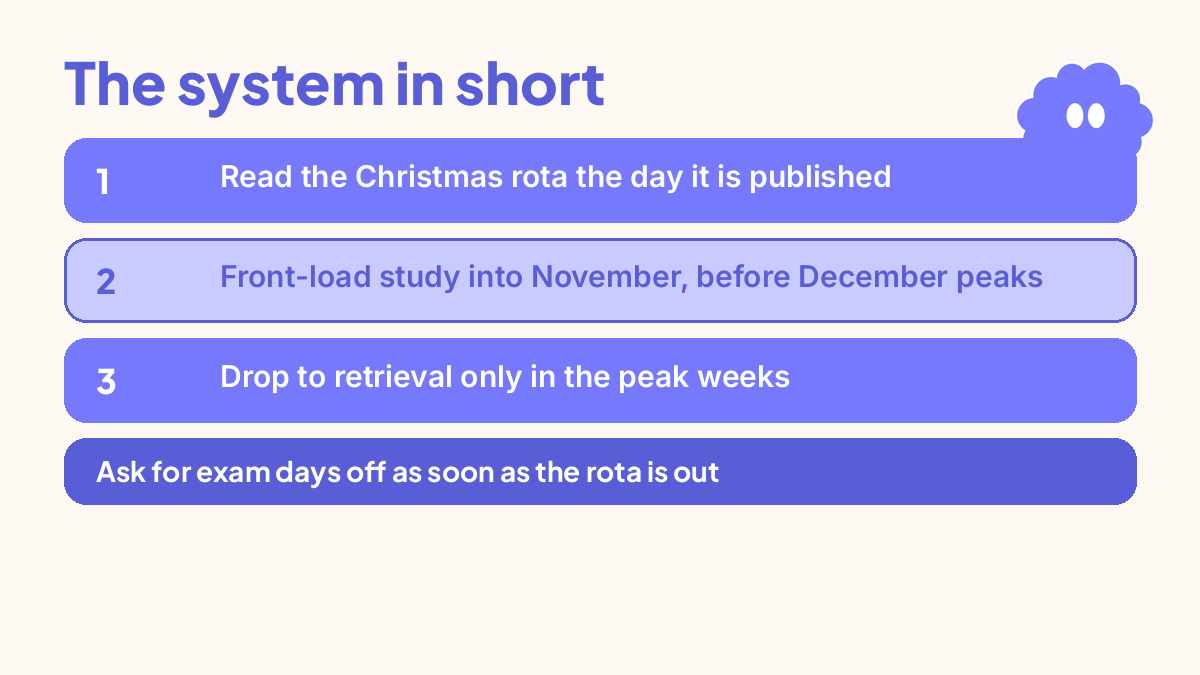
The system in short
- Read the Christmas rota the day it is published.
- Front-load study into November, before December peaks.
- Drop to retrieval only in the peak weeks.
- Keep one anchor session a week on the quietest morning.
- Ask for exam days off as soon as the rota is out.
- Keep a January deadline list, and review it every Sunday.
Step 1: Read the Christmas rota the day it is published
Christmas rotas usually come out in late October or early November. The day yours lands, sit down with it and a calendar, and mark your shifts, your exam dates, and the quiet days between Christmas and New Year.
Count your December hours week by week. If December jumps from 12 hours a week to 25, plan November around it instead of discovering it in mid-December. If your hours are on a zero-hours contract, re-plan the day each new rota lands: the Study system for students on a zero-hours contract sets out the three-plan-sizes routine, and How to study when your rota changes gives you the five-minute re-plan.
Find your quietest morning, the morning each week with no shift or the latest start. That morning holds your anchor session, so write it in the calendar now. Then write down every January deadline: coursework dates, submission portals, and the last day to request adjustments.
Step 2: Front-load study into November, before December peaks
November is the month that saves January. You still have your normal hours, your normal energy, and four clear weeks. Every hour of real learning in November is an hour you do not have to find in December.
Set a November target in hours, not topics. Two exams with four topics each is eight topics, and at roughly three hours per topic you need about 24 hours. Four weeks at seven hours a week gives you 28, which covers the topics with room for past papers.
Build the week around three 90-minute blocks and one Sunday session of two and a half hours, which is seven hours a week. Put the blocks in the morning, before work. Each block has one topic: learn it, then test yourself from memory before it ends. Do the hard topics first. If you need help turning a topic list into a plan, How to make a revision timetable that works shows how to start from your real hours.
Step 3: Drop to retrieval only in the peak weeks
A peak week is a week where work takes 20 hours or more, or where the rota changes daily. In a peak week, stop trying to learn new material. Learning needs a fresh brain and unbroken time, and a peak week gives you neither. Instead, test what you already learned in November, in short bursts, from memory.
The peak-week shape is simple: five 20-minute retrieval tests, one a day, plus the anchor session. Each test covers one topic: close the book, write down everything you remember, then check your notes and write the gaps on your wrong-answer list. Twenty minutes fits into a lunch break or before a shift, and recalling then checking builds memory far better than re-reading.
Prepare the tests on Sunday, for the whole week: five sets of questions, one per day, each on a single topic from November. Five questions per set is enough. The lunch break is the best gap: How to study on your lunch break sets out the 20-minute test, prepared the day before, stopped on time.
Step 4: Keep one anchor session a week on the quietest morning
The anchor session is the one block that keeps the week from drifting: 90 minutes, once a week, on the quietest morning.
Pick the morning when you start latest, or do not work at all. Protect it like a shift: phone on silent, start on time. Ninety minutes is long enough to learn one small topic, or to do one timed past paper question and mark it. Run it the same way every week: 25 minutes testing last week’s topic, 45 minutes on the new topic, 20 minutes testing the new topic and listing the gaps.
If the rota moves, move the anchor to the new quietest morning the same day the rota lands. If every morning is wiped out, use the quietest evening and shrink the anchor to 60 minutes. Students who work every weekend face the same problem: Study system for students who work weekends shows how to build a study week that never touches the working days.
Step 5: Ask for exam days off as soon as the rota is out
This step costs one conversation and saves your exams. Ask for the exam days off, plus the day before each exam, as soon as the Christmas rota is published, and ask in writing, so there is a record. Managers plan Christmas cover weeks ahead: a request made in November is easy to grant, and one made in the week of the exam usually is not.
The day before is for a final review and an early night, not a late shift ending at 10pm. Sitting an exam after a late shift means sitting it tired, and tired brains recall slowly. One day off before the exam is worth more than three tired revision sessions.
If the answer is no, ask the next question straight away: can you swap the shift, finish earlier, or start later? A swap is often possible in November and impossible in January. If you are counting down, How to use an exam countdown to stay on track turns the days left into a counted number of study sessions.
Step 6: Keep a January deadline list, and review it every Sunday
The January deadline list is one page, and it holds every date that matters after Christmas: exam dates and times, coursework deadlines, submission portals, the last day to request adjustments, and the date your library books are due back. Write it in November, from the exam timetable and your course handbook.
Review it every Sunday, in the same 20-minute review as your study week, and answer six questions: hours studied and worked, topics tested or only re-read, questions still wrong after three tests, what changed in next week’s rota, which January deadline comes next, and the one change for next week.
The list stops a deadline being missed because Christmas buried it: coursework due 9 January is easy to forget on 20 December, and the list keeps it visible every Sunday. In early January it tells you which exam comes first and which topics are weakest. If one hour a day is all January gives you, How to study in one hour a day shows how one protected hour still moves study forward.
A worked example
Your situation: You are a first-year business student with a retail temp job. In December you work 25 hours a week, mostly evenings and weekends. You have two January exams, Introduction to Business and Economics for Business, in the second week of January, four topics each. Your Christmas rota came out on 3 November.
November is the front-load: seven hours a week, three 90-minute blocks on Monday, Wednesday, and Friday mornings, plus a two-and-a-half-hour session on Sunday. Four weeks is 28 hours, and at roughly three hours per topic that covers six of your eight topics, with the other two saved for December anchor sessions.
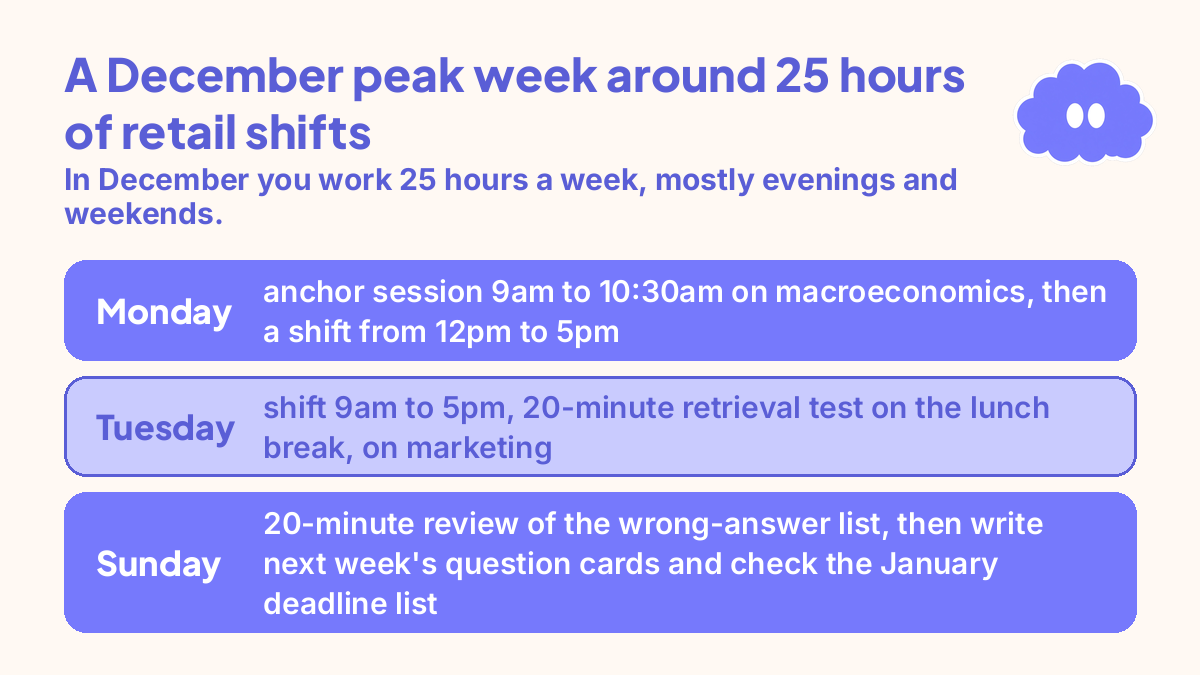
December is retrieval only. Here is one peak week, the week of 8 December:
- Monday, the quietest morning: anchor session 9am to 10:30am on macroeconomics, then a shift from 12pm to 5pm. 90 minutes.
- Tuesday: shift 9am to 5pm, 20-minute retrieval test on the lunch break, on marketing. 20 minutes.
- Wednesday: shift 1pm to 9pm, 20-minute retrieval test before the shift, 9am to 9:20am, on finance. 20 minutes.
- Thursday: shift 9am to 1pm, then a 20-minute retrieval test at home, on organisational behaviour. 20 minutes.
- Friday: shift 10am to 6pm, 20-minute retrieval test on the lunch break, on microeconomics. 20 minutes.
- Saturday: shift 9am to 6pm, the longest day, no study.
- Sunday: 20-minute review of the wrong-answer list, then write next week’s question cards and check the January deadline list. 20 minutes.
Count the week: 90 minutes plus five 20-minute tests is 190 minutes, about three hours, so three peak weeks is about nine and a half hours. From 2 January to 11 January you study two hours a day for ten days, which is 20 hours, covering the last two topics and past papers. November 28 hours, plus December nine and a half, plus January 20, is about 57 hours.
When it goes wrong
The Christmas rota doubles your hours and November is already gone. Do not try to learn everything in December. Learn the two topics that carry the most marks, test the rest from memory, and leave the rest for early January.
You miss the anchor session two weeks in a row. That usually means the quietest morning is not quiet any more, so move the anchor to a new home, even an evening, even shortened to 60 minutes. An anchor that moves still happens.
You study hard through December and burn out before Christmas. Stop. Go back to retrieval only, cut the anchor to 60 minutes, and take Christmas Day and Boxing Day fully off.
The rota changes and wipes out your study day. Re-plan on the day the new rota lands, in five minutes. Move the anchor and the tests, do not cancel them. If the whole week is brutal, run the minimum week: three 20-minute tests and one review of the wrong-answer list.
Your exam day off is refused. Ask for a swap first, then an early finish the day before, then a late start on the exam day. If none of those work, study the night before in a single 90-minute block, sleep properly, and sit the exam after sleep.
January arrives and you have forgotten a coursework deadline. Check the deadline list on the first Sunday of January, before anything else. If a deadline is closer than you thought, tell your tutor straight away: an extension asked for early is usually possible.
Weekly review checklist
- How many hours did I study this week, and how many did I work?
- Which topics did I test from memory, and which did I only re-read?
- Which questions are still wrong after three tests?
- What changed in next week’s rota, and where do the anchor and tests move?
- Which January deadline comes next, and what does it need from me this week?
- What is the one change I will make next week?
Downloadable infographic spec: A vertical 1000 by 1500 image in Thynq colours, cream background, cloud-purple headings, phoenix-pink accents, and the Thynq cloud mascot at the top. Title: “How to study when work gets busy at Christmas”. Six steps, word for word from the article: “Read the Christmas rota the day it is published”, “Front-load study into November, before December peaks”, “Drop to retrieval only in the peak weeks”, “Keep one anchor session a week on the quietest morning”, “Ask for exam days off as soon as the rota is out”, “Keep a January deadline list, and review it every Sunday”. Then the six review questions, word for word: “How many hours did I study this week, and how many did I work?”, “Which topics did I test from memory, and which did I only re-read?”, “Which questions are still wrong after three tests?”, “What changed in next week’s rota, and where do the anchor and tests move?”, “Which January deadline comes next, and what does it need from me this week?”, “What is the one change I will make next week?”.
What this system is not
It is not a way to study hard through December and arrive fresh in January. If your exams are in December rather than January, this is the wrong system. It is not a promise of a grade, and it is not a claim that three hours a week is enough on its own: it is only enough because November did the learning. It is not permission to ignore your job: the system fits study around work, it does not pretend work does not exist.
Sources
- Roediger & Karpicke (2006). Test-enhanced learning: Taking memory tests improves long-term retention. Psychological Science, 17(3), 249-255. Supports the retrieval-only rule in the peak weeks: testing from memory keeps topics warm better than re-reading.
- Gollwitzer & Sheeran (2006). Implementation intentions and goal achievement: A meta-analysis of effects and processes. Advances in Experimental Social Psychology, 38, 69-119. Supports the if-then planning in Steps 1 and 5: deciding in advance when the anchor moves and when the exam days off are requested.
Questions
Should I study in December, or wait until January?
Do both, in different ways. Front-load the real learning into November, then drop to short retrieval tests in the December peak weeks, and go back to full study in early January. Waiting until January means learning everything under pressure, and studying hard through December means burning out before the exams start.
How do I study when my Christmas rota keeps changing?
Re-plan on the day each new rota lands, not on Monday. Keep one anchor session on the quietest morning of the week, and move it when the rota moves, never cancel it. On the other days, use 20-minute retrieval tests in the gaps the rota leaves. If a week is brutal, run the minimum week: three 20-minute tests and one review of your wrong-answer list.
How much study can I do in a peak Christmas week?
About three hours, and that is enough if the learning already happened in November: one 90-minute anchor session plus five 20-minute retrieval tests is 190 minutes. Do not try to learn new topics in a peak week. Test what you already know, fix the gaps, and save new material for the anchor session or January.
When should I ask for my January exam days off?
As soon as the Christmas rota is published, and in writing. Ask for the exam days themselves plus the day before each exam, so you can sleep and revise instead of working a late shift. Managers plan Christmas cover weeks ahead, and a request made in November is easy to grant. A request made in the week of the exam usually is not.