The direct answer
To learn how to paraphrase sources without copying, read a short passage until you understand it, cover the source, write the idea in your own sentence structure, check your version against the original for meaning and borrowed phrases, then add a citation.
Paraphrasing goes wrong in a predictable way. You keep the source open, swap a few words and keep the sentence shape. The result looks different at a glance and still follows the original line by line. Universities call that patchwriting, and a citation alone does not fix it, because the wording and structure were never really yours.
The routine below removes the source from view at the moment you write. That one change forces you to work from understanding. The check that follows protects meaning, and the citation gives credit for the idea. Read, cover, write, check, cite. Five moves, in that order, every time.
The system in short
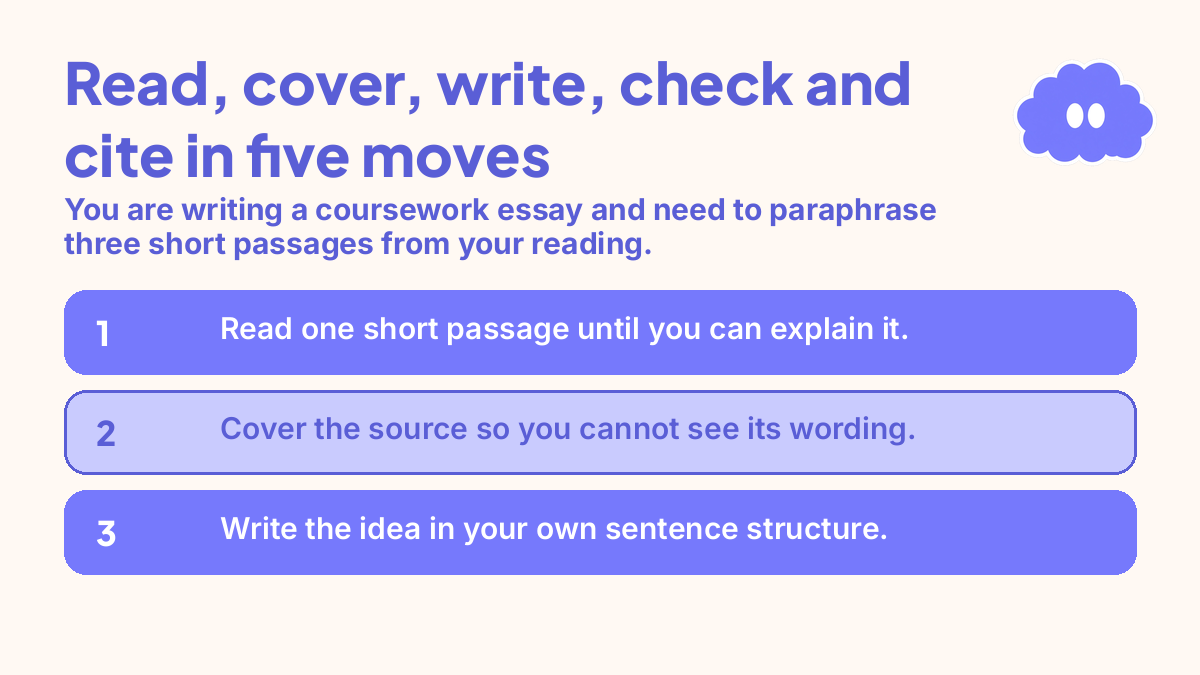
- Read one short passage until you can explain it.
- Cover the source so you cannot see its wording.
- Write the idea in your own sentence structure.
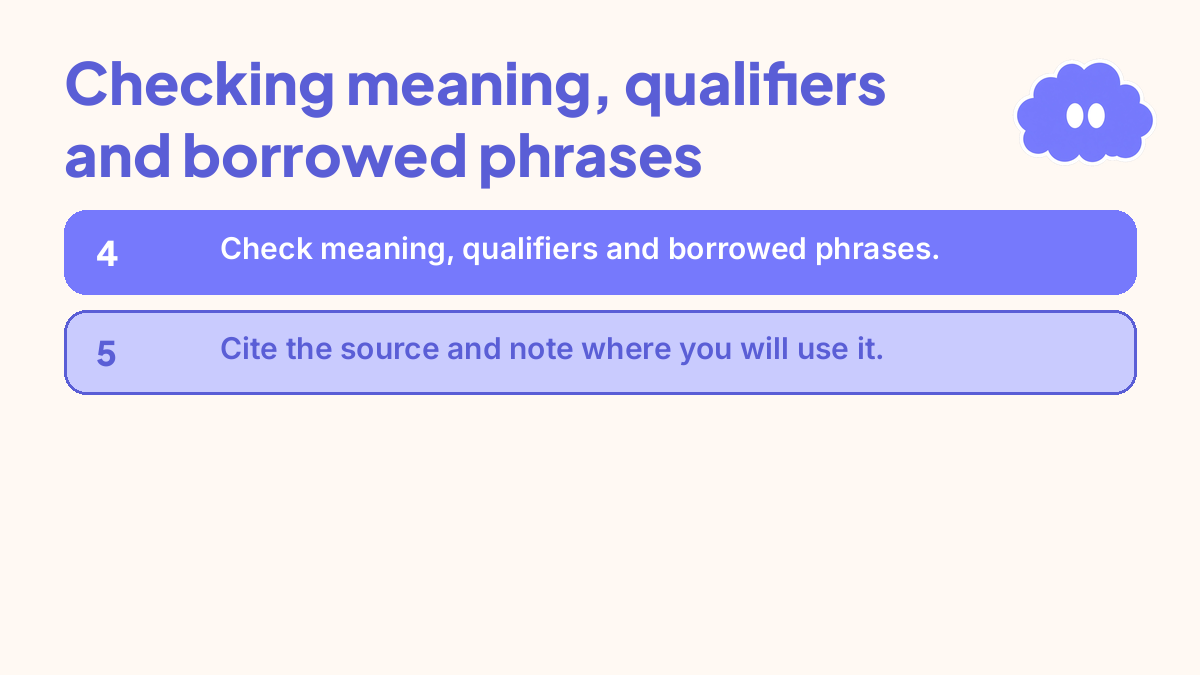
- Check meaning, qualifiers and borrowed phrases.
- Cite the source and note where you will use it.
Step 1: Read one short passage until you can explain it
Work with one short passage at a time. A paragraph or a few sentences is enough. Long passages invite copying because you cannot hold the whole argument in mind while you write. Short passages let you understand first and write second.
Read the passage twice. On the first read, find the main claim. On the second read, note the limits the author sets: words such as may, often, in this sample or under these conditions. Those qualifiers are part of the meaning. Dropping them can turn a careful claim into a stronger claim the author never made.
Look up words you do not know before you write. If a term carries the argument, check how the author defines it. Then say the idea aloud in plain words, without looking at the page. If you cannot explain it simply, read again. You cannot paraphrase what you do not understand, and guessing at meaning produces errors that no synonym can repair.
Note the source details now, while the page is open: author, year and page number where your style requires it. The note taking method in how to take notes from research papers keeps those details beside each idea, so citation later takes seconds rather than a search through open tabs.
Step 2: Cover the source so you cannot see its wording
Close the document, turn the page over or scroll away. This step feels small and does most of the work. With the source visible, your eye returns to its phrases and your sentences borrow its shape. With the source covered, you must rebuild the idea from understanding.
Keep only your plain spoken explanation in mind. If you wrote keywords during Step 1, keep them brief: two or three content words, not a copied phrase. Keywords remind you of the idea without handing you the original sentence.
Resist the urge to peek mid sentence. Finish your draft first, even if it feels rough. A rough draft in your own structure can be improved in Step 4. A smooth draft copied from the visible source has to be discarded. The discipline is similar to writing from memory in Blurting method for students: write down everything you remember: produce first, check second.
If you cannot write anything with the source covered, that is useful information. It means Step 1 ended too early. Go back, reread for understanding, explain the idea aloud again and cover the source once more. Do not solve the blank page by reopening the source and transcribing it.
Step 3: Write the idea in your own sentence structure
Write the paraphrase as you would explain the idea to a classmate. Start at a different point from the original where the logic allows it. Split one long sentence into two shorter ones, or combine two short sentences into one. Change the voice where it stays natural, and turn nouns into verbs or verbs into nouns when the meaning stays exact.
Aim for roughly the same level of detail as the original. A paraphrase is not a summary. A summary shortens a whole source into its main points. A paraphrase keeps the meaning of a short passage, including its qualifiers, in new wording. If your version adds a claim the author did not make, cut it. If it drops a condition the author set, restore it.
Keep precise subject terms when no clear alternative exists. Terms such as photosynthesis or inflation carry exact meanings, and inventing a loose substitute can distort the idea. Generic words also stay. What must change is the sentence structure and the surrounding wording, so the sentence is genuinely built by you.
Write a signal phrase where it helps the reader. Phrases such as the author argues or the study reports show whose idea follows. The signal phrase also prepares the citation in Step 5, so borrowed ideas and your own ideas stay clearly separated in the paragraph.
Follow the paraphrase with a sentence in your own voice that explains why the idea matters for your argument. A paraphrase dropped into a paragraph with no comment reads like a borrowed block. One sentence of comment turns it into evidence: what it supports, what it limits or what question it leaves open. That comment is where your thinking becomes visible to the marker, and it cannot be copied from any source. Keep the comment separate from the paraphrase itself, so the reader can always tell which words report the source and which words present your judgement.
Step 4: Check meaning, qualifiers and borrowed phrases
Now reopen the source and compare the two versions side by side. Check meaning first. Does your version say the same thing, with the same strength? Watch qualifiers closely. May is weaker than can, and can is weaker than does. A change there is a change in meaning, even when every other word looks fine.
Check wording second. Highlight any run of words that matches the original. A single subject term can stay. A distinctive phrase should either be rewritten in a new structure or placed in quotation marks with a citation. If your sentence still follows the original order clause by clause, rewrite it from the covered source again rather than swapping more synonyms.
Check numbers, names and conditions third. Dates, sample descriptions and exceptions are easy to distort from memory. Correct them from the source, then read your sentence once more to confirm it still sounds like your writing. The comparison should make your version more accurate, not pull it back toward the original phrasing.
If the check shows you misunderstood the passage, return to Step 1. That loop is normal, especially with dense academic writing. The wider writing process in how to write a coursework essay leaves time for this loop by drafting sources before the final week, when pressure makes copying most tempting.
Step 5: Cite the source and note where you will use it
Add the in-text citation as soon as the paraphrase passes the check. Do not leave citations for the end of the assignment. A paraphrase without a citation presents another author idea as your own, even when the wording is fully yours. Citation is part of the paraphrase, not an optional extra.
Use the style your course requires and add the full reference to your reference list at the same time. If you need the format for a journal article, how to cite a journal article in APA style shows the pattern to follow. Whatever the style, keep author, year and page details accurate to the source you read.
Write one short note beside the paraphrase: where it will go in your work and what point it supports. A paraphrase with a planned use becomes evidence in an argument. A pile of paraphrases with no planned use becomes a patchwork paragraph that lists sources without saying anything.
Keep tools in their place. Software can help you organise notes, but generating a reworded sentence for you does not show your understanding and can still produce patchwriting. The boundaries in how to use AI tools for study without cheating keep the writing and the credit where they belong: with you and the source author. If a tool drafts a sentence, treat that draft as another source to check, cover and rewrite from understanding, never as finished work.
A worked example: three passages in 90 minutes
Your situation: You are writing a coursework essay and need to paraphrase three short passages from your reading. You set aside 90 minutes on Tuesday evening, from 19:00 to 20:30, and work on one passage at a time.
Each passage gets 25 minutes. Three passages take 75 minutes. The final 15 minutes go to citations and reference list entries. The parts add to 90 minutes, which matches the session you set aside.
Passage one states that the library opens at nine and closes at eight during term time. You read it, cover it and write that term time library hours run from 09:00 to 20:00. You check the times against the original, confirm the meaning matches and add the citation. The structure changed and the facts stayed exact.
Passage two says that short rest breaks may help students sustain attention during long study sessions. Your first draft says breaks improve attention. The check catches the change: may help is weaker than improve. You rewrite the sentence to keep the weaker claim, then cite the source. The qualifier survives because Step 4 compared strength, not just topic.
Passage three contains a distinctive phrase you cannot reword without losing precision. You keep the short phrase in quotation marks, build the rest of the sentence in your own structure and cite the source. At 20:15 you stop drafting. In the last 15 minutes you add three in-text citations, check three reference list entries and note the paragraph where each paraphrase will appear.
When it goes wrong
You swap synonyms and keep the sentence shape. The wording changes and the structure does not, which is patchwriting. Cover the source, explain the idea aloud and write a new sentence that starts in a different place.
Your version says more than the source. Qualifiers such as may and often disappear under time pressure. Compare strength word by word in Step 4 and restore any condition you dropped.
You borrow a distinctive phrase without quotation marks. A citation does not turn copied wording into a paraphrase. Quote the phrase properly or rebuild the sentence so the phrase is no longer needed.
You leave citations until the end. By then you cannot remember which idea came from which source. Cite each paraphrase as soon as it passes the check and add the reference list entry at the same time.
You cannot write with the source covered. The reading step ended too early. Reread the passage, define the key terms and explain the idea aloud before you try again. The blank page is a signal to understand more, not to copy faster.
Weekly review checklist
Copy this list and use it each week:
- Did I cover the source before writing each paraphrase?
- Does each paraphrase keep the original meaning and qualifiers?
- Have I highlighted and fixed any borrowed phrases?
- Does every paraphrase carry a citation and a reference entry?
- Can I explain each paraphrased idea without looking at the source?
- What one change will I make next week: shorter passages, earlier citations or a stricter check?
Downloadable infographic spec: one vertical 1000x1500 image in Thynq colours with the cloud mascot, title “How to paraphrase sources without copying”, with the five steps “Read one short passage until you can explain it”, “Cover the source so you cannot see its wording”, “Write the idea in your own sentence structure”, “Check meaning, qualifiers and borrowed phrases” and “Cite the source and note where you will use it”, plus the six weekly review questions above. Text word-for-word from this article.
What this system is not
It is not a way to disguise copied work or to evade plagiarism detection. The aim is the opposite: writing you understand, in sentences you built, with credit given openly. Any routine used to hide borrowing breaks the purpose of paraphrasing and risks serious academic penalties under your institution rules.
It is also not a substitute for reading. The cover step only works when the reading step produced real understanding. Dense sources may need several reads, a dictionary and help from a teacher or writing support service. That extra time is part of honest academic writing, and the wider system in how to build a study system that fits your life can protect time for it in a busy week.
Sources
- Massachusetts Institute of Technology. Avoiding Plagiarism: Paraphrasing. Academic Integrity at MIT. Supports restating meaning in new vocabulary and structure, combining strategies and citing the source.
- University of Wisconsin-Milwaukee Libraries. Citations and Ethical Scholarship: Paraphrasing. UWM Libraries Research and Course Guides. Supports reading carefully, looking away to rewrite, checking meaning and wording, citing with page details and avoiding patchwriting.
Questions
Is changing a few words enough to paraphrase?
No. Swapping synonyms while keeping the original sentence shape is patchwriting, not paraphrasing. Cover the source, write from understanding in a new structure, then check meaning and add a citation.
Does a paraphrase still need a citation?
Yes. Your words may be new, but the idea still belongs to the source author. Add an in-text citation for every paraphrase and include the full reference in your reference list.
What if I cannot find different words for a key term?
Keep precise subject terms that have no clear alternative, and put quotation marks around any distinctive phrase you borrow. Change the sentence structure around the term and cite the source as usual.
When should I quote instead of paraphrase?
Quote when the exact wording matters, such as a definition you plan to analyse. Keep quotes short, use quotation marks and cite the source. Paraphrase when the idea matters more than the wording.