The direct answer
To learn how to make a quiz from your notes to test yourself, pick 5 to 10 key ideas from a lecture, write one question per idea, enter them in a quiz tool, answer them a day later without your notes. Retest only the questions you miss. Testing yourself beats rereading: it shows what you know, not what looks familiar.
Rereading feels productive. The words look familiar, the page turns smoothly, and you finish feeling as if you have learned something. That feeling is misleading. Recognition is not recall, and an exam asks you to recall. A quiz you wrote yourself closes that gap in about twenty minutes, and it does it with the notes you already have.
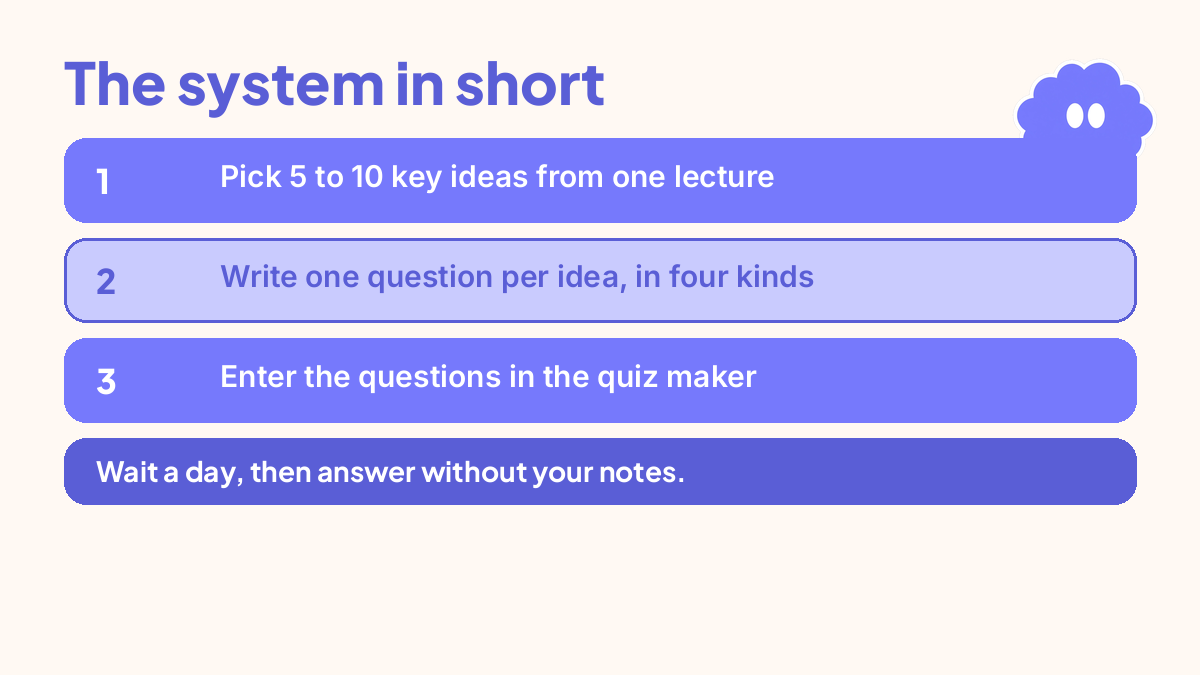
The system in short
- Pick 5 to 10 key ideas from one lecture or chapter.
- Write one question per idea, using four kinds of question.
- Enter the questions in the quiz maker, with the correct answers.
- Wait a day, then answer the quiz without your notes.
- Mark your answers and list the misses.
- Retest only the misses a day later, until you get each one right twice.
Step 1: Pick 5 to 10 key ideas from one lecture
Open your notes for one lecture and read them once, slowly. Mark the ideas the lecture was actually about, not every detail on the page. A key idea is one you could explain to a classmate in two sentences. If you cannot say what it is in two sentences, it is probably a detail, not an idea.
Aim for 5 to 10 ideas. Fewer than 5 and the quiz misses too much of the lecture. More than 10 and the quiz takes too long to write and to take, so you will skip it next time.
Write each idea as a short phrase on its own line, for example “price elasticity of demand formula” or “why necessities are inelastic”. This list is your quiz plan, and it also tells you whether your notes are complete: if you cannot find 5 ideas, the notes need work before the quiz does. The retrieval practice system for students explains why pulling ideas from memory, rather than copying them, is the skill underneath everything here.
Step 2: Write one question per idea, in four kinds
Write one question for each idea on your list, and vary the kind of question. Four kinds cover most exam demands. A define question asks for a term or formula. An explain-why question asks for the reason behind a fact. An apply question gives a new case and asks what happens. A compare question asks how two ideas differ.
Use all four kinds across the quiz, not just one. A quiz of only define questions tests memory of words, while an exam will also ask you to use the ideas. For eight ideas, aim for two of each kind.
Write the correct answer beside each question before you enter anything anywhere. That answer is your marking key, and writing it forces you to be precise. A vague answer, such as “demand falls”, is not a marking key. A precise answer, such as “quantity demanded falls by 4 percent”, is. If you cannot write the precise answer, you have found a gap in your own understanding.
Step 3: Enter the questions in the quiz maker
Open the quiz maker and enter your questions. It does not generate questions from your notes, so you type each one yourself. That typing time is not wasted: it is a second pass over the material, and it is the moment most students spot a question that is badly worded or an answer that is wrong.
The quiz maker has three question types. Use multiple choice with four options when the exam will be multiple choice, and make the wrong options plausible: a common mistake, a near-miss number, or a confused term. Use true or false for claims that are exactly true or exactly false. Use short answer when you need to produce the answer from memory, such as a formula or a number, and mark short answers yourself.
Enter the questions in any order. The quiz maker runs them in shuffled order, so the sequence changes each time you take it, and it keeps your best score so you can see whether you are improving. It has no timed mode and no teacher features, which is fine: this quiz is for you, not for a class.
Step 4: Wait a day, then answer without your notes
Close your notes and wait a day before taking the quiz. This is the most important rule in the system. Taking the quiz straight after writing it only tests whether you remember what you just wrote, which tells you nothing. A day later, the easy familiarity has faded, and what is left is what you actually know.
Sit down with nothing open except the quiz. Answer every question before checking any of them, and do not skip the ones that feel hard. Give yourself roughly two minutes per question, and stop when the time is up.
This quiz is not a mock exam. Its job is to find gaps, not to simulate exam pressure. For full past-paper practice under exam conditions, use the past-paper system for exams alongside this quiz, because the two methods find different kinds of gap.
Step 5: Mark your answers and list the misses
Mark each answer against the key you wrote in Step 2, and be strict. An answer that is nearly right is wrong, because an exam marker would not give it full marks either. For short answer, compare your answer with the key word for word: if the number or term differs, it is a miss.
Write the misses in a short list: the question, your answer, and the correct answer, one line each. The miss list is the only output that matters, because it is the list of what to study next. The misses are rarely the hard ideas; they are often the ideas that looked obvious while reading.
Count your score honestly and note it down with the date. The quiz maker keeps your best score, so you can watch it climb over repeated attempts. A first score of 5 out of 8 is normal and useful. A first score of 8 out of 8 usually means the questions were too easy, not that you know the material perfectly.
Step 6: Retest only the misses a day later
A day later, take a new quiz made only of the questions you missed. Do not retake the whole quiz. The questions you got right are done for now, and retaking them wastes the time your misses need. This is the rule that makes the system sustainable across a whole term: each round gets shorter as the miss list shrinks.
Keep retesting the misses until you get each one right twice in a row. Twice matters, because getting a question right once can be luck, especially on multiple choice. Twice in a row, on different days, means you know it. When a question reaches two in a row, cross it off the miss list and move on.
If a question keeps failing after three rounds, the problem is not your memory. The question is probably badly written, or the idea is unclear in your notes. Go back to the source: reread that part of the lecture, check a textbook, or ask a tutor, then rewrite the question so it tests the idea cleanly. Flashcards work the same way for single facts, and the flashcard system that works is a good companion for the definitions your quiz keeps catching.
A worked example
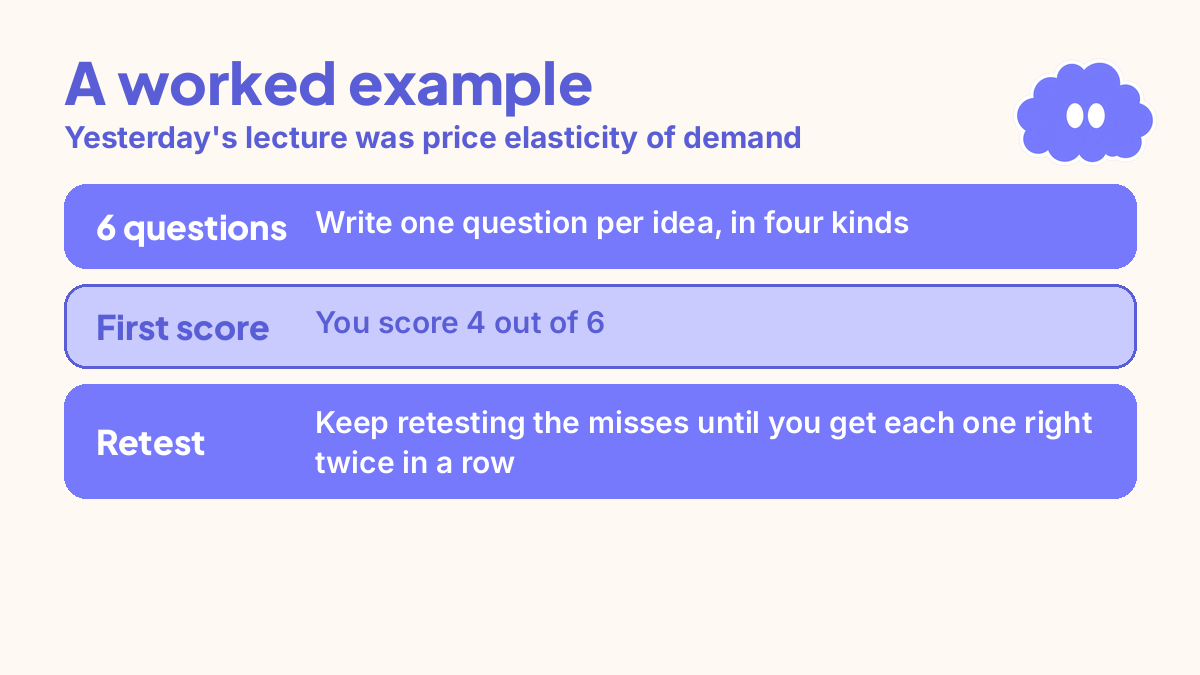
Your situation: You are a first-year economics student. Yesterday’s lecture was price elasticity of demand, and your notes cover the formula, the factors that affect elasticity, and the difference between elastic and inelastic demand. You have 25 minutes tonight to build the quiz and 20 minutes tomorrow to take it.
First, pick the key ideas. Your notes give you six: the elasticity formula, what the number means, why necessities are inelastic, why substitutes make demand elastic, the effect of a price rise on revenue when demand is inelastic, and the difference between elastic and inelastic demand curves.
Next, write one question per idea, mixing the four kinds. Define: “What is the formula for price elasticity of demand?” Answer: percentage change in quantity demanded divided by percentage change in price. Explain why: “Why is demand for insulin inelastic?” Answer: because it is a necessity with no close substitutes, so buyers keep buying it even when the price rises. Apply: “A shop raises the price of coffee by 10 percent. Price elasticity of demand is minus 0.4. What happens to quantity demanded?” Answer: it falls by 4 percent, because 10 percent times 0.4 equals 4 percent. Compare: “How does a demand curve for an elastic good differ from one for an inelastic good?” Answer: the elastic curve is flatter, while the inelastic curve is steeper. Add two more: define “inelastic demand”, and apply the revenue rule, “If demand is inelastic and the price rises, what happens to total revenue?” Answer: revenue rises, because quantity falls by less than the price rises.
- Monday evening, 7.00 to 7.10 pm: read the lecture notes once and list the 6 key ideas.
- Monday evening, 7.10 to 7.25 pm: write 6 questions and their answers, using two define, one explain-why, two apply, and one compare question.
- Monday evening, 7.25 to 7.35 pm: enter the 6 questions in the quiz maker, two as multiple choice, one as true or false, and three as short answer.
- Tuesday evening, 7.00 to 7.20 pm: take the quiz without notes. You score 4 out of 6. You miss the revenue question and the compare question.
- Wednesday evening, 7.00 to 7.10 pm: retest only the 2 misses. You get the revenue question right and the compare question wrong.
- Thursday evening, 7.00 to 7.05 pm: retest the 1 remaining miss. You get it right. Retest it once more on Friday to make it two in a row, then cross it off.
The whole cycle takes about an hour spread over five days, and it ends with six ideas you can recall without notes. Compare that with rereading the same lecture notes five times, which takes the same hour and leaves you with no evidence of what you know. If you want an outside check on your written answers, Use AI to mark your past paper answers shows how to get honest feedback on exam-style answers.
When it goes wrong
You write questions straight from the notes without thinking. If every question is answered by copying a sentence, the quiz tests copying, not understanding. Rewrite each question so the answer is not visible in the question itself.
You take the quiz straight after writing it. The score will be high and meaningless. Wait a day. The delay is the test.
You mark yourself generously. “Nearly right” becomes right, and the miss list stays empty while the exam finds the gaps. Be strict now, when it costs nothing.
A question keeps failing after three rounds. Stop retesting it. The question is badly written or the idea is unclear. Reread the source material, rewrite the question, and start its count again.
You write 20 questions for one lecture. The quiz becomes a chore and you stop making quizzes. Cut the list to the 5 to 10 ideas that matter most, and let the rest go.
Weekly review checklist
- Did I make a quiz for every lecture this week, or did some lectures get skipped?
- Are my quizzes 5 to 10 questions, or are they drifting longer?
- Did I use all four question kinds, or only define questions?
- Did I wait a day before taking each quiz?
- Is my miss list shrinking, or are the same questions failing?
- Did any question fail three times, and did I fix it or just keep retesting it?
- What is my best score on each quiz, and is it climbing?
Downloadable infographic spec: A vertical infographic in Thynq colours (cream background, dark purple title, cloud-purple steps, pink accents) with the cloud mascot at the top, titled “How to make a quiz from your notes to test yourself”. It lists 6 steps: pick 5 to 10 key ideas from one lecture; write one question per idea, in four kinds; enter the questions in the quiz maker; wait a day, then answer without your notes; mark your answers and list the misses; retest only the misses a day later. It ends with 6 review questions: Did I make a quiz for every lecture this week? Are my quizzes 5 to 10 questions? Did I use all four question kinds? Did I wait a day before taking each quiz? Is my miss list shrinking? Did any question fail three times, and did I fix it?
What this system is not
This system is not a mock exam. A six-question quiz finds gaps in one lecture; it does not test your timing, your stamina, or your ability to write under pressure. Use past papers for that job.
It is not a replacement for understanding. If you do not understand an idea, no number of quiz rounds will fix it. Quizzes find the gaps; reading, asking, and thinking fill them.
It is also not a way to generate questions without effort. The quiz maker does not write questions from your notes, and that is a feature, not a missing feature. Writing the question is the first test, and skipping it would remove the most useful ten minutes in the whole system.
Sources
- Roediger, H. L., & Karpicke, J. D. (2006). Test-enhanced learning: Taking memory tests improves long-term retention. Psychological Science, 17(3), 249-255. Supports the core claim that testing yourself from memory improves long-term retention more than rereading.
For the full system behind this method, start with How to build a study system that fits your life.
Questions
Does the Thynq quiz maker write questions from my notes?
No. The quiz maker does not generate questions from your notes; you write your own questions and enter them yourself. That is the point: writing the question is part of the learning, because it forces you to decide what matters in the material.
How many questions should a self-made quiz have?
Five to ten questions per lecture is enough. Each question should cover one key idea, so a quiz of eight questions covers eight ideas. More than ten questions in one sitting turns testing into a chore, and you will stop doing it.
When should I take the quiz after making it?
Wait a day, then answer it without looking at your notes. Testing yourself after a delay is what makes the knowledge stick. Taking it straight after writing it only checks your short-term memory.
What should I do with the questions I get wrong?
Retest only the misses, a day later, until you get them right twice in a row. Do not rebuild the whole quiz. The questions you already know are done; your time belongs to the ones you missed.