The direct answer
How to keep studying when you are ill is a system built on one decision, made fresh each morning: rest, light study, or normal study. A mild cold gets short blocks of low-energy work from a sick-day menu. A fever gets rest, full stop. Ask for help on day one, and plan the catch-up week before you feel better.
The mistake is to treat illness as a willpower problem. It is an energy problem. A tired brain cannot learn at full speed, and pushing through a fever costs more days than the study session ever saves. The system below respects how little energy you have, moves the important work forward in small pieces, and makes sure the backlog does not become a second illness.
The system in short
- Decide each morning with the three-tier rule: rest tier, light tier, or normal tier, based on how you actually feel.
- Build a sick-day menu: every study task sorted by energy cost, so you can pick the task that fits the energy you have.
- Study in 15 to 20 minute blocks with real breaks: short, defined, and easy to stop.
- Keep the thread, not the pace: one tested session a day, even on a bad day, so the subject stays warm.
- Ask early: email your teacher on day one, borrow notes, and move what can be moved.
- Plan the recovery week before you feel better: a catch-up list, sorted must-learn, useful, and can-skip, worked through in short blocks.
Step 1: Decide each morning with the three-tier rule
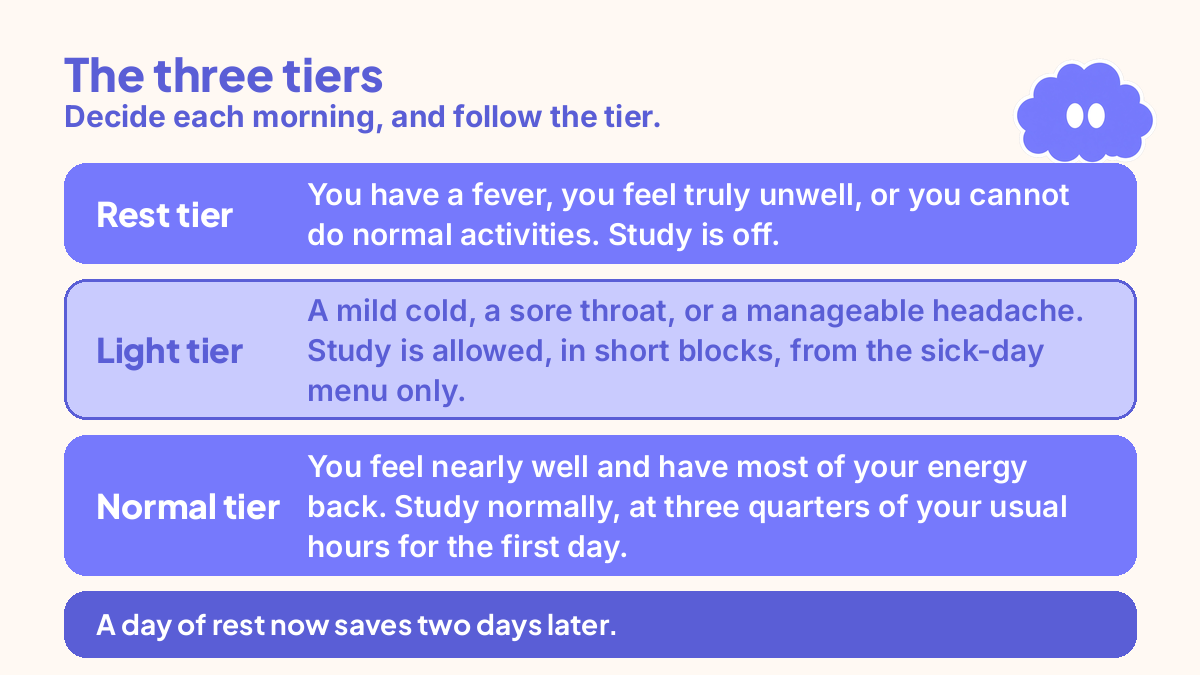
Do not decide the night before. Decide in the morning, when you know how you feel. The three tiers are simple, and the rule is to be honest about which one you are in.
Rest tier: you have a fever, you feel truly unwell, you cannot do normal activities, or you have symptoms that need a doctor, such as difficulty breathing, persistent vomiting, or severe dizziness. Study is off. Sleep, drink water, eat lightly, and rest. A day of rest now saves two days later. If you are unsure whether you are in this tier, you are in it.
Light tier: you have a mild cold, a sore throat, a headache that is manageable, or you are recovering and have some energy but not your normal amount. Study is allowed, in short blocks, from the sick-day menu only. No new topics, no timed papers, no late nights.
Normal tier: you feel nearly well, you slept properly, and you have most of your energy back. Study normally, but at three quarters of your usual hours for the first day, and stop early if the symptoms return. If you push too hard on the first normal day, you will be back in the light tier tomorrow.
Write the tier on a piece of paper each morning, with the time and how you feel in one line. The tier is the decision. Once it is made, follow it without arguing.
Step 2: Build a sick-day menu sorted by energy
On a normal day you choose study tasks by subject. On a sick day you choose them by energy. Build the menu before you are ill if you can, or on the first light-tier morning if you cannot. It takes 15 minutes, and it saves every decision that follows.
High energy tasks, for a good light-tier hour: testing yourself from memory, working through a past paper question, writing a short summary from memory, and explaining a topic aloud. These are the only tasks that actually move learning forward, and they belong in your best hour of the day.
Medium energy tasks, for a middling hour: reading your notes once, copying up neat notes, making flashcards, watching a short video lesson, and organising your files. These keep the day moving, but they do not teach as much as testing does
Low energy tasks, for the worst hour: listening to a recording of your notes, listening to a lecture recording, reading flashcards someone else made, and re-reading a summary. These are the only tasks for a bad day.
Keep the menu on one page, pinned where you study. When a block starts, look at the menu, check your energy, and pick the task that fits. The flashcard system that works is the best low energy tool in the menu, because a card can be tested in a minute and put down again.
Step 3: Study in 15 to 20 minute blocks with real breaks
The normal 50-minute block does not work when you are ill. Your concentration will break at 20 minutes, and the last 30 minutes will be foggy re-reading that teaches nothing. Shorten the block and lengthen the break.
Set a timer for 15 to 20 minutes. Study one task from the menu, then stop when the timer ends, even if you feel you could go on. Take a real break: close your eyes, lie back, drink some water, and let your mind go quiet.
Do two or three blocks a day on a light-tier day, with at least 30 minutes of rest between them. That is 30 to 60 minutes of real study, which is enough to keep the thread and not enough to slow your recovery. If you finish a block and feel worse, stop for the day. The system is working when you stop on time, not when you push through.
Use the Pomodoro technique for students with the timer shortened to 15 or 20 minutes, and the guide to taking breaks that actually help study for what a real break looks like.
Step 4: Keep the thread, not the pace
The goal of a sick week is not to keep pace. It is to keep the thread: to stay in touch with the subject so that coming back does not feel like starting again. One tested session a day is enough to keep the thread.
Each light-tier day, do one thing only, and do it properly: test yourself on one topic from memory. Close the notes, write or say everything you remember for 15 minutes, then check in a different colour. That is the session. Everything else that day is optional. If you do the one session, the day counts. If you do not, the thread breaks, and the first day back will be spent remembering where you were.
Do not learn new topics while you are ill. New learning needs full energy, and a tired brain will learn it badly and remember it worse. Use the sick days to test what you already learned, and leave the new topics for the recovery week.
Step 5: Ask early, on day one
Illness is not a private problem. It is a timetable problem, and the people who can move the timetable need to know on day one, not on the day the work is due.
Email your teacher or tutor on the first day you are ill. Keep it short: what is wrong, how long you expect to be away, what you will miss, and what you are asking for. Ask for the notes, the slides, or a recording of the lesson you missed. Ask whether a deadline can move, and by how long. A short email on day one saves far more than a heroic all-nighter on the day the work is due, and teachers expect it: they would rather move a deadline than mark rushed work.
Ask a friend for the notes from the lessons you miss. One friend, one message, on day one. Offer to return the favour when you are better.
If you have an exam while you are ill, tell your teacher or your exam officer immediately. There are rules for illness during exams, but they only help if they are told in advance. Do not sit an exam with a fever and hope for the best.
Step 6: Plan the recovery week before you feel better
The catch-up fails when it starts the day you feel better, because that day is spent deciding what you missed. Plan it while you are still ill, in one 20-minute session on the last light-tier day.
List everything you missed: lessons, topics, assignments, and deadlines. Mark each one must-learn, useful, or can-skip. Must-learn is anything the exam tests or the next lesson builds on. Useful is anything that helps but is not essential. Can-skip is anything you can learn later or not at all. Be ruthless with can-skip: a week of missed work cannot be done in a week of catch-up on top of normal work.
Work through the must-learn list in short blocks over the next week, one topic at a time, testing each one as you finish it. Do not try to do a week of missed work in a day.
Use the system for revising when you are behind for the full catch-up routine,
A worked example: four days of flu, with an exam in three weeks
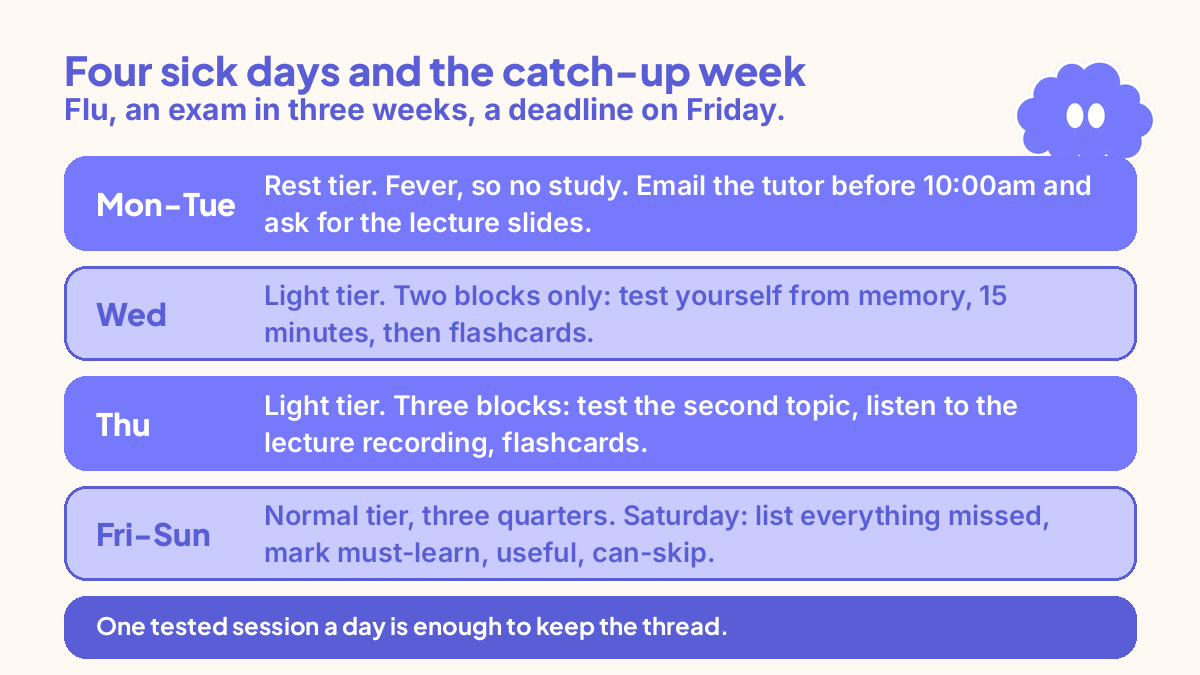
Your situation: First-year university student, exam in three weeks. You wake up on Monday with flu: fever, headache, no energy. You have lectures Monday to Thursday and a coursework deadline on Friday.
- Monday: rest tier. Fever, so no study. Email the tutor before 10:00am: ill, expect three days away, ask for the lecture slides and whether the Friday deadline can move to Monday. Sleep, drink water, eat lightly. One message to a friend asking for Monday’s notes.
- Tuesday: rest tier. Still feverish. No study.
- Wednesday: light tier. Fever gone, energy low. Two blocks only. Block one, 10:00-10:20am: test yourself on last week’s topic from memory, 15 minutes, then check. Block two, 3:00-3:20pm: flashcards for the same topic, low energy task. Log both blocks in one line each.
- Thursday: light tier. Three blocks. Block one, 10:00-10:20am: test the second topic from memory. Block two, 2:00-2:20pm: listen to the lecture recording for Monday’s missed lecture, at normal speed, no notes. Block three, 4:00-4:20pm: flashcards for both topics. Email the tutor: deadline moved to Monday, confirmed.
- Friday: normal tier, three quarters. Coursework deadline moved, so the day is for lectures and one tested session on the third topic. Stop at 4:00pm, sleep early.
- Saturday and Sunday: recovery week planning. Saturday, 20 minutes: list everything missed, mark must-learn, useful, can-skip.
- Next week: catch-up week. Must-learn topics in short blocks, one a day, tested as each finishes. Coursework submitted Monday. Normal hours resume Wednesday.
When it goes wrong
You study through a fever because you feel guilty. Stop. A fever is the rest tier, and studying through it costs more days than it saves. Write the tier on paper, and follow it. Guilt is not a study method.
You do nothing for a week because you feel behind. Do one tested session a day, 15 minutes, on one topic. That is the thread. Everything else is optional. The backlog is handled in the recovery week, not in the sick week.
You keep re-reading because testing feels too hard. Testing feels hard because it works. Re-reading feels easy because it does not. Set the timer for 15 minutes, close the notes, and write what you remember. If the page stays blank, write the topic headings first, then one fact per heading.
You feel better, push too hard, and relapse. The first normal day runs at three quarters of your usual hours, and you stop early if the symptoms return. One careful day back beats two days ill again.
Weekly review checklist
Use this checklist at the end of each week you are ill or recovering, in writing, in 20 minutes.
- Which tier was I in each day, and did I follow it honestly?
- Did I do one tested session on each light-tier day, and what did it show?
- Which tasks from the sick-day menu actually fit my energy, and which did not?
- Have I emailed my teacher, borrowed the notes, and moved what can be moved?
- Is the catch-up list written, sorted must-learn, useful, and can-skip?
- What one change will I make to next week’s plan, and what stays the same?
Downloadable infographic spec: one vertical image, title “How to keep studying when you are ill”, with the six steps from “The system in short” and the six review questions above, in Thynq cream, Cloud Purple, Dark Purple and pink, with the Cloud mascot. Text taken word-for-word from this article.
What this system is not
This system is not a way to study at full speed while you are ill. It does not promise grades, and it does not replace rest or medical care. It keeps the thread with small tested sessions, and it makes the catch-up manageable.
Sources
- Dunlosky, J., et al. (2013). Improving students’ learning with effective learning techniques. Psychological Science in the Public Interest, 14(1), 4-58. Only practice testing and distributed practice rated high utility; re-reading and highlighting rated low.
- Roediger, H. L., & Karpicke, J. D. (2006). Test-enhanced learning. Psychological Science, 17(3), 249-255. Retrieval practice beat restudying after a delay; short tested sessions count as real study.
- Cepeda, N. J., et al. (2006). Distributed practice in verbal recall tasks: a review and quantitative synthesis. Psychological Bulletin, 132(3), 354-380. Spaced practice beat massed practice; the catch-up week is spaced, not crammed.
For the full system behind this method, start with how to build a study system that fits your life.
Questions
Should I study when I am ill?
It depends on how ill you are. If you have a fever, feel truly unwell, or cannot do normal activities, rest comes first and study waits. If it is a mild cold and you have some energy, study lightly in short blocks. Use the three-tier rule in this article to decide each morning.
How can I study when I have no energy?
Use the lowest-energy methods that still test you: flashcards, listening to a recording of your notes, and saying one topic aloud from memory. Study for 15 to 20 minutes, then rest properly. One short tested session beats an hour of foggy re-reading.
What should I do about deadlines when I am ill?
Ask early. Email your teacher or tutor on the first day you are ill, say how long you expect to be away, and ask what can move. A short email on day one saves far more than a heroic all-nighter on the day the work is due.
How do I catch up after being ill for a week?
Do not try to do a week of missed work in a day. List what you missed, mark it must-learn, useful, or can-skip, and work through the must-learn list in short blocks over the next week. Re-test each topic as you finish it, and ask a friend for the notes you cannot replace.