The direct answer
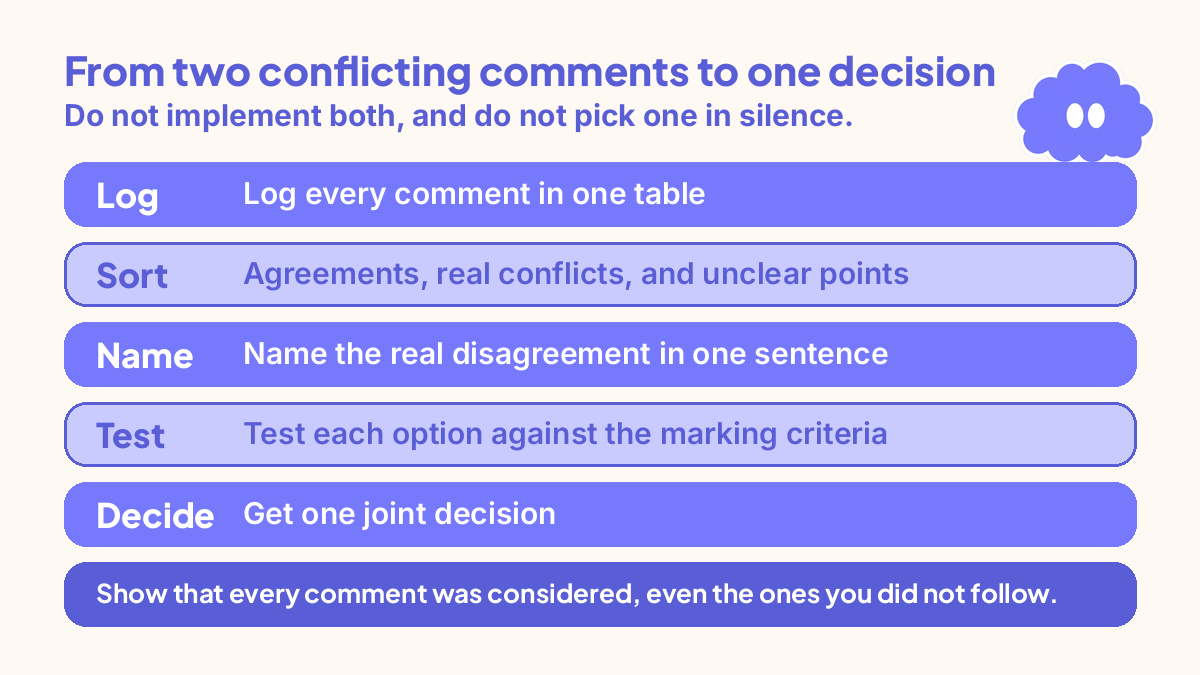
How to handle conflicting feedback from two supervisors? Do not implement both, and do not pick one in silence. Log every comment in one table the day it arrives, sort them into agreements, conflicts, and unclear points, name the real disagreement in one sentence, test each option against the marking criteria, and get one decision in writing from both supervisors.
Conflicting feedback is ordinary, not a sign that you have done something wrong. Two supervisors bring different strengths and different readings of the criteria, and they will disagree about scope, method, structure, and wording. The damage comes from how students respond: rewriting the same chapter twice, pleasing one supervisor and hiding it from the other, or freezing for a month. The system below turns the conflict into a decision in about a week. If they cannot agree, follow your main supervisor, and if the conflict still blocks your work, escalate to your programme lead with a one-page summary.
The system in short
- Log every comment in one table the day it arrives, with the section, who said it, and the draft version.
- Sort the comments into agreements, real conflicts, and unclear points, and act on the agreements at once.
- Name the real disagreement in one sentence, and say what kind of disagreement it is.
- Test each option against the marking criteria, the evidence, and the time it would take.
- Get one joint decision, in a meeting or in writing, and record it the same day.
- Follow the decision, tell both supervisors what you did, and escalate only if the conflict still blocks you.
Step 1: Log every comment in one table, the day it arrives
Make one table and put every comment in it the day it arrives. Four columns are enough: section, supervisor A, supervisor B, and my response. Put each comment in the row for its section, with the draft version and the date. Do not keep one supervisor’s comments in email and the other’s in a marked-up document.
Write the response column last, after you have sorted the comments in Step 2. For each point, the response says how you will address it, or why you will not, in one or two sentences. That column shows your supervisors that you take their feedback seriously, and it makes it easier to reject certain advice: a rejection with a reason, written down, is a judgement. Keep the drafts too: save each version with the date in the filename.
Step 2: Sort into agreements, conflicts, and unclear points
Sort every comment into three piles. Agreements are comments both supervisors made, or comments one made that the other would plainly accept. Act on these at once. Clearing them first shrinks the table and shows both supervisors that you are moving. If both supervisors say the introduction is too long, shorten it. Fix what everyone agrees on before you tackle the conflicts.
Real conflicts are comments that cannot both be followed. Mark them clearly, and do not act on them yet. Unclear points are comments you cannot act on as written: “tighten this”, “more analysis”, “rethink the argument”. Do not guess what they mean. Write down what you think they mean, and check it in the next meeting. A vague comment acted on wrongly is worse than a vague comment left alone.
Step 3: Name the real disagreement in one sentence
For each real conflict, write the disagreement in one sentence. For example: “Supervisor A recommends broadening the literature review; Supervisor B suggests narrowing to a single framework.” One sentence forces you to find the actual point, and it is often smaller than it felt. Two comments that looked like a fundamental clash may turn out to be a disagreement about one section, or about wording rather than substance.
Then say what kind of disagreement it is: scope, method, analysis, structure, referencing, or wording. A scope conflict is tested against the word limit and the criteria. A method conflict is tested against feasibility and time: How to write a thesis methodology shows what the chapter must prove, which is the test to apply. A wording conflict is tested against clarity, and it is rarely worth a joint meeting. Save wording for the final pass: How to edit and proofread a thesis covers it. Do not act yet. Resist the temptation to pick the supervisor you like more and rewrite the chapter. A choice made before you have named the disagreement is a choice made on instinct.
Step 4: Test each option against the criteria, the evidence, and the time
For each conflict, draft a very short proposal: the two options, your recommendation, and the reason, tied to the marking criteria. If a suggestion does not improve the piece against the relevant criterion, it may not be helpful, however senior the person who made it. Anchor the question to the criteria: which assessment strands are affected? A proposal that ties each option to a criterion is a proposal a supervisor can answer.
Test each option on three things. First, the criteria: which option scores better, and can you say why in one sentence? Second, the evidence: which option fits the data you actually have? Third, the time: how many days would each option take, and does the deadline allow it? A late-stage change that needs two weeks of new data is a different decision from a wording change that needs an afternoon. If an option fails on time, say so in the proposal, with the number of days. Write the proposal down, on one page, and bring it to the meeting or attach it to the email.
Step 5: Get one joint decision, in a meeting or in writing
The best way to deal with conflicting feedback is to discuss it in a joint meeting. Send one short email to both supervisors, with a three-item agenda: the conflict in one sentence, the two options, and your recommendation. Ask for 15 minutes, name two possible times, and attach the proposal. Open with neutral language: “I am trying to reconcile two suggestions. Can I outline both and get your view on which best supports the marking criteria?”
If a joint meeting is not possible, get the decision in writing: send the proposal to both in one email, ask each to reply, and confirm the decision back to both. What does not work is asking each supervisor separately and reconciling their answers yourself. That makes you the mediator, which is not your job.
If the conflict cannot be resolved, follow the main supervisor. They are ultimately responsible for conveying the degree, so their view carries more weight. But there are limits: if their advice would break the marking criteria, speak to your co-supervisor in confidence and ask them to help. How to handle supervisor feedback on a thesis covers the general approach: show that every comment was considered, even the ones you did not follow.
Step 6: Record the decision, tell both supervisors, and move on
After any meeting, send a short summary email the same day to both supervisors, confirming the agreed approach and next steps. Two or three lines are enough: “Thanks for meeting. To confirm, we agreed to proceed with Option A, and I will submit the revised chapter by Friday. Please let me know if that is still okay.” That email is the record. It stops the decision from drifting.
Update the table: mark each conflict row as decided, with the decision and the date, and move on. Do not keep re-arguing a decided point. Tell both supervisors what you did when you submit the next draft: “I have applied the decision from our meeting on 12 March.” That line closes the loop. How to get unstuck on a thesis has the routine for the weeks when a conflict has frozen your writing: the table tells you which paragraph to write first.
A worked example: a Thursday in February, two supervisors and one method chapter
Your situation: You are a PhD student in sociology. Your main supervisor is Professor Khan, and your co-supervisor is Dr Osei. You sent the method chapter to both on Monday. Professor Khan replied on Tuesday: “Add a full section on the pilot study, with the pilot data.” Dr Osei replied on Wednesday: “Cut the pilot study entirely. The chapter is already 9,000 words.” The chapter limit is 12,000 words, and the thesis is due in five months.
Thursday morning, you log both comments in the table. You sort the rest: both supervisors agree the sampling section needs a clearer justification, so you fix that on Thursday morning. The pilot study is the only real conflict.
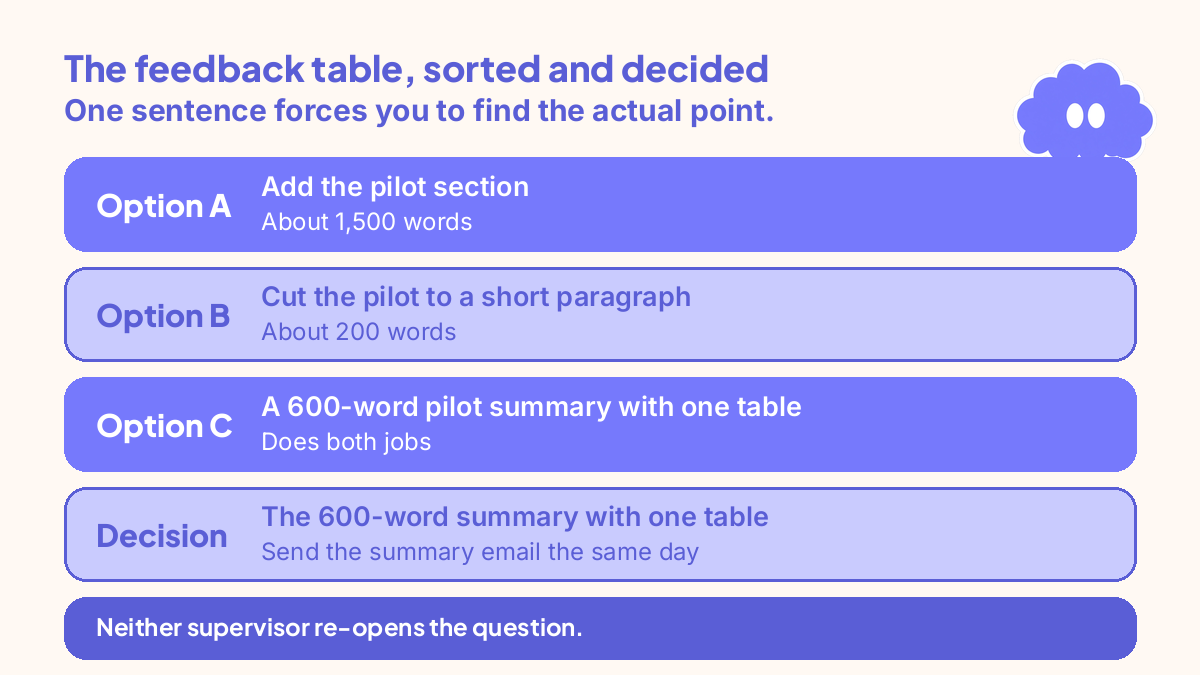
Thursday afternoon, you name the disagreement in one sentence: “Professor Khan wants the pilot study added with its data; Dr Osei wants it cut to keep the chapter within the word limit.” The kind is scope. You draft the proposal. Option A: add the pilot section, about 1,500 words. Option B: cut the pilot to a short paragraph, about 200 words. Your recommendation is Option C: a 600-word pilot summary with one table.
Friday, you email both supervisors with the three-item agenda and attach the proposal, asking for 15 minutes on Monday. On Monday, they meet for 20 minutes and agree the 600-word summary with one table does both jobs. You send the summary email the same day, update the table, and revise the chapter on Tuesday and Wednesday. The chapter comes in at 9,800 words. When you submit it, you write one line noting the decision. Neither supervisor re-opens the question.
When it goes wrong
Your supervisors will not meet together. Try once, with a short email and a clear agenda. If they will not meet, get the decision in writing: send the proposal to both in one email, ask each to reply, and confirm the decision back to both. If one supervisor will not reply, follow the main supervisor.
The main supervisor is wrong, and you can prove it. Speak to your co-supervisor in confidence and ask them to raise it, with the evidence. If the advice would break the marking criteria, say so in the proposal, with the criterion named.
The feedback contradicts the marking criteria. Anchor the proposal to the criteria: “Option A meets the analysis criterion because it tests the claim against a second dataset. Option B does not.” If a supervisor still insists on the option that breaks the criteria, record it in the table and take it to your programme lead.
One supervisor goes silent for weeks. Do not wait. Send the proposal with a deadline: “If I do not hear otherwise by Friday, I will proceed with Option A.” A supervisor who does not reply has not vetoed anything.
The same conflict repeats in every chapter. Point to the recorded decision. “We agreed in March to narrow the literature review to one framework, so I have applied the same decision here” is a complete answer. If a supervisor keeps re-opening decided points, raise it in the next meeting.
You are frozen and cannot choose. Pick the option your proposal recommended and write one paragraph. If the conflict has already cost you a month, How to finish a thesis when you are behind shows how to rebuild the plan.
Weekly review checklist
Review your feedback table once a week while you are revising, and answer these six questions in one page. Once the decisions are recorded, the Thesis weekly review and supervisor meeting system keeps the table and the meetings in one routine.
- Is every comment from both supervisors logged in the table, with the section, the date, and the draft version?
- Have I acted on every agreement, and cleared them from the table?
- Have I named each real conflict in one sentence, and said what kind of disagreement it is?
- Have I tested each option against the criteria, the evidence, and the time it would take?
- Have I got one joint decision for each conflict, in a meeting or in writing, and recorded it the same day?
- Have I told both supervisors what I did, and updated the table so no decided point is still open?
Downloadable infographic spec: one vertical image, title “Handle conflicting feedback from two supervisors”, with the six steps and the six weekly review questions, in Thynq cream, Cloud Purple, Dark Purple and pink, with the cloud mascot. Text taken word-for-word from this article.
What this system is not
This system is not a way to play one supervisor against the other. Picking the advice you like, hiding it from the other supervisor, and hoping neither notices is not a system. It is a gamble, and it fails the moment both supervisors read the same draft. Everything here happens in the open, in one email, with both supervisors named.
It is not a substitute for judgement. The table, the proposal, and the criteria help you decide, but they do not decide for you. Where both options are defensible, pick the one you can defend, say why in one sentence, and move on.
It is not a way to avoid the conversation. The joint meeting in Step 5 is the heart of the system, and no amount of logging replaces sitting down with both supervisors and asking for a decision.
Sources
- Master Academia. Dealing with conflicting feedback from different supervisors, 2021, updated 2023. Supports the feedback table, the joint meeting as the best way to resolve conflict, following the main supervisor when opinions cannot be reconciled, and escalating when conflicts escalate.
- Sparkl. IB DP IA Mastery: Supervisor Dynamics, How to Handle Conflicting Guidance, 2025. Supports naming the disagreement in one sentence, anchoring decisions to the criteria, drafting a short proposal, and recording the outcome in writing.
Questions
What should I do first when two supervisors disagree?
Pause, and do not rewrite anything yet. Log both comments in one table, with the section, who said what, and the draft version, then work out whether they actually conflict. Many apparent conflicts are two comments about different things. Sorting takes an hour. Rewriting the chapter twice takes a week.
Should I follow my main supervisor or my co-supervisor?
If the conflict cannot be resolved in a joint discussion, follow the main supervisor, because they are ultimately responsible for conveying the degree. But if their advice would break the marking criteria, raise it with your co-supervisor in confidence. Following the main supervisor is the default, not a rule that overrides your judgement.
How do I ask two supervisors to meet together?
Send one short email to both, with a three-item agenda: the conflict in one sentence, the two options, and your recommendation. Ask for 15 minutes, name two possible times, and attach the proposal. Supervisors who will not meet together will often reply in writing instead, which is also a decision, as long as you record it and confirm it back to both.
What if my supervisors will not resolve the conflict?
If you have tried a joint meeting, proposed options tied to the criteria, and recorded everything, and the conflict still blocks your work, escalate. Take a one-page summary to your programme lead or PhD representative. Bring the conflict in one sentence, the attempts you made, and the evidence. Escalation is not failure.