The direct answer
To cite a website in MLA style, write the author’s surname in brackets in your text, for example (Osei), and add one full entry to your Works Cited list: Author Last, First. “Title of Page.” Website Name, Day Month Year, URL. The page title goes in quotation marks and the website name in italics.
A website is the hardest source to cite well, because the details are scattered across the page and some are missing altogether. The template is short, but finding the author and the date takes a system, and copying the URL from the address bar is not enough.
The system in short
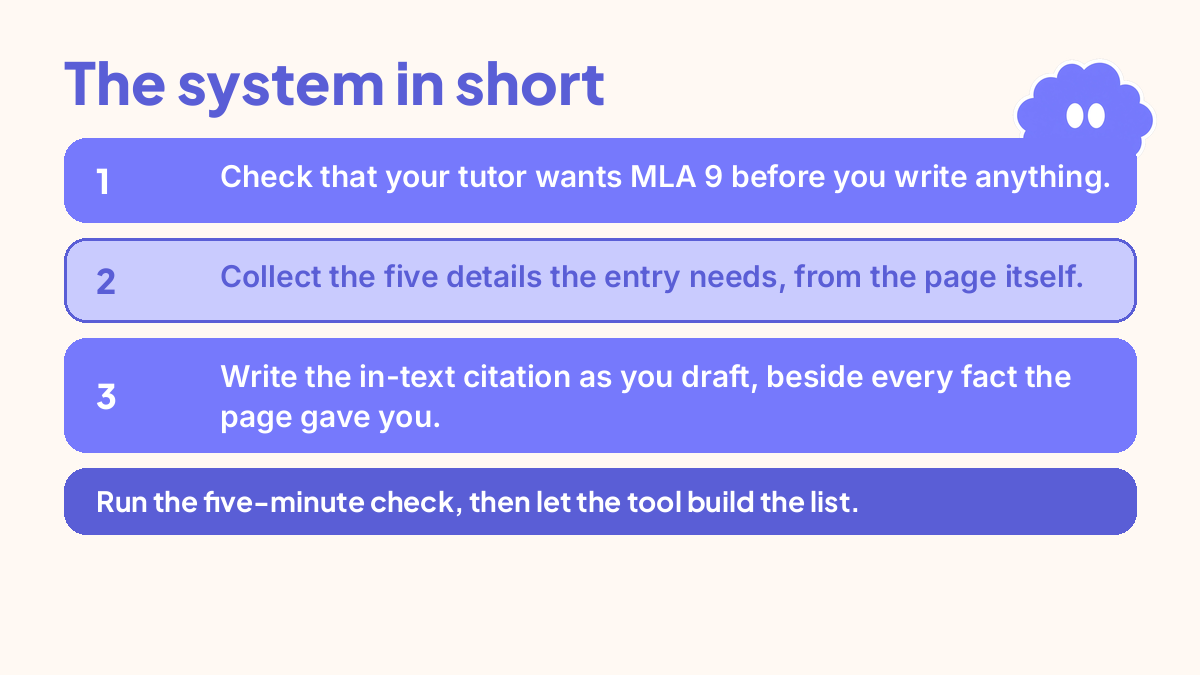
- Check that your tutor wants MLA 9 before you write anything.
- Collect the five details the entry needs, from the page itself.
- Write the in-text citation as you draft, beside every fact the page gave you.
- Build the Works Cited entry from one template, with the page title in quotation marks.
- Handle the awkward cases: no author, no date, same publisher and site name, and long URLs.
- Run the five-minute check, then let the tool build the list.
Step 1: Check that your tutor wants MLA 9
MLA is one style among several, and the rules here apply only if your tutor asked for MLA. The current edition is MLA 9, published in the MLA Handbook, 9th edition, in 2021. If your handbook names APA or Harvard instead, stop.
Open your university or department guide and find its website page. Note whether it wants an accessed date and how it writes the URL. Your tutor’s guide always wins where it differs from this article.
The core elements are the heart of MLA 9, and they always appear in this order: Author. Title of source. Title of container, Other contributors, Version, Number, Publisher, Publication date, Location. For a web page, the page is the source, the website is the container, the date is the publication date, and the URL is the location.
In MLA, the page title uses title case, which means the main words are capitalised, and it goes in quotation marks. The website name also uses title case, and it goes in italics. Remember this: the page is quoted, the site is italicised.
Step 2: Collect the five details the entry needs, from the page itself
A website entry needs five details. First, the author, from the top or the bottom of the page. Second, the title of the page, exactly as printed. Third, the name of the website. Fourth, the date the page was published or last updated. Fifth, the URL, copied from the address bar.
Write the five details on one line, in the order the template uses them, and keep that line next to your notes. The author and the date are the two details most often missing: the author may sit at the bottom of the page, and the date may sit under the title or in the footer.
Use the date the page was published, or the date it was last updated if that is what the page shows. MLA writes it as Day Month Year, for example 14 Mar. 2024, with the month shortened to three letters except for May, June and July. If the page shows only a year, give the year. If it shows no date at all, leave the date out: do not guess one.
If you study with a full-time job, you probably read most of your sources on a phone in short gaps, and it is tempting to copy a link and move on. The guide to How to study with a full-time job shows how to protect two fixed evening blocks, and the five details above take two minutes inside one of them. Collect them when you first read the page.
Step 3: Write the in-text citation as you draft, beside every fact the page gave you
The MLA in-text citation for a website is the author’s surname in brackets: (Osei). Web pages have no page numbers, so there is nothing after the name. Write it as you draft, beside every fact.
If the page has no author, use a shortened version of the page title in brackets, for example (“Take Notes That Work”). It must match the start of the Works Cited entry so your reader can find it. With two authors, name both: (Osei and Linden). With three or more, use the first author’s surname and et al.: (Osei et al.).
A website citation has no page number and no year in the brackets. That is what makes it different from a book citation, which has a page number, and from a Harvard citation, which has a year. The Harvard website guide uses the year form, so keep the two templates apart.
Step 4: Build the Works Cited entry from one template, with the page title in quotation marks
The Works Cited entry follows one template: Author Last, First. “Title of Page.” Website Name, Day Month Year, URL. The page title goes in quotation marks, the website name in italics, and nothing else is italicised. Entries sit in alphabetical order by the author’s surname, on a new page titled Works Cited, with a hanging indent.
For the worked example, a page by Maya Osei published on 14 March 2024, the entry reads: Osei, Maya. “Take Notes That You Will Actually Review.” StudyHub, 14 Mar. 2024, www.studyhub.org/take-notes-that-work. Note the surname first, the page title in quotation marks, the website name in italics, and the URL at the end, without the web prefix at the start. There is no publisher, because the publisher is the same as the website name.
An accessed date is optional in MLA 9. Add one only if your tutor asks for it, or if the page is likely to change. Write it at the end, after the URL, as Accessed 22 Nov. 2026. A stable page does not need one.
The Works Cited page starts on a new page, the title Works Cited is centred at the top, and it is not bold and not in italics. Entries are double-spaced, in alphabetical order, with a hanging indent. Every in-text citation needs an entry, and vice versa.
Step 5: Handle the awkward cases
Five cases cause most of the lost marks. First, no author: start the entry with the page title, in quotation marks, and alphabetise by the title’s first main word. In the text, use the shortened title, as in step 3. Never invent an author.
Second, no date: leave the date out and end the entry with the URL. Do not guess a date. If your tutor asks for an accessed date, add it at the end, after the URL.
Third, publisher and website name are the same: list the name once, as the website name, and leave the publisher out. If they differ, give the publisher after the website name. This is rare, and most web pages need no publisher at all.
Fourth, a very long URL: give the full URL. Do not use a link shortener, and do not give a search result URL: the URL must lead to the page itself.
Fifth, a page that changed since you read it: cite the version you read, with the date it showed when you read it, and add an accessed date if your tutor wants one. If the page has disappeared, do not cite a cached copy from a search engine.
Step 6: Run the five-minute check, then let the tool build the list
Before you submit, spend five minutes checking every website reference. First, does each entry have the five details, in the core elements order? Second, is the page title in quotation marks and the website name in italics? Third, is the date in Day Month Year order, and is the URL the page itself? Fourth, does every in-text citation have a matching entry, and vice versa? Fifth, is the list alphabetical, with a hanging indent?
Then let the citation generator build the list. Choose MLA 9, choose Website, and type the five details into the fields that appear. The tool shows an in-text citation beside every reference. Check the output against your guide once, and then trust it: the tool’s job is the punctuation, and yours is the details.
Scan the list for years in brackets in the text, which belong to Harvard, and for page numbers in website citations, which belong to books and articles. A website citation has the author’s surname and nothing else in the brackets.
A worked example: citing a website in an essay on note-taking
Your situation: First-year student, essay on how to take notes that you can actually review. You used one web page throughout: an illustrative example, “Take Notes That You Will Actually Review” by Maya Osei, on the StudyHub website, published 14 March 2024. The essay is due on Friday, and the page details below are made up to show the system working, not a real citation.
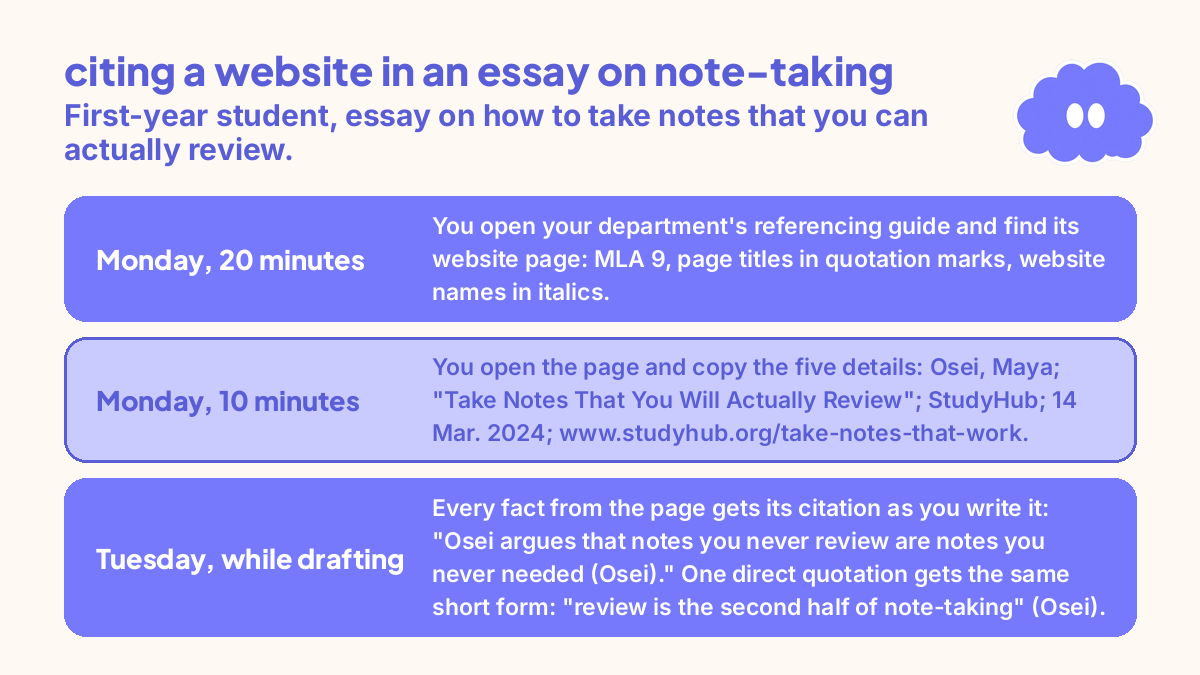
- Monday, 20 minutes: You open your department’s referencing guide and find its website page: MLA 9, page titles in quotation marks, website names in italics. You write the template on a sticky note.
- Monday, 10 minutes: You open the page and copy the five details: Osei, Maya; “Take Notes That You Will Actually Review”; StudyHub; 14 Mar. 2024; www.studyhub.org/take-notes-that-work.
- Tuesday, while drafting: Every fact from the page gets its citation as you write it: “Osei argues that notes you never review are notes you never needed (Osei).” One direct quotation gets the same short form: “review is the second half of note-taking” (Osei).
- Wednesday, 15 minutes: You build the Works Cited entry: Osei, Maya. “Take Notes That You Will Actually Review.” StudyHub, 14 Mar. 2024, www.studyhub.org/take-notes-that-work.
- Thursday, 5 minutes: You run the check: all five details are there, the date is in Day Month Year order, and the in-text citations match the entry. The book in MLA style guide covers the book template.
- Friday, 5 minutes: You put the details into the citation generator, choose MLA 9 and Website, and let it build the entry. It matches yours. You copy it into the Works Cited list and submit.
The references took an hour in total.
When it goes wrong
You cite the search result instead of the page. The URL must lead to the page itself. Copy it from the address bar while the page is open, not from the search results list.
You use the website name as the author. The website name is the container, and it goes in italics after the page title. The author is a person, and if the page names no person, the entry starts with the title.
You put a year in the in-text citation. That is Harvard, not MLA. A website citation holds the author’s surname and nothing else.
You trust the page without checking it. A web page can be wrong, out of date, or written to sell something. The guide to How to check if an AI answer is wrong shows the same habit for AI answers: check the claim against a second source before you build an argument on it.
Your Works Cited list has an entry with no in-text citation. Every entry must be cited in the text, and vice versa.
Weekly review checklist
- Have I checked that my tutor wants MLA 9, not APA or Harvard?
- Have I collected all five details for each web page?
- Did I write the in-text citation as I drafted, with the surname only?
- Is the page title in quotation marks and the website name in italics?
- Have I handled the awkward cases: no author, no date, long URLs?
- Did I run the five-minute check, and does the tool’s output match my guide?
Downloadable infographic spec: one vertical image, title “How to cite a website in MLA style”, with the six steps from “The system in short” and the six review questions above, in Thynq cream, Cloud Purple, Dark Purple and pink, with the Cloud mascot. Text taken word-for-word from this article.
What this system is not
It is not a substitute for your university’s referencing guide, which always wins where it differs from this article. It is not a way to cite a page you have not read: the five details come from the page itself, not from a search result. It does not cover APA or Harvard. And it does not make referencing interesting; it makes it routine.
If you take most of your notes from online courses, the same routine applies to every page you cite from them, and the guide to How to take notes from online courses shows how to keep those notes in a form you can review.
Sources
- Modern Language Association. MLA Handbook. 9th ed., Modern Language Association of America, 2021. Supports the MLA 9 core elements order and the website template in this article.
- Purdue OWL. MLA Formatting and Style Guide. Purdue Online Writing Lab. Read November 2026. Supports the MLA 9 website template and the author-only in-text form.
- Thynq citation generator. The tool page on thynq.org, read 22 November 2026. Supports the tool description in this article: three styles including MLA 9 and four source types including website.
For the full system behind this method, start with How to build a study system that fits your life.
Questions
How do I cite a website in MLA style?
Write the author’s surname in brackets in your text, for example (Osei), then add one full entry to your Works Cited list: Author Last, First. “Title of Page.” Website Name, Day Month Year, URL. The page title goes in quotation marks and the website name in italics. Collect the author, page title, site name, date and URL from the page itself before you write.
What do I do if a web page has no author in MLA style?
Start the Works Cited entry with the title of the page, in quotation marks, and alphabetise the entry by the title’s first main word, ignoring A, An or The. In the text, use a shortened version of the title in brackets, for example (“Take Notes That Work”). Never invent an author, and do not use the website name as the author unless the site itself names it as one.
Do I need an accessed date when I cite a website in MLA style?
No, an accessed date is optional in MLA 9. Add one only if your tutor asks for it, or if the page is likely to change, for example a page that is updated often. Write it at the end of the entry as Accessed Day Month Year. A stable page, such as a published article, does not need one.
How do I cite a website with no publication date in MLA style?
Leave the date out and give the URL at the end of the entry. Do not guess a date, and do not use the date you read the page unless your tutor asks for an accessed date. If the page shows only a year, give the year. If it shows no date at all, the entry simply ends with the URL.