The direct answer
To cite a book in MLA style, write the author’s surname and the page number in brackets, for example (Bhabha 23), and add one full entry to your Works Cited list: Author Last, First. Title of Book in Title Case. Publisher, Year. The book title goes in italics, and every detail you need sits on the title page.
A book is the easiest source to cite well in MLA, and the easiest to get wrong. The template never changes, and the details are printed in the book itself, but students copy details from the cover, guess the year, or cite the editor instead of the author.
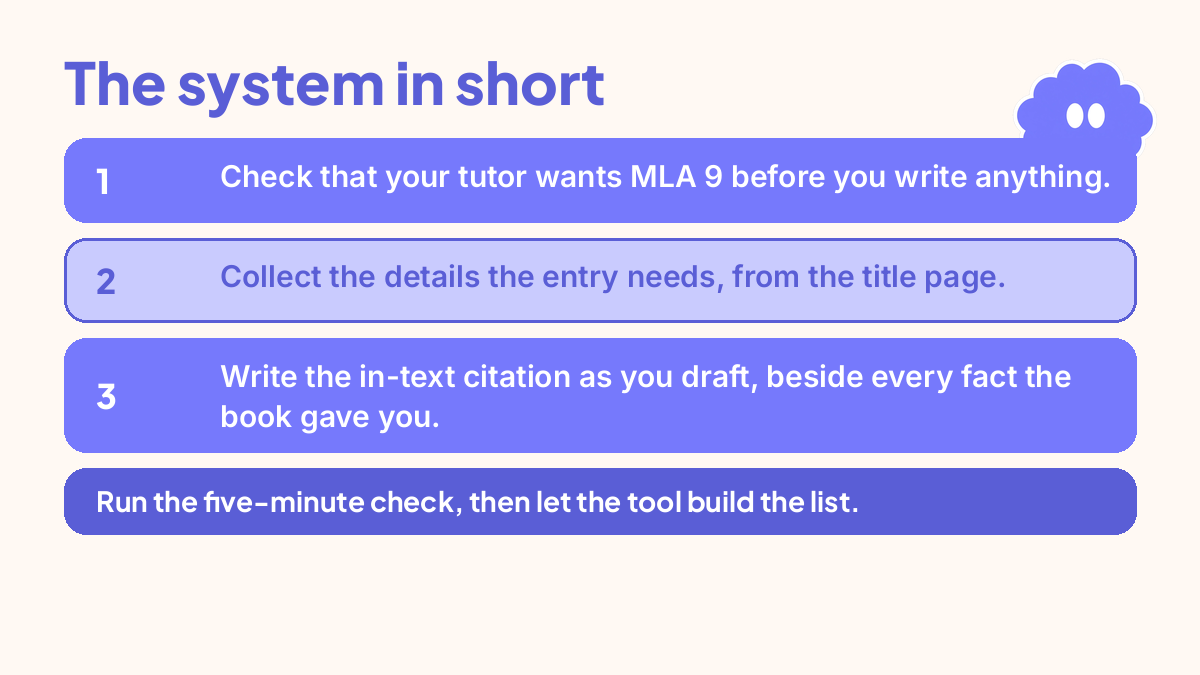
The system in short
- Check that your tutor wants MLA 9 before you write anything.
- Collect the details the entry needs, from the title page.
- Write the in-text citation as you draft, beside every fact the book gave you.
- Build the Works Cited entry from one template, with the book title in italics.
- Handle the awkward cases: no author, editors, editions, and many authors.
- Run the five-minute check, then let the tool build the list.
Step 1: Check that your tutor wants MLA 9
MLA is one style among several, and the rules here apply only if your tutor asked for MLA. The current edition is MLA 9, published in the MLA Handbook, 9th edition, in 2021. If your handbook names APA or Harvard instead, stop: those styles use different templates. Do not mix styles in one list.
Open your university or department guide and find its book page. Note how it writes an edition and how many authors it names before et al. Your tutor’s guide always wins where it differs from this article.
The core elements are the heart of MLA 9, and they always appear in this order: Author. Title of source. Title of container, Other contributors, Version, Number, Publisher, Publication date, Location. A book usually needs only four of them: author, title of source, publisher, and publication date.
In MLA, the titles of books and other longer works use title case, which means the main words are capitalised. Shorter works, such as articles and chapters, go in quotation marks. Longer works and containers, such as books, journals and websites, are italicised. A book title is italicised and in title case, and nothing else in the entry is italicised.
Step 2: Collect the details the entry needs, from the title page
A book entry needs four details, and a missing one is the most common reason a reference loses marks. First, the author, from the title page, not the cover. Second, the title, exactly as printed, including any subtitle. Third, the publisher. Fourth, the year of publication.
Write the four details on one line, in the order the template uses them, and keep that line next to your notes. The line is the entry, half built, and it stops the most common error in student essays: writing first and hunting for the details after, when the book is back in the library.
Use the year of the edition you read, not the year the book was first published. The copyright page, behind the title page, lists the years of each edition.
The publisher is the name on the title page. Do not use the bookseller or the library. If the title page shows an imprint, a smaller name owned by a larger publisher, use the imprint name as printed.
Step 3: Write the in-text citation as you draft, beside every fact the book gave you
The MLA in-text citation for a book is short: the author’s surname and the page number, in brackets, with no comma between them. “Bhabha argues that culture is made in the space between traditions (Bhabha 23).” Write it as you draft, beside every fact, not at the end: a citation added later is usually wrong about the page.
Add a page number when you quote directly, or when the fact sits on one page of a long book. No page number is needed for a general idea drawn from the whole book. Copy the words exactly, use quotation marks, and give the page: a quotation without a page number cannot be checked.
With two authors, name both in the text: (Linden and Okafor 58). With three or more, use the first author’s surname and et al.: (Linden et al. 58).
This is where MLA differs most from Harvard. Harvard writes the year in the text, as in (Bhabha, 1994), while MLA writes the page number instead. If your last essay used Harvard, check every in-text citation in this one: a year in brackets is a Harvard citation. The Harvard book guide uses the year form, so keep the two templates apart.
Step 4: Build the Works Cited entry from one template, with the book title in italics
The Works Cited entry follows one template: Author Last, First. Title of Book in Title Case. Publisher, Year. The book title goes in italics; nothing else does. Entries sit in alphabetical order by the author’s surname, on a new page titled Works Cited, with a hanging indent.
For the verified example, a book by Homi K. Bhabha published in 1994, the entry reads: Bhabha, Homi K. The Location of Culture. Routledge, 1994. Note the surname first, the title in italics and in title case, the publisher, and the year at the end. There is no place of publication in MLA 9, and no access date for a printed book.
For two authors, name both, in the order they appear on the title page: Linden, Sarah, and Chidi Okafor. Reading the City: Literature and Urban Life. Oxford University Press, 2021. Only the first author’s name is reversed. For three or more, name the first author followed by et al.: Linden, Sarah, et al. Reading the City: Literature and Urban Life. Oxford University Press, 2021.
The Works Cited page starts on a new page, the title Works Cited is centred at the top, and it is not bold and not in italics. Entries are double-spaced, in alphabetical order, with a hanging indent.
Step 5: Handle the awkward cases
Five cases cause most of the lost marks. First, no author: start the entry with the title, in italics, and alphabetise by the title’s first main word, ignoring A, An or The. In the text, use a shortened title and the page number, for example (Reading the City 41). Never invent an author.
Second, an edited book with no single author: cite the editor, with “editor” after the name, for example: Okafor, Chidi, editor. City Voices: New Writing on Urban Life. Faber, 2019. If you used one chapter, cite the chapter author instead, using the template in the chapter in an edited book guide.
Third, a later edition: give the edition after the title, for example: Linden, Sarah. Reading the City: Literature and Urban Life. 2nd ed., Oxford University Press, 2023. If the edition is the first, say nothing about it.
Fourth, an e-book: reference it as a printed book if it has publication details and page numbers, which most do. If it has no page numbers, use the chapter number in your in-text citation instead, for example (Bhabha, ch. 2).
Fifth, a book with an organisation as author: use the organisation’s name, for example: Modern Language Association. MLA Handbook. 9th ed., Modern Language Association of America, 2021.
Step 6: Run the five-minute check, then let the tool build the list
Before you submit, spend five minutes checking every book reference. First, does each entry have all four details, in the core elements order? Second, is the book title in italics and in title case? Third, is the year the year of the edition you read? Fourth, does every in-text citation have a matching entry, and vice versa? Fifth, is the list alphabetical, with a hanging indent, on a new page titled Works Cited?
Then let the citation generator build the list. Choose MLA 9, choose Book, and type the four details into the fields that appear. The tool shows an in-text citation beside every reference and keeps the list in alphabetical order in your browser. Check the output against your guide once, and then trust it: the tool’s job is the punctuation, and yours is the details.
Scan the list for years in brackets, which belong to Harvard, and for a reference list titled References, which belongs to APA.
A worked example: citing a book in an essay on literature and the city
Your situation: Second-year English literature student, essay on how novels represent city life. You used one book throughout: an illustrative example, Reading the City: Literature and Urban Life by Sarah Linden, published by Oxford University Press in 2021. The essay is due on Friday, and the book details below are made up to show the system working, not a real citation.
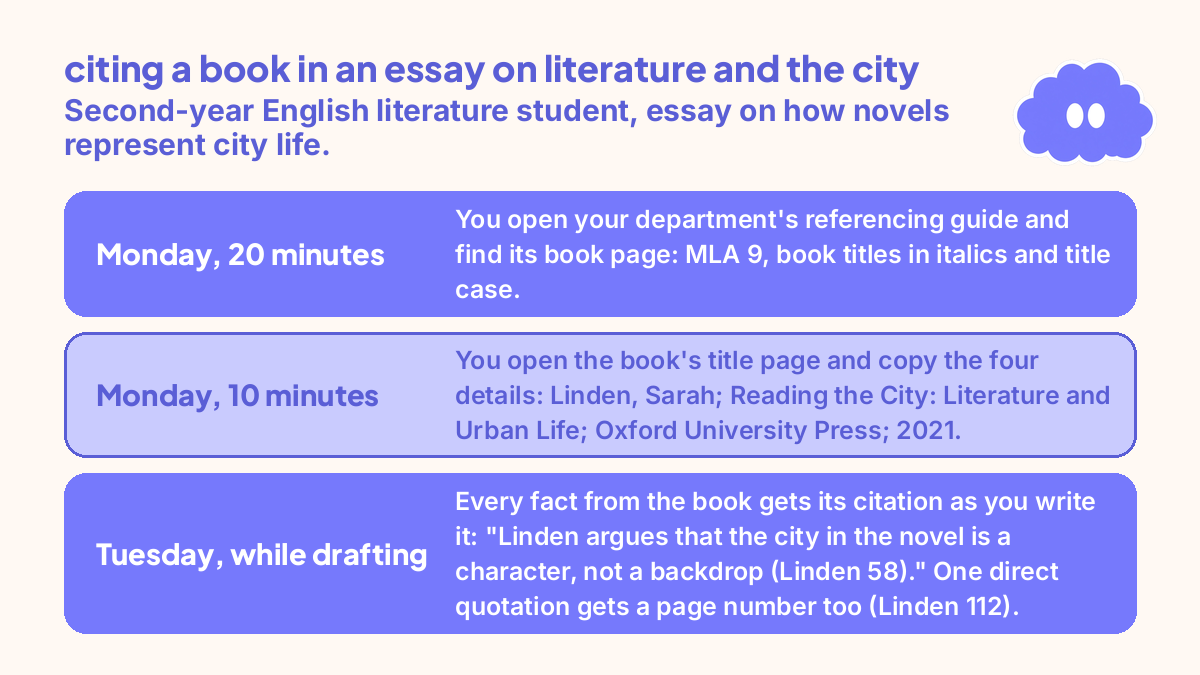
- Monday, 20 minutes: You open your department’s referencing guide and find its book page: MLA 9, book titles in italics and title case. You write the template on a sticky note.
- Monday, 10 minutes: You open the book’s title page and copy the four details: Linden, Sarah; Reading the City: Literature and Urban Life; Oxford University Press; 2021.
- Tuesday, while drafting: Every fact from the book gets its citation as you write it: “Linden argues that the city in the novel is a character, not a backdrop (Linden 58).” One direct quotation gets a page number too (Linden 112).
- Wednesday, 15 minutes: You build the Works Cited entry: Linden, Sarah. Reading the City: Literature and Urban Life. Oxford University Press, 2021.
- Thursday, 5 minutes: You run the check: all four details are there, the title is in italics, and the in-text citations match the entry. You start the Works Cited page on a new page.
- Friday, 5 minutes: You put the details into the citation generator, choose MLA 9 and Book, and let it build the entry. It matches yours. You copy it into the Works Cited list and submit.
The references took an hour in total, spread across the week, and none of it was done in a panic on Friday night.
When it goes wrong
You cite the editor instead of the author. The author wrote the book, and the editor put it together. If you used the whole book, cite the author. If you used one chapter, cite the chapter author instead.
You guess the year. The year of the edition you read sits on the copyright page, behind the title page. Do not use the year of the first edition.
You copy the details from the cover. The cover is marketing, not referencing: the name on it can be an editor or the writer of the foreword.
You put the year in the in-text citation. That is Harvard, not MLA. In MLA the brackets hold the author’s surname and the page number, with no comma between them.
Your Works Cited list has an entry with no in-text citation. Every entry must be cited in the text, and vice versa. A book you read but never cited does not belong in the list.
Weekly review checklist
- Have I checked that my tutor wants MLA 9, not APA or Harvard?
- Have I collected all four details for each book, from the title page?
- Did I write the in-text citation as I drafted, with the surname and the page number?
- Is the book title in italics and in title case, and is the entry in the right order?
- Have I handled the awkward cases: no author, editors, editions, many authors?
- Did I run the five-minute check, and does the tool’s output match my guide?
Downloadable infographic spec: one vertical image, title “How to cite a book in MLA style”, with the six steps from “The system in short” and the six review questions above, in Thynq cream, Cloud Purple, Dark Purple and pink, with the Cloud mascot. Text taken word-for-word from this article.
What this system is not
It is not a substitute for your university’s referencing guide, which always wins where it differs from this article. It is not a way to cite a book you have not read: the four details come from the title page of the book in your hand, not from a search result. It does not cover APA or Harvard, which use different templates. And it does not make referencing interesting; it makes it routine, so an hour spread across the week replaces a panicked Friday night.
If you are writing a thesis, the same routine scales up: capture every book once. The guide to How to write a thesis conclusion shows how the last chapter pulls the argument together, and How to manage references for a thesis shows how to keep one list to submission.
Sources
- Modern Language Association. MLA Handbook. 9th ed., Modern Language Association of America, 2021. Supports the MLA 9 core elements order, the book template, and the Works Cited rules in this article.
- Purdue OWL. MLA Formatting and Style Guide. Purdue Online Writing Lab. Read November 2026. Supports the MLA 9 book template and the (Author page) in-text form.
- Thynq citation generator. The tool page on thynq.org, read 22 November 2026. Supports the tool description in this article: three styles including MLA 9, four source types including book, and the in-text citation shown beside every reference.
For the full system behind this method, start with How to build a study system that fits your life.
Questions
How do I cite a book in MLA style?
Write the author’s surname and the page number in brackets in your text, for example (Bhabha 23), then add one full entry to your Works Cited list: Author Last, First. Title of Book in Title Case. Publisher, Year. The book title goes in italics. Collect the author, title, publisher and year from the title page before you write, and check that your tutor wants MLA 9 first.
What do I do if a book has no author in MLA style?
Start the Works Cited entry with the title, in italics, and alphabetise the entry by the title’s first main word, ignoring A, An or The. In the text, use a shortened version of the title and the page number, for example (Reading the City 41). Never invent an author, and do not use Anonymous unless the book itself prints that word.
Do I need a page number in an MLA in-text citation?
Yes, when you quote directly or point to a fact on one page of a long book. Write the author’s surname and the page number with no comma between them, for example (Bhabha 23). No page number is needed for a general idea drawn from the whole book. A quotation without a page number cannot be checked, so always give one.
How do I cite a book with more than two authors in MLA style?
In the Works Cited list, name the first author followed by et al., for example Linden, Sarah, et al. In the text, use the first author’s surname and et al., for example (Linden et al. 58). With two authors, name both in the list and in the text. With one author, the entry is simply the author’s surname and first name, reversed.