The direct answer
Cite the author of the chapter, not the editor of the book. In the text, give the chapter author’s name and the year. In the reference list, give the chapter author and chapter title first, then the editor, the book title, and the page range.
An edited book is a book with many authors, one per chapter, held together by an editor. Students get the citation wrong in exactly one place: they cite the editor, because the editor’s name is on the cover. The chapter author is the person who wrote the words you are using, so the chapter author is the person you cite. The editor appears in the reference list, after the chapter details, and almost never in the text. The system below gives you a five-step routine for getting it right every time, a worked example in Harvard and APA, and a check that catches the mistakes markers see most.
The system in short
- Identify the chapter author from the chapter heading, not from the book cover.
- Collect the six details the reference needs: chapter author, chapter title, editor, book title, publisher, and page range.
- Check which style your course wants, and which version of Harvard, before you write the reference.
- Write the in-text citation from the chapter author and the year, with no editor.
- Write the reference list entry from the template for your style, then run the five-minute check.
- Review weekly for 15 minutes: every new chapter reference checked against the template, and every mistake logged so it is not repeated.
Step 1: Identify the chapter author from the chapter heading
Open the chapter and look at the heading, not the cover. The chapter author’s name is usually printed under the chapter title, or at the start of the chapter. The editor’s name is on the cover and the title page, and it is the name most students copy by mistake, because it is the first name they see.
If the chapter has two or three authors, note all of them, in the order printed. If the chapter is written by the editor themselves, then the editor is also the chapter author, and you cite them as the author of that chapter. That is the only case where the editor’s name belongs in the text, and it belongs there as the chapter author, not as the editor.
Write the chapter author’s name down exactly as printed, surname first for the reference list, and keep the initials as they appear. For the wider system behind this, How to manage references for a thesis covers keeping track of sources as you read, so the details are there when you need them.
Step 2: Collect the six details the reference needs
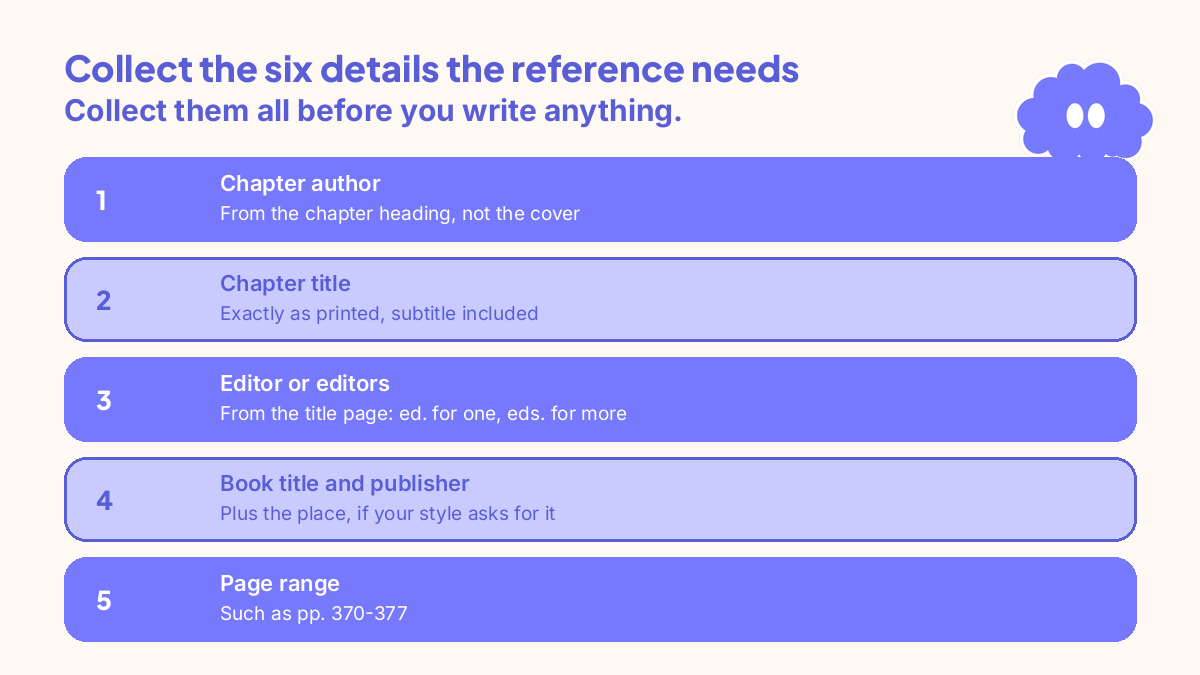
A chapter reference needs six details, and a missing one is the most common reason a reference loses marks. Collect them all before you write anything. First, the chapter author, from Step 1. Second, the chapter title, exactly as printed, including any subtitle. Third, the editor or editors, from the title page, with “ed.” for one editor and “eds.” for more than one. Fourth, the book title, exactly as printed. Fifth, the publisher, and the place of publication if your style asks for it. Sixth, the page range of the chapter, from the first page to the last page, such as pp. 370-377.
The page range is the detail students skip most, and it is the detail that proves you used this chapter and not the whole book. Find it in the contents page, which lists the first page of each chapter, or check the last page of the chapter itself.
Step 3: Check which style your course wants, and which version of Harvard
Before you write the reference, check two things: which style your course wants, and, if it is Harvard, which version. APA 7 and MLA 9 are single published styles, so their rules are the same everywhere. Harvard is different: it is a generic name for many author-date styles, and universities vary them. The Open University guide, Cite Them Right, and your own university’s guide can all give slightly different punctuation for the same chapter, and your marker will use your university’s version.
Find your university’s referencing guide, usually on the library website, and read the page for a chapter in an edited book. Note four things: whether the chapter title goes in single quotes, double quotes, or no quotes; whether the place of publication is included; whether the editor is written as “ed.” or “(Ed.)”; and whether the page range uses “pp.” or “p.” for a single page.
If your course uses APA, the answer is simpler: APA 7 has one form, and the worked example in this article uses it. If your course uses Harvard, the tool in Step 5 follows Cite Them Right Harvard, which is the version many UK universities use, but it is not the only one. Check your guide, and if it disagrees with the tool, follow your guide.
Step 4: Write the in-text citation from the chapter author and the year
The in-text citation is the easy part, and it is the same in Harvard and APA: the chapter author’s surname and the year. For a chapter by Peter Straub, published in 1992, the citation is (Straub, 1992). No editor, no book title, no page range, unless you are quoting directly, in which case add the page number, such as (Straub, 1992, p. 372).
The only time the editor appears in the text is when you are citing the whole edited volume, or a contribution the editor wrote themselves. For the whole volume, the citation names the editor, such as (Etchison, 1992) for the anthology Metahorror, edited by Dennis Etchison. If you are citing a chapter from that volume, the citation names the chapter author, not the editor. Mixing those two up is the mistake this system exists to prevent.
Step 5: Write the reference list entry from the template for your style
In Cite Them Right Harvard, the form is: Chapter Author, A. (Year) ‘Title of chapter’, in Editor, A. (ed.) Title of book. Place: Publisher, pp. xx-xx. For the worked example in this article, a chapter by Peter Straub in an anthology edited by Dennis Etchison, the entry reads: Straub, P. (1992) ‘The ghost village’, in Etchison, D. (ed.) Metahorror. Dell Publishing, pp. 370-377. Note the single quotes around the chapter title, the word “in” before the editor, “(ed.)” after the editor’s name, and the page range at the end. Some Harvard versions leave out the place of publication, and some use double quotes, so check your guide, as Step 3 says.
In APA 7, the form is: Chapter Author, A. (Year). Title of chapter. In A. Editor (Ed.), Title of book (pp. xx-xx). Publisher. The same chapter reads: Straub, P. (1992). The ghost village. In D. Etchison (Ed.), Metahorror (pp. 370-377). Dell Publishing. Note the differences: no quotes around the chapter title, “(Ed.)” with a capital E, the page range in brackets after the book title, and the publisher at the end with a full stop.
For more than one editor, list them all and change the abbreviation to the plural. In APA, three editors read: In N. B. Dirks, G. Eley, and S. B. Ortner (Eds.), Culture/power/history: A reader in contemporary social theory (pp. 123-154). Princeton University Press. In Harvard, the same change applies: “(eds.)” instead of “(ed.)”. If you use the citation generator, pick the chapter type and your style, and check the result against your university guide before you submit, because the tool formats what you type, and it cannot see your source.
Step 6: Review weekly for 15 minutes
Once a week, spend 15 minutes checking every new chapter reference against the template. Three questions: does the in-text citation name the chapter author, not the editor? Does the reference list entry have all six details, including the page range? Does the punctuation match your university guide, not a different version?
Keep a list of the mistakes you make, one line each: “Cited the editor in the text”, “Forgot the page range”, “Used double quotes, guide wants single”. That list is the fastest way to stop repeating them, because the same three mistakes cause most lost marks on references, and they are all caught by this check. When the list stops growing, the system is working.
A worked example: citing one chapter from an anthology
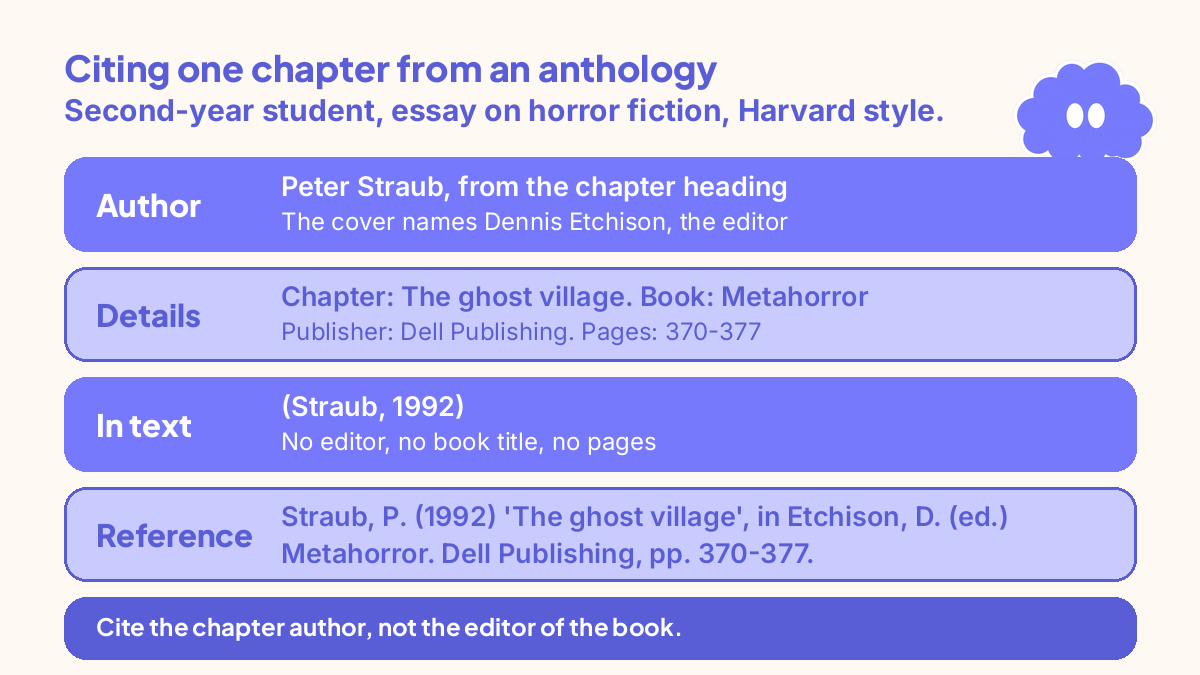
Your situation: Second-year student, essay on horror fiction. You are using one chapter, “The ghost village” by Peter Straub, from the anthology Metahorror, edited by Dennis Etchison, published by Dell Publishing in 1992, pages 370 to 377. Your course uses Harvard, and your university guide follows Cite Them Right.
- Step 1, chapter author: The chapter heading names Peter Straub. The cover names Dennis Etchison, the editor. You cite Straub.
- Step 2, six details: Chapter author: Straub, P. Chapter title: The ghost village. Editor: Etchison, D. Book title: Metahorror. Publisher: Dell Publishing. Page range: 370-377.
- Step 3, style check: Your guide follows Cite Them Right Harvard: single quotes around the chapter title, “(ed.)” after the editor, place and publisher, page range at the end.
- Step 4, in-text citation: “An abandoned village was home to unhappy spirits (Straub, 1992).” No editor, no book title, no pages.
- Step 5, reference list entry: Straub, P. (1992) ‘The ghost village’, in Etchison, D. (ed.) Metahorror. Dell Publishing, pp. 370-377. The place of publication is left out here because this copy gives none; if your copy shows one, add it before the publisher, in the form “Place: Publisher”.
- Step 6, check: In-text names the chapter author. Entry has all six details. Punctuation matches the guide. Done, in five minutes.
- If your course used APA 7 instead: The in-text citation is the same, (Straub, 1992). The reference list entry is: Straub, P. (1992). The ghost village. In D. Etchison (Ed.), Metahorror (pp. 370-377). Dell Publishing.
When it goes wrong
You cited the editor in the text. Fix it to the chapter author and check every other chapter citation in the essay, because this mistake usually repeats. If you cited the whole volume on purpose, make sure the sentence is actually about the whole book, not about one chapter in it.
You cannot find the page range. Check the contents page for the chapter’s first page, then look at the last page of the chapter, which is the page before the next chapter starts. If you are reading online and the pages are not numbered, note that in your records and ask your tutor how they want it handled, because a reference without a page range is incomplete.
Your Harvard does not match your marker’s Harvard. That is not your fault, but it is your problem. Harvard has several versions, and the fix is to find your university’s guide and follow it exactly, even when it disagrees with a website or a tool. If the guide is silent on a detail, pick one form and use it for every chapter reference, because consistency matters more than the single detail.
The tool gives you a reference that looks wrong. Check what you typed. The tool formats the details you enter, and the usual errors are typing the editor as the author, leaving out the page range, or picking the wrong source type. Fix the details, generate it again, and check the result against your university guide before you submit.
Weekly review checklist
- Does every in-text citation for a chapter name the chapter author, not the editor?
- Does every reference list entry have all six details, including the page range?
- Does the punctuation match your university guide, including quotes and “ed.”?
- Did you check the style and Harvard version before writing, or after?
- Which mistakes appeared this week, and are they on your list?
- Are the six details for every chapter saved together, ready for the next essay?
Downloadable infographic spec: one vertical image, title “How to cite a chapter in an edited book”, with the six steps from “The system in short” and the six review questions above, in Thynq cream, Cloud Purple, Dark Purple and pink, with the Cloud mascot. Text taken word-for-word from this article.
What this system is not
It is not a substitute for your university’s referencing guide. Harvard has several versions, and this article shows the Cite Them Right form and the Open University form, but your guide is the one your marker uses. It does not cover every source type: journal articles, websites, and whole edited books each have their own forms. What it does is smaller: it gives you a routine that puts the chapter author first, collects the six details before you write, and checks the result against your guide.
Sources
- Knowadays. Citing chapters of edited books in Harvard and APA. Read 17 November 2026. In-text citations name the chapter author, not the editor; Harvard and APA reference templates with the Straub and Bennett worked examples.
- Dundalk Institute of Technology Library. Research process: Harvard referencing, part 2. Read November 2026. Chapter in an edited book: in-text citation from the chapter author, reference list entry with editor, book title, place, publisher, and page range.
- University of Sheffield Library. Harvard referencing pre-entry guide, based on Cite Them Right. Read November 2026. Book chapter in an edited book: chapter author and year in the text, full details in the reference list.
For the references behind this article, read How to manage references for a thesis. For the reading system that finds the chapters, read How to write a literature review system.
Questions
How do I cite a chapter in an edited book?
Cite the author of the chapter, not the editor of the book, in the text. In the reference list, give the chapter author and chapter title first, then the editor, the book title, and the page range. The exact punctuation depends on your style, so check your university guide and use one style throughout.
Do I cite the editor or the author for a chapter in an edited book?
Cite the chapter author in the text, because they wrote the words you are using. The editor appears only in the reference list entry, after the chapter details. Cite the editor in the text only when you are referring to the whole edited volume, or to a contribution the editor wrote themselves.
What is the Harvard reference for a chapter in an edited book?
In Cite Them Right Harvard, the form is: Chapter Author, A. (Year) ‘Title of chapter’, in Editor, A. (ed.) Title of book. Place: Publisher, pp. xx-xx. Harvard has several versions, so check your university guide: some leave out the place, and some use double quotes instead of single.
What is the APA reference for a chapter in an edited book?
In APA 7, the form is: Chapter Author, A. (Year). Title of chapter. In A. Editor (Ed.), Title of book (pp. xx-xx). Publisher. The in-text citation is the chapter author and the year, such as (Straub, 1992), with no mention of the editor.