The direct answer
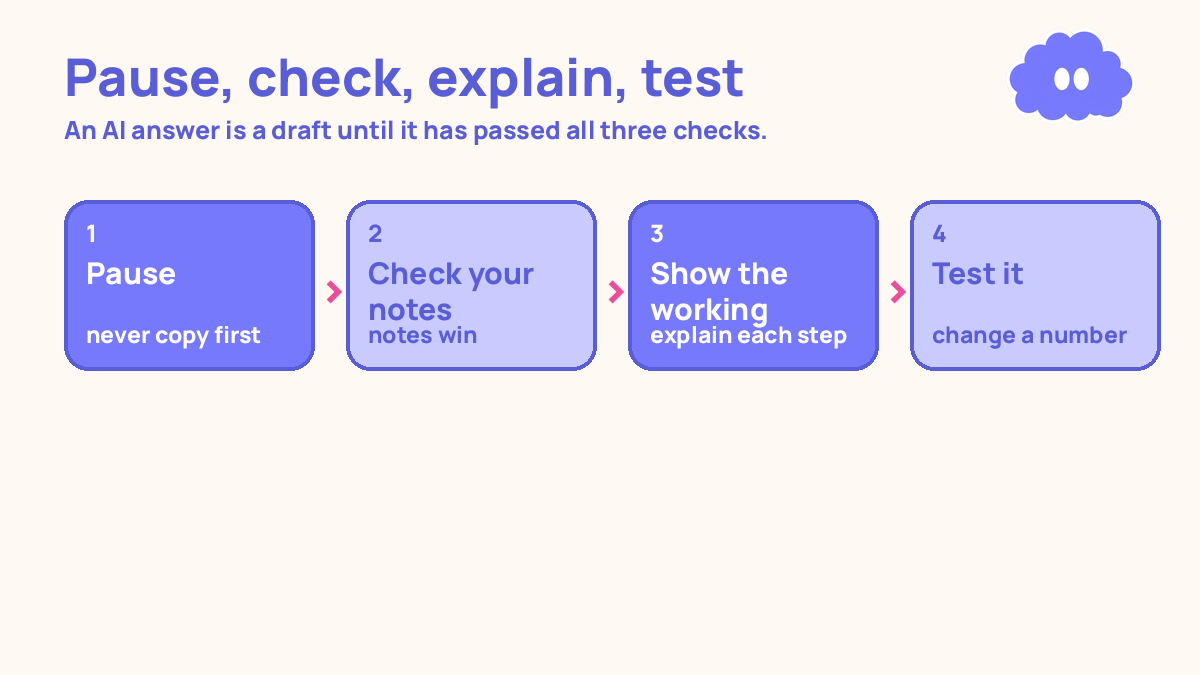
How to check if an AI answer is wrong: never copy it straight into your work. First check it against your textbook or notes — they are the source of truth. Then make the AI show its working, step by step. Then test it: change a number, or ask a follow-up question it cannot dodge. If two sources disagree, ask your teacher. An AI answer is a draft until it has passed all three checks.
You asked the AI a question. It answered, quickly and confidently, in clean sentences. And now you are not sure it is right. That doubt is the most useful thing in this article. An AI writes confidently whether it is right or wrong. It does not hesitate, it does not say “I am not sure,” and it does not show its working unless you ask. Confidence is not evidence. Your textbook is evidence. Your notes are evidence. Your teacher is evidence. The AI is a draft.
This matters because students are systematically wrong about what is helping them. In one study, students who built concept maps predicted they would do best and did worst a week later, while the retrieval group predicted worst and did best (Karpicke & Blunt, 2011). Feeling sure is not the same as being right — and an AI answer that feels right because it is well written is the same trap, in a new form. The only honest check is an outside source: your notes, your textbook, your teacher.
This system fits inside how to use AI tools for study without cheating — the boundary is the same: AI is for testing, explaining, and drafting questions, never trusted without checking. It also fits with how to check your own understanding when studying alone, because checking an AI answer is a special case of checking your own understanding: if you cannot explain it, you do not know it.
The system in short
- Pause. Never copy an AI answer straight into your notes or your work.
- Check it against your textbook or notes. If they disagree, your notes win.
- Make the AI show its working, step by step, and explain each step in your own words.
- Test it: change a number, or ask a follow-up question the AI cannot dodge.
- If two sources disagree, ask your teacher — and keep a list of every AI mistake you catch.
Step 1: Pause before you copy anything
The first check is a pause. When the AI gives you an answer, do not copy it into your notes, do not paste it into your work, and do not move on. Read it once, slowly, and ask one question: does this match what I already know? If it contradicts something in your notes, that is a flag, not a reason to update your notes. If it uses a word you do not know, that is a flag too. If it feels too easy — a whole topic reduced to three neat sentences — that is a flag as well. A neat answer is not necessarily a right answer.
Write the AI’s answer down in your own words before you check it. Not copied — rewritten. Rewriting forces you to decide what the answer actually says, and it shows you the parts you do not understand. If you cannot rewrite it, you cannot check it, and you certainly cannot use it. That rewrite is the first test, and it takes two minutes.
The pause matters most when you are in a hurry. A deadline, a late night, a question due tomorrow — that is when the copy button is most tempting, and when a wrong answer costs the most. The rule does not change when you are busy. It matters more.
Step 2: Check it against your textbook or notes
Open your textbook or your notes and find the same fact. If the AI’s answer matches, it is probably right. If it does not match, your notes win — not because your notes are perfect, but because they are your course. The exam tests your course, not the AI’s memory. An AI trained on the whole internet will give you the most common version of a fact. Your course may teach a different version, a different definition, or a different method. The common version is not automatically the right one for your exam.
This check takes under a minute for a fact, and it catches most errors. A date, a definition, a formula, a name — all of them are in your notes or your textbook, and all of them can be checked in one look. If the fact is not in your notes at all, that is information too: either your notes are missing something, or the AI has added something your course never taught. Find out which one before you use it.
If you have a mark scheme — for a past paper, or for a worked example — check the answer against that too. A mark scheme shows you what the examiner accepts, and an AI answer that would not score the mark is a wrong answer for your purposes, even if it is true in general.
Step 3: Make the AI show its working
For anything that is not a simple fact — a calculation, a method, a chain of reasoning — ask the AI to show its working, step by step. “Show each step, and explain why you did it.” Then read each step and check it separately. A wrong answer usually has one wrong step, and the wrong step is usually the one that looks most obvious. If a step says “therefore” and you cannot see why it follows, that step is the one to check.
Then explain the working back, in your own words, out loud or in writing. Explaining why each step works is a moderate-utility technique (Dunlosky et al., 2013), and a 2018 meta-analysis across 64 reports found a moderate average benefit for prompting self-explanation (Bisra et al., 2018). The original study behind it was small — 8 physics students, thinking aloud while they studied worked examples (Chi et al., 1989) — so treat the explanation as a practical check, not a proven method. The check is simple: if you cannot explain a step, you do not understand it, and an answer you do not understand is an answer you cannot trust.
If the AI’s explanation contradicts your textbook’s method, your textbook wins. Different methods can both be right, but your exam expects the method your teacher taught. Learn the AI’s method if it helps you understand, but answer in the method your course uses.
Step 4: Test it — change a number, ask a follow-up
A wrong answer often survives a reading and dies on a test. So test it. If the AI solved a problem with numbers in it, change one number and ask it to solve the new version. If it gives a different answer for the same method, something is wrong — either the method or the arithmetic. Work the changed version yourself, by hand, and compare. The hand calculation is the check.
If the AI gave you a definition, ask a follow-up question it cannot dodge: “Give me an example of this in a real situation.” “What would happen if this part were missing?” “How is this different from the thing that sounds like it?” A wrong definition usually produces a wrong example, and a wrong example is easier to spot than a wrong definition. If the example contradicts your notes, the definition is wrong, however good it sounded.
If the AI gave you an essay paragraph or a summary, ask it to turn the paragraph into three short-answer questions, then answer them yourself with the notes closed. If you cannot answer the questions from your own notes, the paragraph taught you nothing — or it taught you something your course does not cover.
Step 5: Ask your teacher when two sources disagree — and keep a list
When your notes and the AI disagree, and you cannot tell which is right, ask your teacher. Bring both versions, with your notes open: “My notes say this, the AI says this, which one is right for our exam?” That is a good question, and teachers like good questions. It also tells your teacher exactly where the confusion is, which is more useful than “I don’t understand the topic.”
Keep a list of every AI mistake you catch, in your notes app: the question you asked, the wrong answer, and the right answer from your notes. One line per mistake. The list does two things. First, it shows you the pattern — the AI is wrong most often on the same kind of question, and that is the kind you must always check by hand. Second, it reminds you, on the days when the AI is fast and confident and you are tired, that you have caught it before, and you will catch it again. The list is the habit, written down.
A worked example: five AI answers, two wrong
This is a worked example, with the article’s own numbers — not a real student, and not a promise of a grade.
You are revising chemistry, and you ask the AI five questions from your notes. You run each answer through the three checks: notes, working, test.
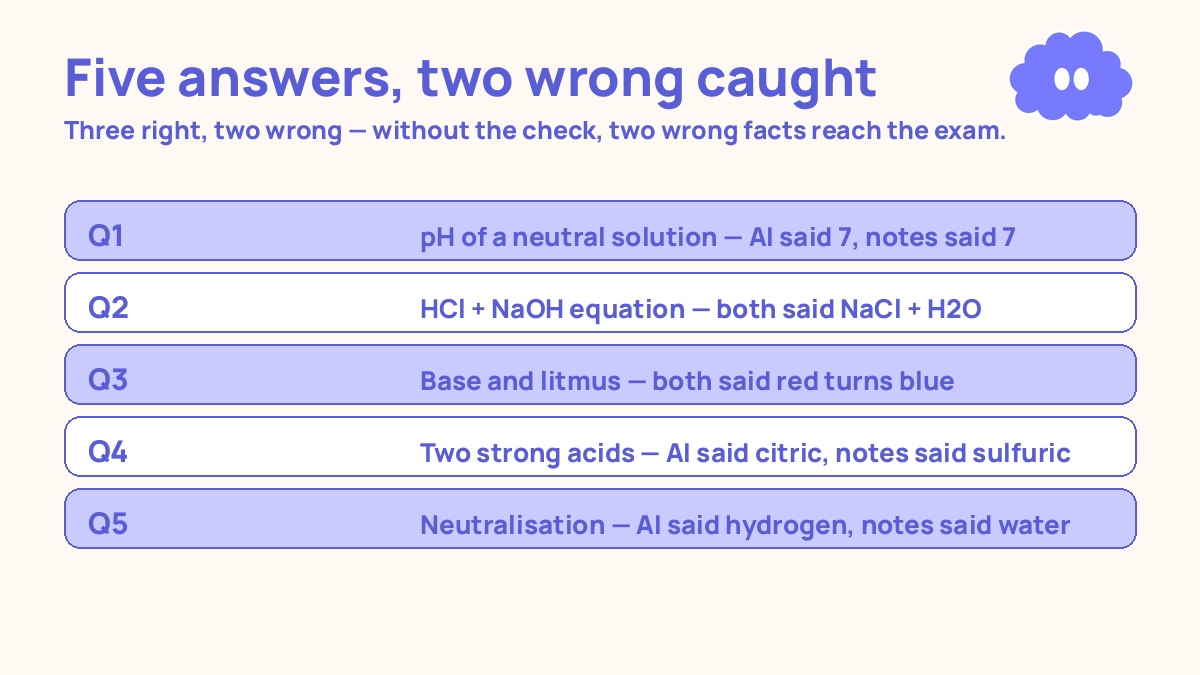
Question 1 — “What is the pH of a neutral solution?” The AI says 7. Your notes say 7. Match. One check, done. You use it.
Question 2 — “Write the equation for hydrochloric acid and sodium hydroxide.” The AI writes HCl + NaOH → NaCl + H₂O. Your notes agree. Match. You use it.
Question 3 — “What does a base do to litmus paper?” The AI says a base turns red litmus paper blue. Your notes say the same. Match. You use it.
Question 4 — “Name two strong acids.” The AI says hydrochloric acid and citric acid. Your notes say hydrochloric acid and sulfuric acid. Citric acid is a weak acid. The check catches it. You throw out the AI’s answer, write the right one from your notes, and add the mistake to your list.
Question 5 — “What is neutralisation?” The AI says “when an acid and a base react to make a salt and hydrogen.” Your notes say a salt and water. The AI confused neutralisation with a metal reacting with an acid. The check catches it. You write the right answer from your notes and add the mistake to your list.
Five answers, three right, two wrong. Without the check, you would have learned two wrong facts and carried them into the exam. With the check, you learned three right facts and found two gaps in the AI — and the two gaps are now on your list, which means you will not trust that kind of answer again without checking.
| Question | AI answer | Your notes | Verdict |
|---|---|---|---|
| pH of a neutral solution | 7 | 7 | Right — use it |
| HCl + NaOH equation | NaCl + H₂O | NaCl + H₂O | Right — use it |
| Base and litmus paper | Red litmus turns blue | Red litmus turns blue | Right — use it |
| Two strong acids | Hydrochloric, citric | Hydrochloric, sulfuric | Wrong — citric is weak |
| What is neutralisation | Salt and hydrogen | Salt and water | Wrong — confused with metal + acid |
When it goes wrong
You copy the answer before you check it. The pause is the system. If the answer is already in your notes before you have checked it, the check will never happen — you will read your notes later and assume they are right, because they are your notes. Check first, copy second, always.
You check the AI against another AI. Two AIs can be wrong in the same way, because they were trained on similar material. A second AI is a second opinion, not a verdict. Your textbook, your mark scheme, or your teacher is the verdict.
You accept the answer because it is well written. An AI writes clearly whether it is right or wrong. Clear sentences, neat structure, confident tone — none of them are evidence. The evidence is your notes. If the answer does not match your notes, the writing does not save it.
You ask the AI to explain, and the explanation sounds right, so you stop. An explanation can be smooth and wrong. Explain it back in your own words, and test it with a changed number or a follow-up question. The explanation is a draft until it survives the test.
You find a disagreement and decide your notes must be wrong. Your notes can be wrong — but the AI is wrong more often, and your exam tests your course. If you cannot settle it from the notes, ask your teacher. Do not silently replace your course with the internet.
Weekly review checklist
Copy this list and use it each week:
- How many AI answers did I check against my notes this week, and how many were wrong?
- What kind of question is the AI wrong about most often, and did I add those to my list?
- Did I explain any AI answer back in my own words, or did I just read it and move on?
- What one change will I make next week: slower checks, a longer mistake list, or asking the teacher sooner?
Downloadable infographic spec: one vertical image, title “How to check if an AI answer is wrong”, with the five steps — pause, check your notes, make it show its working, test it, ask your teacher — and the rule “an AI answer is a draft until it has passed all three checks” in Thynq cream, Cloud Purple, Dark Purple and pink, with the cloud mascot. Text taken word-for-word from this article.
What this system is not
It is not a claim that AI is useless, and it is not a claim that AI is always wrong. It is a way to use AI answers without being misled by them: check every answer that matters against a source you trust, make the AI show its working, test what it gives you, and keep a list of the mistakes you catch. The system does not make the AI right. It makes you harder to fool.
Sources
- Karpicke, J. D. & Blunt, J. R. (2011). Science, 331(6018), 772-775. Retrieval beat concept mapping a week later, and the students who felt most confident did worst.
- Dunlosky, J., et al. (2013). Psychological Science in the Public Interest, 14(1), 4-58. Self-explanation rated moderate utility.
- Chi, M. T. H., et al. (1989). Cognitive Science, 13(2), 145-182. The 8 students who explained most solved problems best.
- Bisra, K., et al. (2018). Educational Psychology Review, 30(3), 703-725. Prompting self-explanation gave a moderate average benefit across 64 reports.
For the boundary this system works inside, read how to use AI tools for study without cheating, and for checking your own understanding, read how to check your own understanding when studying alone.
Questions
How often are AI answers wrong?
Often enough that you must check every one that matters. An AI writes confidently whether it is right or wrong, and confidence is not evidence. This article does not give a percentage, because the rate depends on the subject, the question, and the AI — and any single number would be invented. Check, every time.
What is the fastest check?
Open your textbook or notes and find the same fact. If the AI’s answer matches your notes, it is probably right. If it does not match, your notes win. That one check catches most errors, and it takes under a minute. The other checks in this article are for the answers your notes cannot settle.
Should I ask a second AI to check the first one?
It helps a little, but two AIs can be wrong in the same way, because they were trained on similar material. A second AI is a second opinion, not a verdict. Your textbook, your mark scheme, or your teacher is the verdict.
What if the AI answer looks right but I do not understand it?
Then do not use it. An answer you cannot explain in your own words is an answer you do not know, and it will fail you in the exam even if it is correct. Ask the AI to explain each step, then explain it back in your own words. If you cannot, the topic needs study, not a better answer.