The direct answer
This is how to choose a thesis supervisor on evidence, not reputation: shortlist three to five candidates by fit, read two recent papers from each, meet each one for 30 minutes with the same five questions, talk to two of their current students, and score them on expertise, availability, feedback, and fit before you ask anyone.
Most students choose badly in the same two ways: some pick the most famous name and discover, six months in, that the famous name meets them twice a year; others pick the lecturer they liked most in class and discover that a good teacher is not always a good supervisor. Both mistakes come from deciding on one piece of evidence.
The system in short
- Write your one-paragraph topic and your supervision needs before you look at any names.
- Shortlist three to five candidates by research fit, not by reputation, and check each one is taking students.
- Read two recent papers from each candidate and note one question per paper.
- Meet each candidate for 30 minutes with the same five questions, and take notes in the meeting.
- Talk to two current or recent students of each finalist, and ask about availability and feedback.
- Score every candidate on expertise, availability, feedback, and fit, then ask your first choice in writing.
Step 1: Write your topic and your supervision needs first
Before you look at a single name, write two short paragraphs. The first is your topic in plain words: the question, the evidence you expect to use, and the method you are considering. Keep it under 150 words. If you cannot, narrow the topic before you shop for a name. How to choose a thesis topic gives you the narrowing system, and it is worth doing before this one.
The second paragraph is your supervision needs: how often you want to meet, how fast you need drafts returned, and how much structure you need. If you need a meeting every two weeks and a reply within ten days, write that down. If you work best with a light touch and a monthly check-in, write that down instead. But do not pretend you are fine with a hands-off supervisor when you need regular contact: that pretence is how students end up six months in with no meeting and no draft read.
Step 2: Shortlist three to five candidates by research fit
Make the list from the department website and staff pages. Read the titles of their last five papers: a supervisor whose last five sit in your area is a fit, and one whose last paper on your topic is ten years old is not, however famous they are.
Shortlist three to five names, not one. One name is a hope, not a choice, and if that one person says no or is on leave, you are back to the start with no time left.
Check two practical facts for each name. First, are they taking new thesis students this year? Some staff are on sabbatical or have a full group, and the department office or staff page usually says so. Second, do they supervise at your level? A professor who only supervises PhD students cannot take a master’s thesis, however good the fit. Cross off anyone who fails either check.
Step 3: Read two recent papers from each candidate
For each candidate still on the list, read two recent papers. Not skim, read: you need to know what they argue, what methods they use, and what they care about. Two papers take about three hours per candidate, and How to read research papers for a thesis shows how to read for the argument. Fifteen hours of reading now is cheap against a year of supervision that does not fit.
While you read, write down one question per paper, a specific one: “Why did you use interviews instead of a survey here?” A supervisor who lights up at a sharp question about their own work will enjoy supervising your thesis. One who waves the question away is telling you something too.
Note the method each candidate uses most. If your thesis needs interviews and the candidate only ever runs experiments, that is a gap you will have to bridge yourself.
Step 4: Meet each candidate for 30 minutes with the same five questions
Email each candidate and ask for a 30-minute meeting to discuss supervising your thesis. Keep the email short: your name, your programme, the topic in two sentences, and two possible times. Attach nothing. If they do not reply in a week, send one polite follow-up, then move on. A supervisor who cannot answer an email in a week will not read a draft in a week either.
Ask the same five questions in every meeting. The five questions are: “Does my topic fit your research, and what would you change about it?” “How often would we meet, and how quickly do you usually return drafts?” “How do you like to work with a thesis student: regular check-ins, or long stretches of independent work?” “Who else in the department works in this area, and would you bring them in?” “What does a good thesis look like to you, and what makes a student struggle?”
The first question tests fit. The second and third test availability and style. The fourth tests honesty about limits. The fifth tells you what they value, which is what they will mark you against. Listen for specifics: “I return drafts in a week” is a promise you can hold them to. “I get to them when I can” is also an answer, and it is not a good one. If you felt small in the first meeting, do not expect the tenth to feel different.
Step 5: Talk to two of their current or recent students
Before you decide, talk to two students who have worked with each finalist. Ask the department office, ask classmates, or ask the supervisor: “Could you put me in touch with a student you supervise now?” A supervisor who will not do that is worth noting.
Ask the students four questions, and listen for patterns rather than single complaints. “How often do you actually meet?” “How long does a draft take to come back?” “When you were stuck, what did they do?” “Would you choose them again?” One unhappy student may be a bad match. Two students describing the same problem, slow drafts, cancelled meetings, vague feedback, is a pattern.
Take care with what you hear: students sometimes blame a supervisor for a problem they caused themselves. That is why you ask two students, and why you ask about facts, not opinions. If the supervisor said “I return drafts in a week” and both students say “three weeks, usually”, you have learned something important before committing.
Step 6: Score every candidate, then ask your first choice in writing
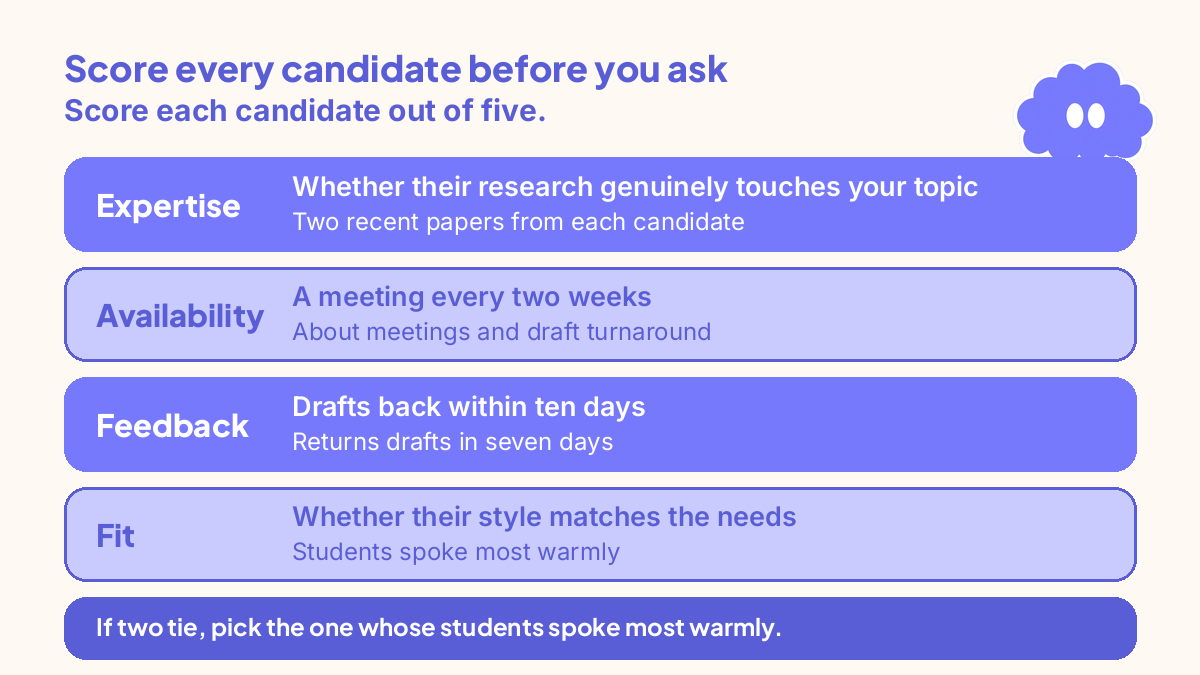
Score each candidate out of five on expertise, availability, feedback, and fit. Expertise is whether their research genuinely touches your topic. Availability and feedback are judged on the evidence of the meeting and the students. Fit is whether their style matches the needs you wrote down in Step 1. Add the scores: the highest total is your first choice. If two tie, pick the one whose students spoke most warmly.
Do not let reputation override the scores. If the famous name scored 12 and the less well-known name scored 17, trust the scores. You are choosing a working relationship, not a name for your acknowledgements page.
Ask your first choice by email within a week of the last meeting, in ten lines: what you want to work on, why you are asking them, and what you would like from the supervision. If they say yes, confirm the practical details in the same thread: how often you will meet, when the first meeting is, and what you should bring. With the supervisor agreed, your next step is the proposal: How to write a thesis proposal shows how to write one a supervisor can approve. If they say no, or they do not reply in a week, ask your second choice the same day.
A worked example: three meetings in one week
Your situation: You are a master’s student in education, starting your thesis in September. Your topic is how new teachers in rural schools decide what to teach when the curriculum and the community disagree. You need a meeting every two weeks and drafts back within ten days, because you work part time and cannot afford a month of silence.
Monday, you write your two paragraphs: twelve interviews with new teachers about curriculum decisions, and a meeting every two weeks with drafts back within ten days.
Tuesday, you shortlist four names. Dr Ahmed has published three papers on teacher decision-making in four years. Dr Okafor works on rural education but uses surveys. Dr Lindqvist has supervised five interview-based theses. Professor Hart is the most cited name in the department, but her last paper on teachers is from 2016.
Wednesday to Friday, you read two papers from each, about six hours, and write one question per paper: why Dr Ahmed stopped at eight interviews, whether Dr Okafor would support an interview study, and how Dr Lindqvist would narrow three countries to one region.
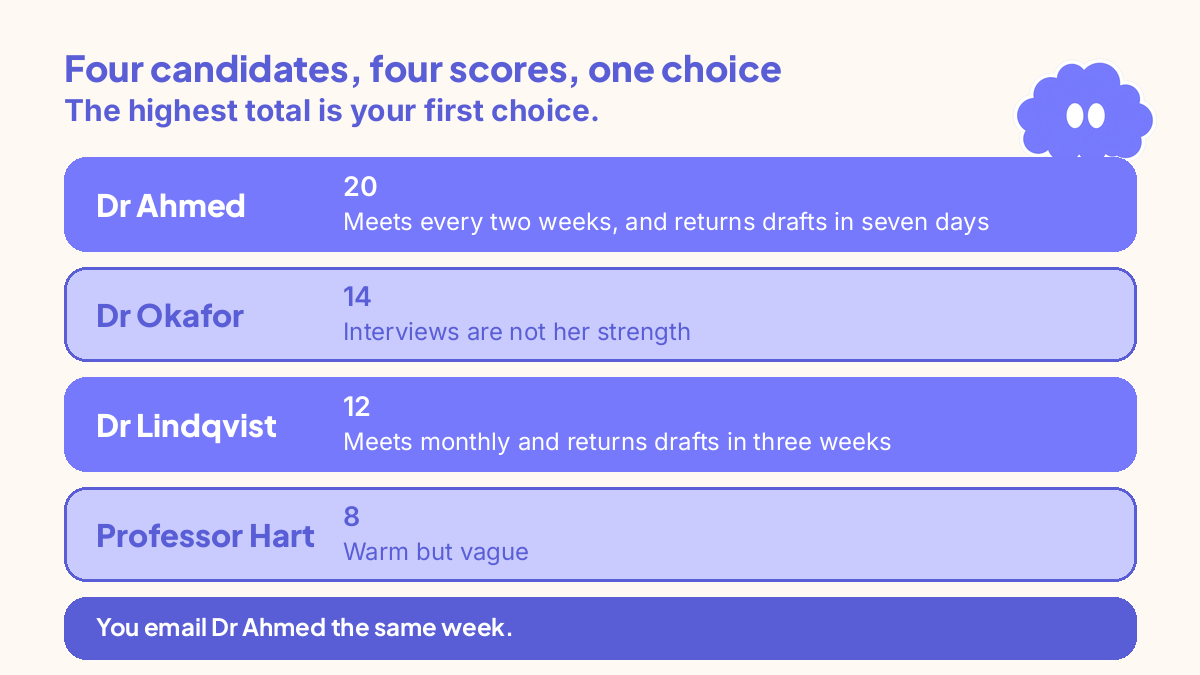
The next week, you meet all four. Dr Ahmed answers all five questions directly, meets every two weeks, and returns drafts in seven days. Dr Okafor is honest: interviews are not her strength, but a colleague could co-supervise. Dr Lindqvist meets monthly and returns drafts in three weeks. Professor Hart is warm but vague, and says she is “very busy this year”.
You talk to two students of each finalist, then score them: Dr Ahmed 20, Dr Okafor 14, Dr Lindqvist 12, Professor Hart 8. You email Dr Ahmed the same week, she says yes, and you agree a first meeting for the following Tuesday, where you will plan the year ahead: How to plan a long research project covers the timeline.
When it goes wrong
Your first choice says no. This is normal, not a rejection of you. Supervisors say no because they are full, on leave, or the fit is wrong. Ask your second choice the same day, with the same email.
Nobody replies to your emails. Check the email first: is it short, does it name the topic in two sentences, does it offer two times? Long emails with attachments get ignored. If the email is right and still nobody replies in a week, ask the department office who is taking students this year.
Every candidate looks weak on availability. Widen the shortlist before you settle: look at neighbouring departments, look at staff who supervise jointly, and ask the programme lead who has capacity. Check your programme rules first, because some require the main supervisor to be in the department.
You picked on reputation and now regret it. Talk to the supervisor first, with specifics: “I need a meeting every two weeks, and we have met twice in three months. Can we fix a regular time?” Give it one month. If nothing changes, talk to your programme lead about changing supervisor. How to handle supervisor feedback on a thesis shows how to raise it without burning the relationship.
Two supervisors both want you, and you cannot decide. Go back to the scores, and add one more test: which one’s students would you rather be? Imagine yourself in six months, stuck on a chapter, needing a meeting. Which supervisor do you picture calling?
Weekly review checklist
Review your choice every week until you have asked someone, and answer these six questions in one page. Once you have a supervisor, the Thesis weekly review and supervisor meeting system pairs this review with the meeting rhythm.
- Is my topic paragraph still under 150 words, and does it still describe what I want to study?
- Have I shortlisted three to five candidates who are taking students?
- Have I read two recent papers from each candidate, with one question written down per paper?
- Have I met each candidate for 30 minutes and asked the same five questions?
- Have I talked to two students of each finalist about meetings and draft turnaround?
- Have I scored every candidate on expertise, availability, feedback, and fit, and asked my first choice in writing?
Downloadable infographic spec: one vertical image, title “Choose your thesis supervisor in five weeks”, with the six steps, write your topic and needs, shortlist three to five, read two papers each, meet for 30 minutes, talk to two students, score and ask in writing, and the six weekly review questions, in Thynq cream, Cloud Purple, Dark Purple and pink, with the cloud mascot. Text taken word-for-word from this article.
What this system is not
This system is not a guarantee. A supervisor who scores well can still turn out to be a poor fit. The system lowers the risk. It does not remove it.
It is not a way to pick the easiest supervisor. A thesis needs someone who will read your drafts properly and tell you when the argument is weak. The system rewards availability and feedback, not leniency.
It is not a substitute for your department’s rules. Some programmes assign supervisors or set a deadline you cannot move. Check those rules first, before you spend five weeks on a choice the programme will not allow.
Sources
- Bar-Ilan University. Choosing a Thesis Supervisor: A Decision That Shapes Your Academic Journey, 2026. Supports defining the field, meeting the supervisor, seeking student feedback, and thinking ahead.
- Pennsylvania State University, School of Hospitality Management. The First Steps: Choosing a Topic and a Thesis Supervisor, thesis guide. Supports meeting several faculty members and requesting a meeting with a short description of the topic.
Questions
When should I choose a thesis supervisor?
Start looking the term before you need one, and ask your first choice four to six weeks before the department deadline. That leaves time to meet two or three candidates, read their recent work, and talk to their students. A supervisor chosen in a rush is chosen on reputation alone, and reputation is the weakest evidence you have.
What matters more: expertise or availability?
Both matter, and neither covers for the other. A world expert who meets you twice a year cannot guide a thesis, and a very available supervisor outside your field cannot judge your argument. Pick the one who clears your minimum on both. If nobody does, widen the shortlist before you settle.
Can I change supervisor after I start?
Usually yes, but it is slow and awkward, so treat it as a repair, not a plan. Most departments have a process: talk to your programme lead, explain what is not working, and name a replacement who has agreed in principle. Changing supervisor is possible, which is exactly why choosing carefully now is worth five weeks of effort.
Should I pick the most famous supervisor I can get?
No. Fame tells you about a researcher’s standing, not about how they supervise. A famous supervisor with twenty students and a hands-off style may give you less guidance than a less well-known supervisor who reads drafts in a week. Judge supervisors on fit, availability, and feedback, and let reputation be the last factor, not the first.