The direct answer
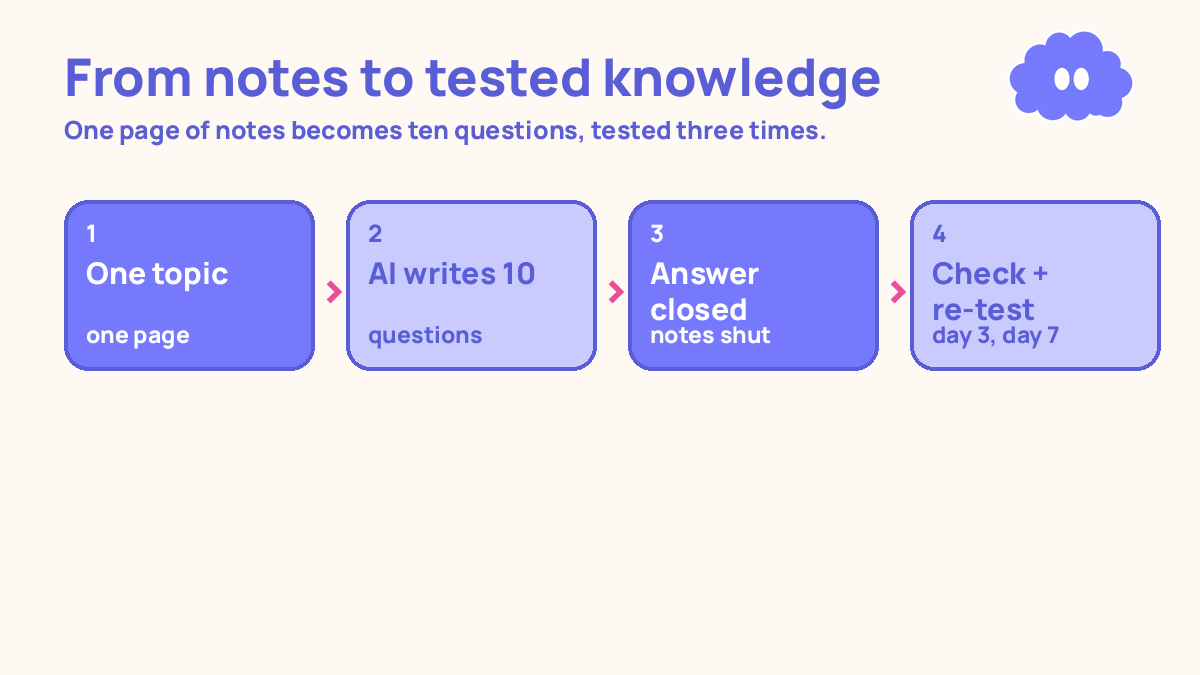
Using AI to make practice questions from your notes: paste one page of notes into any AI chat app, ask for ten short-answer questions with the answers kept separate, answer them with your notes closed, then check every answer against your notes and re-test the ones you missed in three days and again in seven days. The AI writes the questions; your notes decide what is right.
You have notes. Pages of them, from lectures and textbooks. And you have nothing to test yourself with. That is the gap this system closes. Notes are for reading; questions are for learning. In a 2013 review, Dunlosky and colleagues rated ten common study techniques, and only two received a high utility rating — practice testing and distributed practice. Re-reading your notes was rated low. So the notes you already have are only half the job. The other half is turning them into something you can be tested on, and that is what the AI is for.
The AI does one job here: it reads your notes and turns them into questions. You do the learning, by answering them with the notes closed. How to use AI tools for study without cheating draws the boundary: AI is for testing, explaining, and drafting questions — never for writing the work, and never trusted without checking. It fits inside the retrieval practice system for students, and it needs the notes system that you can actually review underneath it. Fix the notes first — the questions can only be as good as the notes they come from.
The system in short
- Pick one topic and one page of notes — not a whole chapter, not the whole subject.
- Ask the AI to turn that page into ten short-answer questions, with the answers listed separately at the end.
- Answer the questions with your notes closed, in writing, before you look at anything.
- Check every answer against your notes, mark what was wrong, and make the AI re-ask only the ones you missed.
- Re-test the missed questions in three days, and the whole set again in seven days.
Step 1: Pick one topic and one page of notes
Start small. One topic, one page of notes. Photosynthesis, not biology. The causes of the First World War, not history. One page is enough for ten good questions, and small enough that you will actually check all ten answers properly. If your notes for the topic run to three pages, pick the one page that holds the facts you keep forgetting. The system works on the weak page, not the whole chapter.
Read the page once before you paste it in — not to memorise it, but to know what is on it, so you can tell whether a question came from your notes or from the AI’s memory. That one read is the only reading this system asks for. Do not paste a whole textbook chapter — long pastes make the AI write vague questions that cover everything and test nothing.
Step 2: Ask the AI for questions, not answers
The prompt matters, because the default thing an AI does with your notes is summarise them — a summary is re-reading in a different font. You want questions. Paste the notes, then write something like this: “Turn these notes into 10 short-answer questions. Each question should test one fact from the notes. Do not use multiple choice. Put the answers in a separate list at the end, and do not show them with the questions.”
Three parts of that prompt do real work. “Short-answer” matters because recall beats recognition as practice: across 61 studies, testing beat restudying, and recall formats beat recognition formats (Rowland, 2014). Multiple choice lets you recognise the answer; a short answer makes you produce it. “One fact per question” matters because a question asking for three things is three questions hiding in one. “Answers separate” matters because if the answers sit under the questions, you will read them while you answer.
Read the ten questions before you answer any of them, and check each one against your notes. If a question comes from outside your notes — a fact the AI added from its own memory — cross it out and ask for a replacement. Two minutes, and it is the difference between testing your course and testing the AI’s memory.
Step 3: Answer with your notes closed
Close the notes. Put the phone with the notes on it face down, or close the notebook. Then answer all ten questions in writing, from memory, before you check anything — an answer you say in your head feels right far more often than it is right. Do not look anything up mid-test. If you cannot answer a question, write “do not know” and move on. That blank is the list of what to fix.
It will feel worse than re-reading. That feeling is not evidence: students who recalled a passage remembered more a week later than students who restudied it, even though the restudiers felt more confident immediately after studying (Roediger & Karpicke, 2006). Feeling fluent right after re-reading is not the same as remembering a week later.
Step 4: Check every answer against your notes
Now open the notes, and check every answer — including the ones you felt sure about. Feeling sure is not the same as being right: students who built concept maps predicted they would do best and did worst, while the retrieval group predicted worst and did best a week later (Karpicke & Blunt, 2011). Your confidence is not a reliable guide. The check is.
For each answer, write one of three marks: right, partly right, or wrong. “Partly right” counts as wrong for the re-test list. Write the correct answer next to the wrong ones, in your own words, from your notes. Do not copy the AI’s answer — its list is a draft, not a mark scheme. If it disagrees with your notes, your notes win.
Then make the re-test list: the questions you got wrong or partly right. That list is the whole point of the session. Ask the AI to re-ask only the missed questions, in a different order, and answer them again the next day. Do not re-test the ones you got right.
Step 5: Re-test in three days and again in seven days
Test the missed questions again in three days, and the whole set of ten again in seven days. That 1-3-7 pattern is a practical starting schedule, not a research rule. The research says spacing beats massing, and the right gap grows with how long you need to remember the material (Cepeda et al., 2006). A gap is what turns the second test into a real test instead of a re-read. Sleep is when the day’s learning is consolidated (Diekelmann & Born, 2010).
If a question is still wrong on day seven, do not just test it again. Go back to the notes, read the one point you missed, and say it aloud in your own words before you test it again. A question that fails three times is an understanding problem, not a memory problem — explaining it is the fix, not another round of the same test.
A worked example: photosynthesis, ten questions, one week
This is a worked example, with the article’s own numbers — not a real student, and not a promise of a grade.
You have one page of notes on photosynthesis. You paste it into the AI and ask for ten short-answer questions, answers separate. Nine come from your notes; one asks about a pigment your notes never mention, so you cross it out and ask for a replacement.
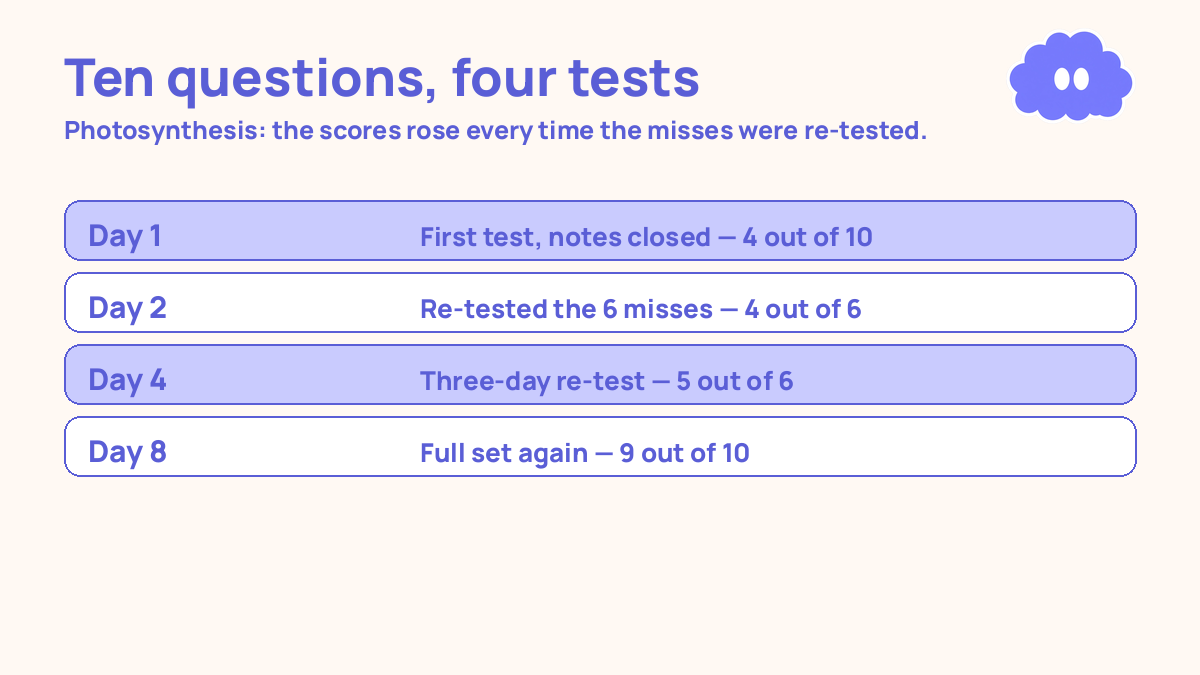
Day 1 — first test, notes closed: You answer all ten in writing, in fifteen minutes. You get 4 right, 2 partly right, 4 wrong — the chloroplast definition, the two stages, the role of chlorophyll, and the equation. You write the correct answers from your notes, in your own words.
Day 2 — re-test the misses: The AI re-asks the six you missed, in a different order. You get 4 of the 6 right. The two still wrong are the two stages and the equation — you read those points again and explain them aloud.
Day 4 — three-day re-test: You answer the six missed questions again and get 5 of the 6 right. The equation is still shaky, so you write it out three times from memory, checking each time.
Day 8 — seven-day re-test: You answer all ten again and get 9 right. The one miss is a detail about where the light reactions happen. You fix it — nine out of ten, a week after the first test, notes closed.
| Day | What you did | Score | The one change |
|---|---|---|---|
| Day 1 | First test, notes closed | 4 out of 10 | Wrote the correct answers from your notes |
| Day 2 | Re-tested the 6 misses | 4 out of 6 | Explained the 2 still-wrong ones aloud |
| Day 4 | Re-tested the misses again | 5 out of 6 | Wrote the equation out 3 times from memory |
| Day 8 | Full set again | 9 out of 10 | Fixed the one remaining detail |
When it goes wrong
The AI writes questions that are too easy. “What is photosynthesis?” is not a test question, it is a topic heading. If the questions feel easy, the prompt was too vague — ask for questions that test one specific fact each.
The AI writes a wrong question and you do not catch it. This is the failure the checking step exists to prevent. Skip the check and you can spend a week learning a fact your course never taught.
You copy the AI’s answers instead of checking them against your notes. The AI’s answer list is a draft, not a mark scheme. Study it without comparing it to your notes and you are studying the AI’s memory, not your course.
You test the whole chapter at once, or re-test what you got right. Twenty questions across five topics feels productive and teaches nothing well. One topic, ten questions, checked properly, beats a whole chapter tested once and never checked. Re-testing the ones you got right wastes the session — the re-test list is the misses only.
You use the AI to write the answers for an assignment. That is not this system, and it is not studying. Questions are for testing yourself. If the AI writes your work, you have not learned the topic. The boundary is in how to use AI tools for study without cheating.
Weekly review checklist
Copy this list and use it each week:
- How many topics did I turn into question sets this week, and did I check every question against my notes?
- Which questions are still wrong on the second test, and did I explain those points aloud instead of just re-testing them?
- Did I re-test the misses on day three and the full set on day seven, or let the sets pile up untested?
- What one change will I make next week: smaller topics, sharper prompts, or a stricter check of the AI’s questions?
Downloadable infographic spec: one vertical image, title “Using AI to make practice questions from your notes”, with the five steps — one topic, ask for questions, answer notes closed, check against your notes, re-test in 3 and 7 days — and the rule “the AI writes the questions, your notes decide what is right” in Thynq cream, Cloud Purple, Dark Purple and pink, with the cloud mascot. Text taken word-for-word from this article.
What this system is not
It is not a promise of a better grade, and it is not a claim that AI questions are as good as a teacher’s questions. They are not — a teacher knows what the exam tests, and the AI only knows your notes. This system is a way to turn notes you already have into tests you can actually take, to find the gaps while there is still time to fix them, and to measure whether the fixing worked, instead of hoping it did.
Sources
- Dunlosky, J., et al. (2013). Psychological Science in the Public Interest, 14(1), 4-58. Only practice testing and distributed practice rated high utility.
- Roediger, H. L., & Karpicke, J. D. (2006). Psychological Science, 17(3), 249-255. Retrieval practice beat restudying after a delay.
- Rowland, C. A. (2014). Psychological Bulletin, 140(6), 1432-1463. Across 61 studies, testing beat restudying, with a larger advantage with feedback; recall formats beat recognition formats as practice.
- Karpicke, J. D. & Blunt, J. R. (2011). Science, 331(6018), 772-775. Retrieval beat concept mapping a week later.
- Cepeda, N. J., et al. (2006). Psychological Bulletin, 132(3), 354-380. Spaced practice beat massed practice; the right gap grows with how long you need to remember the material.
- Diekelmann, S. & Born, J. (2010). Nature Reviews Neuroscience, 11(2), 114-126. Sleep consolidates what was learned.
For the retrieval system this fits inside, read retrieval practice system for students, and for the notes it starts from, read notes system that you can actually review.
Questions
Will the AI make wrong questions?
Sometimes, yes. Check every question against your own notes before you answer it, and throw out any question your notes cannot answer. A wrong question you catch is harmless; a wrong question you answer is a wrong fact learned. The checking step is the system.
Why not just ask the AI to quiz me directly?
Because a quiz from the AI’s memory can drift away from what your course actually teaches. Questions made from your own notes stay on your syllabus, in your teacher’s wording, and at your level. The AI is the question writer; your notes are the source of truth.
How many questions should I make per topic?
Ten short-answer questions per topic is a good starting number. Fewer than five and the test does not cover the topic; more than fifteen and you stop checking the answers properly. If a topic is big, split it into two topics of ten questions each.
What if I have no notes to start from?
Then make the notes first, from your textbook or lecture slides, one page per topic. This system needs notes to work from. Without them the AI will invent questions from its own memory, and you will not know which ones your course actually covers.