The direct answer
Use AI to plan a study week: give any AI chat app your real hours, your weak topics, and the fixed things in your week — let it draft the plan, then check every hour and every topic yourself, add an if-then plan for starting each session, and re-test each topic on day 1, day 3, and day 7. That is the whole system.
Most students skip planning and just start studying — usually the subject they like, usually the topic they already know. By Friday they have studied a lot and fixed nothing, because the weak topics never got a slot. AI can write the plan in a minute. What it cannot do is know your life: the hours you actually have, the days that are already full, the topics you are weakest at. So you give it the facts, it drafts the week, and you check the draft. The checking is the system.
This is different from use AI to build a revision timetable, which plans several weeks before an exam. This one is an ordinary study week: no exam coming, just the week’s subjects, the hours you have, and the weak topics you need to work on. It fits inside the weekly study planner for students, and it uses the nightly step from how to plan a study day the night before.
The system in short
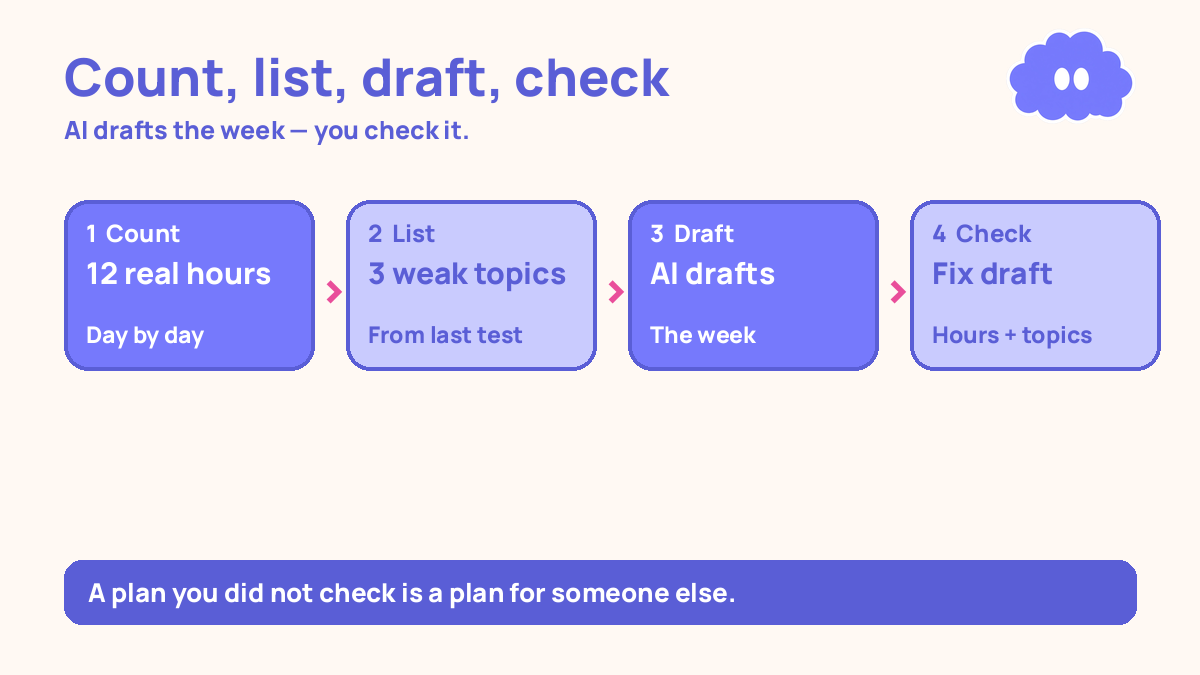
- Count your real hours for the week: the hours you actually have, day by day, after classes, work, and family.
- List your weak topics — the ones your last test showed you get wrong, not the ones you like.
- Give AI the hours, the weak topics, and the fixed things, and ask it to draft the week.
- Check the draft: count its hours against your hours, and check every topic against your weak list.
- Add one if-then plan per session, and re-test each topic on day 1, day 3, and day 7.
Step 1: Count your real hours, day by day
Before you open AI, count the hours you actually have. Not the hours you wish you had — the hours you have, after everything fixed in the week is taken out. What is left is the study time, and it is usually less than you think.
Write it down day by day: Monday 2 hours, Tuesday 1 hour, Wednesday 3 hours, and so on. A week with 12 real hours is a normal week, and a plan built on 12 hours is a plan you can follow. A plan built on 25 hours you do not have fails on Tuesday, and a failed plan teaches you to stop planning.
Do not count hours you might have. “Maybe free on Thursday” is not an hour. If Thursday frees up, that is a bonus session, not a planned one. The plan uses only hours you are sure of.
Step 2: List the weak topics, from your last test
List the weak topics from your last test, quiz, or past paper — the topics you got wrong, not the topics you like. Three or four topics is enough for one week.
For each weak topic, write one line: what you got wrong, and what the fix is. “Photosynthesis — could not remember the steps, fix is testing, not re-reading.” The line matters, because AI will otherwise plan “study photosynthesis” with no idea what studying it means.
If you have no recent test to work from, test yourself first: ten questions, notes closed, on the topics you think you know. The ones you get wrong are the weak list. Across 61 studies, testing beat restudying, and the advantage was larger when the test came with feedback (Rowland, 2014).
Step 3: Give AI the facts and ask it to draft the week
Open any AI chat app and give it the facts in one message:
“Plan my study week. I have 2 hours on Monday, 1 on Tuesday, 3 on Wednesday, 2 on Thursday, 1 on Friday, 2 on Saturday, and 1 on Sunday — 12 hours total. My weak topics are photosynthesis, fractions, and essay introductions. I have class until 3 every day and family dinner on Friday. Put the weakest topic first, test each topic on day 1, day 3, and day 7, and give me one 25-minute session at a time with a 5-minute break.”
The message has four parts, and each one matters. The hours stop AI inventing free time. The weak topics stop it planning the subjects you already know. The fixed things stop it putting a session where a class already is. And “test each topic on day 1, day 3, and day 7” stops it planning one session per topic and calling the week done.
That 1-3-7 pattern is a practical starting schedule, not a research rule — the research says spacing beats massing, and the right gap grows with how long you need to remember the material (Cepeda et al., 2006).
Step 4: Check the draft before you follow it
Do not follow the draft until you have checked it. AI will get things wrong, and a plan followed blindly is a week spent on the wrong topics at the wrong hours.
First, count the hours. Add up the sessions in the draft and compare with your real hours from step 1. If the draft uses 15 hours and you have 12, it invented 3 hours. Cut the sessions until the total matches.
Second, check the topics. Every session in the draft should be a weak topic from your step 2 list. If AI added a topic you never listed, cut it, and give the hour to the weakest topic instead.
Third, check the shape. The weakest topic should come first in the week, not last. Each topic should appear at least twice, with a gap between sessions, not twice in one day. No day should hold more than three sessions.
Fix the draft in the same chat: “Cut Wednesday to 2 hours, move fractions to Thursday, and drop the extra session on Sunday.” AI revises fast, and the revised draft is yours — checked against your hours and your weak list.
Step 5: Add an if-then plan for each session, and re-test
For each session, write one if-then plan: “If I sit down after lunch on Monday, then I will test myself on ten photosynthesis questions, notes closed.” An if-then plan names the cue and the action in advance, so starting does not need a fresh decision every time. Across 94 studies, if-then plans raised goal attainment by a medium-to-large amount (Gollwitzer & Sheeran, 2006).
Then run the week, and re-test each topic on day 1, day 3, and day 7. The re-test is the only honest check: a topic you get right on day 7 is a topic the week fixed. A topic you still get wrong on day 7 goes back on next week’s weak list.
If a session is missed, do not double up to catch up. Move it to the next free slot, or cut it and let the topic wait for next week. A daily study habit takes weeks to feel automatic — a median of 66 days in one study — and one missed day does not reset it (Lally et al., 2010).
A worked example: 12 hours, 3 weak topics, 1 week
This is a worked example, with the article’s own numbers — not a real student, and not a promise of a grade.
Your week: 12 real hours — Monday 2, Tuesday 1, Wednesday 3, Thursday 2, Friday 1, Saturday 2, Sunday 1. Your weak topics: photosynthesis, fractions, essay introductions. Class until 3 every day, family dinner Friday.
Monday — the draft: You give AI the hours, the topics, and the fixed things. It drafts 15 hours across the week, with photosynthesis twice on Monday and nothing on Friday. You check it: 3 hours invented, Friday empty. You fix it in the chat: cut to 12 hours, move one photosynthesis session to Friday.
Tuesday to Saturday — the week: Photosynthesis tested Monday, Thursday, and Sunday. Fractions tested Tuesday, Friday, and Saturday. Essay introductions tested Wednesday and Saturday. Each session is 25 minutes with a 5-minute break, notes closed.
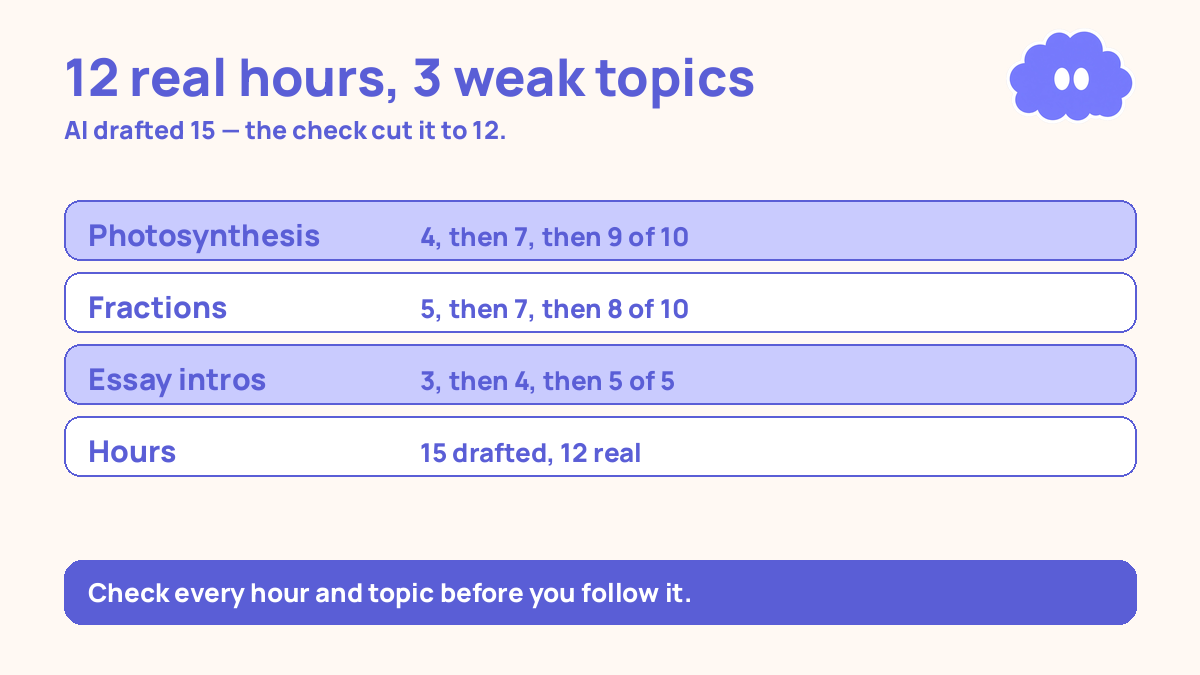
Sunday — the count: Photosynthesis, 4 right out of 10 on Monday, 7 on Thursday, 9 on Sunday. Fractions, 5 of 10, then 7, then 8. Essay introductions, 3 of 5, then 4 of 5. Fractions, still weakest at 8 of 10, goes back on next week’s list.
| Topic | Day 1 score | Day 3 score | Day 7 score |
|---|---|---|---|
| Photosynthesis | 4 of 10 | 7 of 10 | 9 of 10 |
| Fractions | 5 of 10 | 7 of 10 | 8 of 10 |
| Essay introductions | 3 of 5 | 4 of 5 | 5 of 5 |
| Hours planned vs real | 15 drafted | — | 12, fixed before Monday |
When it goes wrong
You let AI plan from no facts. Then the plan is a guess: invented hours, easy topics, sessions where classes already are. Give it the hours, the weak topics, and the fixed things first.
You follow the draft without checking it. Then you spend the week on topics you never listed, at hours you do not have. Count the hours, check the topics, check the shape.
You plan the subjects you like, not the weak topics. Then Friday arrives and you have studied a lot and fixed nothing. The weak list comes from your last test.
You miss one session and try to double up. A double session is two tired sessions. Move the missed session to the next free slot, or let it wait for next week.
You plan 25 hours you do not have. Then the plan fails on Tuesday, and you learn to stop planning. Count the real hours first. A plan built on 12 real hours beats one built on 25 invented ones.
Weekly review checklist
Copy this list and use it each week:
- How many of my real hours did the plan use, and did any day overload?
- Did every session work on a weak topic from my list?
- How did each topic score on day 1, day 3, and day 7?
- What one change will I make next week: fewer hours, a different weakest topic, or a better if-then plan?
What this system is not
It is not a promise that AI will plan your week perfectly. AI drafts fast and gets things wrong: it invents hours, adds topics you never listed, and crams a topic into one day. This system is a loop: you give it your real hours and your real weak topics, it drafts the week, you check every hour and every topic, and you re-test after a gap. If the day 7 scores rise, the week worked.
Sources
- Gollwitzer, P. M. & Sheeran, P. (2006). Advances in Experimental Social Psychology, 38, 69-119. Across 94 studies, if-then plans raised goal attainment by a medium-to-large amount (d = 0.65).
- Cepeda, N. J., et al. (2006). Psychological Bulletin, 132(3), 354-380. Spaced practice beat massed practice, and the right gap grows with how long you need to remember the material.
- Rowland, C. A. (2014). Psychological Bulletin, 140(6), 1432-1463. Across 61 studies, testing beat restudying, and the advantage was larger with feedback (g = 0.73) than without it (g = 0.39).
- Lally, P., et al. (2010). European Journal of Social Psychology, 40(6), 998-1009. The median time for a behaviour to feel automatic was 66 days, range 18 to 254 days, and missing one day did not measurably hurt the process.
- Dunlosky, J., et al. (2013). Psychological Science in the Public Interest, 14(1), 4-58. Only practice testing and distributed practice rated high utility; rereading rated low.
For the weekly planner this fits inside, read the weekly study planner for students, and for the nightly step, read how to plan a study day the night before.
Questions
Can AI plan my study week for me?
It can draft the plan, but it cannot know your real hours. AI will invent free time you do not have and skip the subjects you are weakest at. You give it your hours and your weak topics, it drafts the week, and you fix the draft before you follow it.
What should I give AI before it plans the week?
Three things: the hours you actually have each day, the subjects and the weak topics inside them, and anything fixed that week — classes, work, family. Without those, the plan is a guess dressed up as a schedule.
How do I check a plan AI made?
Count the hours it used against the hours you have, check every topic against your own weak list, and look for the day it overloaded. A plan that fits your real hours and your real weak topics is a plan you can follow.
What if the week falls apart by Wednesday?
That is normal, and the plan should expect it. Move the missed session to the next free slot, do not double up to catch up, and cut the topic list to the biggest weak topic. A plan that cannot survive one bad day is not a plan.