
The direct answer
When you run a side business and study, draw a hard line between the two. Give the business its own days and hours, and give study its own days and hours, and do not let either side cross the line. Business on Monday, Wednesday and Friday evenings. Study on Tuesday, Thursday and Saturday, eight hours a week in total. One job per day, one start time, one stop time. That is the whole system: two calendars, one line between them, and a weekly review that checks both sides kept to it.
You do not need a business plan or a productivity app. You need fixed hours for each side, a rule for what happens when a customer writes on a study day, and a Sunday review that looks at the money and the study together.
Why a side business eats study time
A part-time job has a boss, a rota, and a finish time. A side business has none of those. It is yours, so it has no edges. A customer messages at 9pm, and you answer, because it is your business and the customer is yours. An order comes in on a study day, and you do it, because the money is real and the study can wait.
The problem is not that the business takes time. The problem is that it takes time without asking. A job with a rota takes its hours and stops. A business takes whatever hours you give it, and you give it the study hours first, because study is the only thing in your week that does not send you a message demanding attention.
The system in short
- Draw the line: fixed business hours and fixed study hours, on different days, written down.
- Give each side its own days: business Monday, Wednesday, Friday; study Tuesday, Thursday, Saturday.
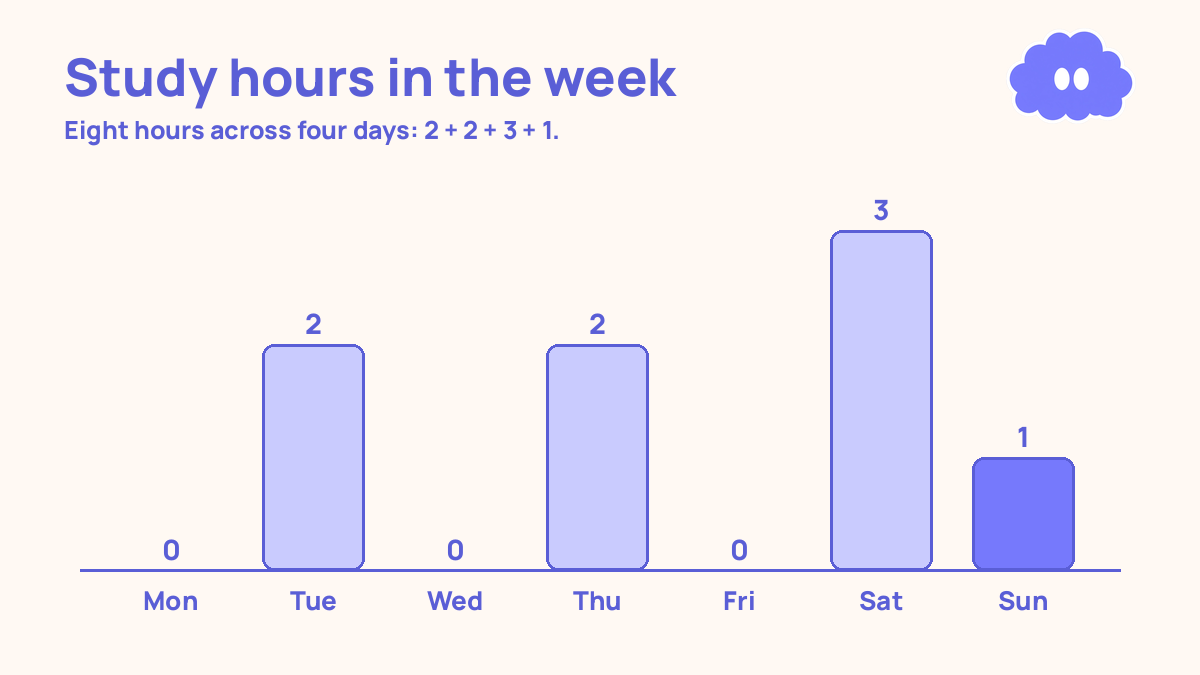
- Hold the study floor: eight hours a week — two on Tuesday, two on Thursday, three on Saturday, one on Sunday.
- Review on Sunday: money in, hours worked, study hours kept. One change if something is off.
When the business leaves you with no drive to study, How to study when you have no motivation starts smaller than this system does. Batch the switches: one job per day, so you are not switching between business and study every hour.
Step 1: Draw the line, on paper
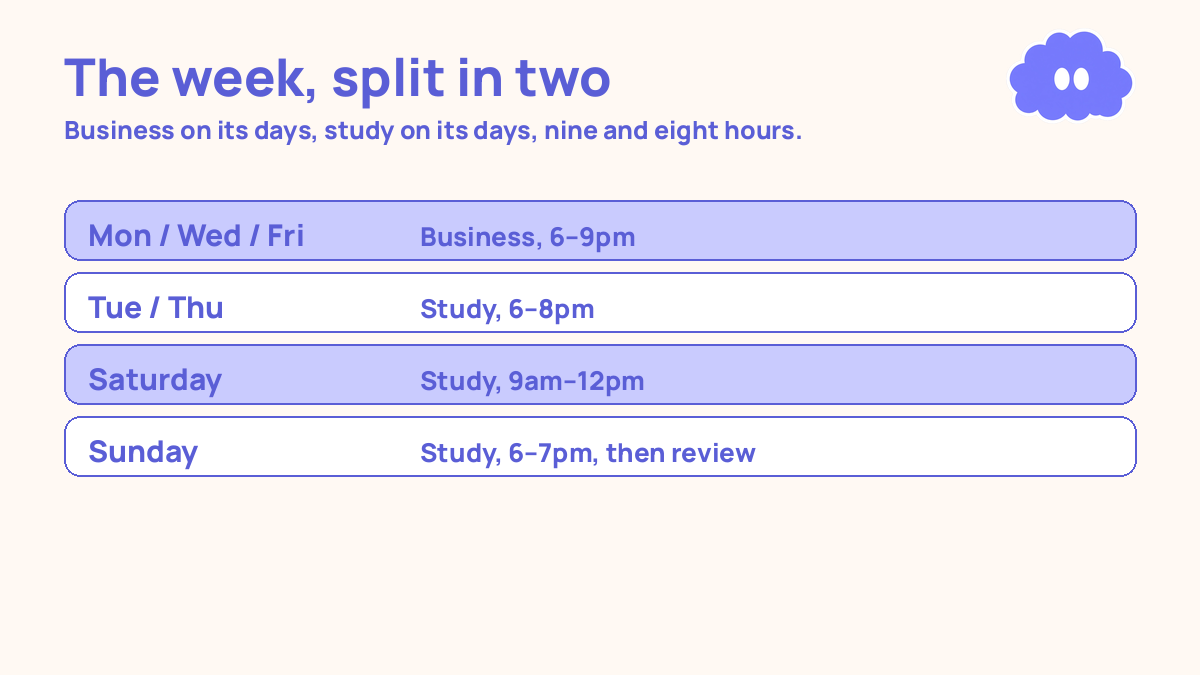
Write down the business hours and the study hours, on paper, in one place. Business: Monday, Wednesday, Friday, 6:00–9:00pm. Study: Tuesday and Thursday 6:00–8:00pm, Saturday 9:00am–12:00pm, Sunday 6:00–7:00pm. That is nine hours of business and eight hours of study a week, and neither side gets the other’s hours.
Put the line where the business lives: in your booking message, in your profile, in the reply you send when someone asks for a time. “I take orders Monday, Wednesday and Friday evenings” is a business rule, not an excuse.
Step 2: One job per day
One day, one job. A business day is a business day: orders, customers, deliveries, accounts. A study day is a study day: testing yourself, working problems, reading. Do not mix them. A day with both jobs is a day where each job gets half your attention and neither gets finished.
The reason is switching. Every switch between tasks costs time, and the cost grows with complexity: in four experiments, people lost 614 to 1,096 milliseconds on every switch between tasks, and lost more as the tasks got more complex or less familiar (Rubinstein, Meyer & Evans, 2001). A switch is reloading — dropping one set of rules and loading another — and you pay that cost every time, whether or not you notice it. An hour that switches between business and study four times is not an hour of either.
Step 3: Hold the eight-hour study floor
Eight hours a week is the floor: two hours on Tuesday, two on Thursday, three on Saturday morning, one on Sunday evening. Fix those hours in the diary before anything else gets booked in, the same way you would fix a shift.
Spend the floor testing yourself, not re-reading. In a 2013 review, Dunlosky and colleagues rated ten common study techniques, and only two received a high utility rating: practice testing and distributed practice. Testing yourself is one of the two best-supported things you can do — and it fits in a two-hour evening. Close the book, write down what you remember, check your answers, and move on. Fixed days help the habit form: a daily behaviour takes a median of 66 days to feel automatic, with a range of 18 to 254 days, and missing one day does not reset it (Lally et al., 2010).
The floor works because it is spread across the week. Four sessions on four days means every session after the first is a review after a gap, and a gap is what makes the second attempt a test rather than a re-read.
Step 4: The customer rule
A customer will write on a study day. It will happen, and the system needs a rule for it, because a system with no rule for the interruption is a system the interruption breaks.
The rule is: answer the message, note the job, do it on the next business day. Answering is polite and takes a minute. Doing the job is work, and work belongs to a business day. Write the job on the business list — one line, what it is, when it is due — and go back to studying.
Decide the rule in advance, in if-then form: “If a customer writes on a study day, I will answer, note the job, and do it on the next business day.” Across 94 studies, if-then plans raised goal attainment by a medium-to-large amount (d = 0.65) over holding the goal alone (Gollwitzer & Sheeran, 2006).
The exception is a genuinely urgent job: a customer who has paid and is waiting, or a deadline you promised. If it is truly urgent, do it, and take the time back from the next business day, not from the next study day. One urgent job is real. Most are not urgent, and answering every message the minute it arrives is how study days disappear.
Step 5: The Sunday review
Ten minutes, every Sunday, three questions. How much money came in this week, and how many business hours did it take?
If the business keeps growing past its hours, that is good news and a problem at the same time. It means the business works — and it means the hours have to be renegotiated, not quietly stolen from study.
A worked example: a week with a small design business
You run a small design business — logos and social media posts for local shops — and you study business management. Your week has nine business hours and eight study hours, on different days.
Monday, 6:00–9:00pm — business, 3 hours: Two logo drafts for a cafe, sent by 9pm. Orders done, inbox cleared, list written for Wednesday.
Tuesday, 6:00–8:00pm — study, 2 hours: Test yourself on last week’s marketing material from memory, then work through the practice questions and check every answer. No business. The phone is on silent.
Wednesday, 6:00–9:00pm — business, 3 hours: Revisions on the cafe logos, one new order started. A customer writes at 8pm asking for a Friday slot — you answer, note it, and offer Monday.
Thursday, 6:00–8:00pm — study, 2 hours: The weakest topic from Tuesday, re-tested. Then you listen back to a recording of yourself explaining one idea from the week.
Friday, 6:00–9:00pm — business, 3 hours: The new order finished and sent. Accounts done: money in, money out, what is owed.
Saturday, 9:00am–12:00pm — study, 3 hours: One hour working problems, one hour testing yourself on the whole week, one hour planning next week.
Sunday, 6:00–7:00pm — study, 1 hour, then review: One hour reviewing the week’s cards, then ten minutes: business 9 hours, study 8 hours, nothing crossed the line.
When it goes wrong
A big order lands and eats the whole week. A customer wants a rush job, and the money is good. The fix is a price, not a yes: rush work costs more, and the extra money pays for the study hours it takes. If the order still eats the week, take the time back from the next business week, not from study.
You answer every customer message the minute it arrives. Your study days become business days with a book open on the table. The fix is the customer rule: answer, note, do it on the next business day. Put the phone on silent during study blocks. A message answered an hour later is still answered.
The business grows and the study floor shrinks. First it is seven hours, then five, then two. The fix is the Sunday review, which is there to catch exactly this. When the review shows three weeks of shrinking study, stop and renegotiate: raise the business hours by agreement, raise prices, or turn work away. Do not let the drift continue.
You feel guilty studying when the business could be earning. The guilt is the problem, not the study. Eight hours of study is the cost of the course, and the course is the reason the business exists — to pay for it. Study is not time away from the business. It is what the business is for.
Weekly review checklist
Copy this list and use it each Sunday:
- How many business hours did I work this week, and how much money came in?
- How many of the eight study hours did I keep, on the fixed days?
- Did either side cross the line — business on a study day, or study skipped for a customer?
- Is the business growing past its hours, and does it need new prices or new hours?
- What one change will I make next week: a firmer customer rule, a different study day, or a clearer line?
Downloadable infographic spec: one vertical image, title “Business and study, split in two”, with the week — business Monday, Wednesday, Friday evenings; study Tuesday, Thursday, Saturday and Sunday — and the customer rule: answer, note the job, do it on the next business day, in Thynq cream, Cloud Purple, Dark Purple and pink, with the cloud mascot. Text taken word-for-word from this article.
What this system is not
It is not a business plan, and it is not a promise that eight hours a week will carry you through a course on its own. Eight hours is a floor, not a full plan — it keeps you moving while the business runs. It is also not a way to grow a business and study at full speed at the same time. Both sides have a cap, and the caps are the point.
Sources
- Dunlosky, J., et al. (2013). Improving students’ learning with effective learning techniques. Psychological Science in the Public Interest, 14 (1), 4-58. Only practice testing and distributed practice received a high utility rating.
- Rubinstein, J. S., Meyer, D. E. & Evans, J. E. (2001). Executive control of cognitive processes in task switching. Journal of Experimental Psychology: Human Perception and Performance, 27 (4), 763–797. Mean switch costs were 614 to 1,096 milliseconds per switch, and grew with complexity.
- Gollwitzer, P. M. & Sheeran, P. (2006). Implementation intentions and goal achievement: a meta-analysis of effects and processes. Advances in Experimental Social Psychology, 38 , 69–119. If-then plans raised goal attainment (d = 0.65) over holding the goal alone.
- Lally, P., et al. (2010). How are habits formed: modelling habit formation in the real world. European Journal of Social Psychology, 40(6), 998–1009. Median time for a behaviour to feel automatic was 66 days, range 18–254; missing one day did not measurably hurt the process.
For the full system this fits inside, start with the two-hour study system for working students, and if you also work a part-time job alongside the business, read the study system for students with a part-time job as well.
Questions
How do I split my week between a business and study?
Give each side its own days. Business on Monday, Wednesday and Friday evenings; study on Tuesday, Thursday and Saturday. A day with one job is a day that gets done — a day with both is a day that gets half of each.
What if a customer needs me on a study day?
Answer the message, note the job, and do it on the next business day. One urgent job is real; most are not urgent, and answering every message the minute it arrives is how study days disappear.
How many study hours do I need with a side business?
Eight hours a week is the floor: two hours on Tuesday and Thursday, three on Saturday morning, one on Sunday. That is enough to keep moving. Less than that and the course starts slipping behind the business.
Should I pause the business before exams?
Yes, for the last two weeks before an exam. Tell customers in advance, finish open jobs, and put the business on hold. Two weeks of lost orders is cheaper than a failed exam and a retake.