
The direct answer
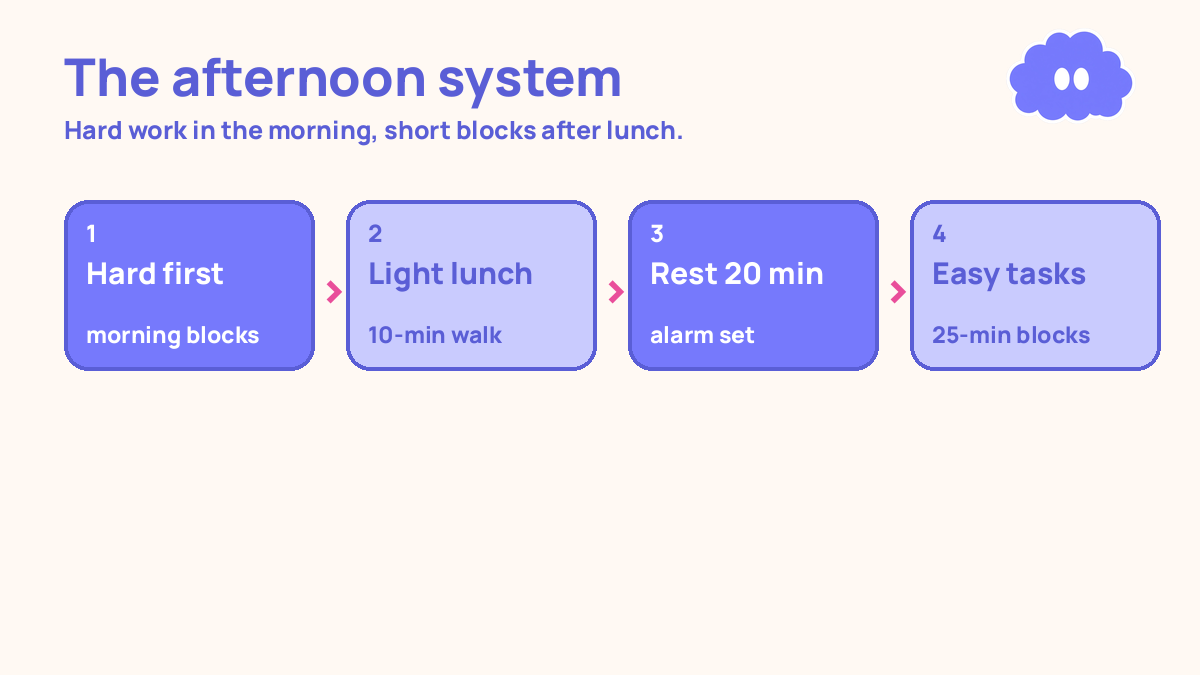
This study system for students who cannot focus after lunch works like this: do the hard work in the morning, eat a light lunch, take a 10-minute walk, rest for 20 minutes, and study the afternoon in short 25-minute blocks with easy tasks. That is the whole system. The afternoon dip is normal, so the system does not fight it. It plans around it.
You do not need more willpower at 2pm. You need a morning that carries the hard work and an afternoon that asks less of you.
The 2pm wall
Lunch is over. You sit down at 2pm with a chapter to read, and by 2:15 your eyes are closing. You read the same paragraph three times. You check your phone. You tell yourself you are lazy, and you push on, and nothing goes in.
The problem is not laziness. The early afternoon is the hardest part of the day for most students, and the harder you push against it, the worse it gets. A heavy lunch, a warm room, and a hard topic at 2pm is a combination that fails almost every time. The system below changes the combination instead of blaming you for it.
There is a second problem, and it is the switching. After lunch you tend to drift: read a page, check a message, open a different book, go back to the first page. In four experiments, Rubinstein, Meyer and Evans (2001) found that people lost between 614 and 1,096 milliseconds on every switch between tasks. A tired afternoon full of switches is an afternoon with no real work in it, even if you sat at the desk for three hours.
The system in short
- Morning: the hard topic first, in 50-minute blocks. This is when your brain is freshest.
- Lunch: eat light, drink water, and take a 10-minute walk outside.
- After lunch: rest for 20 minutes with an alarm set. No screens during the rest.
- Afternoon: short 25-minute blocks, easy tasks only — review, flashcards, organising notes.
- 3pm check: one 10-minute test from memory on the morning’s topic, then stop or continue.
Step 1: Put the hard work in the morning
Look at tomorrow and ask: what is the hardest thing I need to learn? Put it in the first study block of the day, before lunch. The morning is when you are freshest, and the hard topic deserves your freshest hour.
This is a scheduling decision, not a willpower decision. If the hard topic always lands at 2pm, it will always lose to the afternoon dip, and you will always conclude that you cannot focus. Move it to 9am and the same topic becomes doable. The topic did not change. The hour did.
If your mornings are full of classes, use the first free hour before lunch for the hard topic, and use the afternoon for the easier work. The morning study routine for students shows how to build a morning that carries the hard work, with the first task written down the night before.
Step 2: Eat light, then walk for 10 minutes
A heavy lunch makes the afternoon worse. You do not need a diet plan — just a lighter lunch on study days. Less bread, less fried food, more water. Eat enough to stop being hungry, not enough to feel full and sleepy.
Then walk for 10 minutes, outside if you can. Not a workout, not a run — a walk. Around the block, to the shop, across the campus. Ten minutes of moving and daylight is the reset between the morning and the afternoon. It is also the break your brain needs after three hours of morning study.
Do not eat lunch at your desk while scrolling. Eat at a table, away from the books, and then walk. The walk is the boundary between the morning’s work and the afternoon’s work. Without it, the two blur together, and the afternoon feels like a continuation of a tired morning instead of a fresh start.
Step 3: Rest for 20 minutes, then start small
After the walk, rest for 20 minutes. Sit in a chair, lie down, close your eyes. Set an alarm for 20 minutes. No phone, no screens, no “just one video”. This is a practical routine, not a research prescription — the research base does not include a nap study — but a short rest with an alarm is a reasonable way to spend the worst 20 minutes of the afternoon.
When the alarm rings, get up and start with a 25-minute block, not a 50-minute one. The afternoon is for short blocks. Twenty-five minutes is small enough to start when you are still groggy, and the timer gives you a finish you can see. Use the Pomodoro technique for students if you want the full 25-minute timer system.
If you sleep through the alarm and wake up groggy, the rest was too long. Tomorrow, set the alarm for 15 minutes instead of 20, and rest sitting up, not lying down. The rest is a reset, not a sleep.
Step 4: Easy tasks only in the afternoon
The afternoon is for easy tasks: review, flashcards, organising notes, copying up the morning’s work, testing yourself on yesterday’s topic. It is not for new hard material. New hard material belongs in the morning.
This is the rule that makes the system work. If you try to learn a new topic at 2pm, you will fail, and you will blame your focus. If you review at 2pm, you will succeed, and the review still counts — testing yourself is one of only two techniques Dunlosky and colleagues (2013) rated high utility in their review of ten common study techniques. The other was distributed practice, spacing study out. Re-reading was rated low. So the afternoon review is a test, not a re-read: close the notes, write from memory, then check.
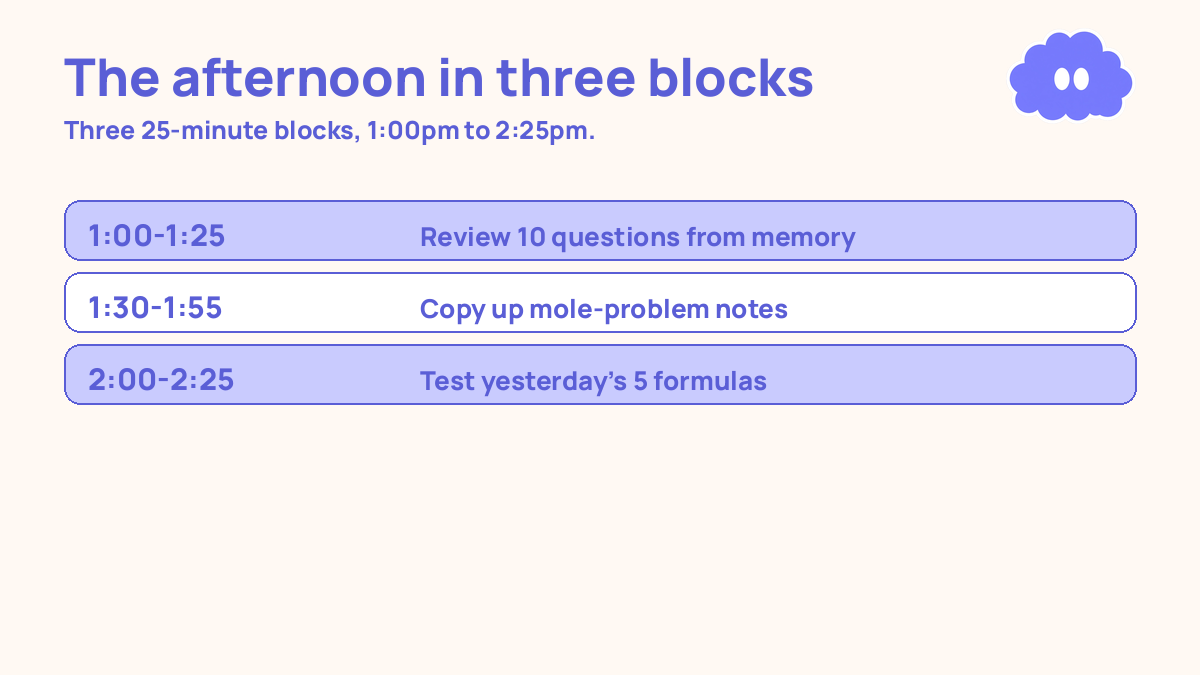
Pick the afternoon tasks in the morning, when you are fresh. Write them down: “Review the 10 cell-division questions. Copy up the mole-problem notes. Test yesterday’s five formulas.” Then at 2pm you do not decide. You look at the list and start. If your phone keeps breaking the afternoon blocks, the phone focus system for distracted students covers the phone part: phone in another room, timer on, one task at a time.
A worked example: a Wednesday with classes in the morning
You have classes from 9am to 12pm. The afternoon is free. Your hard topic is mole calculations.
9:00–9:50am — Before class: Work through three mole problems at your desk. Two right, one wrong. Write the wrong one out slowly. 12:00–12:30pm — Lunch: A light lunch at a table, away from the books. Water, not a second coffee. 12:30–12:40pm — Walk: Ten minutes outside, around the block. 12:40–1:00pm — Rest: Sit in a chair, eyes closed, alarm set for 20 minutes. No phone. 1:00–1:25pm — Block 1: 25 minutes. Review the 10 cell-division questions from memory, then check. Eight right. 1:25–1:30pm — Break: Stand up, water, window. 1:30–1:55pm — Block 2: 25 minutes. Copy up the mole-problem notes from the morning, writing each step. 1:55–2:00pm — Break: Stretch, water. 2:00–2:25pm — Block 3: 25 minutes. Test yesterday’s five formulas from memory. Four right. 2:25pm — Stop: Three afternoon blocks done, and the hard topic was finished in the morning.
| Usual afternoon | System afternoon | |
|---|---|---|
| 12:30pm | Heavy lunch at desk | Light lunch, then walk |
| 1:00pm | New hard topic, failing | 25-min review block |
| 2:00pm | Phone, guilt, nothing done | Third block, testing formulas |
| 3:00pm | Still at desk, tired | Done, evening free |
| Hard topic | Not finished | Finished at 9am |
Study system for students who cannot focus after lunch: what changes
The first week, the afternoon still feels hard. The 25-minute blocks feel short, and you will want to go back to pushing through a 50-minute block at 2pm. Do not. The short blocks are the point. Three 25-minute blocks with real breaks is 75 minutes of actual work, which is more than most students get from a three-hour afternoon of drifting.
After a week, the pattern settles: the morning carries the hard work, the walk and the rest reset the day, and the afternoon becomes the review shift. The afternoon stops being the part of the day you dread, because it stops asking you to do the hardest thing when you are at your worst. If your breaks are the part that keeps failing — the phone, the wandering — the how to take breaks that actually help study covers the break itself: what to do, what not to do, and how long.
When it goes wrong
You skip the walk and the rest, and go straight from lunch to the desk. Then the afternoon is a continuation of a tired morning. The walk and the rest are not optional extras. They are the reset. If you only have time for one, take the walk.
You rest for 20 minutes and wake up groggier. The rest was too long, or you lay down. Tomorrow, rest for 15 minutes sitting up, and set two alarms. If resting never works for you, skip it and go straight to a 25-minute block after the walk. The system bends.
You try a new hard topic at 2pm and fail. That is the system telling you the rule works. Move the hard topic to the morning and use the afternoon for review. The failure is information, not a verdict on your ability.
You do the afternoon blocks but spend them re-reading. The timer only controls time. What you do inside it still matters. Dunlosky and colleagues (2013) rated re-reading low utility and practice testing high. Use the afternoon blocks to test yourself: close the notes, write from memory, then check.
Weekly review checklist
Copy this list and use it each week:
- How many days this week did I do the hard topic before lunch?
- How many afternoons did I walk for 10 minutes after lunch?
- How many 25-minute afternoon blocks did I actually finish?
- What one change will I make next week: a lighter lunch, a real walk, or easier afternoon tasks?
Downloadable infographic spec: one vertical image, title “The afternoon system”, with the five steps — hard work in the morning, light lunch and a 10-minute walk, 20-minute rest with an alarm, short 25-minute blocks, easy tasks only — and the rule “new material belongs in the morning”, in Thynq cream, Cloud Purple, Dark Purple and pink, with the cloud mascot. Text taken word-for-word from this article.
What this system is not
It is not a claim that a nap is scientifically proven to help study — the research base does not include a nap study, and the 20-minute rest is a practical routine. It is not a promise that your afternoons will feel easy. It is a practical system: hard work in the morning, a light lunch, a walk, a short rest, and easy tasks in short blocks. If your timetable forces afternoon classes, the morning is your study time and the afternoon is for listening and notes.
Sources
- Rubinstein, J. S., Meyer, D. E. & Evans, J. E. (2001). Executive control of cognitive processes in task switching. Journal of Experimental Psychology: Human Perception and Performance, 27(4), 763-797. Mean switch costs were 614 to 1,096 milliseconds per switch.
- Dunlosky, J., et al. (2013). Improving students’ learning with effective learning techniques. Psychological Science in the Public Interest, 14(1), 4-58. Only practice testing and distributed practice received a high utility rating; rereading was rated low.
- Cirillo, F. — Pomodoro Technique, late 1980s. The 25-minute length was Cirillo’s practical choice, not a number derived from cognitive science.
For the morning part, read the morning study routine for students, and for the breaks, how to take breaks that actually help study.
Questions
Is it normal to lose focus after lunch?
Yes. Most students find the early afternoon the hardest part of the day. The system works with that, not against it: hard work in the morning, short blocks and easy tasks after lunch.
Should I nap after lunch?
A short rest of 20 minutes can help, but it is a practical routine, not a research prescription. Set an alarm for 20 minutes. If you sleep longer, you will wake up groggier than before.
What if my classes are in the afternoon?
Then the morning is your study time. Do the hard topic before lunch, and use the afternoon classes for listening and notes. Review the class material in the evening with a 10-minute test from memory.
Does coffee after lunch help?
It can feel like it helps, but it often just moves the tiredness to later. If you drink coffee, have it with lunch, not at 4pm. And a 10-minute walk after lunch does more than a second coffee.