
The direct answer
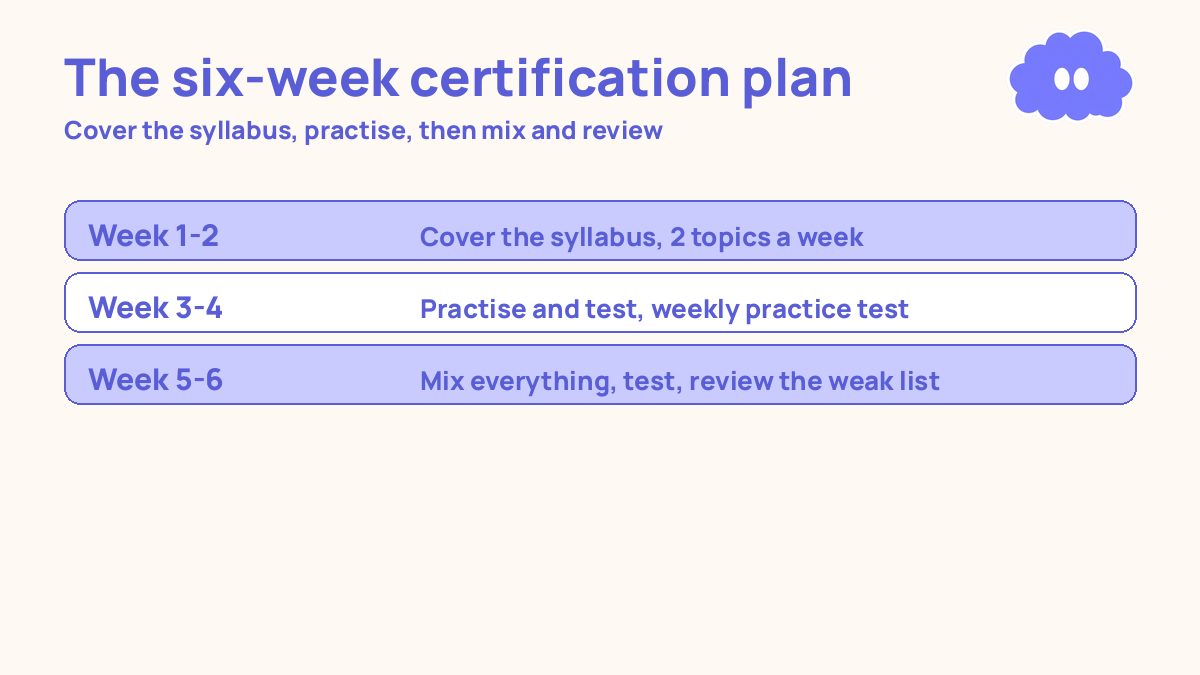
Map the syllabus to the exam date, study it in weekly cycles, and test yourself with practice tests under exam conditions. Each week ends with a practice test, and every wrong answer goes on a weak list that you study again after a gap. Six weeks is a practical minimum: two to cover the syllabus, two to practise, two of mixed tests and review. That is the whole system.
A certification exam is different from a school exam. Nobody teaches you the syllabus. The provider publishes a list of topics, a date, and a pass mark, and the rest is up to you.
That is why so many students prepare badly for them. They read the whole textbook once, watch a video course, and then take the exam hoping it is enough. Reading is not preparation. Preparation is knowing, topic by topic, what you can answer and what you cannot.
The system in short
- Get the official syllabus and the exam date. Write both down.
- Split the syllabus into weekly chunks that fit the weeks you have.
- Each week: study the chunk, then test yourself on it from memory.
- Take a full practice test at the end of every week, under exam conditions.
- Every wrong answer goes on a weak list. Study the weak list again after a gap, then test it again.
- In the final two weeks, stop learning new material. Mix everything, test everything, and review the weak list until the exam.
For a certification, practise under exam conditions with How to use mock exams to prepare before the real date.
Step 1: Get the syllabus and count the weeks
Start with the provider’s own syllabus, not a video course. The provider’s document is the only list that decides what the exam can ask. Download it, print it if you can, and read it through once. Cross out anything you already know well.
Then count the weeks between today and the exam date. Six weeks is a practical minimum for most certification exams. If you have fewer than four weeks, the system still works, but the chunks get bigger and the final two weeks shrink to one — and you should know that before you start, not discover it in week five.
Divide the syllabus by the weeks. If the syllabus has 12 topics and you have 6 weeks, that is 2 topics a week. Write the plan on one page: week 1, topics 1 and 2; week 2, topics 3 and 4, and so on. Put the hardest topics in the middle weeks, not the last ones.
Step 2: Study each chunk, then test it from memory
Each week has the same shape. Study the week’s topics first, then test yourself on them. Do not test yourself on topics you have not studied yet — that is not a test, it is a guess, and it tells you nothing.
Study means working through the material, not reading it once. Read the chapter, watch the lesson, work the examples. Then close the material and write down what you remember: the key facts, the steps of each process, the terms and what they mean. Then open the material and check.
This is the part the research is clearest about. In a 2013 review, Dunlosky and colleagues rated ten common study techniques, and only two received a high utility rating: practice testing and distributed practice. Re-reading was rated low. A week spent re-reading the textbook is a well-organised version of the weakest method.
Testing works best with feedback. Across 61 studies, testing yourself beat restudying by a medium amount (g = 0.50), and the advantage was larger with feedback (g = 0.73) than without it (g = 0.39) (Rowland, 2014).
Step 3: Take a full practice test every week
At the end of each week, sit a full practice test under exam conditions. Same time limit as the real exam. Same format. No notes, no phone, no pausing. If the real exam is 60 questions in 90 minutes, your practice test is 60 questions in 90 minutes.
Use the provider’s own practice tests first. If the provider has none, use a practice test from a source you trust, and check that its questions match the syllabus.
Score the test the same day, and write the score down. Not to judge yourself — to see the direction. A score that climbs week by week means the system is working. A score that stays flat means something in the week is not working.
Step 4: Keep a weak list and study it after a gap
Every wrong answer from every test goes on a weak list. One line per wrong answer: the topic, the question, and why you got it wrong. “Topic 4, question 12 — mixed up the two methods.” “Topic 7, question 3 — did not know the term.”
Study the weak list again, but not the same day. Wait for a gap. The right gap depends on when the test is — a day or two for a test next week, longer for a test in a month (Cepeda et al., 2008). There is no single best gap. A practical starting schedule is to review a topic the next day, then after 3 days, then after 7 days — a starting point to try, not a rule from the research.
When the gap is over, test the weak list again from memory. Items you now get right leave the list. Items you still get wrong stay, and get studied again after another gap. The list shrinks every week if the system is working. If it grows, you are adding new topics faster than you are fixing old ones — slow down the new material and clear the list first.
Step 5: The final two weeks — mix, test, review
Two weeks before the exam, stop learning new material. Everything from here is mixing, testing, and reviewing. This is the part students skip, and it is the part that decides the result.
Mix the topics. Do not study topic by topic any more. A practice test that mixes everything forces you to choose the right method for each question, instead of repeating the last one you studied.
Take two full practice tests in the final two weeks, under exam conditions, and review every wrong answer the same day. Then spend the days between tests on the weak list only. No new chapters, no new videos, no new material.
A worked example: six weeks to a cloud certification
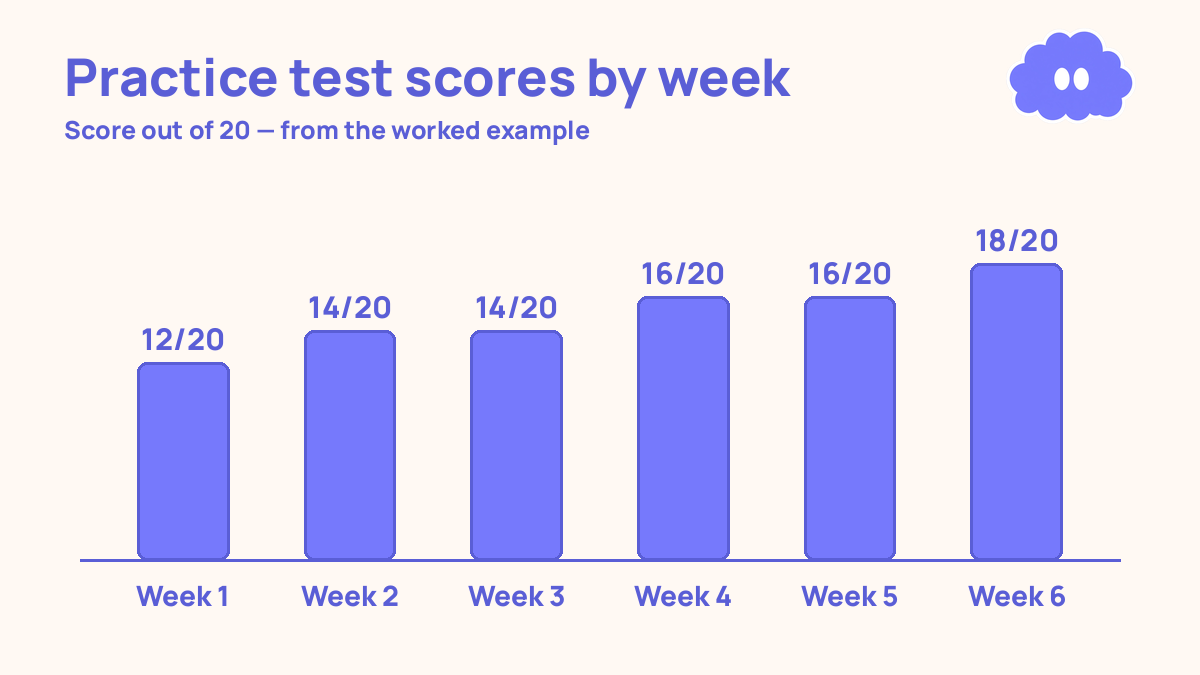
You have six weeks until a cloud certification exam. The syllabus has 12 topics. You study one hour a day, five days a week, and you take a practice test every Saturday.
| Week | Topics | Practice test score |
|---|---|---|
| Week 1 | Topics 1–2 | 12 out of 20 |
| Week 2 | Topics 3–4 | 14 out of 20 |
| Week 3 | Topics 5–6 | 14 out of 20 |
| Week 4 | Topics 7–8 | 16 out of 20 |
| Week 5 | Mixed review, weak list | 16 out of 20 |
| Week 6 | Mixed review, weak list | 18 out of 20 |
The scores climb, but not in a straight line. Week 3 stays at 14 out of 20 even though you studied two new topics — because the new topics were hard and the weak list from weeks 1 and 2 was still long. That flat week is information, not failure. By week 6 the list is short, the score is 18 out of 20, and you know exactly which topics are still weak.
For the wider system this sits inside, start with the self-study system for online learners, the full system for learning on your own with no teacher. For the general revision system behind this one, read how to revise for exams without cramming — it is the same spacing and testing, applied to any exam, while this article is built for a certification exam with a set syllabus and a set date.
When it goes wrong
You have four weeks left and twelve topics to cover. Do not try to cover everything at the same depth. Rank the topics by weight in the exam — the provider’s syllabus usually says how much each topic counts — and cover the heavy ones properly. Cover the light ones with one study session and one test each.
Your practice test scores are not moving. The test is telling you the study is not working. Check what you are actually doing in the week: if it is mostly re-reading, switch it to testing from memory. If you are testing but never checking the answers, start checking them the same day. If the weak list is growing, stop adding new topics until it shrinks.
You keep learning new material in the final week. The final week is for mixing and review, not new chapters. If a topic is still new in the final week, it was scheduled too late. Study it once, test it once, and let it go.
You take practice tests but never under exam conditions. A test with the book open and no timer is not a practice test. It is reading with questions attached. It will tell you that you know more than you do, and the real exam will correct that. Sit the test properly, or do not count the score.
Weekly review checklist
Copy this list and use it at the end of each week:
- Which topics did I cover this week, and did I test myself on each one from memory?
- What was my practice test score, and which topics cost me the most marks?
- How long is my weak list now — shorter or longer than last week?
- Which weak-list items did I clear this week, and which are still stuck after two tries?
- What one change will I make next week: slower new material, more testing, or more time on the weak list?
Downloadable infographic spec: one vertical image, title “Your certification exam plan”, with the six weeks — cover the syllabus, practise, mix and review — the weekly practice test under exam conditions, the weak list, and the rule “stop new material two weeks before the exam”, in Thynq cream, Cloud Purple, Dark Purple and pink, with the cloud mascot. Text taken word-for-word from this article.
What this system is not
It is not a promise that you will pass, and it is not a claim that six weeks is enough for every exam. It is a practical system for turning a syllabus and a date into a plan you can actually follow. Some exams need more time, some need less, and the provider’s syllabus is the honest guide to which one yours is.
Sources
- Rowland, C. A. (2014). The effect of testing versus restudy on retention: a meta-analytic review of the testing effect. Psychological Bulletin, 140(6), 1432–1463. Across 61 studies, testing beat restudying by a medium amount (g = 0.50); with feedback the effect was larger (g = 0.73) than without it (g = 0.39).
- Dunlosky, J., et al. (2013). Improving students’ learning with effective learning techniques. Psychological Science in the Public Interest, 14(1), 4–58. Only practice testing and distributed practice received a high utility rating; rereading was rated low.
- Cepeda, N. J., et al. (2008). Spacing effects in learning: a temporal ridgeline of optimal retention. Psychological Science, 19(11), 1095–1102. The best gap grew as the test delay grew; there is no single best gap.
- Roediger, H. L. & Karpicke, J. D. (2006). Test-enhanced learning. Science, 311, 1539–1540. Students who recalled a passage remembered more a week later than students who restudied it, even though restudiers felt more confident immediately after studying.
Questions
How far ahead should I start preparing for a certification exam?
Six weeks is a practical minimum for most certification exams: two weeks to cover the syllabus, two weeks to practise, and two weeks of mixed practice tests and review. Start earlier if the syllabus is large or the exam is your first one.
Are practice tests really the best way to prepare?
Testing yourself is one of the two techniques learning researchers rated highest, and across 61 studies it beat restudying by a medium amount (Rowland, 2014). The benefit grows with feedback — with feedback the effect was larger (g = 0.73) than without it (g = 0.39).
What do I do with topics I keep getting wrong?
Put them on a weak list and study them again after a gap, then test them again. A question you keep getting wrong is a map of what to study next — do not just read the right answer and move on.
How many practice tests should I take?
At least four full practice tests under exam conditions: one early to find your weak areas, two in the middle to check progress, and one in the final week as a dress rehearsal. Check every wrong answer and write down why it was wrong.