
The direct answer
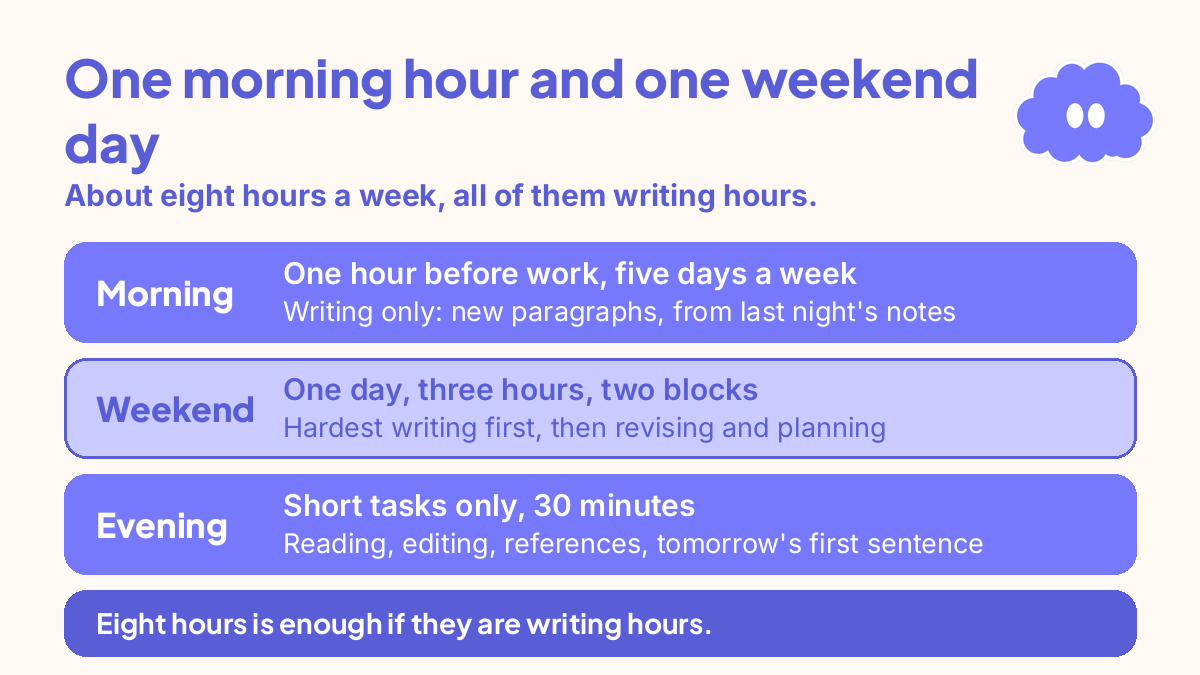
Protect one morning writing block before work, one weekend day, and a weekly chapter milestone, and report progress to your supervisor every two weeks. A full-time job leaves about eight hours a week for a thesis, and eight hours is enough if they are writing hours.
Writing a thesis while working full-time is a different job from writing one as a full-time student. The hours are fewer, the days are broken by work, and the thesis competes with a job that pays the rent and expects your best energy. The students who finish do not work harder in the evenings. They write in the morning before work, they protect one weekend day, and they plan the thesis in chapters with dates attached. The system below gives you that shape, a weekly rhythm your supervisor can see, and a plan for the weeks when work wins.
The system in short
- Write in the morning before work, one hour, five days a week, and protect that hour like a shift.
- Protect one weekend day for three hours of thesis work, and keep the other weekend day free.
- Plan the thesis in chapter milestones with dates, not in total hours, so progress is visible.
- Use evenings after work for short tasks only: reading, editing, references, and planning tomorrow’s writing.
- Send your supervisor a short progress report every two weeks, and meet on a fixed rhythm.
- Review on Sunday for 15 minutes: hours written, words written, milestone progress, and what work did to the week.
Step 1: Write in the morning before work, one hour, five days a week
The morning hour is the heart of this system. Get up one hour earlier, sit down, and write thesis text for one hour before work starts. Not reading, not planning, not fixing references. Writing: new paragraphs, in the chapter you are working on, from the notes you made the evening before.
Mornings work because they come before the job has taken anything. An hour before work is an hour with a fresh mind, and five of them make five hours a week, which is more than most working students manage in tired evenings. Evenings after a full working day are for short tasks, covered in Step 4, because new writing needs your best hour, and your best hour is not at 9.00 in the evening after eight hours of work.
Protect the morning hour the way you protect a shift. Each evening, write down the first sentence of tomorrow’s writing, or the three points tomorrow’s paragraph must make, so the morning starts with writing, not with deciding. For the wider question of studying around a full-time job, How to study with a full-time job sets out the weekly shape this system sits inside.
Step 2: Protect one weekend day for three hours of thesis work
One weekend day, three hours, in two blocks with a break. Saturday or Sunday, whichever your job leaves free, and the same day each week if you can. The morning block, 90 minutes, is for the hardest writing: the argument, the analysis, the section you have been avoiding. The second block, 90 minutes after a real break, is for the work that supports it: revising yesterday’s draft, checking the evidence, or writing the next section’s outline.
Keep the other weekend day free. A thesis written on both weekend days, every week, for months, is a thesis that ends in exhaustion, and exhaustion is what makes working students quit. The free weekend day is not laziness. It is the rest that makes the working weekend day possible, week after week. If work takes your thesis weekend day, move the three hours to the other day that week, and protect it the same way. If work takes both days, run the minimum week, covered in “When it goes wrong”, and do not try to catch up by skipping rest.
Tell your family or housemates which day is the thesis day, and what time it runs. A protected day that nobody knows about is a day that gets interrupted. A day that is named, with hours attached, is a day people respect.
Step 3: Plan the thesis in chapter milestones with dates
Plan the thesis as a list of chapters, each with a date, not as a total number of hours. “Write the methodology chapter by 15 December” is a milestone you can see and miss. “Work on the thesis for 200 hours” is a number that tells you nothing until it is too late. Break each chapter into two or three milestones: a first draft, a revised draft, and a version sent to your supervisor.
Work out the dates backwards from your deadline. If the thesis is due in six months and has five chapters, that is about five weeks per chapter, including revision and supervisor feedback. Write the dates down, one line per milestone, and put them where you can see them. When a milestone slips, move the dates that follow it, and say so in your next supervisor report. A plan that moves honestly is still a plan. A plan that pretends nothing slipped is a surprise waiting to happen.
Count words, not hours, in the weekly review. Hours are easy to fill with reading and tidying. Words are proof that writing happened. A reasonable target for a working student is 500 to 800 new words a week in the morning hours, plus revision on the weekend day. If your thesis is behind schedule, How to finish a thesis when you are behind has a recovery plan for exactly that position.
Step 4: Use evenings after work for short tasks only
Evenings after a full working day are not for new writing. They are for the short tasks that keep the thesis moving without needing a fresh mind: reading one paper and noting two lines about it, editing yesterday’s draft, fixing references, checking a figure, or writing tomorrow’s first sentence. Thirty minutes is enough, and on the worst days, ten minutes is enough.
This split matters because it stops the evening from becoming a second shift. Students who try to write new thesis text at 9.00 after a full day at work usually produce little, feel guilty about it, and go to bed later than they should, which wrecks the morning hour. The morning writes. The evening prepares, tidies, and reads. Both count, but they count differently, and the system works because each kind of time does the job it is good for.
Step 5: Send your supervisor a short progress report every two weeks
Every two weeks, send your supervisor a short report: two paragraphs, no more. What you wrote, what you will write next, and what you need from them. Even when progress is small, send it, because supervisors worry when they hear nothing, not when progress is slow. A report that says “I wrote 600 words of the methodology chapter and I need you to check the sampling section by Friday” keeps the relationship working. Silence for six weeks, followed by a long apology, does not.
Meet on a fixed rhythm, even if the meetings are short. Once a month, 30 minutes, same day if you can, is enough for a part-time thesis. Bring the report, the current chapter draft, and one question. If feedback arrives, handle it with the system in How to handle supervisor feedback on a thesis, which covers turning comments into a revision plan instead of a pile of worry.
If your supervisor is slow to reply, the fortnightly report still helps, because it creates a written record of progress and requests. And if you need a regular writing companion, the thesis weekly review and supervisor meeting system pairs the weekly review with the meeting rhythm in one routine.
Step 6: Review on Sunday for 15 minutes
On Sunday, or on your first free evening, spend 15 minutes on four numbers and one question. The numbers: morning hours written this week, weekend hours written, new words written, and milestones hit or missed. The question: what did work do to the week, and what will you change next week?
Write the answers in a few lines. After a month, you will know your real pattern: which mornings survive, and how many words a normal week actually produces. That pattern is the basis for the next month’s milestones. If the numbers say eight hours a week is not happening, change the milestones, not the facts.
A worked example: a thesis in six months around a full-time job
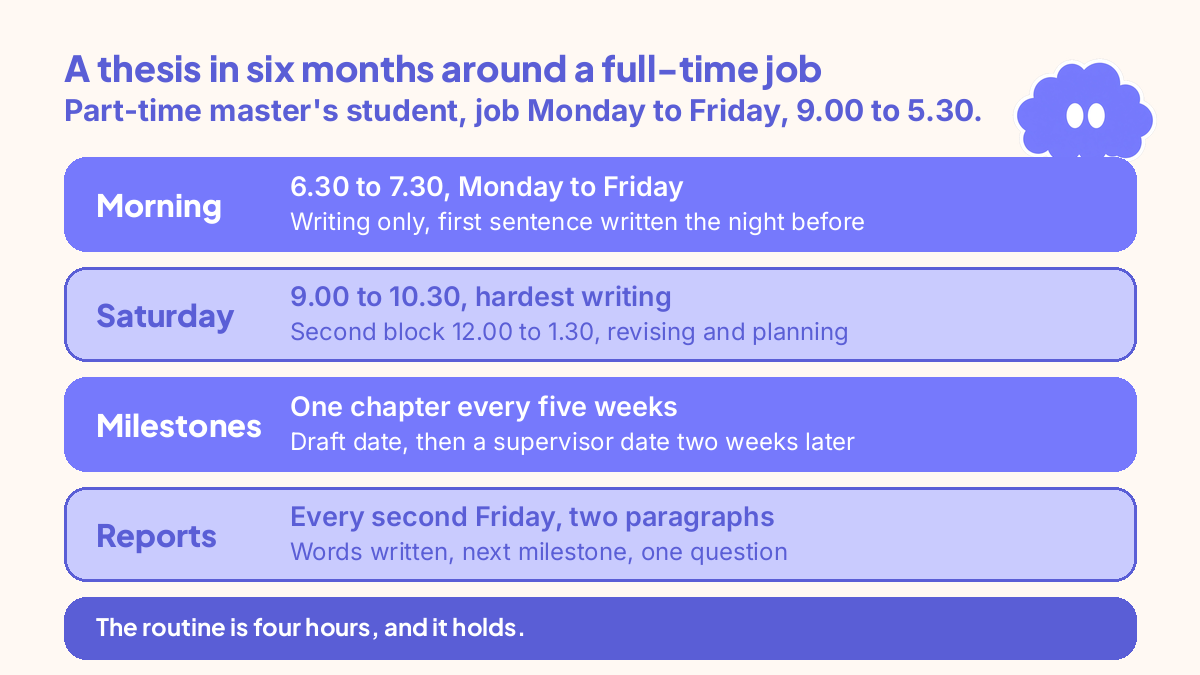
Your situation: Part-time master’s student, full-time job, Monday to Friday 9.00 to 5.30. Thesis of 15,000 words due in six months. Chapters: introduction, literature review, methodology, results, discussion and conclusion. Supervisor meets monthly.
- Morning hour: 6.30 to 7.30, Monday to Friday, writing only. First sentence for each morning is written the evening before. Five hours a week.
- Weekend day: Saturday 9.00 to 10.30, hardest writing. Break 10.30 to 12.00. Second block 12.00 to 1.30, revising and planning. Three hours. Sunday free.
- Evenings: 30 minutes, short tasks only: reading, references, tomorrow’s first sentence. Never new writing after 8.30.
- Milestones: Literature review draft by end of month one, methodology by end of month two, results by end of month four, discussion and conclusion by end of month five, full revision in month six. Each chapter has a draft date and a supervisor date two weeks later.
- Fortnightly report: Every second Friday, two paragraphs to the supervisor: words written, next milestone, one question. Monthly meeting, 30 minutes, same day each month.
- A bad week: In month three, work has a deadline and the mornings shrink to three hours. The weekend day holds, the evenings hold, and the week produces 400 words instead of 700. The milestone moves by one week, the supervisor is told in the next report, and the plan continues. No catch-up weekend, no skipped rest day.
When it goes wrong
Work takes the morning hour for a whole week. Run the minimum week: two 30-minute test sessions are for study, but a thesis minimum is different: write for 20 minutes on three days, any time you can find, and keep the weekend day. Twenty minutes of writing, three times, keeps the chapter warm. A week with no writing at all is the week to avoid, because restarting after a blank week takes days.
You are too tired in the morning to write. Check the evening first. If you are going to bed after midnight, the morning will always fail, and the fix is the bedtime, not the alarm. Go to bed 30 minutes earlier for a week and see if the morning returns. If the mornings still fail, move the writing hour to the lunch break or the first hour after work, and protect that instead. The hour matters. The time of day does not.
A chapter milestone slips by a month. Do not hide it. Tell your supervisor in the next report, move the dates that follow, and say what you will cut to recover the time. The usual recovery is to narrow the chapter: fewer sources, one case instead of two, a shorter method section. A thesis that is narrower and finished beats a thesis that is ambitious and late.
Your supervisor says progress is too slow. Ask what slow means in numbers: how many words a week would be enough, and which chapter matters most? Then agree a new milestone together. A supervisor who has named a number is a supervisor you can satisfy. A supervisor who just says “faster” is a supervisor you cannot plan around.
Weekly review checklist
- How many morning hours did you write, and how many new words did they produce?
- Did the weekend day happen, and did it carry the hardest writing?
- Were the evenings used for short tasks only, and did you stop on time?
- Which milestone is next, and is it still on its date?
- Did the fortnightly supervisor report go out, and what did you ask for?
- What did work do to the week, and what will change next week?
Downloadable infographic spec: one vertical image, title “How to write a thesis while working full-time”, with the six steps from “The system in short” and the six review questions above, in Thynq cream, Cloud Purple, Dark Purple and pink, with the Cloud mascot. Text taken word-for-word from this article.
What this system is not
It is not a way to write a thesis as fast as a full-time student. Eight hours a week is about a third of a full-time student’s writing time, and the thesis will take longer. It does not cover fieldwork, lab work, or data collection, which need their own plans around work. What it does is give a working student a shape that lasts: a morning hour, a weekend day, chapter milestones with dates, and a supervisor who hears from you every two weeks.
Sources
- Inside Higher Ed. Dissertating while working. Read November 2026. Early mornings as the most valuable writing time, one full weekend day committed to the dissertation, and a hard stop at night.
- Grad Coach. Writing a dissertation while working: a how-to guide. Read November 2026. Clear boundaries, fixed study hours, small time slots, and using a supervisor’s expertise.
- University of Victoria Graduate Writers Community. Having a full time job and writing a thesis. Read November 2026. Two hours a day, four paragraphs at a time, and a writing appointment that holds the habit.
For the full-time job behind this system, read How to study with a full-time job. For the writing habit that carries it, read Thesis writing system that keeps moving.
Questions
How do I write a thesis while working full-time?
Protect one morning writing block before work, one weekend day, and a weekly chapter milestone. Write in small daily amounts, report progress to your supervisor every two weeks, and plan the thesis in chapters, not in hours. A full-time job leaves about eight hours a week for a thesis, and eight hours is enough if they are writing hours.
How many hours a week can I write a thesis while working full-time?
About eight hours is a realistic target: five weekday mornings of one hour, plus one weekend day of three hours. Some weeks will give less, and exam or deadline weeks at work will give almost none. Plan the thesis around eight hours, and treat more as a bonus, not the plan.
Should I write my thesis in the morning or the evening after work?
In the morning, before work, when your mind is fresh. Evenings after a full working day are for short tasks: reading, editing, or fixing references. Writing new thesis text needs your best hour, and for most working students that hour is before work, not after it.
How do I keep my supervisor happy while writing a thesis part-time?
Send a short progress report every two weeks, even when progress is small, and meet on a fixed rhythm. Supervisors worry when they hear nothing, not when progress is slow. A two-paragraph report that says what you wrote, what you will write next, and what you need from them keeps the relationship working.