
The direct answer
To learn how to work out your GPA across semesters, add up every grade point you have earned and every credit you have taken, then divide total grade points by total credits. Never average your semester GPAs, because a heavier semester should count more. One calculation per semester keeps your cumulative GPA exact.
Most students get this wrong in exactly one place. They finish each semester, work out that semester’s GPA correctly, and then average the two numbers at the end of the year. That feels fair, and it is close to right, but close is not right. If one semester had 12 credits and the next had 14, the heavier semester must carry more weight. The method below takes ten minutes with a calculator and gives you the number your university would give you.
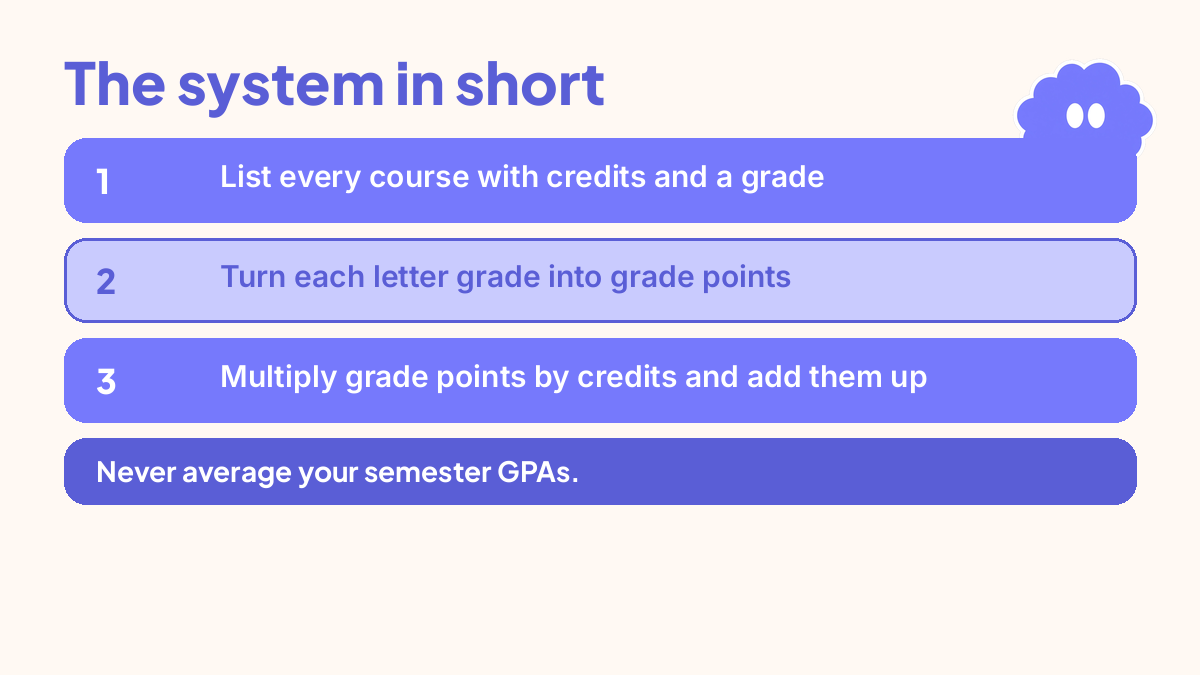
The system in short
- List every course you have taken, with its credits and letter grade.
- Turn each letter grade into grade points using your university’s scale.
- Multiply grade points by credits for each course, then add the results.
- Add up all your credits across every semester.
- Divide total grade points by total credits to get your cumulative GPA.
- Record the result and the date, then plan next semester from it.
Step 1: List every course with credits and a grade
Start with a single sheet of paper or a simple spreadsheet. Make one row per course, with four columns: course name, semester, credit hours, and letter grade. Include every course you completed, even the ones you would rather forget. A C+ counts just as much as an A, and leaving it out is how students end up believing a GPA they do not have.
Work one semester at a time, oldest first. Check each row against your transcript or student portal rather than memory, because one wrong credit count throws the whole calculation off. If a course was retaken, follow your university’s rule for retakes: some replace the old grade, others average the two attempts, and a few count both. Look this up once and write the rule at the top of your sheet so you never have to look it up again.
Leave out courses that carry no credits, and leave out courses still in progress until the grade lands.
Step 2: Turn each letter grade into grade points
Use the standard 4.0 scale unless your university publishes a different one. On the standard scale, A is 4.0, A- is 3.7, B+ is 3.3, B is 3.0, B- is 2.7, C+ is 2.3, C is 2.0, C- is 1.7, D+ is 1.3, D is 1.0, and F is 0.0. Write the scale on your sheet so you are not guessing halfway through.
Some universities add honours or AP and IB bonus points, which raise certain grades above 4.0. If your course uses one of those scales, use it for every course on it and say so on your sheet. Mixing scales inside one calculation is the second most common error after averaging semester GPAs. If you are unsure which scale applies, your handbook or transcript states it.
The GPA calculator handles this step for you: you enter each course with its credits and letter grade, pick your grade scale, and it shows your cumulative GPA. Use it to check your hand calculation, not to replace it. If the two disagree, your sheet has an error, and finding it teaches you more than the answer does.
Step 3: Multiply grade points by credits and add them up
This is the step that makes credits count properly. For each course, multiply its grade points by its credit hours. A 4-credit course at B+ gives 13.2 grade points, while a 2-credit course at the same grade gives only 6.6. Same grade, different weight, because you spent twice as long on one as on the other.
Add the results course by course, keeping a running total per semester. Write the semester total at the bottom of each semester’s block, with the credit total beside it. This gives you two useful numbers per semester: the semester grade points and the semester credits. Dividing those two gives the semester GPA, which is worth recording even though it is not the final answer.
Do this slowly. One slipped digit, such as writing 3.7 for a B+ instead of 3.3, changes the result more than most students expect.
Step 4: Add up all your credits across every semester
Now add the credit totals from every semester together. This is your total credit count, the denominator of the whole calculation. It is also the number that averaging semester GPAs ignores, which is why averaging fails.
Check the total against your transcript. Most universities show total credits earned on the transcript page, and the two numbers should match exactly. If they do not, go back to Step 1 and find the missing or extra course. Common causes are a course you forgot, a summer course filed under a different term, or a transferred course with credits that your university counts differently.
Keep this total on your sheet and update it each semester. As the total grows, each new semester moves your cumulative GPA less, which matters for planning in your later years.
Step 5: Divide total grade points by total credits
Divide your total grade points by your total credits. The result, rounded to two decimal places, is your cumulative GPA. Round only at the end. Rounding each semester first and then combining the rounded numbers introduces small errors that grow across semesters.
Compare your answer with the GPA calculator result. If they match, you have a verified number. If they do not, check the grade point values first, then the credit counts, then the addition. Do not adjust the answer to match the tool; find the real error.
Now use the number. The most useful question is not “what is my GPA” but “what do I need next semester”. The worked example below shows that calculation in full, using the same two totals you have just worked out.
Step 6: Plan next semester from your cumulative GPA
Pick a target cumulative GPA for the end of next semester. Be honest about what is reachable: raising a cumulative GPA by 0.3 in one semester is a different job from raising it by 0.05, and the calculation will tell you which one you are asking for.
The method is simple. Multiply your target cumulative GPA by the total credits you will have after next semester. That gives the total grade points you need. Subtract the grade points you already have. The result is the grade points you still need, and dividing that by next semester’s credits gives the semester GPA you need. If that number is above 4.0, the target is impossible on a 4.0 scale, and you need a longer plan or a lower target. If it is below what you usually earn, the target is comfortable.
Write the target and the required semester GPA on your sheet before the semester starts, and compare what you needed with what you earned when results arrive.
This planning step connects directly to your study hours. Once you know the semester GPA you need, work out how much study time that implies with How to work out how many study hours you need before an exam, and if one exam will decide a large share of your grade, check How to work out what mark you need on your final exam to pass so you know the mark that keeps the plan on track. UK students should use How to work out your degree classification instead, because most UK universities grade by classification, not GPA.
A worked example
Your situation: You are a second-year student on a US-style course. You have finished two semesters and want your cumulative GPA, plus the semester GPA you need next semester to reach a cumulative 3.50.
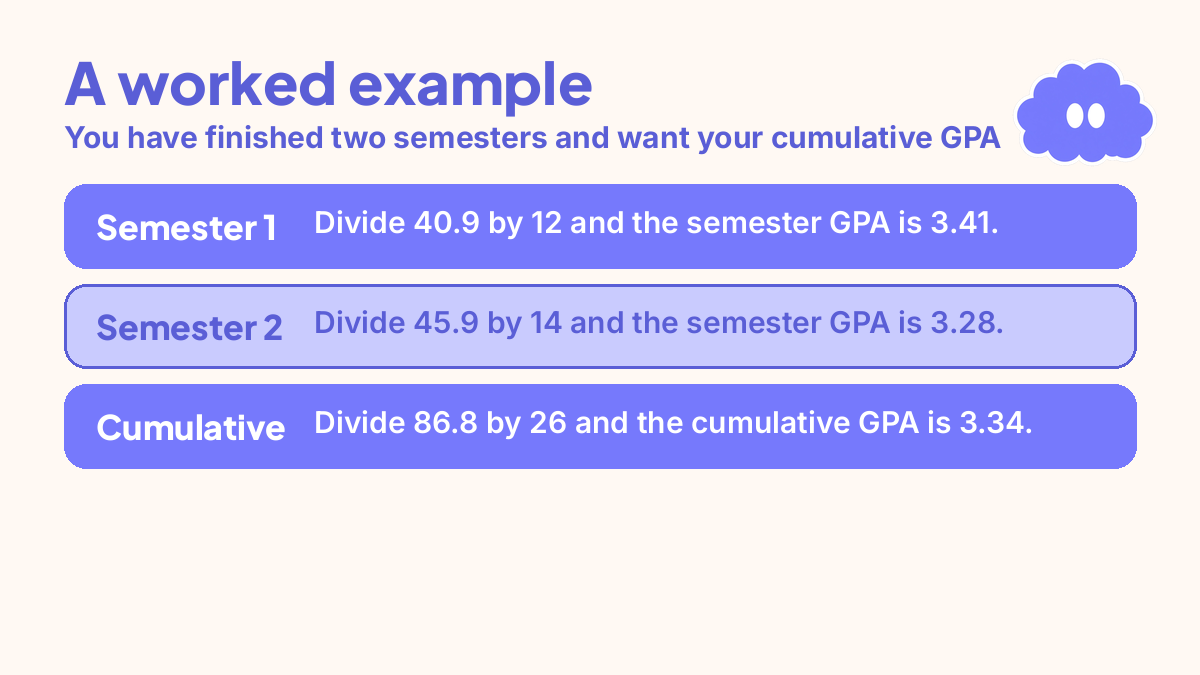
Semester 1 has four courses. English, 3 credits, A (4.0), gives 12.0 grade points. Maths, 4 credits, B+ (3.3), gives 13.2. Psychology, 3 credits, A- (3.7), gives 11.1. Biology, 2 credits, C+ (2.3), gives 4.6. Add them up: 12.0 plus 13.2 plus 11.1 plus 4.6 equals 40.9 grade points over 12 credits. Divide 40.9 by 12 and the semester GPA is 3.41.
Semester 2 has four courses. Maths, 4 credits, B (3.0), gives 12.0 grade points. Chemistry, 4 credits, B- (2.7), gives 10.8. History, 3 credits, A (4.0), gives 12.0. Communication, 3 credits, A- (3.7), gives 11.1. Add them up: 12.0 plus 10.8 plus 12.0 plus 11.1 equals 45.9 grade points over 14 credits. Divide 45.9 by 14 and the semester GPA is 3.28.
Now the cumulative figure: 40.9 plus 45.9 equals 86.8 grade points, and 12 plus 14 equals 26 credits. Divide 86.8 by 26 and the cumulative GPA is 3.34. Averaging would have given 3.35, wrong by 0.01 because semester 2 carried more credits.
- Monday evening, 7.00 to 7.30 pm: copy both semesters from the portal into the sheet, four courses each, with credits and grades.
- Monday evening, 7.30 to 7.50 pm: convert each grade to grade points, multiply by credits, and add each semester’s total. Semester 1 gives 40.9 over 12 credits; semester 2 gives 45.9 over 14 credits.
- Monday evening, 7.50 to 8.00 pm: divide 86.8 by 26 to get 3.34, then check it against the GPA calculator.
- Tuesday morning, 8.00 to 8.15 am: plan next semester. You will take 14 credits, so your total will become 40 credits. A target cumulative GPA of 3.50 needs 140.0 total grade points, because 3.50 times 40 equals 140.0. You already have 86.8, so you need 53.2 more. Divide 53.2 by 14 and you need a semester GPA of 3.80.
- Tuesday morning, 8.15 to 8.30 am: decide whether 3.80 is realistic. It means mostly A- grades with no grade below B. If that is a stretch, set the target to 3.45 instead, which needs 138.0 total points, 51.2 new points, and a semester GPA of 3.66.
When it goes wrong
You averaged your semester GPAs. Rework it with total grade points divided by total credits. The difference is usually small, but it is a real error, and it matters most when you are close to a boundary such as 3.50.
Your total does not match your transcript. Check for a missing course first, then for a retaken course counted under the wrong rule, then for a transferred course with different credits. One of those three explains almost every mismatch.
You used the wrong grade scale. Some courses use honours or AP and IB bonus points, which change the grade point values. Check the handbook for each course, use one scale per course, and write the scale on your sheet.
Weekly review checklist
- Is my course list complete, with every finished course and its credits?
- Does my total credit count match my transcript exactly?
- Have I used the right grade scale for every course?
- Does my hand calculation match the GPA calculator result?
- What semester GPA do I need next semester to hit my target?
- Is that required GPA realistic, given my recent grades?
- Which course is dragging my GPA most, and what changes next semester?
Downloadable infographic spec: A vertical infographic in Thynq colours (cream background, dark purple title, cloud-purple steps, pink accents) with the cloud mascot at the top, titled “How to work out your GPA across semesters”. It lists 6 steps: list every course with credits and a grade; turn each letter grade into grade points; multiply grade points by credits and add them up; add up all your credits across every semester; divide total grade points by total credits; plan next semester from your cumulative GPA. It ends with 6 review questions: Is my course list complete? Does my total credit count match my transcript? Have I used the right grade scale? Does my calculation match the GPA calculator? What semester GPA do I need next? Is that required GPA realistic?
What this system is not
This system is not a prediction. It tells you exactly where you stand today, not what grade you will get next semester. A cumulative GPA is a record, and the planning step is arithmetic, not a promise.
It is not a substitute for your university’s official calculation. Universities differ on retakes, transferred credits, and bonus scales, and their figure is the one that counts for progression and graduation. If your number and theirs disagree, theirs wins, and the difference is worth asking the registrar about.
It is also not a reason to chase a number at the cost of learning. A GPA target is useful when it shapes how you study, and it is harmful when it makes you pick easy modules over useful ones. Use the number to plan, then put it away and study the material.
Sources
No external source was used for this article: no verified statistics about GPA calculation were available, so none are stated. The grade point values are the standard 4.0 scale as published by universities, and the method is total grade points divided by total credits.
For the full system behind this method, start with How to build a study system that fits your life.
Questions
Can I just average my semester GPAs to get my cumulative GPA?
No. Averaging semester GPAs gives the wrong answer whenever your semesters have different credit totals, because a semester with more credits should count more. Add up all your grade points from every semester, add up all your credits, then divide total grade points by total credits.
What grade point is a B+ worth?
On the standard 4.0 scale, a B+ is worth 3.3 grade points. An A is 4.0, an A- is 3.7, a B is 3.0, a B- is 2.7, and a C+ is 2.3. Your own university may use a slightly different scale, so check its handbook before you calculate anything.
How do I work out what GPA I need next semester to reach a target?
Multiply your target cumulative GPA by the total credits you will have after next semester, then subtract the grade points you already have. The result is the grade points you still need; divide it by next semester’s credits to get the semester GPA you need.
Do UK students use GPA?
Most UK universities use degree classifications instead of GPA: first, upper second (2:1), lower second (2:2), and third. GPA is mainly used by US-style courses. If you study in the UK, work out your classification rather than a GPA.