
The direct answer
How to work out how many study hours you need before an exam: count the topics, time one topic honestly, and divide the total by the days you have left. Most students need 1.5 to 3 hours per topic, so the total is topics times hours per topic, and the daily target is that total divided by study days.
Most students guess their study hours. They pick a number that sounds good, such as four hours a day, and then discover in the last week that the number was wrong: too much for the time they have, or too little for the topics they need to cover. The system below replaces the guess with a count, so the shortfall, if there is one, shows up early enough to fix.
The system in short
- List every topic for every subject, and count them, so the total is a number, not a feeling.
- Time three topics honestly, and take the average, so the hours per topic is measured, not guessed.
- Multiply topics by hours per topic to get the total hours, then add a 20 percent buffer for review and surprises.
- Count the real study days left, taking out days off and the exam day itself, and divide the total by that number.
- If the daily hours do not fit, triage: rank subjects by priority, give every subject at least one topic, and fill the rest with the highest-priority topics.
- Review for 15 minutes each week: are the hours per topic still right, and is the daily target still holding?
Step 1: List every topic for every subject, and count them
Start with a list, not a guess. For each subject, write down every topic that could be examined: chapters, units, themes, whatever your course calls them. Count them. A subject with 12 topics is a different job from a subject with six, and the list is what makes that visible. Do this for every subject you are sitting, and add the counts together. That total is the size of the job.
Be honest about the list. A topic you have never studied counts the same as a topic you know well, because it still needs time. A topic that will not be examined does not count, so check the syllabus and cross off anything that is not in it. A list with 30 topics on it is a plan. A feeling that there is “a lot to do” is not.
Write the list where you can see it, and keep it updated. As you finish a topic, cross it off. The list shrinking is the clearest sign the plan is working, and it is much more useful than a vague feeling that you are behind or ahead. If you use the past paper tracker to find your weak topics, the list and the tracker should match: the topics you keep getting wrong are the ones that need the most hours.
Step 2: Time three topics honestly, and take the average
The hours per topic is the number the whole plan depends on, so measure it. Pick three topics: one you know well, one you know partly, and one you barely know. Time yourself revising each one properly, from the start to the point where you can answer practice questions on it from memory. Write down the three times, and take the average.
Most students need 1.5 to 3 hours per topic to revise it properly with practice questions. A topic you already know well might take 90 minutes. A new or hard topic might take three hours. The average of your three timed topics is your number, and it is better than any number you could guess, because it is yours. If the three times are very different, time two more topics and take the average of five.
Do not cheat the timing. Revising a topic means reading it, testing yourself on it from memory, and checking what you got wrong, not just reading it once. A topic that takes 40 minutes to read takes two hours to revise properly, and the plan needs the two-hour number.
Step 3: Multiply topics by hours per topic, and add a buffer
The total is simple: topics times hours per topic. Twelve topics at two hours each is 24 hours. Nineteen topics at two hours each is 38 hours. Three subjects with 10 topics each, at two hours a topic, is 60 hours. Write the total down, for each subject and for all of them together. That total is the job, in hours, and it is the number every other step uses.
Then add a 20 percent buffer, for review and for surprises. A total of 24 hours becomes about 29 hours. The buffer is not wasted time. It is the time for the second pass over the topics you got wrong, the practice paper at the end, and the day when a topic takes an hour longer than you planned.
If the total shocks you, that is useful information, and it is better to know it now than in the last week. A total of 60 hours with two weeks to go is a different problem from a total of 60 hours with six weeks to go, and Step 5 is where the difference is handled.
Step 4: Count the real study days left, and divide
Count the days from today up to the day before the exam, then take out the days you will not study. Sundays off, a family event, a shift at work, a day for another exam: all of them come out. Never count the exam day itself, because the exam day is for the exam, not for study. What is left is the real study days, and it is always fewer than you think. Five weeks with Sundays off is 30 study days, not 35.
Now divide. Total hours, including the buffer, divided by real study days, is the hours a day you need. Twenty-nine hours over 14 study days is just over two hours a day. Write the daily target down, and check it against the hours you can really give. Two hours a day is realistic for most students. Six hours a day is not, and a plan that asks for six hours a day will fail by the third day.
If the daily target is realistic, the plan is done, and the work is to follow it. If it is not, Step 5 is where the fix happens. The calculator on this site does this division for you: enter your exam date, the topics left, and the time you can give, and it shows the hours a day you need, with the days off taken out. Use it to check your own numbers, and use the tool link at the end of this article to open it.
Step 5: If the hours do not fit, triage honestly
When the daily hours do not fit, do not pretend they do. Triage. Rank your subjects by priority: which exam matters most, which one you are weakest in, which one carries the most marks. Give every subject at least one topic if you can, so no exam is left completely unprepared. Then spend the rest of the hours on your highest-priority topics, in order, until the hours run out.
Work out what would close the gap, in numbers. How many extra hours a day would you need, and can you find them? How much less time per topic would you need? Sometimes the answer is one extra hour a day, which is findable. Sometimes it is three extra hours a day, which is not, and the triage is the honest answer.
The triage also tells you what to drop. A topic that is worth few marks and that you know badly is a candidate for dropping, if the exam allows it. A topic that comes up every year is never a candidate for dropping. Make the decision with the list in front of you, not in your head, and write it down, so the dropped topics are a choice, not an accident. For the wider skill of building a revision plan around a deadline, the system in How to make a revision timetable that works covers the week-by-week shape.
Step 6: Review for 15 minutes each week
At the end of each week, spend 15 minutes on three questions. First, are the hours per topic still right, or are topics taking longer than the average said? Second, is the daily target still holding, or have days been lost? Third, how many topics are left, and does the total still fit in the days that remain?
Write the answers in two or three lines, and update the numbers. If topics are taking longer than planned, the average goes up, the total goes up, and the triage may need to change. That is not a failure. It is the plan doing its job, by telling you early, while there is still time to adjust.
A worked example: three subjects, four weeks, 30 study days
Your situation: Final-year student, three exams in four weeks. Biology, 12 topics left. Chemistry, 10 topics left. Maths, 8 topics left. Sundays off, one Saturday taken by a family event. Exam day is not counted.
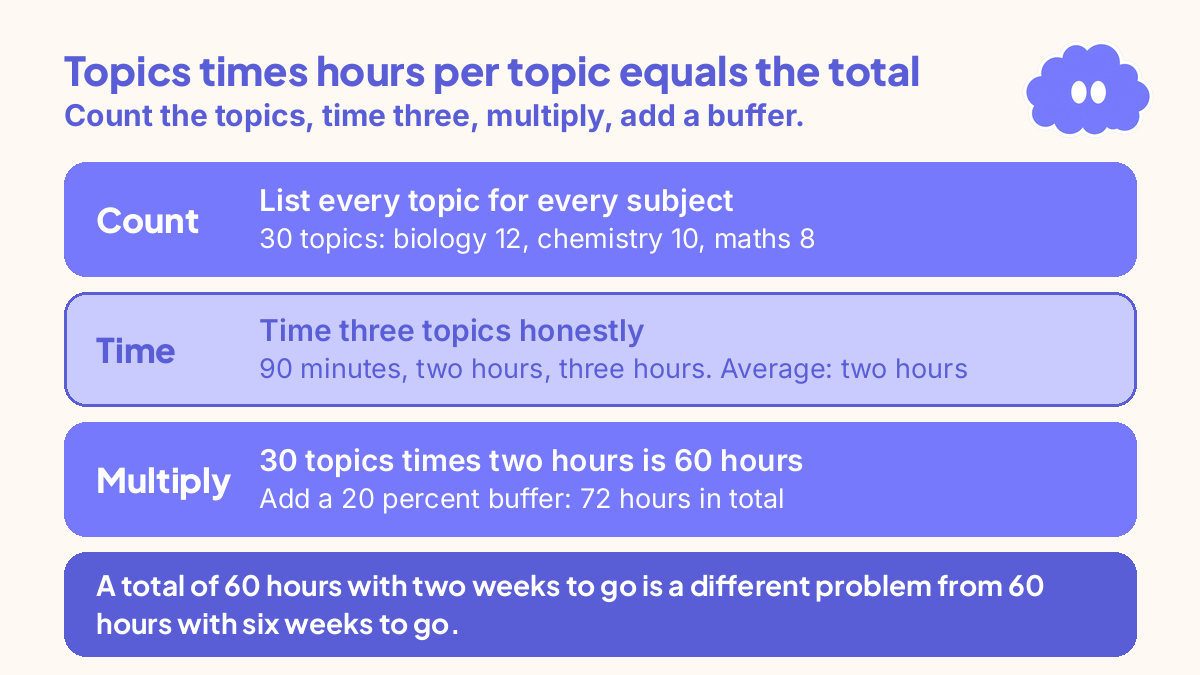
- Step 1, count the topics: Biology 12, chemistry 10, maths 8. Total 30 topics.
- Step 2, time three topics: Biology, a topic you know well, 90 minutes. Chemistry, a topic you know partly, two hours. Maths, a topic you barely know, three hours. Average: just over two hours. Use two hours per topic.
- Step 3, total and buffer: 30 topics times two hours is 60 hours. Add a 20 percent buffer: 72 hours in total.
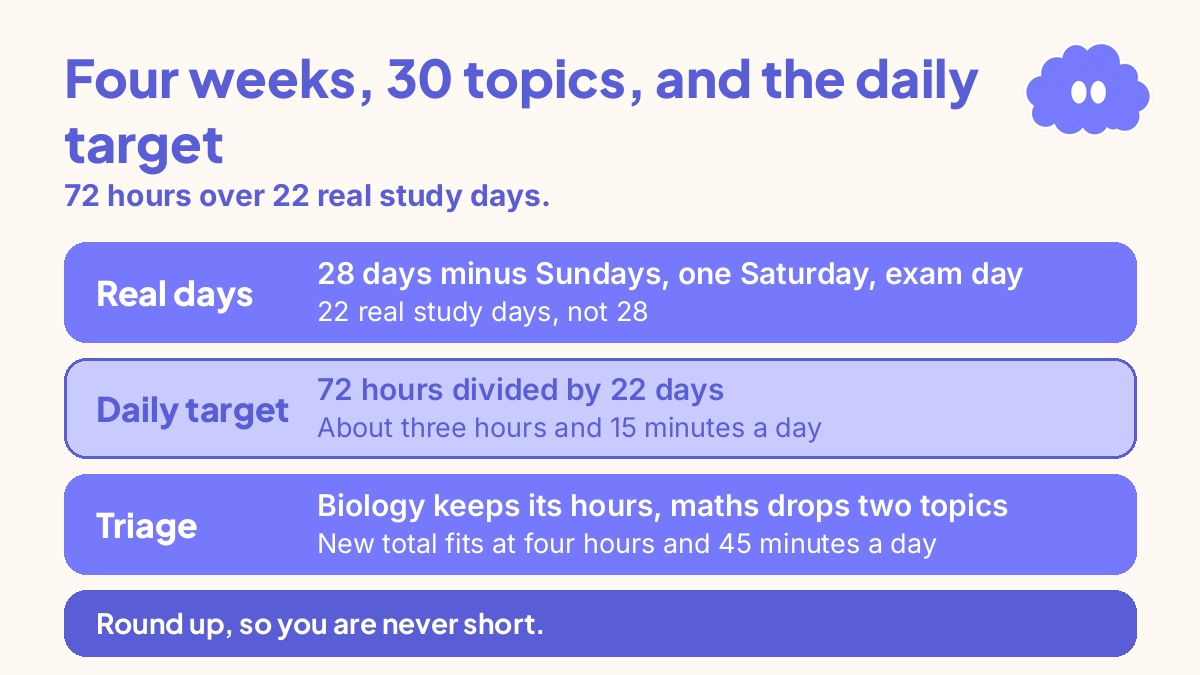
- Step 4, real study days: Four weeks is 28 days, minus four Sundays, one Saturday, and the exam day, is 22 real study days. Seventy-two hours divided by 22 days is about three hours and 15 minutes a day.
- Check: Three hours and 15 minutes a day is a lot, but it is doable for four weeks if the days are protected. The plan holds, with no triage needed, as long as no more days are lost.
- Week two review: Biology topics are taking two and a half hours, not two. The total is now 66 hours plus buffer, about 79 hours. Seventy-nine hours over the 16 days left is about five hours a day, which does not fit. Triage: biology is the weakest subject and carries the most marks, so it keeps its hours. Maths is the strongest, so two maths topics are dropped to retrieval only, 30 minutes each, which saves three hours. The new total fits at four hours and 45 minutes a day.
When it goes wrong
You counted the topics wrong, and there are more than you thought. This happens when the syllabus has sub-topics inside the topics. The fix is the list: add the missing topics, recount the total, and redo the division. It is better to find this in week one than in week three.
You lose study days, and the daily target climbs. A lost day adds hours to every remaining day. If the target climbs above four hours a day, it is time to triage, not time to work harder. Drop the lowest-value topics to retrieval only, and protect the highest-value ones.
Weekly review checklist
- How many topics are left, and has the count changed?
- Are topics taking the hours per topic I planned, or has the average moved?
- Is the daily target still realistic, and how many real study days are left?
- Did I lose any study days this week, and what did that do to the daily target?
- Does anything need triaging, and if so, which topics, and why?
- What must next week protect: a study day, a timed topic, or a practice paper?
Downloadable infographic spec: one vertical image, title “How to work out how many study hours you need before an exam”, with the six steps from “The system in short” and the six review questions above, in Thynq cream, Cloud Purple, Dark Purple and pink, with the Cloud mascot. Text taken word-for-word from this article.
What this system is not
It is not a promise that the hours will fit. Sometimes they will not, and the honest answer is triage, not more hours. It is not a way to study less by counting cleverly, and it will not work if the topic count is guessed or the timing is cheated. What it does is smaller: it replaces a guess with a count, so the shortfall shows up early enough to fix.
Sources
- Dunlosky, J., et al. (2013). Improving students’ learning with effective learning techniques. Psychological Science in the Public Interest, 14(1), 4-58. Practice testing and distributed practice rated high; rereading rated low, which is why each topic is revised with practice questions, not by re-reading.
- Roediger, H. L., & Karpicke, J. D. (2006). Test-enhanced learning. Psychological Science, 17(3), 249-255. Recallers remembered more a week later than restudiers, which supports testing yourself on each topic before moving to the next one.
- Cepeda, N. J., et al. (2006). Distributed practice in verbal recall tasks. Psychological Bulletin, 132(3), 354-380. Spaced practice beat massed practice, which supports spreading the total hours across the study days instead of cramming them into the last week.
To check your own numbers, use the study hours calculator, which takes your exam date, the topics you have left, and the time you can give, and shows the hours a day you need, with the days off taken out.
For the wider revision system behind this one, start with How to build a study system that fits your life.
Questions
How many hours should I study before an exam?
Count your topics, time one topic honestly, and multiply. Most students need 1.5 to 3 hours per topic to revise it properly with practice questions, so 12 topics at two hours each is about 24 hours in total. Divide that total by the study days you have left to get your hours a day.
How do I work out my study hours per day?
Take the total hours your topics need, and divide it by the number of days you will actually study, not the days until the exam. Count only the days you can really study, take out your days off, and never count the exam day itself. Round up, so you are never short.
What if I do not have enough hours before the exam?
Then triage, honestly. Rank your subjects by priority, give every subject at least one topic if you can, and spend the rest on your highest-priority topics. Work out how many extra hours a day, or how much less time per topic, would close the gap, and choose one of them.
How long should I spend on each topic?
Time yourself on one topic first, then use that number for the rest. A topic you already know well might take 90 minutes; a new or hard topic might take three hours. Do not guess for all of them from one number. Time three topics, take the average, and use that.