
The direct answer
How to work out your degree classification: average each year’s module marks by credits, combine the year averages using your university’s year weighting, and read the class from the bands. A First is 70 and above, a 2:1 is 60 to 69, a 2:2 is 50 to 59, and a Third is 40 to 49.
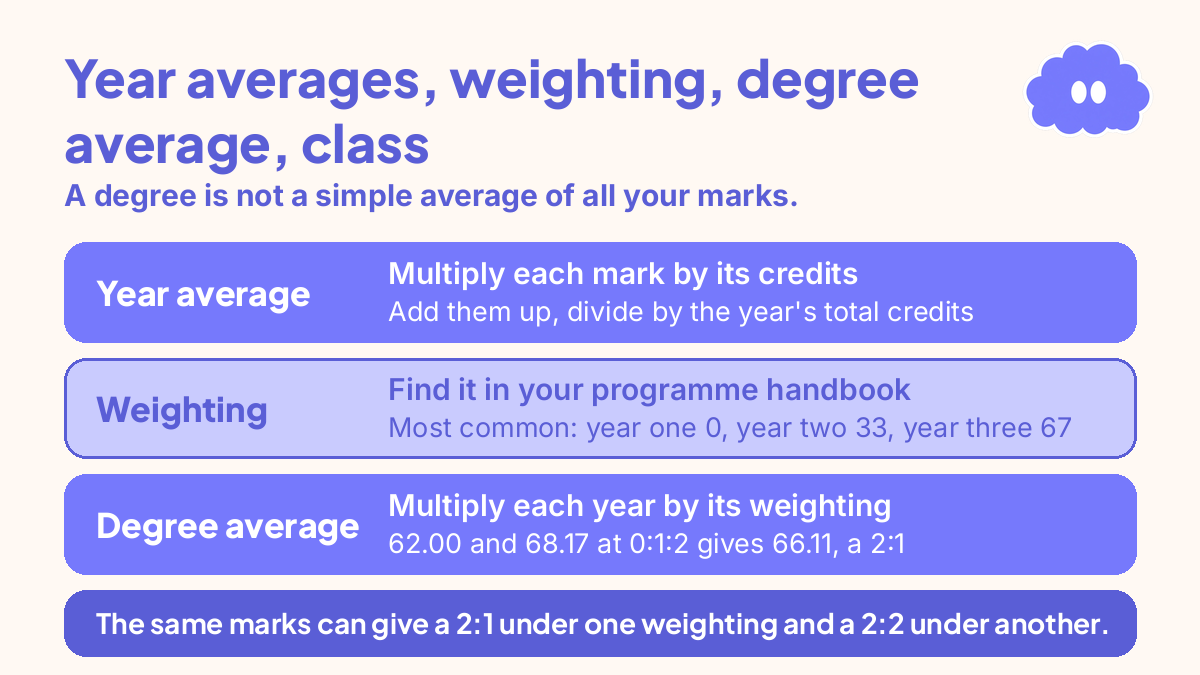
Most students work out their degree classification by averaging all their marks together, which is wrong. A degree is not a simple average. Each year’s mark is a credit-weighted average of its modules, and the degree average combines the year marks by a weighting that your university sets. The same marks can give a 2:1 under one weighting and a 2:2 under another.
The system in short
- Gather your marks and credits for each year, module by module, from your results page or transcript.
- Work out each year’s average: multiply each module mark by its credits, add them up, and divide by the year’s total credits.
- Find your university’s year weighting in your programme handbook, and write it down.
- Combine the year averages by the weighting to get your degree average.
- Read the class from the bands: 70 and above is a First, 60 to 69 is a 2:1, 50 to 59 is a 2:2, 40 to 49 is a Third.
- Check the borderline rules: if you are within two marks of a boundary, find out what your university does, and work out what you still need.
Step 1: Gather your marks and credits, module by module
Start with the raw numbers. For each year that counts, list every module, its mark, and its credits. A full year is usually 120 credits, made up of six 20-credit modules, or a mix: four 20-credit modules plus one 40-credit dissertation, for example. Get the marks from your results page or your transcript, and write them down in a table, one row per module.
Do not use rounded marks if you can avoid it. A module mark of 68.4 is not 68, and the difference matters when the average is near a boundary. If your results page only shows whole numbers, use those, but know that the answer is an estimate, not an exact figure. If a module has no mark yet, leave it blank for now, and come back to it when the mark arrives.
Include every module that counts, and only those. A module you failed and resat may count at the resit mark, or at a capped mark, depending on your university’s rules. A module you took as an extra, outside the 120 credits, may not count at all. Check your handbook for these cases.
Step 2: Work out each year’s average, weighted by credits
For each year, the average is a credit-weighted average, not a simple average. Multiply each module mark by its credits, add those numbers together, and divide by the year’s total credits. A 40-credit module counts twice as much as a 20-credit one, because it is twice as much work, and the calculation should show that.
Take an example. Year two, six 20-credit modules, marked 58, 64, 61, 66, 59, and 64. Multiply each by 20 and add them up: the total is 7,440. Divide by 120 credits, and the year average is 62.00 percent.
Now take a year with a dissertation. Year three, a 40-credit dissertation marked 72, plus four 20-credit modules marked 66, 68, 61, and 70. The dissertation is 72 times 40, which is 2,880. The modules add up to 5,300. The total is 8,180. Divide by 120, and the year average is 68.17 percent. The dissertation, at 40 credits, pulls the average up more than any single module.
Step 3: Find your university’s year weighting, and write it down
The year weighting is the rule your university uses to combine the year averages into a degree average, and it varies. Most English universities ignore year one entirely and weight year two at 33 percent against year three at 67 percent. Some use 30/70. Some use 25/75. Some use 50/50. Some count year one, usually at a small weight. Four-year degrees, including integrated masters, have their own weightings.
Find your weighting in your programme handbook, or in your university’s regulations, and write it down. Do not guess it, and do not use a friend’s weighting from a different university or a different course.
Write the weighting as a ratio, such as 0:1:2, which means year one counts for nothing, year two counts once, and year three counts twice. Or as percentages: 0 percent, 33 percent, 67 percent. Keep the handbook page open while you work, because you will need it again in Step 6, for the borderline rules.
Step 4: Combine the year averages by the weighting
The degree average is the weighted sum of the year averages. Multiply each year average by its weighting, add the results, and divide by the total of the weightings. With a 0:1:2 weighting, the degree average is the year two average times one, plus the year three average times two, all divided by three.
Take the examples from Step 2. Year two average 62.00, year three average 68.17, weighting 0:1:2. The calculation is 62.00 times one, which is 62.00, plus 68.17 times two, which is 136.34. Add them: 198.34. Divide by three: 66.11 percent. That is the degree average, and it falls in the 60 to 69 band, so the class is a 2:1.
Try the same marks with a different weighting. With a 50/50 split, the degree average is 65.09 percent, still a 2:1, but a lower one. With a weighting that counts the final year at 100 percent, the degree average is 68.17, still a 2:1, but much closer to a First. The same marks, three different answers, and the weighting is the only thing that changed.
Step 5: Read the class from the bands
The bands are the same across UK universities for honours degrees. A First is 70 and above. An upper second, or 2:1, is 60 to 69. A lower second, or 2:2, is 50 to 59. A Third is 40 to 49. Below 40 is usually a fail, though the exact rule depends on your university. Compare your degree average with the bands, and that is your class, subject to the borderline rules in Step 6.
Read the bands carefully. A degree average of 69.87 is a 2:1, not a First, unless your university rounds it up. A degree average of 59.6 is a 2:2, not a 2:1, unless the borderline rule applies. The bands are fixed, and the rounding rule is set by your university, so check it. Some round the average to a whole mark before classifying, so 69.5 becomes 70 and a First. Some do not round at all.
Taught postgraduate degrees use different names: Distinction at 70, Merit at 60, and Pass at 50. The calculation is the same, but the names are different, so check which set of bands your degree uses. If you are an international student, do not convert your marks to a GPA and back again.
Step 6: Check the borderline rules, and work out what you still need
If your degree average is within two marks of a boundary, you are in the borderline zone, and most universities have a rule for it. The common rule is preponderance: the university looks at how much of your work sits in the higher class. If your average is 69 but more than half your credits are marked 70 or above, many universities will award the First.
Check your regulations for the exact rule, because it varies, and because it is changing. Some universities have moved away from borderline rules, and some have kept them. Do not assume a 69 average is automatically a First, and do not assume a 59 average is automatically a 2:2. The rule is in your handbook, and it is worth reading.
Then work out what you still need, if you have marks still to come. Take your year two average and your weighting, and work backwards from the boundary. With a 33/67 split and a year two average of 55, you need 63 in your final year to reach a 2:1. With a year two average of 65, you need 58. The lower your year two average, the higher your final year needs to be. For the wider problem of working out what mark you need on a single exam, the system in How to work out what mark you need on your final exam to pass covers the same backwards calculation for one paper.
A worked example: a third-year student, year two done, final year to come
Your situation: Third-year student, year two finished, final year in progress. Year two average is 62.00, from six 20-credit modules. Final year has a 40-credit dissertation and four 20-credit modules. University weighting is 0:1:2, year one does not count. The question is what final-year average is needed for a 2:1, and for a First.
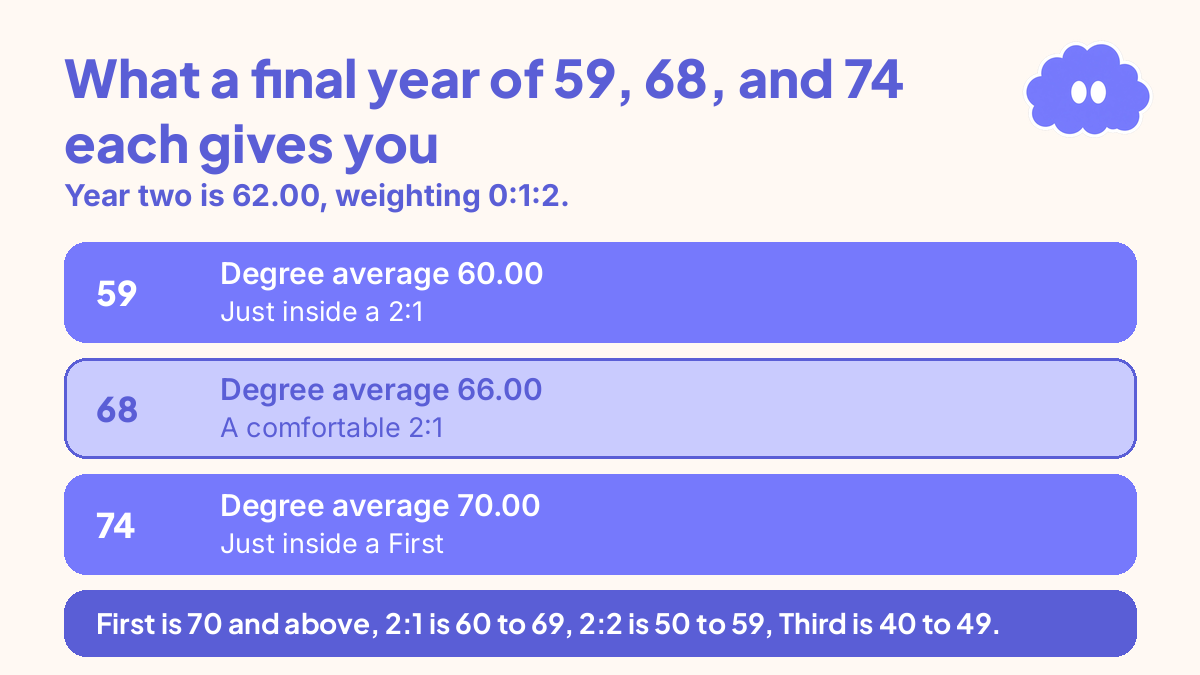
- What a 2:1 needs: The boundary is 60. With a 0:1:2 weighting, the degree average is year two plus two times the final year, divided by three. Year two is 62.00, so two times the final year is 180 minus 62, which is 118, and the final year average needs to be 59. A final year of 59 gives a degree average of 60.00, just inside the 2:1.
- What a First needs: The boundary is 70. Two times the final year is 210 minus 62, which is 148, so the final year average needs to be 74. A final year of 74 gives a degree average of 70.00, just inside a First.
- The borderline check: At 69.11, check the preponderance rule. If more than half the final-year credits are at 70 or above, the university may award the First. The dissertation at 78 is 40 credits, and two modules at 70 or above would add 40 more, which is 80 of 120 final-year credits, more than half, so the borderline case is strong.
When it goes wrong
Your university’s weighting is different from the one you used. This is the most common error, and it changes the answer completely. The fix is the handbook: find the weighting for your programme and your year of entry, because weightings can change between cohorts, and redo the calculation with the right numbers.
You are in the borderline zone and the rule is unclear. Ask your programme office, in writing, what the borderline rule is for your cohort. Do not rely on what a friend was told, or what a forum says, because the rule varies by university, by programme, and by year. A written answer is the only one you can rely on.
Weekly review checklist
- Do I have every module mark and credit, for every year that counts?
- Is each year’s average a credit-weighted average, not a simple average?
- Is the year weighting from my own programme handbook, for my year of entry?
- What is my degree average now, and which band does it fall in?
- Am I in the borderline zone, and what is my university’s rule for it?
- What final-year average do I need for the next class up, and is it realistic?
Downloadable infographic spec: one vertical image, title “How to work out your degree classification”, with the six steps from “The system in short” and the six review questions above, in Thynq cream, Cloud Purple, Dark Purple and pink, with the Cloud mascot. Text taken word-for-word from this article.
What this system is not
It is not a promise of a particular class. The calculation tells you where you stand, not where you will end up, and the final marks are still to come. It is not a substitute for your university’s regulations, which are the authority. What it does is smaller: it gives you the arithmetic, so you know exactly what you need, and you can plan the final year around a number instead of a hope.
Sources
- UK Standing Committee for Quality Assessment. Degree Classification: Transparent, Consistent and Fair Academic Standards. Universities UK, GuildHE and QAA. (2018). Year weightings range from an even split to a 100 percent final-year mark, with common splits of 50/50, 40/60, 33/67, 30/70, 25/75 and 20/80, which supports the weighting tables in this article.
- Dunlosky, J., et al. (2013). Improving students’ learning with effective learning techniques. Psychological Science in the Public Interest, 14(1), 4-58. Practice testing and distributed practice rated high; the same spacing principle supports short weekly checks of your marks over one long calculation at the end.
- Roediger, H. L., & Karpicke, J. D. (2006). Test-enhanced learning. Psychological Science, 17(3), 249-255. Testing from memory beat restudying, which supports working the calculation out by hand before checking it against a calculator.
To check your own numbers, use the degree classification calculator, which takes your module marks, credits, and year weightings, and shows your degree average and classification.
For the wider study system behind this one, start with How to build a study system that fits your life.
Questions
How do I work out my degree classification?
Average each year’s module marks by credits, then combine the year averages using your university’s year weighting, and read the class from the bands: 70 and above is a First, 60 to 69 is a 2:1, 50 to 59 is a 2:2, and 40 to 49 is a Third. Your programme handbook gives the exact weighting your university uses.
What year weighting does my university use for degree classification?
Most English universities ignore year one entirely and weight year two at 33 percent against year three at 67 percent, but the weighting varies. Check your programme handbook or your university’s regulations, because the same marks can give a different class under a different weighting.
How do I work out what final-year average I need for a 2:1?
Take your year two average and your university’s weighting, and work backwards from 60. With a 33/67 split and a year two average of 55, you need 63 in your final year. With a year two average of 65, you need 58. The lower your year two average, the higher your final year needs to be.
What happens if my average is just below a boundary?
Many universities have a borderline zone, often within two marks of a boundary, where they look at how much of your work sits in the higher class. Check your regulations for the exact rule, because it varies, and do not assume a 69 average is automatically a First.