The direct answer
Make your one day off the main study day, with two long blocks and a review, and run short 20-minute test sessions on the six work days. The day off does the heavy learning, and the work days keep it warm.
Six days of work and one day off leaves no room for a normal study week, so do not try to build one. The students who make this shape work do not study a little every day. They study hard on the free day, in two proper blocks, and they use the work days for short tests from memory that stop the free day’s work from fading. The system below shows how to split the day, what to do in the 20-minute gaps, and how to protect the day off when work tries to take it.
The system in short
- Name your day off and protect it like a shift: no overtime, no extra errands, no study in every spare hour.
- Split the day off into two long blocks with a real break: one for new material, one for testing and practice.
- Run 20-minute test sessions on work days, from memory, one topic at a time.
- Plan the day off the evening before, with one task per block written down.
- Review for 20 minutes on the evening of the day off, so the day’s work is checked before the work week starts.
- Review on Sunday for 15 minutes, or on the evening after your day off: what the week cost, what survived, and what the next day off must hold.
Step 1: Name your day off and protect it like a shift
First, name the day. “My day off is Sunday” is a plan. “I will study when I get a free day” is a wish. Write it in your calendar, tell your family and housemates, and treat it the way you treat a work shift: it has a start time, an end time, and it does not move for small reasons.
Protecting it means saying no to the things that eat free days. Overtime on the day off is the biggest one: it pays well precisely because it takes the only day you have. Errands are the second: do them on a work evening, in 30 minutes, instead of letting them spread across the free day.
If your day off moves from week to week, because your rota changes, the day is still named each week, in the five-minute re-plan. How to study when your rota changes covers that routine. If you work weekends as well as weekdays, Study system for students who work weekends covers the shape where the free day is not a weekend day at all.
Step 2: Split the day off into two long blocks with a real break
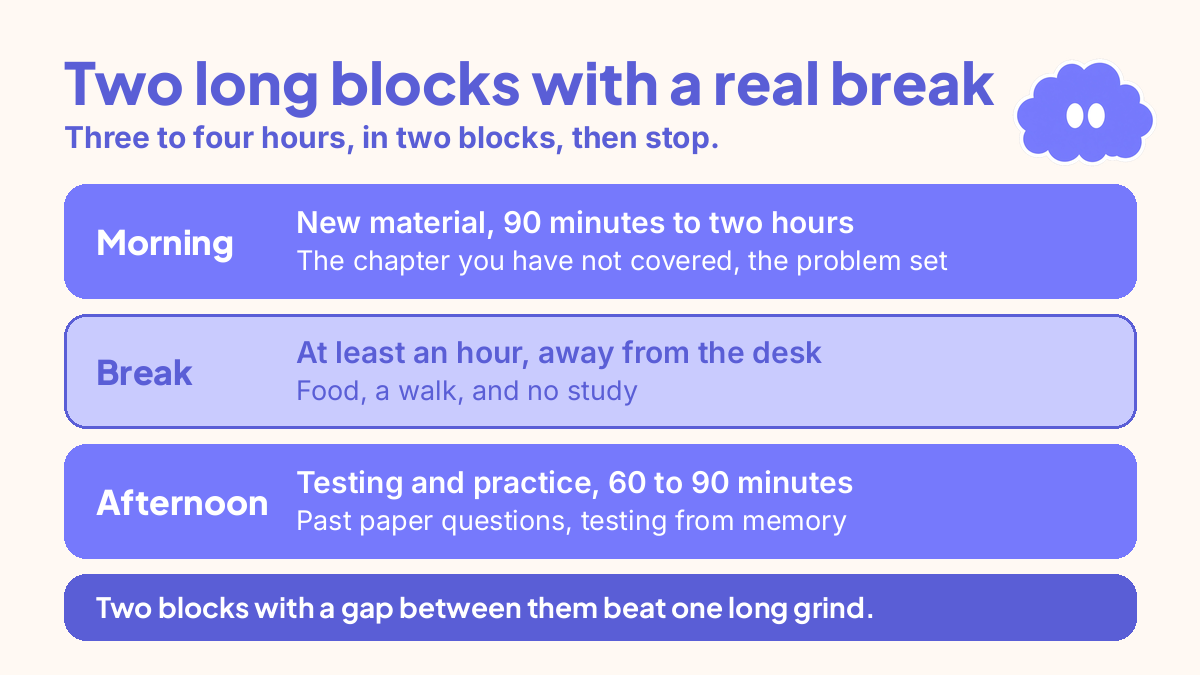
Two blocks, not one long one. Block one, in the morning, is for new material: the chapter you have not covered, the problem set you have not started, the essay section you have been avoiding. Ninety minutes to two hours, one hard task, phone away. Block two, after lunch, is for testing and practice: past paper questions, testing yourself from memory, redoing the problems you got wrong. Sixty to ninety minutes, same subject or a second one, and it ends with you knowing what you can and cannot do yet.
Between the blocks, take a real break: at least an hour, away from the desk, with food, a walk, and no study. A break that is really a break is what makes the second block work. Students who study for five hours straight on their day off usually remember the first two hours and waste the last three. Two blocks with a gap between them beat one long grind, because the gap lets the morning’s work settle and gives your brain a reason to come back fresh.
Stop by early evening. The day off is also a rest day, and the evening belongs to rest. A 20-minute review in the evening is the only study after the second block, and it is covered in Step 5. If an exam is close and you need a third block, add a short one before lunch, 45 minutes, and keep the evening free. More hours do not help if they are tired hours.
Step 3: Run 20-minute test sessions on work days
On the six work days, study is 20 minutes, once a day, testing yourself from memory. Not reading, not watching a lecture, not tidying notes. Testing. Write down everything you remember about one topic, then check it. Or answer three practice questions without looking. Or draw one diagram from memory and compare it with the book.
Twenty minutes is enough for one topic and one check, and that is the whole point. A work day after a full shift has no room for new material, but it has room for a test, and a test is what stops yesterday’s learning from fading. Six 20-minute tests across the week add up to two hours of the most useful revision there is, and they cost less energy than one tired evening of rereading.
Do the session at the same trigger every day, not at the same time, because work days end at different times. After your evening meal, or on the bus home, or in the 20 minutes before bed. A trigger you hit every day beats a time you only sometimes make. Keep the flashcards or questions on your phone so the session starts the moment the trigger arrives. If you come home too tired to start, the system in How to study when you are tired after work has a smaller start: five minutes, one question, and permission to stop.
Step 4: Plan the day off the evening before
The evening before the day off, spend ten minutes planning it. Write down one task for each block, with a finish line. “Morning block: learn the three causes of inflation, test each from memory. Afternoon block: two past paper questions on inflation, marked the same day.” That is a plan you can start on without thinking, which matters, because the first hour of a free day is the easiest hour to waste.
Gather the materials the same evening: the textbook, the past papers, the notes, the charger. A free day that starts with an hour of looking for things is a free day that loses its best block. Put everything in one place the night before, and start the morning block at the time you wrote down.
Step 5: Review for 20 minutes on the evening of the day off
When the second block ends, take your break, rest, and then spend 20 minutes in the evening reviewing what the day produced. Three things: what you can now do from memory that you could not do in the morning, what you got wrong in the afternoon practice, and what the work-day tests this week should cover. Write the answers in a few lines, and write the next three test topics at the bottom.
This review is what connects the day off to the work days. Without it, the week’s 20-minute sessions have no direction, and you will test yourself on whatever comes to mind. With it, each work day has a job: Monday tests the inflation causes, Tuesday tests the diagram, Wednesday re-tests the two questions you got wrong. The day off teaches, the work days keep it warm, and the review is the bridge between them.
Step 6: Review the week in 15 minutes
Once a week, spend 15 minutes on three questions. First, did the day off happen as planned, or did work, errands, or tiredness take part of it? Second, did the six 20-minute sessions run, and which ones were skipped? Third, what must the next day off hold: the same subject again, or the next one?
If the day off keeps shrinking, the problem is usually protection, not discipline. Something is taking it, and the fix is to name that thing and say no to it next week. If the work-day sessions keep failing, pick a trigger that happens every day without fail, such as the bus home, and tie the session to that.
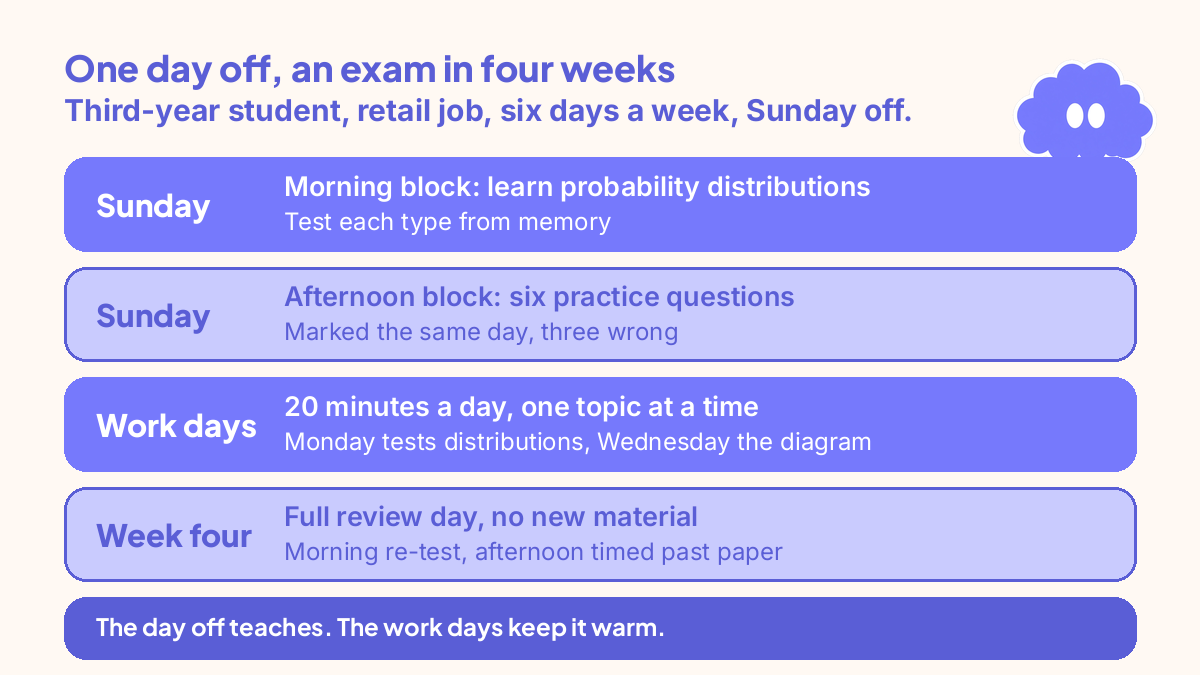
A worked example: one day off, an exam in four weeks
Your situation: Third-year student, retail job, six days a week, Sunday off. Exam in four weeks, weakest subject is statistics. Normal week: Sunday free, Monday to Saturday working 9.00 to 6.00, home by 7.00, tired.
- Sunday, week one: Morning block 9.00 to 10.30, learn probability distributions, three types, each tested from memory. Break 10.30 to 12.00, walk and lunch. Afternoon block 12.00 to 1.30, six practice questions on distributions, marked the same day, three wrong. Evening review 7.00 to 7.20, note the three wrong questions and set the week’s test topics: distributions on Monday, the diagram on Wednesday, the three wrong questions on Friday.
- Work days: Monday after dinner, 20 minutes, test probability distributions from memory. Tuesday, 20 minutes, ten flashcards on key terms. Wednesday, 20 minutes, draw the distribution diagram from memory. Thursday, 20 minutes, three practice questions. Friday, 20 minutes, re-do the three wrong questions from Sunday. Saturday, 20 minutes, test the whole topic from memory.
- Sunday, week two: Morning block, next topic: hypothesis testing. Afternoon block, past paper section on distributions, to check the week’s work stuck. Evening review, set the next week’s tests.
- Week four: The last Sunday before the exam is a full review day: morning block re-tests all four topics from memory, afternoon block is a timed past paper, evening review packs the exam bag. No new material in the final week.
When it goes wrong
Work takes your day off. If it happens once, move the two blocks to the next free gap, even if that gap is split across two evenings, and run the minimum: one 90-minute block and the week’s tests. If it happens every week, the day off is not protected, and the fix is a conversation, not a better plan. Ask for the day by name, and offer a different day for the extra work.
You study all day on the day off and start Monday exhausted. You studied too long, not too well. Cut the day to two blocks, stop by early evening, and protect the break between them. A day off that wrecks the work week costs more than it gives.
The 20-minute sessions keep failing after work. Shrink them to ten minutes and tie them to a trigger that always happens, such as the bus or the meal. Ten minutes of testing beats zero minutes of planning to study later. And if the evenings are truly empty, use the lunch break instead: How to study on your lunch break shows how to make 20 minutes at midday do the same job.
You fall behind because one day a week is not enough. One day plus six short sessions is about five hours a week, which is enough to keep up with one subject and pass an exam, if the hours are testing and practice rather than rereading. If you have three exams at once, the problem is the load, not the day. Talk to your tutor about which exam matters most, and put the day off behind that one first.
Weekly review checklist
- Did the day off happen, and did both blocks run as planned?
- Did the six 20-minute test sessions run, and which ones were skipped?
- Did the evening review set the week’s test topics, or did the work days drift?
- Was the break between the blocks a real break, and did you stop by early evening?
- What took time from the day off, and what will you say no to next week?
- What can you now do from memory that you could not do last Sunday?
Downloadable infographic spec: one vertical image, title “How to study with only one day off a week”, with the six steps from “The system in short” and the six review questions above, in Thynq cream, Cloud Purple, Dark Purple and pink, with the Cloud mascot. Text taken word-for-word from this article.
What this system is not
It is not a way to study as much as a student with five free days. One day off plus short sessions is about five hours a week, and that is a real limit. It will not carry three heavy subjects at once, and it will not make an exam easy. It is not a promise that every week will have a perfect day off, because rotas change and managers ask for extra hours. What it does is narrower and more honest: it turns the one day you have into the main study day, keeps the material warm on the six work days, and stops a hard work pattern from becoming a lost term.
Sources
- Dunlosky, J., et al. (2013). Improving students’ learning with effective learning techniques. Psychological Science in the Public Interest, 14(1), 4-58. Only practice testing and distributed practice rated high; rereading and highlighting rated low.
- Cepeda, N. J., et al. (2006). Distributed practice in verbal recall tasks. Psychological Bulletin, 132(3), 354-380. Spaced practice beat massed practice; the optimal gap grows with how long you need to remember.
- Roediger, H. L., & Karpicke, J. D. (2006). Test-enhanced learning. Psychological Science, 17(3), 249-255. Recallers remembered more a week later than restudiers, though restudiers felt more confident immediately.
For the short blocks this system uses, read How to study in one hour a day. For the weekly review behind it, read the weekly study review system.
Questions
How do I study if I only get one day off a week?
Make the day off your main study day, with two long blocks and one review, and run short 20-minute test sessions on work days. The day off does the heavy learning; the work days keep it warm. Do not try to study for hours after a full shift.
How many hours should I study on my one day off?
Three to four hours, in two blocks with a real break between them, is a strong target. More than that usually means the second half is tired rereading. If you have an exam close, add a third short block, but keep the break and stop by early evening.
What should I study on work days when I only have 20 minutes?
Test yourself from memory on one topic, or review yesterday’s mistakes. Twenty minutes is enough for ten flashcards, three practice questions, or one diagram from memory. It is not enough for new material, so do not try to learn a new chapter in it.
Should I use my day off for rest instead of study?
Use part of it for rest and part of it for study. A full day of study with no rest leaves you exhausted for Monday, and a full day of rest leaves the study undone. Split the day: study in the morning, rest in the afternoon, and review for 20 minutes in the evening.