The direct answer
Study before your shift, not after it. A call centre day leaves your voice tired and your head full of other people’s problems, so evening study after work rarely sticks. Put your main study block in the morning, use quiet low-voice methods such as writing from memory, and keep days off for the heavy work.
Learning how to study when you work in a call centre starts with accepting what the job takes from you. You talk for most of the day, often to people who are upset, and you follow scripts and targets that leave little room to think. By the time you get home, your throat is sore and your brain wants quiet. That is not laziness. It is a real limit, and a system that ignores it will fail within a week.
The system below works with that limit. It puts the hard work where your voice and mind are fresh, rests your voice on purpose, and turns the small gaps in your day into short memory tests. You do not need more hours.
The system in short
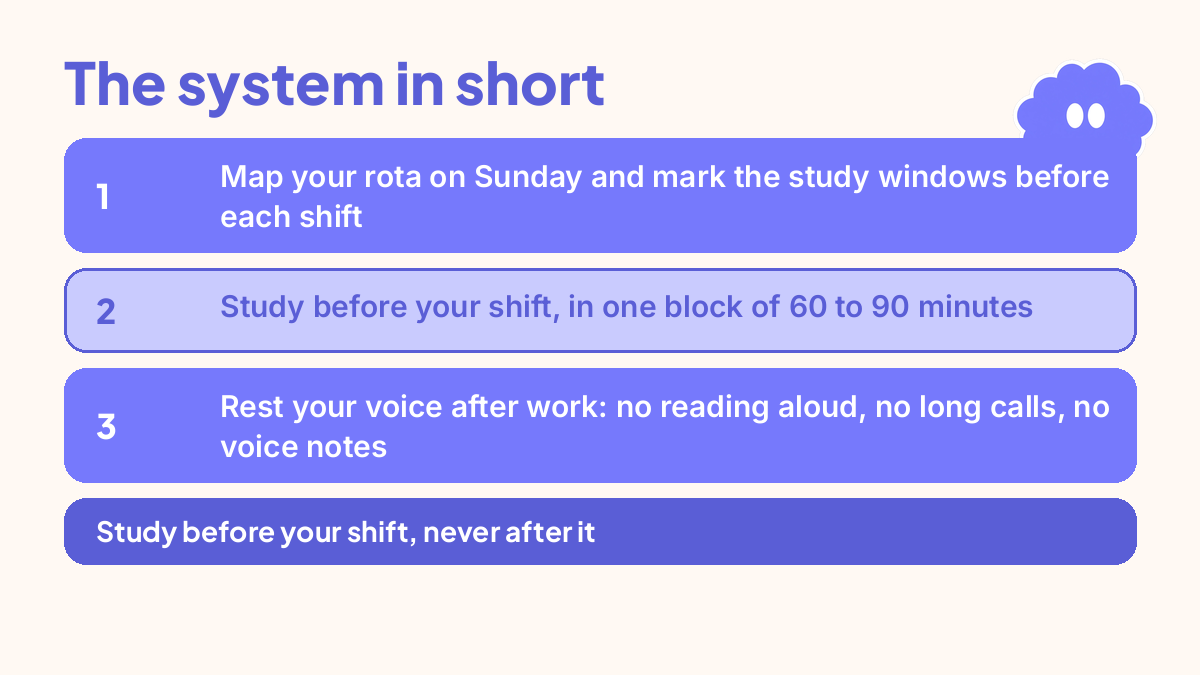
- Map your rota on Sunday and mark the study windows before each shift.
- Study before your shift, in one block of 60 to 90 minutes.
- Rest your voice after work: no reading aloud, no long calls, no voice notes.
- Revise quietly, from memory, using writing, flashcards, and diagrams.
- Use breaks and the commute for short retrieval tests, prepared the night before.
- Put heavy new material on days off, and review every Sunday in 20 minutes.
Step 1: Map the week when the rota comes out
Sit down with your rota as soon as it is published and write down every shift for the coming week. Next to each shift, write the study window that sits before it. A 9am start gives you a window from 7.30am. A 2pm start gives you the whole morning. Write the windows down, in ink, so they feel fixed.
Give each window a job before the week starts: Monday for new material, Tuesday for testing Monday’s work, Wednesday for the topic you got wrong most often. When the decision is made in advance, you open your notes and start instead of spending 15 minutes wondering what to study.
Keep one window free as a spare. Rotas change, shifts run late, and a colleague calls in sick. If nothing goes wrong, use the spare for a second test of your weakest topic. If something does go wrong, the spare absorbs it and the week still holds together. A plan with no spare breaks at the first surprise, and call centre rotas are full of surprises.
Step 2: Study before the shift, never after it
Your best study hour is the one before work. Before a shift you are rested, your voice is fresh, and nobody has asked you for anything yet. After a shift you have spent hours talking, listening, and managing other people’s frustration. Your body may feel fine, but your attention is spent. Reading after a shift often means reading the same paragraph three times and remembering none of it.
Set your alarm 90 minutes earlier than you need for work. Use 15 minutes to wake up, eat, and get ready, then study for 60 minutes with a timer. Sixty minutes is enough for one clear task: learn one new topic, test yourself on one old topic, or write one practice answer. One task, done properly, moves you further than three tasks started and abandoned.
Step 3: Rest your voice after work
Your voice is a working tool, and it needs rest like any other tool. After a shift, give it at least two hours of near silence. Do not read your notes aloud, record voice notes, or ring a friend for a long chat about the course. Drink water, eat something warm, and let your throat recover. This protects your voice for tomorrow’s shift, and it stops study turning into another round of talking.
Voice rest changes how you study in the evening, and that is a good thing. The methods that work without speaking are also the methods that test your memory best. Writing from memory, using flashcards, and redrawing a diagram all force you to produce the answer yourself. If you must study in the evening, use one of these quiet methods for 20 minutes at most, then stop. A short quiet test beats an hour of tired reading aloud.
Step 4: Revise quietly, from memory
The core of this system is retrieval: closing your notes and producing the answer from memory. Retrieval shows you what you actually know, not what you recognise when you see it. It also happens to be silent, which is exactly what a tired voice needs. Every study block ends with a test from memory, even if it started with new material.
Here is how a quiet block works. Spend the first 35 minutes learning: read one section of your notes, slowly, and write a one-page summary in your own words. Then close everything and spend 20 minutes writing down what you remember, without looking. Open your notes again and mark what you missed in a different colour. Those missed points become tomorrow’s test. The whole block takes about an hour.
Flashcards fit this system well, because you can use them anywhere and they need no voice. Diagrams work the same way: draw the diagram from memory, then check it against the original. The pattern is the same one in How to study in one hour a day: the hard task first, then the test.
Step 5: Use breaks and the commute for retrieval only
Your lunch break and your commute are the two gaps in a call centre day that belong to you, worth about 40 minutes of study a day. The rule for both is the same: retrieval only, never new material. New material needs a desk, a quiet room, and your full attention. A short test fits anywhere.
Prepare the test the night before, in five minutes. Write five questions on a card or in your phone, from the topic you studied that morning. At lunch, answer them from memory before you eat. On the commute, answer a different set of five, or test yourself on the same five again. Mark your answers before your next morning block. These gaps are not for new material. They stop the morning’s learning from fading before tomorrow.
Do not study on headset breaks or between calls. Keep study in your own time: your lunch break, your commute, and the blocks before and after work. How to study on your lunch break explains how to run a 20-minute test inside a break. If your lunch break is only 30 minutes, use 15 minutes for the test and 15 minutes to eat and rest.
Step 6: Put new material on days off and review on Sunday
Days off are the only time you have long, quiet, uninterrupted hours, so spend them on the work that needs exactly that: new material. A new topic takes two to three hours to learn properly, with breaks, and it needs a fresh mind. Do it on a day off, in the morning, in two blocks of 50 minutes with a 10-minute break between them. Test yourself from memory at the end of each block. Then stop. A day off is also a rest day, and studying all day on it leaves you as tired as a shift would.
Use the rest of the day off for light work: sorting notes, writing flashcards, planning next week’s rota, and doing the weekly review. The review takes 20 minutes and happens every Sunday, even in a bad week. Ask the six questions in the checklist below, write the answers on one page, and decide the one change for next week. The review keeps the system honest. Without it, you drift: you study the topics you like, ignore the ones you keep failing, and wonder why the exam feels far away until it is suddenly close.
If you have only one day off a week, protect it. Do not let overtime eat it, or friends fill it, without a decision. Study system for students who work weekends covers the same problem for students whose days off fall on weekdays.
A worked example
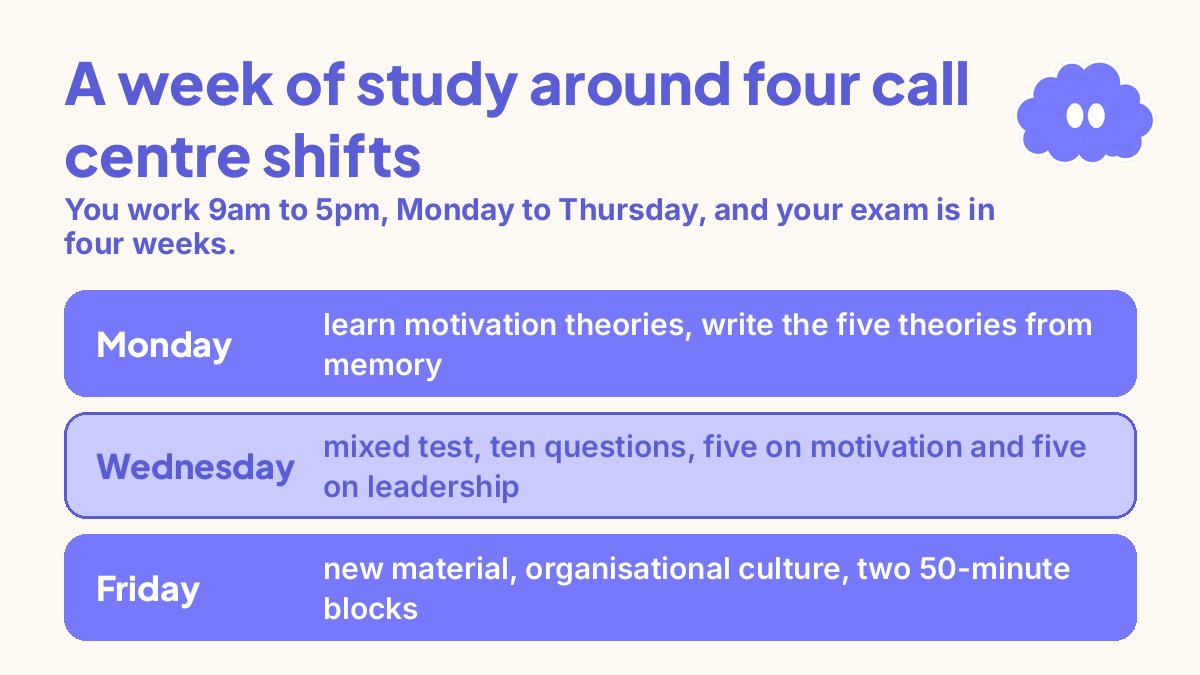
Your situation: You are a second-year business student. You work in a call centre four days a week, Monday to Thursday, 9am to 5pm, with a one-hour lunch break. Your exam in organisational behaviour is in four weeks. You have Friday, Saturday, and Sunday off. Your weakest topics are motivation theories and leadership styles.
- Monday, 7.30am to 8.45am: Learn motivation theories. Read one chapter, write a one-page summary, then close your notes and write the five theories from memory. You get four right and miss one. That one goes on tomorrow’s test card.
- Monday lunch, 1pm: Answer five questions on motivation theories from memory, from a card you wrote on Sunday night. You score three out of five. The two misses join the wrong-answer list.
- Tuesday, 7.30am to 8.45am: Test leadership styles from memory for 20 minutes, then learn the two styles you missed. Write the new material as three short paragraphs you could reproduce in the exam.
- Wednesday, 7.30am to 8.45am: Mixed test. Ten questions, five on motivation and five on leadership. You score seven. The three misses get a flashcard each.
- Thursday, 7.30am to 8.45am: Write one full practice answer by hand in 40 minutes: “Compare two motivation theories and apply them to a call centre.” Then spend 20 minutes marking it against your notes.
- Friday, 9am to 11am: Day off. New material: organisational culture. Two 50-minute blocks, each ending with a test from memory. Afternoon free.
- Sunday, 10am to 10.20am: Weekly review. You studied 7 hours and 25 minutes this week. Motivation theories are still the weakest topic, so next Monday’s block goes to them again.
When it goes wrong
Your shift runs late. Do not study after a late finish. Eat, rest your voice, and go to bed at your normal time. Move the missed block to your spare window, or to the next morning. One missed block is nothing. A late night that wrecks the next morning costs you two blocks.
Your voice is gone. Take a full evening of silence, and tell your team leader in the morning if it is still bad. For study, use only silent methods that day: writing from memory, flashcards, and diagrams. If even writing feels hard, skip the block and use the spare.
You fall asleep over your notes. This is your body telling you the block is in the wrong place. Move it earlier, shorten it to 40 minutes, or swap it for a 20-minute test. Do not fight sleep with caffeine and a longer session. A 20-minute test done awake beats an hour of reading done half asleep. If the morning still feels hard, How to study when you are tired after work covers rest-first study in more detail.
Your rota changes. When a new rota lands, redo Step 1 the same day. Move the study windows to fit the new shifts, and check whether any exam date now clashes with a shift. If it does, ask for the day off at once, not the week before the exam. How to ask your boss for study time gives you the words for that conversation.
Weekly review checklist
- How many hours did I study this week, and how many of them were before a shift?
- Which topics did I test from memory, and which did I only re-read?
- Which questions are still wrong after three tests?
- Did I rest my voice after every shift, and did I keep the quiet methods on tired days?
- What changed in next week’s rota, and where do the study blocks move?
- What is the one change I will make next week?
Downloadable infographic spec: A vertical 1000x1500 infographic in Thynq colours with the cloud mascot, titled “How to study when you work in a call centre”, listing the six steps of the system and the six weekly review questions, word for word from this article.
What this system is not
This system is not a way to study 20 hours a week on top of a full-time call centre job. That much study, on top of 35 hours of talking, is not realistic for most people, and pretending otherwise leads to burnout and a failed exam. Eight to 12 hours a week, placed well, is enough to pass most courses if the hours are spent testing yourself rather than re-reading.
It is also not a substitute for talking to your employer. If your exam dates clash with your shifts, ask early, ask for one specific thing, and get the answer in writing. And it is not a voice care plan: if your throat hurts most days, see a doctor.
Sources
- Roediger, H. L., and Karpicke, J. D. (2006). Test-enhanced learning: Taking memory tests improves long-term retention. Psychological Science, 17(3), 249-255. Supports testing yourself from memory instead of re-reading.
- Tshwane University of Technology. Balancing Act: How to work and study a Master of Management Sciences. Accessed 24 November 2026. Supports studying around contact centre shifts.
- Minni Is Learning. The Balanced Learner: How to Study Effectively With a Heavy Workload. Accessed 24 November 2026. Supports small pockets of study time for front-facing jobs.
For the full system behind this method, start with how to build a study system that fits your life.
Questions
Can I study after a call centre shift?
You can, but keep it short and quiet. After a full day of talking, your voice and your attention are both tired, so a long study session after work rarely sticks. Do one 20-minute test from memory, then stop. Put your main study block before your shift instead.
How many hours a week can I study around call centre shifts?
Most students in this situation manage between 8 and 12 hours a week. That is one 60 to 90-minute block before each shift, plus two longer blocks on days off. Count only real study time, not time spent staring at notes. Eight focused hours beat fifteen tired ones.
What is the best time to study before a call centre shift?
Study in the 90 minutes before your shift starts, after you are dressed and ready. A morning shift that starts at 9am gives you a block from 7.30am to 9am. An evening shift gives you the whole morning. Studying right before work means the material is fresh and the block cannot be stolen by overtime.
How do I revise without talking out loud after a long day of calls?
Write from memory instead of speaking. Close your notes, write down everything you can remember about a topic, then check what you missed. Use flashcards, redraw diagrams, and write practice answers by hand. All of these test your memory without using your voice at all.