The direct answer
How to study when you work as a security guard comes down to three rules: sort each week by shift type when the rota comes out, study before a night shift and never after one, and put heavy learning on your days off. Quiet hours on shift are for reading and flashcards only, and only where your site allows it.
Security work is a hard fit for study: the shifts are long, the rota moves, and nights wreck the next day. A day shift leaves you tired in the evening, and a night shift leaves you asleep for most of the next day.
The system below works with that shape instead of against it. It gives each kind of shift its own kind of study, protects your sleep after nights, and puts the hard learning where your brain is freshest: on days off and before a shift.
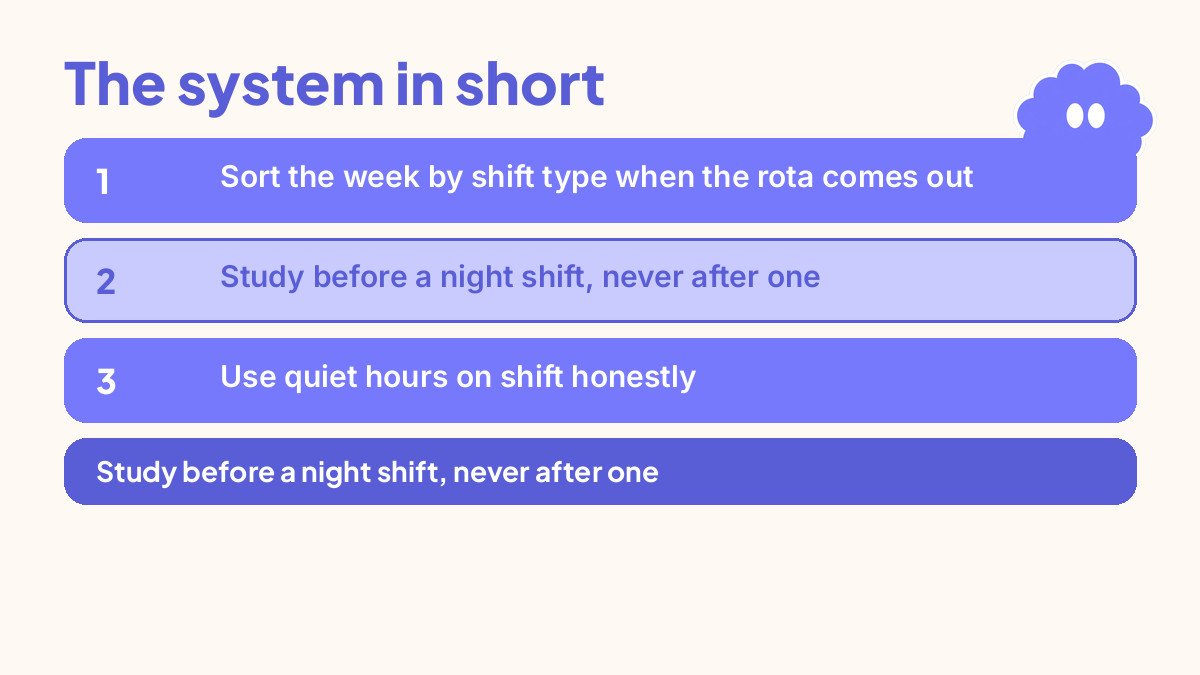
The system in short
- Read the rota the day it comes out and sort the week into day shifts, night shifts, and days off.
- Study before a night shift, never after one.
- Use quiet hours on shift for reading and flashcards only, where the site allows it.
- Put heavy learning on days off, in 50-minute blocks.
- Protect sleep after nights: dark room, phone off, no study until you wake.
- Review every Sunday: hours worked, hours studied, wrong answers, and next week’s rota.
Step 1: Sort the week by shift type when the rota comes out
Do this the day the rota lands, not on Monday. A rota that changes every week makes a fixed timetable useless, so the plan has to be rebuilt each time the rota arrives. It takes ten minutes once you have the routine.
Write three lists: day shifts, night shifts, and days off. A Friday night shift from 10pm to 6am is a different kind of day from a Tuesday day shift from 8am to 4pm. If you want the full five-minute routine for a moving rota, How to study when your rota changes sets it out step by step.
Now give each type its job. Days off take the heavy learning: new topics and past papers. The hours before a night shift take one focused block of 50 to 90 minutes. Write the plan down, with times, before the week starts. If a shift moves mid-week, move the study block with it.
Step 2: Study before a night shift, never after one
This is the rule the whole system turns on. A night shift runs roughly 10pm to 6am, and by 6am you have been awake all night. Studying then means studying with a brain that has had no sleep, and what you read in that state goes in slowly and comes back poorly. Sleep first, then study after you wake.
The block before the shift is the replacement. If your shift starts at 10pm, study from about 7pm to 8:30pm. That gives you 90 minutes with a fresh brain, ending with time to eat and get to work without rushing.
Use the before-shift block for the hardest topic of the week: test yourself from memory for the first 25 minutes, check your answers, then spend the rest of the block on the gaps. Do not use this block for re-reading notes. The Study system for night-shift students makes the same point from the sleep side: study after sleep, not after the shift.
Step 3: Use quiet hours on shift honestly
Night shifts in security often have quiet hours: long stretches at a desk or a gate with nothing happening. Those hours look like free study time, but they come with two limits.
The first limit is the site rule. Some sites allow reading and flashcards between patrols. Some ban phones and books at the desk outright. Ask your supervisor what is allowed and follow the answer exactly.
The second limit is the work itself. Quiet hours end without warning: a delivery arrives, an alarm sounds, and your study stops mid-sentence. So only use quiet hours for work that survives interruption: flashcards, a wrong-answer list, or your own summary notes. Prepare ten to fifteen cards before the shift, all on one topic you have already studied. Never use quiet hours for new material: it needs a fresh brain and the freedom to stop and think.
Step 4: Put heavy learning on days off
Days off are the only days when you have both time and a fresh brain, so they carry the heavy learning: new topics, past papers under timed conditions, and anything that needs you to think hard for an hour.
Use 50-minute blocks with a 10-minute break between them. Two blocks in the morning and one in the afternoon gives you about two and a half hours of real study, which is plenty for a day off. Start with the hardest topic, and test yourself from memory in the first block rather than re-reading. Close the book, write down everything you remember, then check your notes and fix the gaps.
Give each day off a single topic, not three: one topic studied properly beats three skimmed, because a skimmed topic has to be re-learned. If your exam covers six topics and you have three days off a week, that is two topics a week, which clears six topics in three weeks. Past papers belong on days off too: one timed question per day off in the last two weeks, marked the same day.
Step 5: Protect sleep after nights
Sleep is not the leftover after study. It is the thing study depends on, and after a night shift it has to be protected like a shift of its own.
When you get home at about 6:30am, eat something light, change out of your uniform, and go to bed. Make the room dark: curtains closed, phone on silent and face down, earplugs in if the street is noisy. Aim for seven to eight hours.
Do not study in the hour after you wake: eat, drink water, go outside for ten minutes, and let your brain come back online. Then study in one block of 45 to 60 minutes, testing yourself from memory on yesterday’s topic. That block is the only study a post-night day needs. Watch caffeine too: a coffee at the start of a night shift is fine, but a coffee at 5am will still be working when you are trying to sleep, so stop caffeine at least six hours before bed.
Step 6: Review every Sunday, in 20 minutes
The review is what stops small slips becoming a lost month. Every Sunday, sit down for 20 minutes with your rota, your wrong-answer list, and your notes, and answer six questions. How many hours did you work this week, and how many hours did you study? Which topics did you test, and which did you only re-read? Which questions are still wrong after three tests? What changed in next week’s rota, and where do the study blocks move? What is the one change for next week?
The wrong-answer list is the heart of it. Every card you got wrong on shift, every mark you lost on a past paper, every question you could not answer from memory goes on the list, with the date.
If the review shows a week with almost no study, do not add extra blocks next week to catch up. Ask instead: which rule broke? Usually it is one of three: the rota came out and the plan was never rebuilt, the after-shift study happened instead of sleep, or the quiet hours were spent on new material and nothing stayed. Fix that one rule, and next week runs normally. If you want a fuller routine for tired evenings, How to study when you are tired after work covers the rest-first rule, and How to study when you work split shifts covers the same thinking for broken days.
A worked example
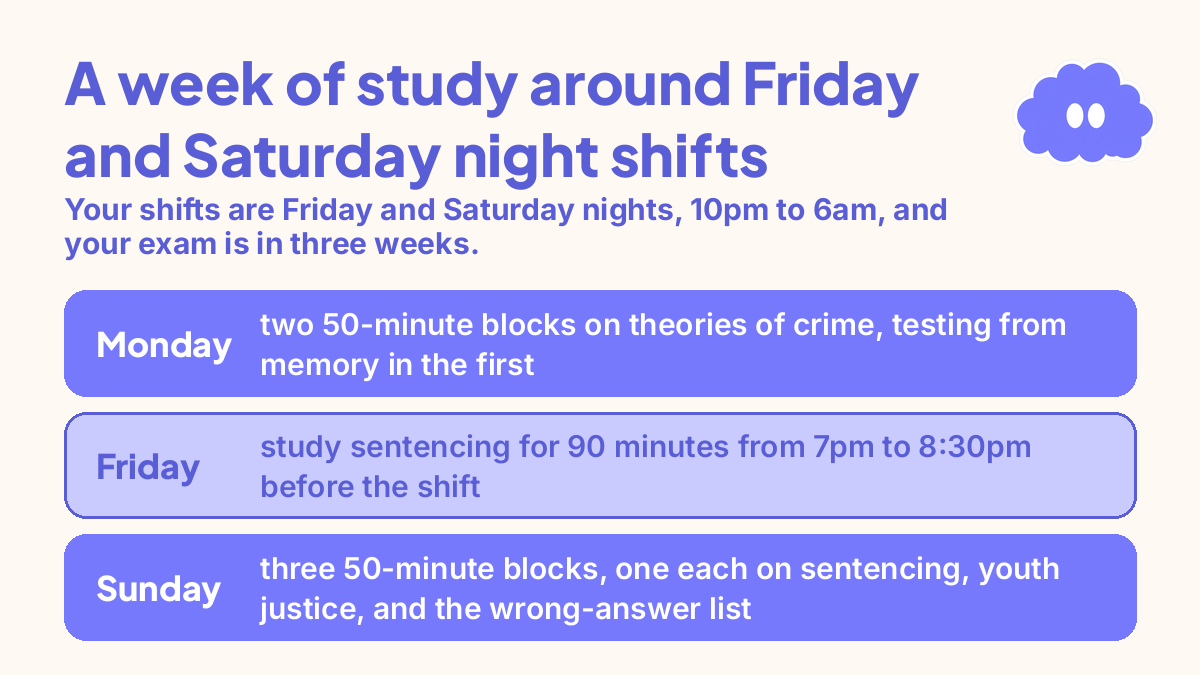
Your situation: You are a second-year criminology student working 16 hours a week as a security guard. Your shifts are Friday and Saturday nights, 10pm to 6am, and your exam is in three weeks. Your lectures are Monday, Tuesday, and Wednesday mornings. You have six topics: theories of crime, policing, the criminal justice process, sentencing, youth justice, and research methods.
- Monday, a day off: two 50-minute blocks on theories of crime, testing from memory in the first. 100 minutes.
- Tuesday, after lectures: one 50-minute block on policing before dinner. 50 minutes.
- Wednesday: a 25-minute test from memory on both topics, then write the wrong answers on your list. 25 minutes.
- Thursday, a day off: two 50-minute blocks on policing, plus one timed past paper question on theories of crime. 100 minutes.
- Friday: study sentencing for 90 minutes from 7pm to 8:30pm before the shift, then ten flashcards on theories of crime. 90 minutes plus 20 minutes of cards.
- Saturday: study youth justice for 50 minutes before the shift, with flashcards on policing. 50 minutes plus 20 minutes of cards.
- Sunday, a day off: three 50-minute blocks, one each on sentencing, youth justice, and the wrong-answer list. 150 minutes.
Count the week: 100 plus 50 plus 25 plus 100 plus 110 plus 70 plus 150 is 605 minutes, just over 10 hours of study in a week with 16 hours of night work. Week two repeats the shape, and week three is past papers and the wrong-answer list only.
When it goes wrong
Your site bans phones and books on shift. The system does not need quiet-hour study: your study time comes from the block before each shift and from days off.
You study after a night shift and remember nothing. That is the expected result, not a personal failure. Studying on no sleep does not work, and the fix is the order, not more effort: sleep first, study after you wake. Test the same topic again after sleep.
The rota changes and wipes out your study day. Re-plan on the day the new rota lands, in ten minutes. Move the blocks, do not cancel them. If a day off becomes a shift, move its heavy learning to the next day off. If the whole week is brutal, run the minimum week: two 25-minute tests from memory and one 20-minute review of the wrong-answer list.
You fall asleep during a quiet-hour flashcard run. That means you were too tired to study, and the flashcards were the wrong tool for that hour. Put the cards away, do your patrol, drink water, and stop trying.
Exam week lands on a weekend of night shifts. Ask for the exam days off as soon as the exam timetable is published, not the week before. If you cannot get the days off, ask to swap the night before the exam for a day shift, or ask a colleague to cover it. If neither is possible, study before the shift the night before, sleep properly, and sit the exam after sleep, not straight after a shift. The same before-shift rule works for early starts and long days on your feet: How to study when you work in a warehouse sets it out for warehouse shifts.
Weekly review checklist
- How many hours did I work this week, and how many hours did I study?
- Which topics did I test from memory, and which did I only re-read?
- Which questions are still wrong after three tests?
- What changed in next week’s rota, and where do the study blocks move?
- Did I study before every night shift, and sleep before studying after one?
- What is the one change I will make next week?
Downloadable infographic spec: A vertical 1000 by 1500 image in Thynq colours, cream background, cloud-purple headings, phoenix-pink accents, and the Thynq cloud mascot at the top. Title: “How to study when you work as a security guard”. Six steps, word for word from the article: “Sort the week by shift type when the rota comes out”, “Study before a night shift, never after one”, “Use quiet hours on shift honestly”, “Put heavy learning on days off”, “Protect sleep after nights”, “Review every Sunday, in 20 minutes”. Then the six review questions, word for word: “How many hours did I work this week, and how many hours did I study?”, “Which topics did I test from memory, and which did I only re-read?”, “Which questions are still wrong after three tests?”, “What changed in next week’s rota, and where do the study blocks move?”, “Did I study before every night shift, and sleep before studying after one?”, “What is the one change I will make next week?”.
What this system is not
It is not a way to study a full course on night shifts alone. If you work 30 or 40 hours a week on nights, no system makes that easy: cut hours in exam weeks if you possibly can. It is not a promise of a grade, and it is not a claim that flashcards on shift replace proper study: they only keep topics warm between proper sessions. It is not permission to break site rules. If your sleep after nights is badly broken for weeks, take that seriously as a health problem, not a study problem.
Sources
- Roediger & Karpicke (2006). Test-enhanced learning: Taking memory tests improves long-term retention. Psychological Science, 17(3), 249-255. Supports the testing-from-memory rule used in the before-shift block, the flashcard runs, and the weekly review.
- Gollwitzer & Sheeran (2006). Implementation intentions and goal achievement: A meta-analysis of effects and processes. Advances in Experimental Social Psychology, 38, 69-119. Supports the if-then planning in Step 1: deciding in advance what happens when the rota changes.
Questions
Can I study during a security guard shift?
Only if your site allows it, and only reading and flashcards. Some sites ban phones and books at the desk, and some allow quiet reading between patrols. Ask your supervisor what is allowed, follow the rule exactly, and never let study come before the job. If study is not allowed on shift, your study time comes from before shifts and days off.
Should I study before or after a night shift?
Before, always. Study for 50 to 90 minutes in the evening before the shift starts, then go to work. After a night shift, sleep first and study only after you wake. Studying straight after a night shift means studying on an empty tank, and very little of it stays.
How do I study when my security rota changes every week?
Re-plan on the day the new rota lands, not on Monday. Sort the week into day shifts, night shifts, and days off, then give each type its own kind of study. Heavy learning goes on days off, a short block goes before night shifts, and quiet hours on shift are for flashcards only. A new rota means a new plan, made in ten minutes.
What should I study during quiet hours on shift?
Only things you have already studied: flashcards, a wrong-answer list, or re-reading your own summary notes. Quiet hours are for testing yourself from memory, not for learning new material. New material needs a fresh brain and a proper desk, so save it for a day off or the block before a shift.