The direct answer
When you start a new job, drop to a minimum week of 80 minutes for the first two weeks, tell your employer your exam dates in the first week, and rebuild your study routine around the real rota in weeks three and four.
A new job eats more than its hours. The first fortnight is full of new names, new systems, new routes, and the mental effort of doing everything for the first time. Students who try to keep their old study hours through that fortnight usually fail at both: they are tired at work, and they sit down to study with nothing left. The system below plans for that. It gives you a small week while you learn the job, a script for the first-week conversation with your employer, and a four-week rebuild that ends with a routine shaped by the job you actually have, not the one you imagined.
The system in short
- Run the minimum week for the first two weeks: two 30-minute test sessions and one 20-minute review, all from memory.
- Learn the job’s real shape in week one: when the rota lands, when the busy times are, and which days leave you tired.
- Tell your employer your exam and assignment dates in the first week, name the dates, and ask for two things only.
- Rebuild the routine in weeks three and four around the real rota, not the hours you had before the job.
- Keep one study trigger that never moves, such as 10 minutes after your evening meal, so the habit survives the change.
- Review at the end of week four for 15 minutes: what the job actually costs, what the routine now looks like, and what to protect next term.
Step 1: Run the minimum week for the first two weeks
For the first two weeks, study is 80 minutes: two 30-minute sessions testing yourself from memory, and one 20-minute review of what you got wrong. That is the whole week. It is small on purpose, because the first fortnight of a new job takes more energy than the hours on the rota suggest, and a plan that asks for six hours will be abandoned by Wednesday.
The three sessions all test from memory, because testing is the most useful thing you can do in a short session, and because it needs no setup. Write down everything you remember about one topic, check it, and note what you missed. Or answer three practice questions without looking. Or draw one diagram from memory. Do them on different days, and never stack them into one session, because spreading them out is what keeps the material warm across a week when you are learning a job.
If even 80 minutes does not fit in the first week, do one 10-minute test a day for five days. Ten minutes, one topic, from memory. It keeps the habit alive, and it is honest about what the week allows. The minimum week is not a failure. It is a plan for a hard fortnight, and it ends in week three. For the evenings when you come home too tired to start, How to study when you are tired after work has a smaller start that works on the worst days.
Step 2: Learn the job’s real shape in week one
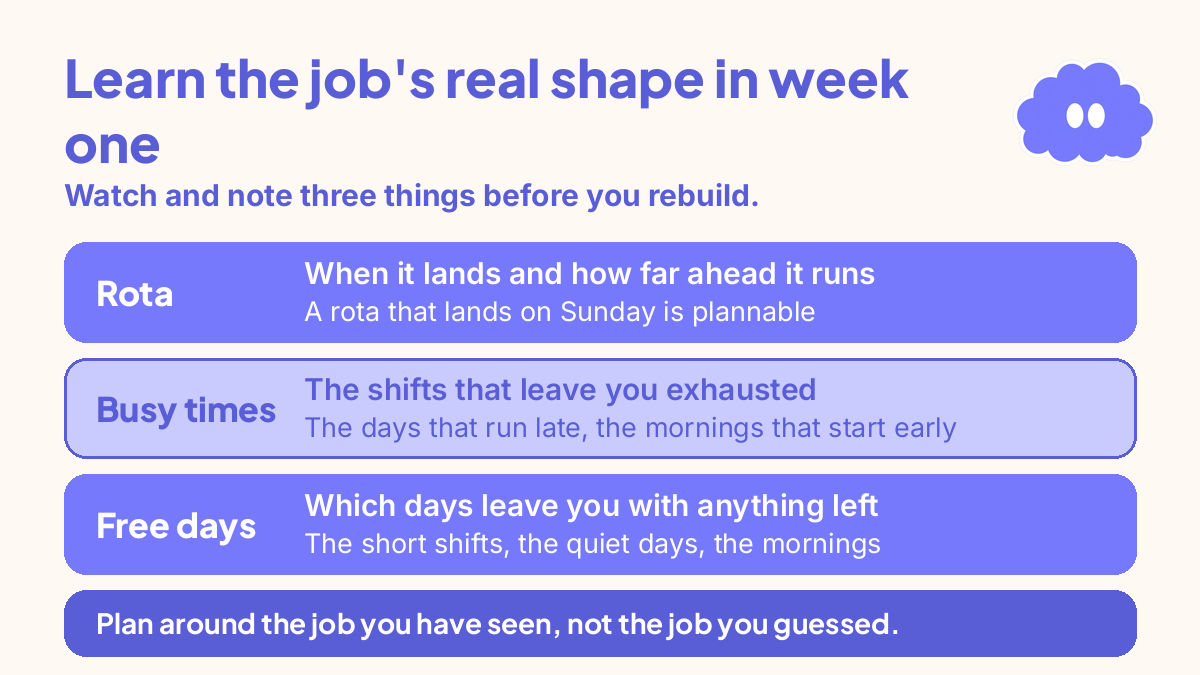
In the first week, watch and note three things. First, when the rota lands and how far ahead it runs: a rota that lands on Sunday for the week ahead is plannable, and a rota that lands the day before is not. Second, when the busy times are: the shifts that leave you exhausted, the days that run late, the mornings that start early. Third, which days leave you with anything left: the short shifts, the quiet days, the mornings before a late start.
Write these down in a few lines at the end of week one. That note is the raw material for the rebuild in weeks three and four, because you cannot plan around a job you have not yet understood. Students who rebuild their routine in week one are planning around a guess. Students who wait until they have seen two real weeks are planning around facts.
Step 3: Tell your employer your exam and assignment dates in the first week
Tell your employer in the first week that you are studying, and name the dates that matter. Not your whole timetable, and not your grades, just the fixed dates: exams and assignment deadlines that cannot move. One sentence is enough: “I am studying alongside this job, and I have an exam on 12 December and an assignment due on 19 December.”
Then ask for two things only. First, advance notice of the rota, or at least knowing the day it will appear, so you can plan study around it. Second, no extra hours in exam week. Two small, specific asks are much easier to agree to than a general request for flexibility, and they are the two things that protect study most. If you need the exact words, How to ask your boss for study time has a script for this conversation, including what to say when the answer is no.
Step 4: Rebuild the routine in weeks three and four around the real rota
In week three, when the job has settled a little, rebuild the study routine around the rota you now understand. Place two longer blocks in the biggest free gaps the real rota leaves, and fill the smaller gaps with short test sessions. Do not try to restore the hours you had before the job. That routine belonged to a life without this job, and it will not fit. Build the routine the job allows, and make it one you can keep for a whole term.
If the job leaves you with four hours a week, plan four hours, and make them testing and practice, not rereading. A routine you can keep beats a routine you abandon, and the rebuild is the moment to be honest about the number. How to study in one hour a day is a good shape for a week where the hours are small but regular.
The rebuild also needs a study trigger that never moves. Pick one thing that happens every day, such as the evening meal or the bus home, and tie a 10-minute test to it. The time will change with the rota, but the trigger will not, so the habit has something to hold on to while everything else is new.
Step 5: Keep one study trigger that never moves
When everything is new, one thing should stay the same. Choose a trigger that happens every day without fail, and attach a small study action to it. After your evening meal, test yourself for 10 minutes on one topic. On the bus home, review ten flashcards. Before bed, write down the one thing you learned today and the one thing you still cannot do.
The trigger matters more than the time, because the time will change with the rota. A student who studies after the evening meal will hit it on late shifts, early shifts, and days off alike. Ten minutes is small enough to survive a bad day, and it keeps the habit alive through the month when everything else is changing.
Step 6: Review at the end of week four for 15 minutes
At the end of week four, spend 15 minutes on three questions. First, what does the job actually cost: how many hours a week, how tired are you after each kind of shift, and which days leave you with nothing? Second, what does the routine now look like: which blocks survived the rebuild, and how many hours a week are you really studying? Third, what must you protect next term: the exam dates, the one block that matters most, and the conversation you still need to have with your manager?
Write the answers down. That note is the new baseline, built on four real weeks. If the job costs more than you expected and the study hours are too small, that is a decision to make with facts in front of you: fewer hours at work, a lighter course load, or a different job.
A worked example: the first month in a new cafe job
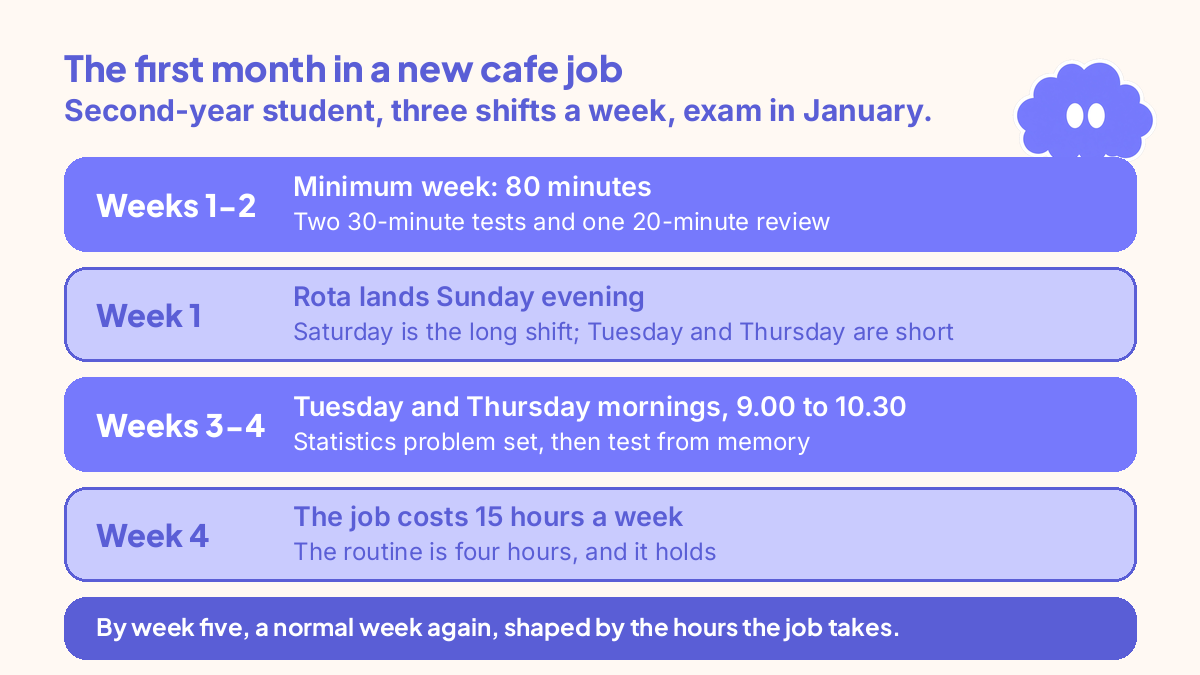
Your situation: Second-year student, starts a part-time cafe job on 17 November, three shifts a week, rota lands on Sunday. Exam in January, weakest subject is statistics. Before the job, study was two hours a day, five days a week.
- Weeks one and two, minimum week: Tuesday 30 minutes, test probability distributions from memory. Thursday 30 minutes, three practice questions. Sunday 20 minutes, review what was wrong. Nothing else. The rest of the week is for learning the job: till, coffee machine, closing routine, names.
- Week one notes: Rota lands Sunday evening for the week ahead. Saturday is the long shift, 8.00 to 6.00, and leaves nothing. Tuesday and Thursday are short shifts, 4.00 to 8.00, and leave the morning free. Commute is 25 minutes by bus.
- First-week conversation: On Wednesday, tell the manager: “I am studying alongside this job. I have an exam on 14 January and an assignment due on 12 December.” Ask for the rota on Sunday as usual, and no extra hours in exam week. Manager agrees to both.
- Weeks three and four, rebuild: Tuesday morning 9.00 to 10.30, statistics problem set. Thursday morning 9.00 to 10.30, test the chapter from memory. Bus, 25 minutes each way, flashcards. Trigger: after the evening meal, 10 minutes, one topic. Total: about four hours a week, all testing and practice.
- Week four review: The job costs 15 hours a week plus the commute, and Saturday leaves nothing. The routine is four hours, and it holds. The exam date is protected. Note for next term: ask for the January rota before Christmas, because exam week needs the same protection.
When it goes wrong
The first week is harder than you expected and even the minimum week fails. Shrink to one 10-minute test a day, tied to the evening meal, and let the rest go. The first week is for learning the job. A week of 10-minute tests is still a week, and week two will be easier than week one.
The rota is nothing like you were told in the interview. That happens, and the fix is the week-one notes, not a complaint. Write down what the rota actually is, rebuild around it in week three, and judge the job on the real hours, not the promised ones. If the real hours leave no study time at all, that is a decision for the week-four review.
You try to keep your old study hours and burn out by week two. Drop to the minimum week now, not next week. Burnout in the first month of a new job costs you the job and the study. The minimum week exists for exactly this moment, and there is no penalty for using it.
You forget to have the first-week conversation and exam week arrives unannounced. Have it now, even if it is late. A late conversation is better than a surprise request, and offering an alternative week for extra hours still helps. Then write the exam dates down for next term, so the conversation happens in week one next time.
Weekly review checklist
- Did the minimum week run in weeks one and two, or did the new job take all of it?
- What is the rota’s real shape: when does it land, and which shifts leave you tired?
- Did you tell your employer your exam dates, and what did they agree to?
- Has the routine been rebuilt around the real rota, or are you still using the old hours?
- Did the daily trigger hold every day this week?
- What does the job actually cost in hours and energy, and is the study it leaves enough?
Downloadable infographic spec: one vertical image, title “How to study when you start a new job”, with the six steps from “The system in short” and the six review questions above, in Thynq cream, Cloud Purple, Dark Purple and pink, with the Cloud mascot. Text taken word-for-word from this article.
What this system is not
It is not a way to keep your old study hours through a new job, because a new job changes the hours you have. It is not a promise that every employer will welcome a studying employee, because some will not. It does not cover apprenticeships in detail, where study days are part of the contract. What it does is simpler: it gives you a small week while you learn the job, a conversation to have in the first week, and a rebuild in weeks three and four that ends with a routine shaped by the job you actually have.
Sources
- Dunlosky, J., et al. (2013). Improving students’ learning with effective learning techniques. Psychological Science in the Public Interest, 14(1), 4-58. Only practice testing and distributed practice rated high; rereading and highlighting rated low.
- Roediger, H. L., & Karpicke, J. D. (2006). Test-enhanced learning. Psychological Science, 17(3), 249-255. Recallers remembered more a week later than restudiers, though restudiers felt more confident immediately.
- Cepeda, N. J., et al. (2006). Distributed practice in verbal recall tasks. Psychological Bulletin, 132(3), 354-380. Spaced practice beat massed practice; the optimal gap grows with how long you need to remember.
For the mornings this system relies on, read How to study before work in the morning. For the switch from work to study in the evening, read How to switch from work mode to study mode.
Questions
How do I study when I start a new job?
Run a minimum week for the first two weeks while you learn the job: two 30-minute test sessions and one 20-minute review, all from memory. Then build back to a normal week in weeks three and four. Do not try to keep your old study hours in the first fortnight.
Should I tell my new employer I am studying?
Yes, if your course has fixed exam or assignment dates that could clash with work. Tell them in the first week, name the dates, and say what you need: usually just advance notice of the rota and no extra hours in exam week. You do not need to share your grades or your timetable.
What is the minimum study week in the first month of a new job?
Eighty minutes: two 30-minute sessions testing yourself from memory, and one 20-minute review of what you got wrong. Do them in the gaps the new job leaves, such as before a shift or on a break. That is enough to keep the material warm until you know the job.
How long does it take to settle into a new job and study routine?
About four weeks. The first two weeks are for learning the job, and study runs on the minimum week. Weeks three and four are for rebuilding the routine around the real rota. By week five, you should have a normal week again, shaped by the hours the job actually takes.