The direct answer
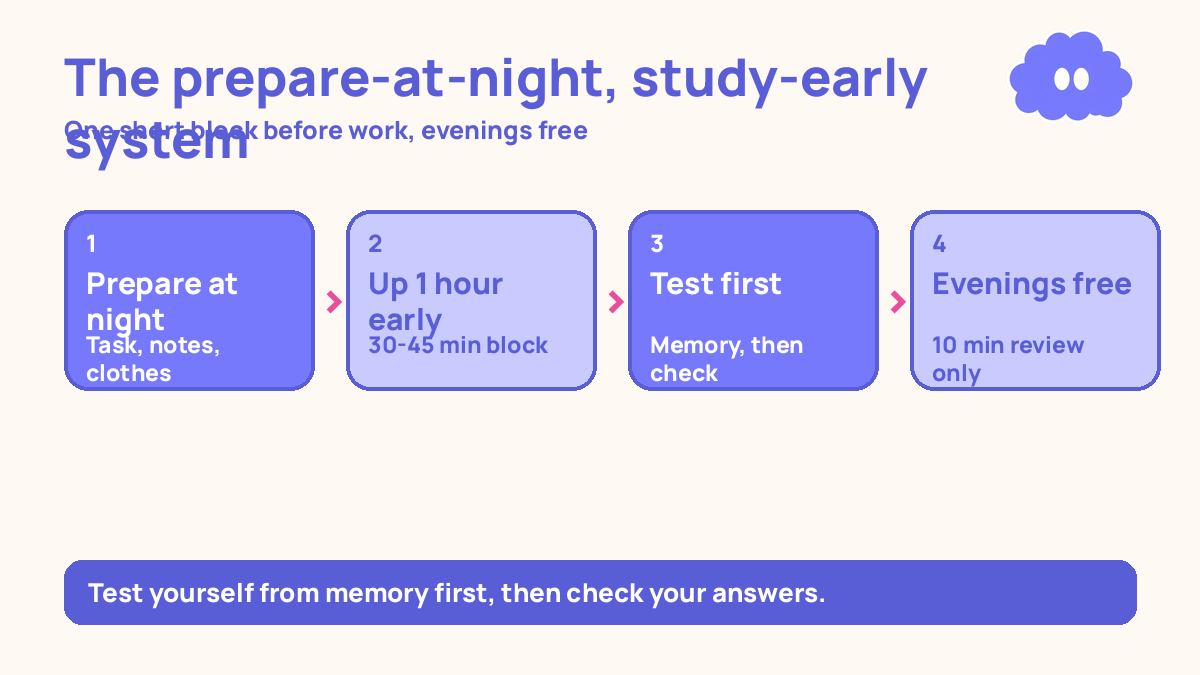
Get up one hour earlier and study for one block of 30 to 45 minutes before work, five days a week, testing yourself from memory and checking your answers. Prepare the task, the materials, and your clothes the night before, so the morning needs no decisions. Keep evenings free or light, and review the week on Sunday. That is the whole system: prepare at night, study early, test yourself, and protect your sleep.
Your evenings are gone. Work runs late, or you get home tired, or the house is busy, and by the time you could study, you cannot. The morning is the only part of the day nobody else owns. It is quiet, it is yours, and it happens before work has taken anything from you.
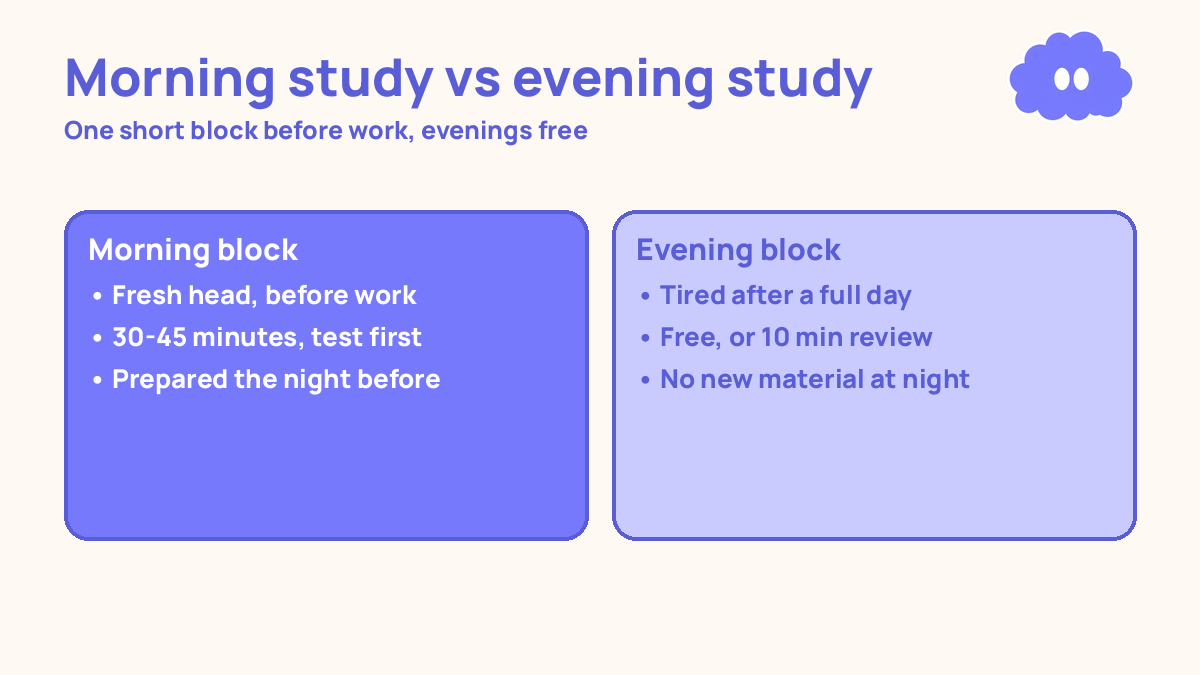
Morning study works for a different reason than evening study. In the evening you study with whatever focus is left. In the morning you study with a fresh head, in a shorter block of 30 to 45 minutes. The two-hour study system for working students is the parent system; this article moves the study to the morning, where one short block replaces two evening blocks. The morning study routine for students is the general morning routine this system is built from, for any student, while this one is for studying before a work shift specifically.
The system in short
- Get up one hour earlier than usual, five days a week.
- Prepare everything the night before: the task, the materials, the clothes, the bag.
- Study for one block of 30 to 45 minutes, testing yourself from memory first.
- Check your answers, write down what you got wrong, and stop when the block ends.
- Keep evenings free, or use them for 10 minutes of light review only.
- Review the week on Sunday, in 15 minutes, and plan the next week.
Step 1: Prepare the night before, or the morning fails
Morning study is decided the night before. If you wake up and have to choose what to study, find your notes, and make breakfast, the block is gone before it starts. So every evening, spend 10 minutes preparing tomorrow morning.
Write the task in one line: “Test Topic A, questions 1 to 10, from memory.” Put the notes, the questions, and a pen on the desk, open at the right page. Lay out your work clothes. Pack your bag. Make breakfast as ready as you can: oats in a bowl, lunch made, water bottle filled.
Use an if-then plan for the morning: “When the alarm rings, I will get up, wash my face, and sit at my desk.” If-then plans raised goal attainment by a medium-to-large amount (d = 0.65) across 94 studies (Gollwitzer & Sheeran, 2006), because the cue and the action are decided in advance. In the morning, that matters more than at any other time of day, because your deciding brain is still half asleep.
Do not check your phone before the block. One message becomes five minutes, five minutes becomes the whole block. Leave the phone charging in another room overnight and use a normal alarm clock to wake up. One study found a phone on the desk cost focus even when off, but a later replication did not find the effect, so the evidence is mixed (Ward et al., 2017). Treat “phone in another room” as a practical system, not a proven fact.
Step 2: One short block, hardest thing first
Set the alarm one hour earlier than usual. If you normally get up at 7am for a 9am shift, get up at 6am. Wash, dress, eat something small, and start studying by 6:15. Study until 7:00. That is a 45-minute block. Then get ready for work as normal.
Start with testing, not reading. Test yesterday’s topic from memory for 20 minutes, then check your answers. Use the last 20 minutes to learn one small new piece. If the new piece is big, split it across two mornings.
If 45 minutes feels too long at first, start with 30, and add the extra 15 minutes in the second week.
Sleep is the price of this system, and you must pay it at night. Going to bed an hour earlier is part of the plan, not optional. Sleep is when the day’s learning is consolidated — a short night after a long study day means the work was done but the consolidation was cut short (Diekelmann & Born, 2010).
Step 3: Test yourself, then check
Close your notes and answer questions from memory, work problems, or write down what you remember. Then open your notes and check. Mark what you got wrong. That is the block.
In a 2013 review, Dunlosky and colleagues rated ten common study techniques, and only two received a high utility rating: practice testing and distributed practice. Re-reading was rated low. A later meta-analysis found testing yourself beat restudying by a medium amount (g = 0.50), and the advantage was larger with feedback (g = 0.73 with feedback, against g = 0.39 without it) (Rowland, 2014). The checking step is the feedback.
Roediger and Karpicke (2006) found students who recalled a passage remembered more a week later than students who restudied it, even though the restudiers felt more confident straight after studying. Feeling fluent right after re-reading is not the same as remembering a week later. If it felt easy, test yourself.
Keep a wrong-answer list: one line per question you got wrong. Test those questions again the next morning, and again after three days. Use a practical starting schedule: review a topic the next day, then after three days, then after seven days. This 1–3–7 schedule is a practical starting point, not a research rule.
Step 4: Keep evenings free, and review on Sunday
The deal with morning study is that evenings are free. Do not fill them with study out of guilt. If you want to do something in the evening, make it 10 minutes of light review: read through the wrong-answer list, or glance at tomorrow’s task. That is all. The real work happened in the morning.
On Sunday, spend 15 minutes reviewing the week. Count the morning blocks you completed. Look at the wrong-answer list: which questions are still wrong after three tests? Write next week’s tasks, one line per morning, and prepare Monday’s task on Sunday evening. Monday morning is the hardest morning of the week, so prepare it twice as carefully.
If your shifts start at different times, adapt the system: skip the block on early-start days and use the full 45 minutes on late-start days. The one-hour study system for working students is the closest alternative: one hour of study a day, at whatever time fits, for students whose shifts move around.
A worked example: a week with a 9am start
You work 9am to 5pm, Monday to Friday. You normally get up at 7am. You move the alarm to 6am, prepare everything the night before, and study from 6:15 to 7:00.
| Day | Morning block (45 min) | Evening | Minutes |
|---|---|---|---|
| Monday | Test last week’s topic, check answers | Free | 45 |
| Tuesday | Test Topic A, learn Topic B first section | 10-min review | 45 |
| Wednesday | Test Topic B, review Topic A | Free | 45 |
| Thursday | Mixed test of A and B | 10-min review | 45 |
| Friday | Test both topics, plan next week | Free | 45 |
| Saturday | No study, rest | Free | 0 |
| Sunday | 15-minute weekly review, prepare Monday | Free | 15 |
That is 240 minutes in the week: 225 in morning blocks and 15 for the Sunday review. The numbers are the plan’s own totals, not a research finding. The shape is what matters: five short mornings, free evenings, and a weekend that is mostly rest.
The system in a diagram
When it goes wrong
You sleep through the alarm three days in a row. The problem is usually the bedtime, not the alarm. Move your bedtime an hour earlier for a week and try again. If you still sleep through it, study after work instead, and come back to mornings when your shifts change.
You get up, but you spend the block on your phone. Move the phone out of the bedroom at night and use a real alarm clock. The first five minutes of the morning decide the block.
You study in the morning and fall asleep at work. Cut the block to 30 minutes and go to bed 30 minutes earlier. If you still fall asleep at work after a week, stop the morning system and study after work instead.
The weekend breaks the habit and Monday feels impossible. Prepare Monday’s task on Sunday evening, in full: the task written down, the materials on the desk, the clothes laid out. A prepared Monday is a Monday that happens.
Weekly review checklist
Copy this list and use it every Sunday:
- How many of the five morning blocks did I complete, and which did I miss?
- Did I prepare the night before on the days I studied, and skip it on the days I missed?
- Which questions are still on my wrong-answer list after three tests?
- What time will I get up next week, and what time will I go to bed?
- What one change will I make next week: earlier bedtime, shorter block, or better preparation?
Downloadable infographic spec: one vertical image, title “Prepare at night, study early”, with the night-before checklist, the 30–45 minute morning block, the memory-first rule, and the five-question weekly review, in Thynq cream, Cloud Purple, Dark Purple and pink, with the cloud mascot. Text taken word-for-word from this article.
What this system is not
It is not a promise of a grade, and it is not a claim that 45 minutes a morning is enough for every course. Some courses need more, and some shifts start too early for a morning block at all. It is a system for doing steady work in the quietest part of your day, and checking honestly whether that work happened. It is also not a claim that early mornings suit everyone. If mornings do not work after a fair two-week trial, the honest answer is to study at another time, not to force a system that fights your life.
Sources
- Dunlosky, J., et al. (2013). Improving students’ learning with effective learning techniques. Psychological Science in the Public Interest, 14(1), 4-58. Only practice testing and distributed practice received a high utility rating; rereading was rated low.
- Rowland, C. A. (2014). The effect of testing versus restudy on retention: a meta-analytic review of the testing effect. Psychological Bulletin, 140(6), 1432-1463. Testing beat restudy by g = 0.50; with feedback g = 0.73, without feedback g = 0.39.
- Roediger, H. L., & Karpicke, J. D. (2006). Test-enhanced learning. Science, 311, 648-649.
- Cepeda, N. J., et al. (2006). Distributed practice in verbal recall tasks. Psychological Bulletin, 132(3), 354-380.
- Gollwitzer, P. M., & Sheeran, P. (2006). Implementation intentions and goal achievement: a meta-analysis. Advances in Experimental Social Psychology, 38, 69-119. If-then plans raised goal attainment by d = 0.65 across 94 studies.
- Diekelmann, S., & Born, J. (2010). The memory function of sleep. Nature Reviews Neuroscience, 11(2), 114-126. Sleep improves consolidation of what was learned.
- Ward, A. F., et al. (2017). Brain drain: the mere presence of one’s own smartphone reduces available cognitive capacity. Journal of the Association for Consumer Research, 2(2). One study found a phone on the desk cost focus even when off; a later replication did not find the effect, so the evidence is mixed.
For the full system behind these blocks, start with the two-hour study system for working students, and for the general morning routine, read the morning study routine for students.
Questions
How early do I need to get up to study before work?
About an hour earlier than usual is enough. A 45-minute block plus time to get ready means setting the alarm 60 minutes earlier, not two hours earlier. Protect your sleep by going to bed earlier too.
What should I study in the morning block?
Test yourself on yesterday’s topic first, then learn one small new piece. The morning block is short, so it suits testing and review better than starting a big new chapter from scratch.
What if I am too tired to study in the morning?
Try it for a week before deciding. Go to bed an hour earlier, prepare everything the night before, and study for 30 minutes instead of 45. If mornings still do not work, study after work instead — the evening system is just as good.
Should I study before work every day?
Five days a week is the plan, with the weekend free or light. If your shifts start at different times, study on the days with later starts and skip the early-start days. A block you do four days a week beats a plan you abandon.